

P0601 on 2010-2017 GMC Terrain: Internal Control Module Memory Error Causes and Fixes
P0601 on a 2010-2017 GMC Terrain indicates a fatal internal memory error in a control module, most often the Engine Control Module (ECM) or Transmission Control Module (TCM). On this platform, the TCM is a very common culprit. The fix is almost always replacing the faulty module and having it professionally programmed, costing between $800 and $1,300.
- P0601 indicates a serious internal module failure, most often the ECM or TCM.
- On the 2010-2017 Terrain, the TCM is a very common point of failure for this code, often accompanied by P0700.
- Diagnosis must start with a scan tool to determine which module stored the code.
- The fix is almost always module replacement and programming, which is not a DIY job.
- Before replacing any module, always verify battery health and check all major power and ground connections.
What's Unique About the 2010-2017 Gmc TERRAIN
For the first-generation GMC Terrain and its sibling, the Chevy Equinox, the P0601 code is frequently associated with the Transmission Control Module (TCM), which is located inside the transmission. While an ECM failure can still be the cause, manufacturer service bulletins specifically mention that this code can be stored in the TCM. This often happens in conjunction with code P0700, which is a general transmission fault request. Owners may experience harsh shifting, particularly when going into reverse, as a primary symptom when the TCM is the culprit.
Diagnostic Flowchart
Tap your situation to follow the diagnostic path that matches what you're seeing on this vehicle.
Symptoms You May Notice
- Check Engine Light is on
- Engine may stall intermittently or not start at all
- Vehicle may enter 'Limp Mode' (reduced power)
- Harsh or erratic transmission shifting, especially when selecting reverse
- Loss of communication with the scan tool
- Slow or no acceleration from a stop
- "Service Stabilitrak" or "Service Transmission" message on the driver information center
- Replacing sensors (e.g., oxygen sensors, crank/cam sensors) will not fix a P0601 code, as it is an internal module error, not a sensor input fault.
Most Likely Causes
- Failed Engine Control Module (ECM) 🔴 High Probability Internal components of the ECM can fail over time due to heat cycles and electrical stress, leading to memory corruption. This is a common failure mode for many vehicles, not just the Terrain.
How to confirm: Use a professional scan tool to confirm the P0601 code is stored in the ECM. After verifying stable power and ground connections to the module, if the code returns immediately after clearing or a reflash attempt, the ECM is condemned.
Typical fix: Replace the Engine Control Module and have it programmed by a dealer or qualified shop using GM's Service Programming System (SPS).
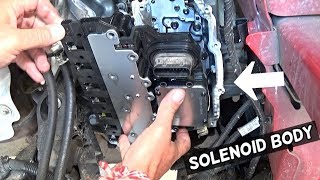
Est. part cost: $400-$750 - Failed Transmission Control Module (TCM) 🟡 Medium Probability As noted in TSB #PIP4653E, the P0601 code can specifically point to a fault within the TCM on this platform. A video for the similar Chevy Equinox shows this failure causing jerking in reverse. The TCM is located on the side of the transmission, requiring removal of a cover for access. 🎬 See this walkthrough for removing the transmission control assembly. Its location inside the transmission as part of the TEHCM (Transmission Electro-Hydraulic Control Module) subjects it to high heat and vibration, a primary cause of failure.
How to confirm: Use a scan tool to check if the P0601 code is stored by the TCM. Often, it will be accompanied by a P0700 code in the ECM. The diagnostic procedure in TSB #PIP4653E directs technicians to verify which module has set the code before proceeding.
Typical fix: Replace the Transmission Control Module. The new module must be programmed to the vehicle's VIN. Some companies offer services to repair the original module via OBD-II or by mail-in.
Est. part cost: $250-$500 - Low Battery Voltage or Poor Connections ⚪ Low Probability Voltage irregularities from a weak battery, failing alternator, or corroded ground wires can sometimes corrupt a module's self-test during startup, triggering a false P0601. While less common, it's the first and cheapest thing to check.
How to confirm: Test the battery voltage (should be >12.4V with engine off, 13.5V+ running). Clean and tighten all battery terminals and check the main engine and chassis ground straps for corrosion and tightness. Pay special attention to grounds G101, G105, and G112 on the engine block.
Typical fix: Charge or replace the battery, clean terminals, or repair ground connections.
Est. part cost: $0-$250
Rare But Worth Checking
- Wiring Harness Issues: While less common than outright module failure, a short or open in the wiring harness providing power or ground to the control module can mimic an internal fault. A visual inspection of the harness and checking for continuity is a wise step before ordering an expensive module. The X411 connector, located under the rear of the vehicle, is a known spot for corrosion that can disrupt CAN bus communication and trigger module faults.
Diagnosis Steps
- Connect a professional OBD-II scanner to confirm the presence of P0601 and to identify which module (ECM, TCM, etc.) has stored the code. This is a critical first step.
- Check for any other stored codes, especially P0700 if transmission symptoms are present.
- Test the battery and charging system. Ensure battery voltage is above 12.4 volts with the key off and that the alternator is charging correctly (typically 13.5-14.5 volts) when running.
- Inspect all battery terminals, power feeds, and ground connections for the suspect module. Clean any corrosion and ensure all connections are tight. A bad ground can mimic a faulty module. Specifically check engine grounds G101, G105, and G112, and chassis ground G103.
- If power and grounds are good, attempt to clear the code. If it returns immediately, the module has a hard internal fault.
- If possible, a dealership or specialty shop may attempt to reflash (reprogram) the module's software using GM's Service Programming System (SPS). If the reflash fails or the code returns, the module hardware is faulty.
- If all previous steps fail, replace the faulty control module (ECM or TCM). The new module must be programmed to the vehicle's VIN.
Parts You'll Likely Need
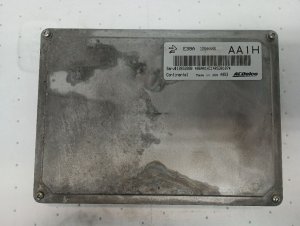
- Engine Control Module (ECM) — This is a common cause of P0601 if the code is stored in the ECM. The internal memory or processor fails, requiring complete replacement.
Trusted brands: ACDelco, GM Genuine
OEM price range: $600-$1050
Aftermarket price range: $400-$800 - Transmission Control Module (TCM)
(OEM #24268164 (Gen 2), 24256861 (Gen 1))— A known issue on this platform where the TCM, located inside the transmission, fails and sets a P0601 code. There are multiple service numbers; the correct one must be verified by VIN.
Trusted brands: ACDelco, GM Genuine
OEM price range: $400-$600
Aftermarket price range: $250-$450
Related Codes That Often Appear With This One
- P0700 — This code is set by the ECM when the Transmission Control Module (TCM) has stored a fault. If you see P0700 with P0601, it strongly suggests the problem is with the TCM.
- P0602, P0603, P0604 — These are related internal control module error codes. TSB #05-06-04-060A notes that these codes can be shared across multiple modules and relate to memory or programming errors.
Technical Service Bulletins (TSBs) & Recalls
- 05-06-04-060A: Information on control module DTCs P0601, P0602, P0603, P0604, P0606, P062F, P06F3, P1621 which can be shared in multiple modules.
- PIP4653E: Information about DTCs P0601, P0603, P0604, P062F or P1621 being stored in the Transmission Control Module (TCM).
Platform-Specific Known Issues
- Per TSB #PIP4653E, the Transmission Control Module (TCM) is a known source for the P0601 code on this vehicle platform.
- TSB #05-06-04-060A is an informational bulletin for technicians acknowledging that P0601 and other related codes can be set in multiple different control modules.
- Owners on forums frequently report experiencing P0601 in conjunction with P0700, confirming the TCM as a common point of failure. Symptoms often include hard shifting and limp mode, especially in stop-and-go traffic which can exacerbate a failing module.
Mechanic-Grade Diagnostic Values
- TCM Power Supply Voltage — expected: 12.0V - 12.6V (measured at the TCM connector power supply pin with ignition on). Failure: Low or no voltage indicates a problem with the fuse, relay, or wiring supplying power to the module.
- TCM Ground Circuit Resistance — expected: < 0.5 Ω (measured between the TCM connector ground pin and a clean chassis ground). Failure: High resistance indicates a corroded or loose ground connection, which can cause intermittent module operation.
- CAN Bus Resistance — expected: 60 Ω (measured between pins 6 and 14 of the DLC with the battery disconnected). Failure: A reading of 120 Ω indicates one of the two terminating resistors (in the ECM or another module) is offline. A reading near 0 Ω indicates a short between the CAN lines.
- Input/Output Speed Sensor Supply Voltage — expected: 8.3 - 9.3 volts (from TCM to sensor). Failure: Voltage outside this range could indicate an internal TCM fault or a wiring issue.
Scan Tool Commands That Help
- GDS2 / Tech2: Module Information / DTC Information — This is the first step to determine which specific module (ECM, TCM, BCM, etc.) has set the P0601 code. The code alone does not specify the source.
- GM Service Programming System (SPS): Replace and Reprogram ECU — This function is required after installing a new, blank ECM or TCM. It downloads the correct software and VIN from GM's servers and flashes it to the new module.
- GDS2 / High-end Scan Tool: Transmission Adaptive Pressure Reset — After a new TCM is programmed and installed, this function should be performed to clear old learned values and allow the new module to learn the transmission's hydraulic characteristics quickly.
Wiring & Ground Locations
- G101 — Left front of the engine, lower block area.. This is a shared ground point for both the Engine Control Module (ECM) and the Transmission Control Module (TCM). A poor connection here can cause faults in both modules.
- G112 (2.4L) — Lower left front of the engine block.. This is a primary ground point for the Engine Control Module (ECM). A bad ground here can cause voltage irregularities leading to a false P0601.
- G103 — Left front of engine compartment, under the battery tray.. This is a major chassis ground. While not a direct module ground, a poor connection here can affect the entire vehicle's electrical stability.
- TCM Fuses (Underhood) — In the underhood fuse block, check fuses #17, #44, and #52.. These fuses provide primary power to the Transmission Control Module. A blown fuse will cause a loss of communication and can lead to various fault codes, including P0601 if it fails during a self-check.
- TCM Fuse (Interior) — In the interior fuse box (passenger side of center console), check fuse #25.. This fuse is also part of the TCM power supply circuit.
- X411 Connector — A 16-pin connector located under the rear of the vehicle on the driver's side, near the fuel tank.. This is a notorious spot for corrosion from road salt and moisture, causing CAN bus communication failures that can disrupt module self-checks and trigger faults.
Real Owner Repair Stories
- Reddit user on r/AskMechanics (2011 Chevy Malibu 2.4L (platform mate with shared 6T40/45 transmission)) — Car enters limp mode with codes P0601 and P0700, but only during slow, stop-and-go city traffic. Drives fine on the highway.
❌ Tried (didn't work) Clearing codes (problem would return within 20 minutes of city driving).
✅ What actually fixed it The user was advised by a transmission shop that this symptom pattern (failure only when hot and in slow traffic) is a classic sign of an internally failing TCM. The heat generated during stop-and-go driving with less airflow causes failing components on the TCM's circuit board to malfunction, which doesn't happen on the cooler-running highway. The implied fix is TCM replacement. - YouTube channel 'Codemans auto' (2012 Chevy Equinox (platform mate)) — P0601 code would set within 5 minutes of starting the engine, even without driving the vehicle.
❌ Tried (didn't work) Checking wiring pins for damage.
✅ What actually fixed it The TCM, located on the valve body inside the transmission, was replaced. The video details the process of removing the transmission side cover to access the module. It is noted that a new module must be programmed to the vehicle's VIN.
OEM Part Supersession History
Multiple (Gen 1)→Multiple (Gen 1)— Firmware/hardware revisions
Heads up: Gen 1 TCMs for the 6T40/6T45 transmission have many part numbers, including 24256524, 24257388, 24260820, 24252871, 24258587, and 24287420. While physically similar, they must be programmed with the correct software for the specific vehicle. A used module must be from an identical vehicle or reprogrammed.Multiple (Gen 2)→Multiple (Gen 2)— Firmware/hardware revisions
Heads up: Gen 2 TCMs also have many part numbers, including 24268164, 24265992, 24286709, and 24296630. These are not interchangeable with Gen 1 modules. The change from Gen 1 to Gen 2 design occurred around the 2012-2013 model year.
Model Year Variations Within This Range
- 2010-2012: These years typically use the 'Gen 1' design of the 6T40/6T45 transmission and its integrated TCM. These modules have a specific set of part numbers and potential failure modes.
- 2013-2017: Starting with the 2013 model year, GM fully transitioned to the 'Gen 2' design of the 6T40/6T45 transmission. These have different internal components and a different series of TCM part numbers. Gen 1 and Gen 2 parts are not interchangeable.
Helpful Videos

Used OEM Parts in Stock




New Aftermarket Parts Available



The information in this article is provided for general reference and educational purposes only. Vehicle specifications, procedures, and part compatibility can vary by production date, trim level, and region. Always consult your vehicle's factory service manual and verify part numbers before purchasing or performing repairs. Safety-critical components such as airbags, seat belts, and braking systems should be installed by a qualified professional.
- Gmc TERRAIN:
- 🎬 Helpful Videos
- 🛍️ Shop This Part
- What's Unique About the 2010-2017 Gmc TERRAIN
- Diagnostic Flowchart
- Symptoms You May Notice
- Most Likely Causes
- Rare But Worth Checking
- Diagnosis Steps
- Parts You'll Likely Need
- Related Codes That Often Appear With This One
- Technical Service Bulletins (TSBs) & Recalls
- Platform-Specific Known Issues
- Mechanic-Grade Diagnostic Values
- Scan Tool Commands That Help
- Wiring & Ground Locations
- Real Owner Repair Stories
- OEM Part Supersession History
- Model Year Variations Within This Range
- 🎟️ Get 5% Off