

P0521 on 2005-2012 Chevrolet Express 3500: Oil Pressure Sensor Causes and Fixes
On a 2005-2012 Express 3500, code P0521 is almost always caused by a faulty oil pressure sensor and/or its small, clogged filter screen. Replacing both parts, located in a difficult-to-reach spot at the back of the engine, typically resolves the issue for about $30-$75 in parts. Using a high-quality OEM oil filter is also a critical and often overlooked part of the fix.
- P0521 on this Express van almost always points to a faulty oil pressure sensor and/or its clogged filter screen.
- Before replacing any parts, you MUST verify the engine's actual oil pressure with a mechanical gauge to rule out a serious internal engine problem.
- Always replace the small, inexpensive filter screen (Part #12585328) when you replace the sensor (Part #12673134).
- The repair is considered difficult for DIYers due to the sensor's location against the firewall, requiring patience and potentially special tools like a swivel-head ratchet and a specific oil pressure sensor socket.
- Using a quality ACDelco oil filter and the correct viscosity oil can help prevent this code from returning.
What's Unique About the 2005-2012 Chevrolet EXPRESS 3500
On the GM V8 engines common in the Express 3500, the P0521 code is a notoriously frequent issue. The problem is often not the sensor itself but a tiny, thimble-shaped filter screen located in the engine block directly beneath it. This screen is prone to clogging with sludge, which prevents the sensor from getting an accurate pressure reading. The sensor's location at the very back of the engine, tucked behind the intake manifold against the firewall, makes what should be a simple repair a significant challenge, often requiring a special 1-1/16" (or 27mm) deep socket, a swivel adapter, and long extensions. For the 6.6L Duramax diesel engines, the sensor is in a much more accessible location on the lower front or side of the engine block near the oil filter.
Diagnostic Flowchart
Tap your situation to follow the diagnostic path that matches what you're seeing on this vehicle.
Symptoms You May Notice
- Check Engine Light is on
- Low Oil Pressure warning light or message on the dashboard
- Oil pressure gauge reads zero, erratically fluctuates, or is stuck at maximum (e.g., 80 psi)
- Engine may stall in some cases
- Engine running rough or making unusual noises
- Replacing the oil pressure sensor without also replacing the small filter screen underneath it. A clogged screen will cause the new sensor to read incorrectly as well.
- Assuming the engine has low oil pressure and proceeding with major engine work without first verifying the actual pressure with a mechanical gauge.
- Replacing the instrument cluster's oil pressure gauge, which is rarely the point of failure.
Most Likely Causes
- Faulty Engine Oil Pressure Sensor (Sending Unit) 🔴 High Probability This sensor is a very common failure point on GM V8 engines of this era, failing from heat and vibration. Aftermarket sensors have a reputation for failing prematurely, so using an OEM ACDelco part is strongly recommended by owners. Oil leaking through the sensor's electrical connector is a definitive sign of internal failure.
How to confirm: After confirming true mechanical oil pressure is good, this is the most likely component failure. With the key on and engine off, a scan tool should show 0 psi; if it shows a high reading, the sensor is bad. A sensor that rattles when shaken has likely failed internally.
Typical fix: Replace the oil pressure sensor. Access requires a special 1-1/16" or 27mm deep socket.
Est. part cost: $30-$60 - Clogged Oil Pressure Sensor Filter Screen 🔴 High Probability A small filter screen is located in the oil port directly under the sensor. It frequently becomes clogged with engine sludge and debris, blocking oil flow to the sensor and causing a false reading.
How to confirm: Visually inspect the screen after removing the oil pressure sensor. If it is dark, full of sludge, or blocked, it needs to be replaced. It can be extracted using a pick tool or by threading a small coarse-thread screw (like a 5/16") into it and pulling it out.
Typical fix: Remove and replace the filter screen. This should always be done when replacing the sensor to prevent a recurrence of the code.
Est. part cost: $5-$10 - Low Engine Oil Level or Incorrect Oil Viscosity 🟡 Medium Probability
How to confirm: Check the engine oil dipstick for proper level and inspect the oil for condition. Verify that the oil viscosity used matches the manufacturer's recommendation (typically 5W-30 for the gas V8s).
Typical fix: Top off or change the engine oil and filter with the correct type and grade of oil.
Est. part cost: $40-$80 - Incorrect or Defective Oil Filter 🟡 Medium Probability GM has issued service bulletins (e.g., PIP5276 series) warning that using non-specified oil filters can trigger a P0521 code, especially in cold weather. The internal bypass valve pressure specification is critical, and some aftermarket filters can cause pressure fluctuations that the ECM interprets as a fault. Some owners specifically report fixing the issue by switching to a Mobil 1 M1-113A or the recommended ACDelco filter.
How to confirm: Check the part number of the installed oil filter. The issue is most common if the code appeared shortly after an oil change.
Typical fix: Replace the oil filter with a high-quality OEM filter, such as an ACDelco PF48 or a recommended high-performance alternative.
Est. part cost: $10-$15
Rare But Worth Checking
- Wiring or Connector Damage: The wiring harness to the sensor is in a hot, tight location. It can become brittle, and the connector lock can break, leading to a poor connection. Check for chafed wires, oil contamination in the connector, or a loose connection.
- Failing Oil Pump or Internal Engine Wear: This is the worst-case scenario. If a mechanical gauge confirms that the oil pressure is actually low (e.g., below 24 PSI @ 1000 RPM when hot), it points to a much more serious internal problem like a worn oil pump, a sticking pressure relief valve, or excessive bearing clearances, requiring significant engine repair. One dealer even quoted an engine replacement for this code, highlighting the importance of proper diagnosis.
Diagnosis Steps
- Check the engine oil level and condition. Top off or change if necessary, ensuring the correct 5W-30 viscosity oil is used.
- Connect a scan tool to read the live oil pressure data from the ECM. Note if the reading is stuck, erratic, or seems incorrect for the engine's state (e.g., showing pressure when the engine is off).
- CRITICAL STEP: Connect a mechanical oil pressure gauge to the engine. For V8s, the port is at the rear top of the engine where the sensor is. Compare the mechanical reading to the scan tool data to determine if you have a sensor problem or a real oil pressure problem. Expected minimum hot pressure for a 5.3L/6.0L is around 24 PSI @ 1000 RPM.
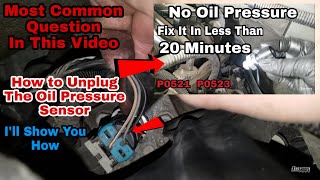
- If mechanical pressure is good, the issue is in the sensor circuit. Inspect the oil pressure sensor's electrical connector and wiring for damage, corrosion, or oil saturation. The connector has a gray locking tab that must be removed before depressing the release. 🎬 See how to safely unplug the sensor connector here.
- If the wiring is intact, the cause is almost certainly the sensor and/or its filter screen.
- Remove the oil pressure sensor. This is difficult due to its location at the back of the engine against the firewall. A special 1-1/16" or 27mm deep socket with a swivel and extensions is highly recommended.
- Once the sensor is out, carefully extract the small, thimble-shaped filter screen from the port below it. A pick tool or a 5/16" coarse-thread bolt can be used to gently pull it out.
- Install a new filter screen and a new, high-quality (preferably OEM ACDelco) oil pressure sensor. Torque the new sensor to spec (approx. 15-22 ft-lbs).
- Clear the DTC with a scan tool and start the engine. Verify the oil pressure gauge reads correctly and check for leaks around the new sensor.
Parts You'll Likely Need
- Engine Oil Pressure Sensor
(OEM #12673134)— This sensor is the most common electrical failure point for the P0521 code, either failing internally or providing inaccurate readings. Using an OEM part is highly recommended for longevity.
Trusted brands: ACDelco
OEM price range: $40-$60
Aftermarket price range: $25-$45 - Engine Oil Pressure Sensor Filter Screen
(OEM #12585328)— This small screen is a critical component that often gets clogged with sludge, causing a false low-pressure reading at the sensor. It is essential to replace it with the sensor.
Trusted brands: ACDelco, Dorman
OEM price range: $5-$10
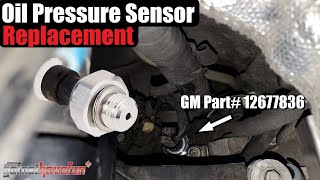
Aftermarket price range: $3-$8 - Oil Pressure Sensor Socket — A special 1-1/16 inch (27mm) deep, thin-walled socket 🎬 Watch a complete walkthrough of the sensor replacement process. is required for removal and installation due to the sensor's tight location. Standard deep sockets may not fit.
Trusted brands: Lisle (p/n 13250), OEM Tools
OEM price range: $10-$20
Aftermarket price range: $8-$15
Related Codes That Often Appear With This One
- P0522 (Engine Oil Pressure Sensor/Switch Circuit Low Voltage)
- P0523 (Engine Oil Pressure Sensor/Switch Circuit High Voltage)
Technical Service Bulletins (TSBs) & Recalls
- PIP4786C: Addresses diagnostics for a low oil pressure message and DTC P0521. [⭐ MANUFACTURER TSB — highest authority]
- PIP5276 (and related versions): Warns that certain oil filters can cause P0521, especially in cold weather or after an oil change.
- 10-06-01-008: Referenced in other TSBs, this document provides details on engine cleaning and issues related to the PF48E oil filter that can trigger P0521.
Platform-Specific Known Issues
- TSB PIP4786C: This Technical Service Bulletin was issued for vehicles exhibiting a low oil pressure message and a P0521 code, instructing technicians to follow standard diagnostic procedure
Mechanic-Grade Diagnostic Values
- Minimum Engine Oil Pressure (Hot, 5.3L/6.0L V8) — expected: 24 PSI @ 1000 RPM, 35 PSI @ 2000 RPM, 38 PSI @ 3000 RPM. Failure: Significantly lower pressure on a mechanical gauge points to internal engine wear, a faulty oil pump, or a sticking pressure relief valve.
- Oil Pressure Sensor 5V Reference Circuit (Gray Wire) — expected: 4.8 - 5.2 Volts with key on, engine off, sensor connector unplugged.. Failure: Voltage outside this range indicates a fault in the ECM or the wiring from the ECM, not the sensor itself.
- Oil Pressure Sensor Low Reference Circuit (Black Wire) — expected: Less than 1.0 ohm of resistance to a known good ground.. Failure: Resistance higher than 1.0 ohm indicates an open or high resistance in the ground circuit provided by the ECM.
- Oil Pressure Sensor Signal Circuit (Tan/White Wire) — expected: Approximately 0.5 Volts with key on, engine off, sensor connected.. Failure: Incorrect voltage with a known-good sensor suggests a wiring or ECM issue.
Scan Tool Commands That Help
- Tech2 / GDS2: Live Data Monitoring — Used to observe the oil pressure value being reported by the sensor to the ECM in real-time. This helps determine if the reading is erratic, stuck high/low, or plausible for the current engine state before connecting a mechanical gauge.
- Tech2 / GDS2: VLOM Solenoid Activation Test — On engines with Active Fuel Management (AFM), this bidirectional test commands the solenoids in the Valve Lifter Oil Manifold (VLOM) to check for pressure leaks. A significant pressure drop during the test can indicate a faulty VLOM is the root cause of the low pressure condition.
Wiring & Ground Locations
- Oil Pressure Sensor Connector — Top rear of the engine block, against the firewall, behind the intake manifold.. This 3-wire connector provides the sensor with a 5V reference (Gray wire), a low reference ground (Black wire), and sends the signal back to the ECM (Tan/White wire). Oil contamination from a leaking sensor, heat damage, or a broken locking tab can cause a poor connection and trigger P0521.
- G102 / G104 — Rear of the driver's side (left) cylinder head.. These are primary engine ground points. The ECM relies on a solid engine ground to provide an accurate low reference signal to sensors. A loose or corroded connection at G102 or G104 can introduce electrical noise or resistance into the sensor circuits, potentially causing an erratic signal from the oil pressure sensor.
Real Owner Repair Stories
- Reddit user in r/ChevyTrucks (Chevrolet Truck with V8 (details analogous to Express 3500)) — Recurring P0521 code, even after replacing the oil pressure sensor.
❌ Tried (didn't work) Replacing the oil pressure sensor, Clearing the code (it would return)
✅ What actually fixed it The issue was finally resolved by switching to a specific high-quality aftermarket oil filter (Mobil 1 M1-113A). This suggests the previous filters had bypass valve characteristics that caused pressure fluctuations, which the sensor correctly reported but the ECM flagged as a fault.
"I Checked Everything" — The Actual Cause
- In cases where a mechanical gauge confirms oil pressure is good and the sensor and screen have been replaced, the P0521 code can still persist. The root cause is often the oil filter itself. Some aftermarket filters have internal bypass valve specifications that differ from the OEM design, causing momentary pressure fluctuations (especially in cold weather) that the sensitive ECM flags as a range/performance error, even though average pressure is acceptable.
When the Usual Fixes Don't Work
- While replacing the oil pressure sensor and the filter screen underneath it is the most common fix, it is not a guaranteed solution. There are documented cases where owners replaced both parts (sometimes multiple times) and the P0521 code continued to return. In at least one instance, the problem was only resolved after switching to a specific high-quality oil filter (Mobil 1 M1-113A), indicating that the dynamic behavior of the oil filter's bypass valve was the true root cause of the out-of-range readings being sent to the ECM.
Model Year Variations Within This Range
- 2007-2012: Introduction of Active Fuel Management (AFM) on certain V8 engines (5.3L, 6.0L). These engines have additional components like a specific Valve Lifter Oil Manifold (VLOM) and deactivating lifters that are highly sensitive to oil pressure and condition. AFM engines are more prone to oil consumption and sludge, which can clog the sensor screen and trigger P0521. A failure in the VLOM itself can also be a root cause for this code on AFM-equipped models.
Helpful Videos
We Have This Part in Stock


The information in this article is provided for general reference and educational purposes only. Vehicle specifications, procedures, and part compatibility can vary by production date, trim level, and region. Always consult your vehicle's factory service manual and verify part numbers before purchasing or performing repairs. Safety-critical components such as airbags, seat belts, and braking systems should be installed by a qualified professional.
- Chevrolet EXPRESS 3500:
- 🎬 Helpful Videos
- 🛍️ Shop This Part
- What's Unique About the 2005-2012 Chevrolet EXPRESS 3500
- Diagnostic Flowchart
- Symptoms You May Notice
- Most Likely Causes
- Rare But Worth Checking
- Diagnosis Steps
- Parts You'll Likely Need
- Related Codes That Often Appear With This One
- Technical Service Bulletins (TSBs) & Recalls
- Platform-Specific Known Issues
- Mechanic-Grade Diagnostic Values
- Scan Tool Commands That Help
- Wiring & Ground Locations
- Real Owner Repair Stories
- "I Checked Everything" — The Actual Cause
- When the Usual Fixes Don't Work
- Model Year Variations Within This Range
- 🎟️ Get 5% Off