

P0506 on 2014-2016 Kia Cadenza 2.4L GDI: Low Idle Speed Causes and Fixes
On the Kia Cadenza with a 2.4L GDI engine, code P0506 almost always means the electronic throttle body is dirty with carbon buildup, causing the idle speed to be too low. This is a characteristic of the Theta II GDI engine design. The most common and effective fix is to clean the throttle body and perform an idle relearn procedure, a low-cost DIY job that typically resolves the issue.
- P0506 means the engine idle is too low, almost always due to a dirty throttle body on this GDI engine.
- The fix is cheap and DIY-friendly: clean the throttle body and perform an idle relearn.
- This is a common maintenance issue for this engine, not a sign of a major failure.
- Do not replace the throttle body unless cleaning and checking for vacuum leaks fails to solve the problem.
What's Unique About the 2014-2016 Kia Cadenza
While the 2.4L GDI engine was available in the Cadenza in some markets, the more common engine in North America was the 3.3L V6. However, both are Gasoline Direct Injection (GDI) engines. Unlike older engines, GDI engines don't have fuel washing over the intake tract. This allows oil and carbon from the PCV (Positive Crankcase Ventilation) system to bake onto the throttle body, which is a known characteristic of these 'Theta II' GDI engines. This buildup restricts airflow at idle, making this code a very common maintenance issue that often requires cleaning every 40,000 to 60,000 miles.
Symptoms You May Notice
- Engine idle speed is lower than normal (e.g., below 750 RPM)
- Rough or vibrating idle
- Engine stalling when coming to a stop or at idle
- Difficulty starting the engine
- Illuminated Check Engine Light
- Hesitation when accelerating from a stop.
- Replacing the throttle body before cleaning it. Cleaning is effective in over 90% of cases and should always be the first step.
- Replacing spark plugs or ignition coils. While these can cause a rough idle, they typically won't cause a consistent P0506 code without other misfire-related codes.
- Forgetting the idle relearn procedure. After cleaning, the PCM's stored adaptive values are incorrect for the clean throttle body, which can cause a continued low or erratic idle until it is reset.
Most Likely Causes
- Dirty Electronic Throttle Body 🔴 High Probability As a GDI engine, it lacks the cleaning effect of fuel spraying on the intake components, leading to significant carbon and oil buildup from the PCV system on the throttle plate and bore over time. This is the number one cause for P0506 on this engine family.
How to confirm: Remove the air intake hose from the throttle body. Visually inspect the throttle plate and the inside of the throttle body bore for a thick layer of black, sticky carbon buildup.
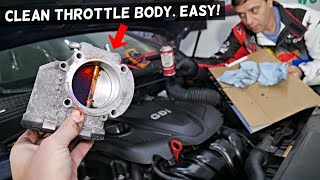
Typical fix: Thoroughly clean the throttle body plate and bore using a dedicated throttle body cleaner and a soft cloth or brush. 🎬 Watch: How to clean the throttle body on a Kia An idle relearn procedure is necessary after cleaning.
Est. part cost: $10-$20 for cleaner - Vacuum Leak 🟡 Medium Probability Hoses and gaskets can become brittle and crack with age and heat cycles. The PCV hose is a common culprit.
How to confirm: Listen for a hissing sound around the engine bay at idle. You can also carefully spray short bursts of brake cleaner or use a smoke machine around intake manifold gaskets, vacuum lines, and the PCV hose to see if the engine idle changes, indicating a leak.
Typical fix: Replace the cracked vacuum hose or faulty gasket.
Est. part cost: $5-$50 - Faulty or Clogged PCV Valve 🟡 Medium Probability A stuck PCV valve can accelerate the carbon buildup in the throttle body by allowing excessive oil vapor into the intake tract. It's a common wear item that contributes directly to the primary cause.
How to confirm: Remove the PCV valve and shake it. If it does not rattle, it is stuck and should be replaced. Inspect the PCV hose for cracks or blockages.
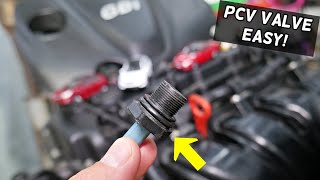
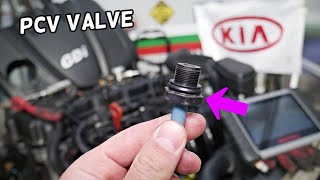
Typical fix: Replace the PCV valve. This is often done as a preventative measure when cleaning the throttle body. 🎬 See this PCV valve replacement walkthrough
Est. part cost: $15-$30 - Clogged Air Filter ⚪ Low Probability This is a general maintenance item. If severely neglected, it can restrict total airflow enough to contribute to a low idle condition.
How to confirm: Visually inspect the engine air filter. If it is black, filled with debris, or you cannot see light through it, it needs to be replaced.
Typical fix: Replace the engine air filter.
Est. part cost: $20-$40
Rare But Worth Checking
- Failing Electronic Throttle Body: While cleaning usually fixes the issue, the electric motor or position sensor within the throttle body can fail. If cleaning doesn't resolve the code and there are no vacuum leaks, the throttle body itself may be faulty and require replacement.
- Powertrain Control Module (PCM) Issue: In very rare cases, the PCM may have a software glitch or internal fault, causing it to incorrectly command or read the idle speed. This should only be considered after all other possibilities have been exhausted.
Diagnosis Steps
- Scan for any other trouble codes. If other codes are present, address them first as they may be the root cause.
- Inspect the air intake system for any obvious blockages or a collapsed intake tube. Check the engine air filter and replace if it's dirty.
- Remove the intake duct from the throttle body and inspect for heavy carbon buildup. This is the most likely cause.
- If carbon is present, disconnect the negative battery terminal for safety. Clean the throttle body thoroughly with a dedicated cleaner and a soft rag. Manually open the throttle plate (with the engine off) to clean the edges and the bore.
- While the intake duct is off, check for vacuum leaks. Listen for hissing noises and inspect all vacuum hoses connected to the intake manifold, especially the PCV hose, for cracks or loose fittings.
- Reassemble the intake and reconnect the battery.
- Perform an Idle Relearn Procedure. A common manual method for Kia is to turn the ignition to 'ON' (engine off) for 1 minute, start the engine and let it idle for 15 minutes, then turn it off for 1 minute before restarting. A key-cycling method (ON for 15s, OFF for 5s, repeated 5 times) is also cited. 🎬 Watch: How to perform an idle relearn without a scan tool
- Clear the P0506 code with a scan tool and perform a test drive. If the code does not return, the issue is resolved.
- If the code returns, and you are certain there are no vacuum leaks, the electronic throttle body itself may be faulty and require replacement.
Parts You'll Likely Need
- Electronic Throttle Body Cleaner — This is required to remove the carbon buildup that is the most common cause of P0506 on this engine.
Trusted brands: CRC, Berryman, WD-40 Specialist
Aftermarket price range: $10-$20 - Electronic Throttle Body Assembly
(OEM #35100-2G700)— This is replaced only if cleaning the original unit does not solve the low idle problem, indicating a failure of the internal motor or sensors. This part number is shared across several Hyundai/Kia models with the 2.4L GDI engine.
Trusted brands: Genuine Hyundai/Kia, Bosch, Standard Motor Products (SMP)
OEM price range: $220-$330
Aftermarket price range: $150-$350
Related Codes That Often Appear With This One
- P0507 — This code means 'Idle RPM Higher Than Expected'. It can appear alongside P0506 if the throttle plate is sticking intermittently due to carbon buildup, causing the computer to struggle and the idle to hunt both high and low.
Platform-Specific Known Issues
- Idle Relearn is Critical: Many owners report that simply cleaning the throttle body is not enough. The idle remains erratic or low until a proper idle relearn procedure is performed. This can be done manually or with a scan tool to reset the ECU's adaptive memory.
- Preventative Cleaning Recommended: Due to the GDI engine design, this is considered a recurring maintenance item. Owners of platform-mate vehicles with the same engine recommend cleaning the throttle body every 40,000-60,000 miles to prevent the P0506 code from appearing.
Mechanic-Grade Diagnostic Values
- Throttle Position Sensor (TPS) 1 & 2 Signal Voltage — expected: One sensor should read approximately 0.5V at closed throttle, sweeping smoothly to ~4.5V at wide-open throttle. The second sensor often works in reverse or on a different scale for redundancy.. Failure: Voltage that is jumpy, has dead spots, does not sweep smoothly, or is stuck at a specific value (e.g., 5V or 0V) indicates a failing sensor, which is integral to the throttle body assembly.
- Scan Tool Live Data: Desired Idle RPM vs. Actual Idle RPM — expected: Actual RPM should be within approximately 25-50 RPM of the Desired RPM value commanded by the PCM.. Failure: When P0506 is active, the Actual RPM will be consistently lower than the Desired RPM by 100 RPM or more.
- MAP Sensor Voltage (Key On, Engine Off) — expected: 4.5V - 5.0V at sea level. This reflects barometric pressure.. Failure: Voltage significantly lower than 4.5V or stuck at 0V can indicate a sensor or wiring issue that could indirectly affect idle calculations.
- MAP Sensor Voltage (Engine Idling) — expected: 1.0V - 1.8V (representing deep engine vacuum).. Failure: Voltage that remains high (near the key-on, engine-off reading) suggests a major vacuum leak, which is a possible cause of P0506.
Scan Tool Commands That Help
- Kia GDS (or capable aftermarket like Autel): ETC Motor Active Test — This bidirectional command allows a technician to force the throttle plate motor to open and close with the engine off. It's used to verify if the motor and internal gears are functioning smoothly and not sticking, helping to confirm a mechanical or electrical failure within the throttle body itself after cleaning has failed.
- Kia GDS (or capable aftermarket): Reset Adaptive Values / Throttle Relearn — This is the most reliable method to perform the idle relearn procedure after cleaning or replacing the throttle body. It directly resets the PCM's stored values, forcing it to recalibrate to the clean or new throttle plate's closed position.
Wiring & Ground Locations
- PCM Connector C300-A — This is one of the main connectors at the Powertrain Control Module (PCM).. The wiring for the Electronic Throttle Control (ETC) system, including the throttle position sensors and motor, runs through this connector. A poor connection or corrosion at these specific pins can cause erratic throttle behavior and trigger codes like P0506.
- Throttle Body Electrical Connector — Directly on the Electronic Throttle Body assembly.. This is the most common point of failure for wiring issues related to the throttle body. It's exposed to engine heat and vibration. Check for loose connections, corrosion on the pins, or damaged wires right at the pigtail, as this can mimic a failed throttle body.
Real Owner Repair Stories
- Reddit User Post (Post-2010 Kia/Hyundai models (procedure is generic)) — Rough idle, jerky shifting at low speeds after battery disconnect or throttle body cleaning.
❌ Tried (didn't work) Simply letting the car idle to relearn on its own., Disconnecting the battery again.
✅ What actually fixed it A specific manual relearn procedure was required: 1. Warm up the engine, then turn it off. 2. Turn the key to the 'ON' position (engine off) for 15 seconds. 3. Turn the key 'OFF' for 5 seconds. 4. Repeat this cycle a total of 5 times. This forces the ECU to relearn the throttle plate's closed position limits. - NHTSA ODI #11513767 — An owner of a related Kia model reported a situation where P0506 appeared alongside a long list of other codes, including P0087, P2096, and multiple misfire codes (P0300-P0306), describing it as an "incredible situation" where the codes would intermittently disappear.
- NHTSA ODI #11499800 — Another owner experienced P0506 in conjunction with P0087 and later P2096, P0137, and misfire codes, noting they were "scared anything come and happen in the highway" due to the recurring nature of these propulsion system faults.
Diagnostic Flowchart
Other Known Issues on This Vehicle
Issues unrelated to this code that are worth knowing about as an owner of this generation:
- Catastrophic Engine Failure (Theta II GDI) 🔴 High — Widespread across millions of 2011-2019 Hyundai/Kia vehicles with Theta II GDI engines. Can occur at various mileages. (Ref: Subject of multiple class-action lawsuits and recalls (e.g., NHTSA 17V-224, Kia Service Campaign SC147) leading to lifetime warranties for the engine short block in many cases.)
- Timing Chain Tensioner Failure 🟠 Medium — A known issue causing a rattling noise on cold starts. If not addressed, can lead to timing chain slack and potential engine damage. (Ref: Kia TSB ENG148R1 addresses this issue.)
- Electrical System Faults 🟡 Low — The 2014 model, in particular, has owner complaints regarding faults with the infotainment system, dashboard display, and other electrical components.
- HECU Short Circuit Fire Risk 🔴 High — Affects certain 2017-2021 Cadenza models, but the underlying issue with the HECU is a known fire risk in other Kia models from the same era. (Ref: NHTSA Recall 21V137000.)
Used vs. New Parts: Buying Guide for This Vehicle
When a used part is the smart pick: A used OEM throttle body from a reputable salvage yard is a very smart choice for this repair. It's often significantly cheaper than a new OEM part and more reliable than a new, non-OEM aftermarket part. Since the primary failure mode is carbon buildup (which can be cleaned), a used part from a low-mileage, rear-ended vehicle is an excellent value.
Donor-vehicle mileage cap: roughly under 80000 miles for the part to have meaningful remaining life.
What to inspect on the donor part:
- Verify the part number (35100-2G700) matches your original part exactly.
- Inspect the throttle plate; it should be relatively clean with no deep scoring or damage.
- Ensure the electrical connector and pins are clean, dry, and free of corrosion or damage.
- Manually move the throttle plate (if possible); it should move smoothly without binding.
- Ask for the donor vehicle's VIN or mileage to gauge its history.
OEM-only on this vehicle (don't cheap out):
- Powertrain Control Module (PCM) - must be new or a specialized remanufactured unit programmed to the vehicle's VIN.
Aftermarket brands forum-validated for this vehicle:
- Bosch (often the original OEM supplier)
- Standard Motor Products (SMP)
- Dorman OE Fix (specifically mentions improvements like better seals to prevent future failure)
Brands owners have reported issues with on this vehicle:
- Unbranded, no-name parts from online marketplaces. While tempting due to low cost, forums often report issues with incorrect calibration, early electronic failure, or poor fitment, leading to persistent codes and drivability problems.
Real Owner Stories
Aggregated from forums and TSBs cited above. Mileages and costs reflect what owners reported in those sources.
2011-2015 Kia/Hyundai models with 2.4L GDI
Symptoms: Erratic or low idle after cleaning the throttle body; the computer did not automatically adjust to the new airflow.
What fixed it: Performed a manual throttle position sensor relearn/reset using a specific key-cycling method: Ignition ON for 15s, OFF for 5s, repeated 5 times.
Source hint: Reddit r/mechanicadvice - "SOLVED: Kia Throttle Position Sensor Relearn or Throttle Body Reset for Push to Start and Key Ignition Models"
Related OBD-II Codes
Frequently Asked Questions
Is there a specific TSB for the rattling noise I hear on cold starts in my 2014 Kia Cadenza?
My 2014 Cadenza has a low idle; is this related to the major Theta II engine recalls?
Can I just clean the throttle body to fix the P0506 code, or is there another step?
How often should I clean the throttle body on the 2.4L GDI engine to prevent idle issues?
Is there a fire risk associated with the 2014-2016 Kia Cadenza?
What part number should I look for if I need to replace the electronic throttle body?
Helpful Videos


Used OEM Parts in Stock
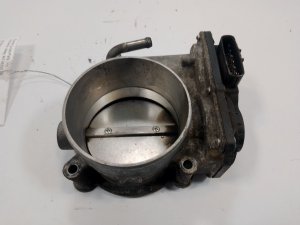
New Aftermarket Parts Available


The information in this article is provided for general reference and educational purposes only. Vehicle specifications, procedures, and part compatibility can vary by production date, trim level, and region. Always consult your vehicle's factory service manual and verify part numbers before purchasing or performing repairs. Safety-critical components such as airbags, seat belts, and braking systems should be installed by a qualified professional.
- Kia Cadenza:
- 🎬 Helpful Videos
- 🛍️ Shop This Part
- What's Unique About the 2014-2016 Kia Cadenza
- Symptoms You May Notice
- Most Likely Causes
- Rare But Worth Checking
- Diagnosis Steps
- Parts You'll Likely Need
- Related Codes That Often Appear With This One
- Platform-Specific Known Issues
- Mechanic-Grade Diagnostic Values
- Scan Tool Commands That Help
- Wiring & Ground Locations
- Real Owner Repair Stories
- Diagnostic Flowchart
- Other Known Issues on This Vehicle
- Used vs. New Parts: Buying Guide for This Vehicle
- Real Owner Stories
- 2011-2015 Kia/Hyundai models with 2.4L GDI
- Related OBD-II Codes
- Frequently Asked Questions
- 🎟️ Get 5% Off