

P0506 on 2005-2008 Audi A4 2.0T FSI: Causes for Low Idle RPM and Fixes
On the 2.0T FSI engine, code P0506 is almost always caused by a failed PCV valve (oil separator) creating a vacuum leak. This is a known weak point on this engine family. Replacing the PCV valve with an updated revision is a common DIY fix costing between $40 and $150 for the part.
- P0506 on a B7 A4 2.0T almost always points to a vacuum leak.
- The most likely culprit is a failed PCV valve (oil separator); check for strong suction at the oil cap as a quick test.
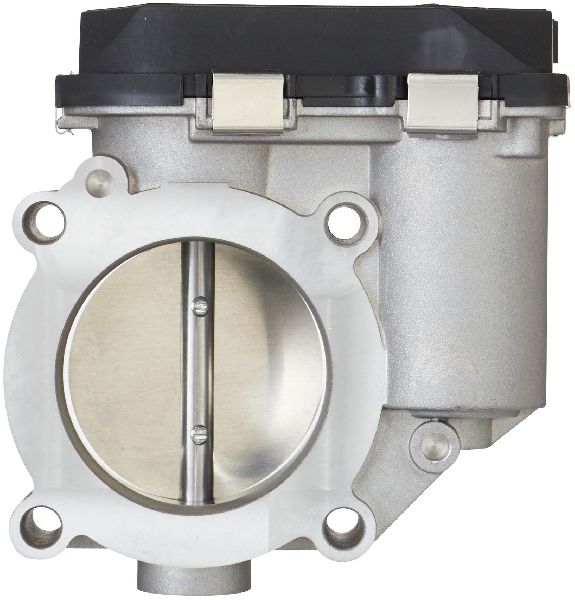
- While you're addressing the issue, it's a good idea to clean the throttle body of any carbon buildup.
- Do not ignore this code, as the underlying vacuum leak can cause a more catastrophic failure of the rear main seal, leading to a much more expensive repair.
- This code is often accompanied by lean codes (P2187) or intake leak codes (P2279), which reinforces the vacuum leak diagnosis.
What's Unique About the 2005-2008 Audi A4

The B7 Audi A4 with the 2.0T FSI engine (engine code BPY) is highly prone to PCV (Positive Crankcase Ventilation) valve failure. This component, also called an oil separator, has an internal rubber diaphragm that frequently tears, creating a significant vacuum leak through the crankcase. This specific failure is the most common reason for a P0506 code on this platform, often appearing alongside lean codes like P2187 and P2279. This issue is shared across many VW and Audi models using the same EA113 FSI engine.
Symptoms You May Notice
- Rough or stumbling idle
- Engine speed drops below normal at idle (e.g., below ~750 RPM)
- Stalling when coming to a stop or when the A/C is on
- Illuminated Check Engine Light
- High-pitched whistling or 'sucking' noise from the engine bay, especially at idle
- Difficulty removing the oil filler cap while the engine is running due to strong vacuum
- In some cases, the idle may hunt or fluctuate between 800-1200 RPM after a failed attempt to clean the throttle body without adaptation.
- Replacing spark plugs or ignition coils. While these can cause a rough idle, they typically trigger misfire codes (P030x) and don't directly cause the P0506 code.
- Replacing the MAF sensor. A vacuum leak occurs *after* the MAF sensor, so the sensor itself is usually reporting airflow correctly; the problem is the unmetered air entering elsewhere.
Most Likely Causes


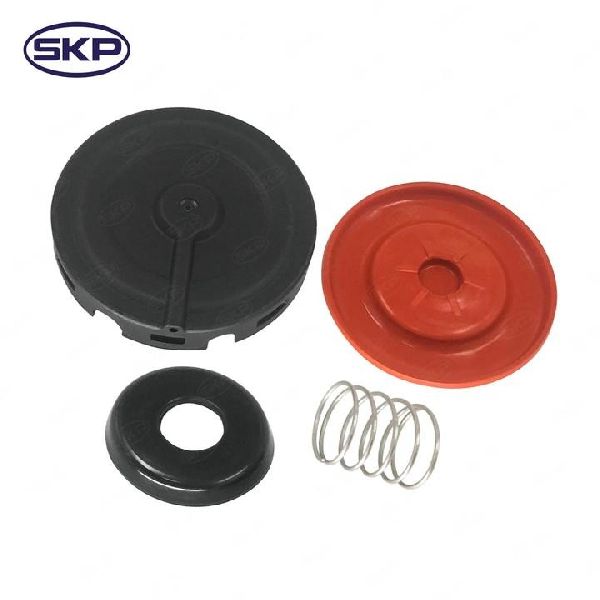
- Failed PCV Valve / Oil Separator 🔴 High Probability The diaphragm inside the factory PCV valve is a known weak point on the 2.0T FSI engine. It is made of a rubber material that becomes brittle and tears over time, with owners describing the failed part as being like 'wet paper'. This creates a large internal vacuum leak.
How to confirm: With the engine idling, try to remove the oil filler cap. If there is very strong suction holding it down, the PCV valve has likely failed. A loud whistling sound is also a primary indicator. A smoke test will definitively show a leak from the PCV assembly or its seals.
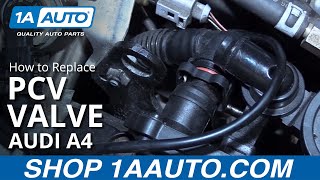
Typical fix: Replace the entire PCV valve assembly. 🎬 Watch: Step-by-step guide to replacing the PCV valve yourself. It is mounted on top of the valve cover. It is critical to use a genuine OEM or high-quality OE supplier part, as cheap aftermarket versions are known to fail quickly. Several part revisions exist; using the latest available version is recommended.
Est. part cost: $40-$150 - Dirty Throttle Body 🟡 Medium Probability As part of the PCV system, oil vapors are recirculated into the intake. Over time, these vapors combine with dirt to create carbon buildup around the throttle plate, restricting the small amount of air needed to maintain a stable idle.
How to confirm: Remove the intake pipe connected to the throttle body and visually inspect for a thick ring of black carbon buildup where the throttle plate closes.
Typical fix: Clean the throttle body thoroughly with a dedicated throttle body cleaner and a soft brush or rag. CRITICAL: A throttle body adaptation (TBA) using a compatible scan tool (like VCDS/VAG-COM) must be performed after cleaning. Failure to do so can result in a continued or even worse rough idle, as the ECM's learned values no longer match the clean throttle plate's position.
Est. part cost: $5-$15 for cleaner - Other Vacuum Leaks (Hoses, Gaskets) ⚪ Low Probability Hoses and gaskets become brittle with age and heat cycles, leading to cracks and leaks. Common culprits besides the PCV can include the brake booster line, intake manifold gaskets, or dipstick tube seal.
How to confirm: Perform a smoke test on the intake system. Smoke will escape from any cracked hoses or failed gaskets. This is the most reliable way to find leaks other than the main PCV failure.
Typical fix: Replace the specific hose or gasket that is found to be leaking.
Est. part cost: $20-$100 depending on the part
Rare But Worth Checking
- Failed Rear Main Seal: This is often a direct consequence of a neglected PCV valve failure. The extreme crankcase vacuum created by a bad PCV can suck the rear main seal inward, causing a massive vacuum leak and/or an oil leak between the engine and transmission. This turns a simple PCV fix into a major repair requiring transmission removal. Forum users have documented getting lean/intake leak codes (P2279, P2187) that were only resolved after replacing a rear main seal that was damaged by a previously failed PCV.
Diagnosis Steps

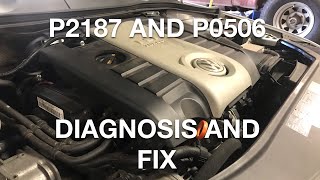
- Read all fault codes with an OBD-II scanner. Note any codes accompanying P0506, especially P2187 or P2279. 🎬 See how to diagnose and fix P2187 and P0506 codes.
- Listen for a high-pitched whistle at idle, which strongly suggests a torn PCV diaphragm.
- With the engine running, carefully attempt to remove the oil filler cap. If strong suction makes it very difficult to remove, a failed PCV valve is highly likely.
- If the PCV is not obviously the cause, perform a smoke test to systematically check the entire intake and crankcase system for leaks. Pay close attention to the area between the engine and transmission to check for a failed rear main seal.
- Remove the intake hose from the throttle body and inspect for heavy carbon buildup. Clean if necessary.
- After any repairs like cleaning the throttle body or replacing the PCV, perform a Throttle Body Adaptation (TBA) using a VAG-COM (VCDS) or similar advanced scan tool to reset the idle baseline.
Parts You'll Likely Need
- PCV Valve / Oil Separator
(OEM #Latest revisions include 06F129101R or 06F129101P. Supersedes older versions like 06F129101N, L, K, G, E.)— This is the most common point of failure on the 2.0T FSI engine leading to vacuum leaks that cause code P0506. It is critical to use a quality part. Note that some revisions may require an updated breather hose (Part No. ~06F103215B) to fit correctly.
Trusted brands: Audi/VW (Genuine OEM), Mann-Hummel (OE Supplier), Vaico
OEM price range: $120-$160
Aftermarket price range: $40-$80 - PCV Valve Gasket
(OEM #06F103483E)— This gasket seals the PCV valve to the valve cover and should always be replaced with the PCV valve to prevent leaks.
Trusted brands: Audi/VW (OEM), Victor Reinz, Elring
OEM price range: $15-$40
Aftermarket price range: $5-$15 - Throttle Body Gasket
(OEM #06F133073D)— Should be replaced whenever the throttle body is removed for cleaning to ensure a proper seal.
Trusted brands: Victor Reinz, Elring
OEM price range: $15-$25
Aftermarket price range: $5-$15
Related Codes That Often Appear With This One
- P2187 — System Too Lean at Idle. A vacuum leak from the PCV or elsewhere introduces unmetered air, causing a lean condition that the ECM detects at idle.
- P2279 — Intake Air System Leak. This is a more general code for the same vacuum leak that triggers P0506 and P2187. It's common to see this code appear after a PCV failure has also damaged the rear main seal.
- P0300, P0301, P0302, P0303, P0304 — Random or specific cylinder misfires. The unstable idle and lean condition caused by the vacuum leak can lead to incomplete combustion and misfires. 🎬 Watch: Diagnosing lean faults and intake leaks with misfires.
Platform-Specific Known Issues
- The 2.0T FSI engine has a well-documented history of PCV valve failures. It is considered a routine maintenance item by many owners. Using cheap aftermarket PCV valves is often not recommended as they can fail quickly, sometimes within months.
- A severely failed PCV valve, if left unaddressed, can create enough vacuum to damage other engine seals, most notably the rear main seal, turning a simple repair into a very expensive one requiring transmission removal. One owner on a forum experienced this firsthand, stating 'My CEL came on... After seeing the dreaded main seal oil puddle on the ground I troubleshot it to a bad diaphragm on the PCV.'
- Even with a new PCV, the rear main seal may remain a weak point. A user on Reddit noted their seal failed despite having replaced the PCV with an updated revision three years prior, suggesting the seal itself can fail from age and the original design's stress.
Mechanic-Grade Diagnostic Values
- Long-Term Fuel Trim at Idle (Additive) — expected: Using VCDS, check Measuring Value Block (MVB) 32, field 1. The value should be close to 0%, ideally within +/- 5%.. Failure: A high positive value (e.g., +6.4% or higher) is a classic indicator of an unmetered air (vacuum) leak, which is the root cause of P0506.
- High-Pressure Fuel Rail Pressure (Actual) — expected: Using VCDS, check Measuring Value Block (MVB) 140. At idle, pressure should be approximately 40 bar (580 PSI).. Failure: A pressure significantly lower than 40 bar at idle (e.g., 6-10 bar) indicates a severe fuel delivery problem, potentially from a failed HPFP or worn cam follower.
- Throttle Valve Opening Angle at Idle — expected: Using VCDS, check Measuring Value Block (MVB) 003. The angle should be stable and typically between 2-3 degrees at warm idle.. Failure: An erratic value or one that is significantly different may indicate severe carbon buildup or a faulty throttle body, though this is less common than a PCV failure.
Hidden / Shadow Codes Worth Checking
- 01286: This is the Volkswagen/Audi specific fault code for 'Idle Control System RPM Lower than Expected', which is the direct equivalent of the generic P0506. (see via VCDS (VAG-COM) or other VAG-specific diagnostic tools.)
- P050A: Closely related code for 'Cold Start Idle Air Control System Performance'. The trigger threshold is a deviation of more than -80 RPM from the target idle speed, which is likely similar to the logic for P0506. (see via Standard OBD-II scanner, VCDS.)
Scan Tool Commands That Help
- VCDS (VAG-COM): Throttle Body Adaptation (TBA) — This is a CRITICAL step after cleaning the throttle body, replacing it, or after a battery disconnect. It recalibrates the throttle plate's closed and open positions. The procedure is: [01-Engine] -> [Basic Settings - 04] -> Group '060' -> [Go!]. The display will show 'ADP RUN' and then 'ADP OK' when complete.
Wiring & Ground Locations
- Ground Point 639 — Located on the left A-pillar, typically behind the kick panel or lower dash trim.. A poor ground at this common location can cause a variety of intermittent electronic issues for modules located in the cabin, including the ECU, potentially leading to incorrect sensor readings or control.
- Ground Connection 135 — This is a common ground point within the main dash panel wiring harness.. Corrosion or a loose connection in a major harness ground can affect multiple systems and cause difficult-to-diagnose faults. While not a primary cause for P0506, it should be considered if other electronic gremlins are present.
Real Owner Repair Stories
- YouTube channel 'Mr. B' (2007 Volkswagen Passat 2.0T FSI (BPY Engine)) — P2187 (Lean at Idle) and P0506 (Idle RPM Low).
❌ Tried (didn't work) A smoke test was performed and showed NO external vacuum leaks.
✅ What actually fixed it The PCV valve was replaced. The failure was an internal vacuum leak through the torn diaphragm inside the PCV, which a standard smoke test does not always reveal. - YouTube channel 'COMMON CAUSE OF' (Audi 2.0T FSI (exact model not specified, but same engine family)) — Rough idle, air intake leak faults, mixture-related faults.
❌ Tried (didn't work) A previous shop had already replaced the ignition coils, spark plugs, fuel injectors, oil separator (PCV), and throttle body without fixing the issue.
✅ What actually fixed it The rear main seal had failed and was sucked inward, creating a massive crankcase vacuum leak. The diagnosis was confirmed by temporarily plugging the intake manifold port for the PCV system and observing that the engine idle smoothed out. The root cause was likely a prior PCV failure creating excessive vacuum that damaged the seal.
"I Checked Everything" — The Actual Cause
- A common scenario for P0506 on this engine is a 'clean' smoke test where no external leaks are found. The actual cause is often an *internal* vacuum leak through the torn diaphragm of the PCV valve. The leak path is from the crankcase directly into the intake manifold via the PCV's internal passages, which is not something a smoke test of the intake piping alone will show.
- In more severe cases, a smoke test of the intake may be clean, but the true leak is a failed rear main seal that has been sucked inward by excessive crankcase vacuum from a bad PCV. This can be diagnosed by feeding smoke directly into the crankcase via the oil filler neck and watching for smoke to exit the bell housing area between the engine and transmission.
OEM Part Supersession History
06F129101C, E, G, K, L, N→06F129101P, 06F129101R— Revisions to improve the durability of the internal rubber diaphragm that is prone to tearing.
Heads up: CRITICAL: Engines built before approximately 12/16/2005 had a check valve integrated into the PCV assembly. Later engines moved this check valve to the breather pipe itself. Installing a 'late' PCV (without the integrated valve) on an 'early' car without also updating the breather pipe will cause severe boost/vacuum leaks and running issues.Banjo-bolt style HPFP fuel line→Barbed fitting style HPFP fuel line— The barbed fitting design was introduced to reduce leaks and simplify service of the HPFP and cam follower.
Heads up: When replacing the HPFP on an early B7 with the newer style pump, an adapter fitting is required to connect the old banjo-bolt fuel line to the new pump's threaded port where the barb would be.
Model Year Variations Within This Range
- 2005-early 2006 (Pre-~12/16/2005 build date): The PCV valve assembly contains an integrated check valve. When replacing, one must either use the correct early-style PCV or update both the PCV and the associated breather tube to the later design.
- Mid-B7 generation onwards: The high-pressure fuel pump (HPFP) uses a barbed fitting for the fuel line, whereas earlier models used a banjo bolt. This affects which parts are needed when servicing the HPFP.
Diagnostic Flowchart
Used vs. New Parts: Buying Guide for This Vehicle
When a used part is the smart pick: For the P0506 fault on this vehicle, buying used parts is strongly discouraged. The primary causes are wear items like rubber diaphragms (PCV valve) and gaskets. A used part is likely to have similar wear or be close to failure. A used throttle body could be considered only if the original is physically broken, but it would still require thorough cleaning and adaptation.
Donor-vehicle mileage cap: roughly under 40000 miles for the part to have meaningful remaining life.
What to inspect on the donor part:
- If forced to consider a used throttle body, inspect for damage to electrical connectors and ensure the throttle plate moves freely without binding.
- Avoid any part with signs of oil sludge, heavy carbon, or corrosion.
OEM-only on this vehicle (don't cheap out):
- PCV Valve / Oil Separator: This is the most critical part to buy OEM or from a validated OE supplier (e.g., Mann-Hummel). Cheap, unbranded aftermarket PCV valves are notorious for failing within a few thousand miles, recreating the problem.
- Rear Main Seal: Given the labor involved in replacement (transmission removal), using a high-quality OEM or OE supplier part (e.g., Victor Reinz, Elring) is essential to ensure longevity.
Aftermarket brands forum-validated for this vehicle:
- Mann-Hummel (for PCV Valve, often the OE supplier)
- Victor Reinz (for gaskets)
- Elring (for gaskets)
Brands owners have reported issues with on this vehicle:
- Unbranded, low-cost PCV valves from online marketplaces like eBay or Amazon. Forum consensus is that these parts have extremely high and rapid failure rates.
Real Owner Stories
Aggregated from forums and TSBs cited above. Mileages and costs reflect what owners reported in those sources.
Volkswagen GTI 2.0T FSI
Symptoms: Check Engine Light came on, followed by seeing a 'dreaded main seal oil puddle on the ground'.
What fixed it: The problem was troubleshot to a bad diaphragm on the PCV valve. Replacing the PCV valve is the implied fix for the root cause.
Source hint: vehicle_specific_issues section citing forum owner experience
Audi A4
Symptoms: The owner received a P2279 (intake air leak) code even after having already replaced the PCV valve.
What fixed it: A smoke test revealed the leak was actually coming from a failed rear main seal, which had likely been damaged by the previously failed PCV. The fix was to replace the rear main seal.
Source hint: AudiWorld Forums: Rear Main Seal causing an intake air leak?
Audi A4 2.0T FSI
Symptoms: The rear main seal failed, causing an oil leak and potential vacuum leak.
What fixed it: The rear main seal required replacement, even though the owner had already replaced the PCV with an updated revision three years prior, suggesting the seal itself can fail from age and stress.
Source hint: vehicle_specific_issues section citing a Reddit user
Related OBD-II Codes
Frequently Asked Questions
I just cleaned the throttle body on my A4 to fix a rough idle, but now it's even worse. What did I do wrong?
I hear a loud whistling noise from the engine bay at idle. Is this related to the P0506 code?
My mechanic says the PCV valve needs to be replaced. Can I just buy a cheap one online?
Is there a simple way to check if my PCV valve has failed before buying a new one?
What's the worst that can happen if I ignore the P0506 code and the bad PCV valve?
My mechanic wants to perform a 'smoke test'. Is this a necessary diagnostic step for P0506?
Helpful Videos
Used OEM Parts in Stock


New Aftermarket Parts Available


The information in this article is provided for general reference and educational purposes only. Vehicle specifications, procedures, and part compatibility can vary by production date, trim level, and region. Always consult your vehicle's factory service manual and verify part numbers before purchasing or performing repairs. Safety-critical components such as airbags, seat belts, and braking systems should be installed by a qualified professional.
- Audi A4:
- 🎬 Helpful Videos
- 🛍️ Shop This Part
- What's Unique About the 2005-2008 Audi A4
- Symptoms You May Notice
- Most Likely Causes
- Rare But Worth Checking
- Diagnosis Steps
- Parts You'll Likely Need
- Related Codes That Often Appear With This One
- Platform-Specific Known Issues
- Mechanic-Grade Diagnostic Values
- Hidden / Shadow Codes Worth Checking
- Scan Tool Commands That Help
- Wiring & Ground Locations
- Real Owner Repair Stories
- "I Checked Everything" — The Actual Cause
- OEM Part Supersession History
- Model Year Variations Within This Range
- Diagnostic Flowchart
- Used vs. New Parts: Buying Guide for This Vehicle
- Real Owner Stories
- Volkswagen GTI 2.0T FSI
- Audi A4
- Audi A4 2.0T FSI
- Related OBD-II Codes
- Frequently Asked Questions
- 🎟️ Get 5% Off