

P0505 on 2001-2005 Honda Civic: Idle Control System Malfunction Causes and Fixes
On a 2001-2005 Honda Civic, code P0505 is almost always caused by a dirty or faulty Idle Air Control (IAC) Valve. A thorough cleaning of the valve and throttle body passages, followed by an idle relearn procedure, often resolves the issue. If cleaning doesn't work, the IAC valve likely needs replacement, but owners report mixed results with aftermarket parts.
- P0505 on a 2001-2005 Civic almost always points to the Idle Air Control (IAC) valve.
- Before buying a new valve, always try cleaning it first. A can of throttle body cleaner and a new gasket are often all that's needed.
- An idle relearn procedure is mandatory after cleaning/replacing the IAC valve or disconnecting the battery to ensure a stable idle.
- Symptoms include a check engine light with an erratic, high, or low idle, and possible stalling at stops.
- This is a common and manageable DIY repair with a difficulty of 2 out of 5.
What's Unique About the 2001-2005 Honda Civic

The seventh-generation Honda Civic (2001-2005), particularly with the 1.7L D17 engine series (D17A1, D17A2), is well-known for this issue. The design of the Idle Air Control (IAC) valve, which uses a rotary shutter, makes it highly susceptible to carbon and gunk buildup from the PCV system. This buildup restricts the valve's movement, leading to the idle problems that trigger the P0505 code. For many owners, simply removing and thoroughly cleaning the valve is enough to fix the problem without buying any new parts besides a new gasket. The IACV is also mounted to the throttle body with coolant lines running through it, which can cause a minor coolant spill during service.
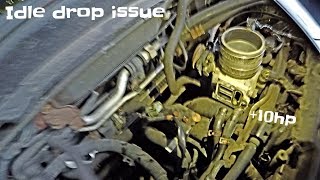
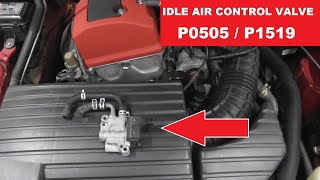
🎬 Watch: How to remove and clean your Civic's IAC valve.Symptoms You May Notice
- Erratic or fluctuating idle speed, often bouncing between 1000 and 2000 RPM.
- Idle speed is too high (e.g., 1000-2000 RPM).
- Idle speed is too low, causing the engine to shudder or stall.
- Engine stalling when coming to a stop or when the gas pedal is released.
- Difficulty starting the engine.
- Illuminated Check Engine Light.
- Vehicle jerking or bucking at low speeds or light throttle.
- Engine hesitates or stumbles when accelerating from a stop.
- Replacing the throttle position sensor (TPS) when it is not faulty.
- Replacing the entire throttle body when only the IAC valve needs cleaning or replacement.
- Repeatedly replacing the IAC valve with cheap aftermarket units that are also faulty.
Most Likely Causes

- Dirty or Clogged Idle Air Control (IAC) Valve 🔴 High Probability The IAC valve on the D17 engine is prone to carbon buildup, which causes the internal rotary valve to stick.
How to confirm: Remove the IAC valve from the throttle body and inspect its air passages and rotary shutter for black carbon deposits. The shutter should move freely when manipulated.
Typical fix: Thoroughly clean the IAC valve and the corresponding ports on the throttle body with throttle body cleaner and a small brush or Q-tips. Some owners completely disassemble the valve by removing the electronic sensor (held on by 5-point star screws) to ensure the rotary barrel spins freely. Replace the gasket upon reinstallation.
Est. part cost: $5-$15 for cleaner and a new gasket. - Faulty Idle Air Control (IAC) Valve 🟡 Medium Probability If cleaning does not resolve the issue, the electronic motor within the valve may have failed or shorted internally. Many owners report that cheap aftermarket IAC valves from eBay or other sources are often faulty out of the box or fail quickly, leading to a repeat of the P0505 code.
How to confirm: After cleaning, if the idle problem persists, test the valve's circuit. A common diagnostic step is to unplug the IAC connector with the engine running; a significant change in idle (or stalling) suggests the valve was working, while no change suggests it is faulty. A multimeter can be used to check for continuity and proper voltage at the connector.
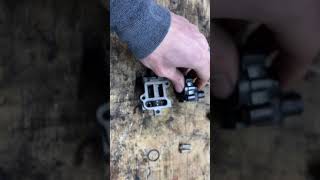
Typical fix: Replace the Idle Air Control Valve and its gasket. Using an OEM (Honda) or a reputable OEM-supplier part (like Denso) 🎬 See this walkthrough on how to replace a faulty valve. is highly recommended.
Est. part cost: $40-$250 - Vacuum Leak ⚪ Low Probability Hoses can become brittle and crack over time, but this is less common than a dirty IAC valve for this specific code. Common leak points include the PCV valve hose, intake manifold gasket, and throttle body gasket.
How to confirm: Inspect all vacuum hoses connected to the intake manifold and throttle body for cracks, loose fittings, or breaks. A smoke test is the most effective method. Alternatively, you can carefully spray brake cleaner near suspected areas; a change in engine idle indicates a leak. Another test involves removing the air intake and covering the lower port inside the throttle body (leading to the IACV) with your finger. If the idle does not drop, a vacuum leak is likely present.
Typical fix: Replace the cracked or broken vacuum hose or faulty gasket.
Est. part cost: $5-$30 - Dirty Throttle Body ⚪ Low Probability
How to confirm: Inspect the throttle plate and bore for carbon buildup that may prevent the plate from closing completely, allowing unmetered air to enter.
Typical fix: Clean the throttle body bore and plate with throttle body cleaner and a rag or soft brush. Be careful not to spray cleaner directly into electronic components.
Est. part cost: $5-$10 for cleaner.
Rare But Worth Checking
- Faulty Engine Control Module (ECM/PCM): This is very rare. Before suspecting the ECM, all other possibilities, including the IAC valve, wiring, and vacuum leaks, must be thoroughly ruled out.
- Wiring Harness Issue: An open or short in the wiring between the ECM and the IAC valve can cause this code. Inspect the connector for corrosion or loose pins and the harness for damage.
- Improperly Set Idle Screw: The throttle body has an idle stop screw that is set from the factory and should not be adjusted. However, a previous owner may have tampered with it. Some owners have found this screw was misadjusted, and correcting it resolved the P0505 code after all other causes were ruled out.
- Air in Cooling System: Since the IACV has coolant flowing through it, air pockets in the cooling system can sometimes cause erratic temperature readings and affect its operation, leading to idle issues. This is more likely if the cooling system was recently serviced.
Diagnosis Steps

- Scan for Codes: Confirm P0505 is the primary code. If other codes like P1129 (MAP Sensor) are present, their cause may be related to the same vacuum issue.
- Visual Inspection: Check all vacuum lines connected to the intake manifold and throttle body for visible cracks or disconnections. Check the air intake hose for tears.
- Clean the IAC Valve and Throttle Body: Remove the air intake assembly. Unbolt the IAC valve from the bottom of the throttle body (typically two 8mm or Phillips head bolts). Be prepared for a small amount of coolant to leak from the connected hoses.
- Thoroughly spray the inside of the IAC valve and its ports with throttle body cleaner, using a small brush or Q-tips to remove all carbon buildup. For a deeper clean, remove the electronic part (may require cutting a slot into the 5-point security screws) and manually spin the rotary barrel with penetrating oil until it moves freely.
- While the IACV is off, clean the throttle body bore and the IAC passages on the throttle body itself.
- Reinstall the IAC valve with a new gasket. Top off any lost coolant.
- Perform an ECU Reset and Idle Relearn Procedure: Disconnect the negative battery terminal for at least 10 minutes to clear the ECU's learned values.
- Idle Relearn Procedure: Make sure all electrical accessories (A/C, radio, lights, etc.) are off. Start the engine and hold the RPM at 3,000 (in Park or Neutral) until the engine reaches operating temperature (usually when the radiator fan cycles on). Then, let the engine idle for at least 5-10 minutes. 🎬 Watch: A step-by-step guide to the Honda idle learn procedure.
- Test Drive: If the idle is now stable and the Check Engine Light stays off, the problem is solved. If the P0505 code returns, proceed to test the IAC valve's electrical circuit.
- Test the IAC Circuit: Unplug the IACV connector while the engine is idling. If the idle speed does not change, the valve or its circuit is likely faulty. Use a multimeter to check for proper voltage and ground at the IAC valve connector according to the vehicle's service manual. If the wiring is good, the IAC valve itself has likely failed electrically.
Parts You'll Likely Need

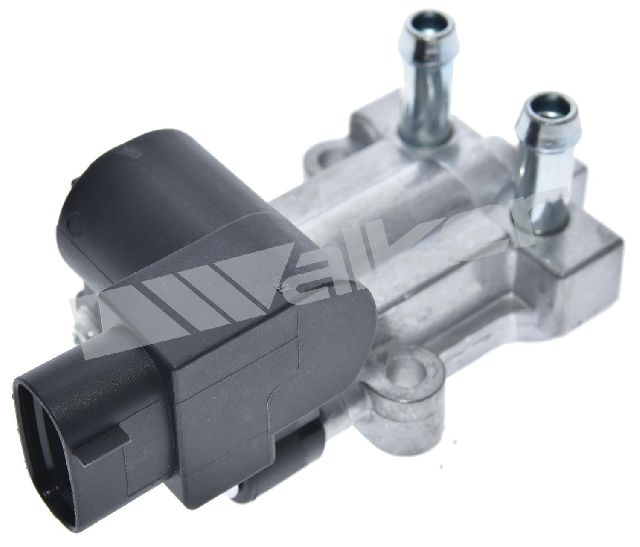
- Idle Air Control (IAC) Valve
(OEM #16022-PLC-J01)— This is the most common failure point for code P0505 on this vehicle. It either gets stuck from carbon buildup or fails electrically. Forum users strongly advise against cheap aftermarket parts, as they often fail quickly or are defective out of the box.
Trusted brands: Honda (OEM), Standard Motor Products, Denso
OEM price range: $180-$250
Aftermarket price range: $40-$120 - Idle Air Control Valve Gasket
(OEM #16456-PLE-J01)— The gasket should always be replaced when the IAC valve is removed to prevent vacuum or coolant leaks.
Trusted brands: Honda (OEM), Fel-Pro
OEM price range: $5-$10
Aftermarket price range: $2-$5
Platform-Specific Known Issues
- 5-Point Security Screws on IACV: The electronic motor on the IACV is attached to the valve body with 5-point (not 6-point Torx) security screws. To perform the most thorough cleaning, these must be removed. Many owners use a small grinder or Dremel to cut a slot into the screw heads so they can be removed with a flat-blade screwdriver.
Mechanic-Grade Diagnostic Values
- IAC Valve Coil Resistance — expected: Approximately 8-15 Ohms between the power and ground terminals.. Failure: A reading of infinity (open circuit) or zero (short circuit) indicates a failed coil.
- IAC Valve Connector Voltage (Key On, Engine Off) — expected: One pin should show battery voltage (~12V), one should be ground, and the center pin is the signal wire from the ECU.. Failure: Absence of ~12V power or a bad ground points to a wiring issue before the valve itself.
- IAC Valve Mounting Bolt Torque — expected: 7 ft-lbs (84 in-lbs).. Failure: Over-tightening can damage the valve or throttle body; under-tightening can cause vacuum leaks.
Scan Tool Commands That Help
- Honda HDS (or advanced bidirectional scanner): IACV Test or Duty Cycle Command — This function allows a technician to command the IAC valve to open or close by specific percentages. It is used to verify if the valve's motor responds correctly to ECU commands, which helps differentiate between a faulty valve, a wiring problem, or an ECU driver issue.
Wiring & Ground Locations
- G101 — On the thermostat housing, at the front/middle of the engine.. G101 is a primary ground point for the Engine Control Module (ECM) and several critical sensors, including the IAC valve. A corroded or loose connection at this location can cause erratic voltage and signal readings, leading the ECM to incorrectly diagnose an IAC system failure and set a P0505 code.
- IAC Valve Connector — Plugged into the IAC valve, which is mounted on the bottom of the throttle body.. This 3-pin connector provides power, ground, and the control signal to the IAC valve. The pins are typically: Pin 1 (Yellow/Black wire) is power, Pin 2 (Blue/Black wire) is the control signal from the ECU, and Pin 3 (Black/Blue wire) is the ground. Verifying voltage and continuity at these specific pins is essential for diagnosing a wiring fault.
Real Owner Repair Stories
- Honda-Tech forum user (2001-2005 Honda Civic (general thread)) — Engine code P0505, erratic idle.
❌ Tried (didn't work) Cleaning the IAC Valve multiple times., Replacing the IAC Valve with a new part.
✅ What actually fixed it The user eventually discovered the issue was a faulty Engine Control Module (ECU). After replacing the ECU, the P0505 code was resolved and the idle returned to normal. This highlights a rare but possible root cause when all other common fixes fail. - 7thgenhonda.com forum user (2001-2005 Honda Civic) — P0505 code, high and surging idle.
❌ Tried (didn't work) Cleaning the original IAC valve., Replacing the IAC valve with an aftermarket part, which also failed.
✅ What actually fixed it The problem was finally solved by replacing the faulty aftermarket IAC valve with a genuine Honda OEM part. The user noted that the money spent on the cheap replacement was wasted and the OEM part fixed the issue immediately.
Documented NHTSA Reports
- NHTSA ODI #10533782: An owner of a Honda vehicle reported that the check engine indicator light illuminated with codes P0730 for incorrect gear ratio and P0505 for idle. The owner noted a dangerous situation while driving uphill when the vehicle speed control was affected.
- NHTSA ODI #10195472: A report describes a vehicle failure where a maintenance technician issued codes P0420, P0505, and P1456. The owner noted the failure occurred at approximately 97,596 miles, despite certain components only being guaranteed for 80,000 miles.
OEM Part Supersession History
16022-PLC-003→N/A— This is the part number for vehicles with a Manual Transmission.
Heads up: This part is specific to manual transmission models.16022-PLC-J01→N/A— This is the part number for vehicles with an Automatic Transmission.
Heads up: This part is specific to automatic transmission models.
Diagnostic Flowchart
Used vs. New Parts: Buying Guide for This Vehicle
When a used part is the smart pick: A used OEM IAC valve from a reputable junkyard can be a smart choice, especially if it comes from a lower-mileage donor vehicle. Given the high failure rate and poor quality of many cheap new aftermarket units, a used original Honda part is often more reliable.
Donor-vehicle mileage cap: roughly under 120000 miles for the part to have meaningful remaining life.
What to inspect on the donor part:
- Check for physical damage to the housing or connector.
- If possible, inspect the rotary valve through the ports for excessive carbon buildup before purchase.
- Ask for the donor vehicle's mileage and check for any warranty from the seller.
OEM-only on this vehicle (don't cheap out):
- Idle Air Control (IAC) Valve
Aftermarket brands forum-validated for this vehicle:
- Denso (often the OEM supplier)
- Standard Motor Products (SMP) - non 'T-Series' line
Brands owners have reported issues with on this vehicle:
- Unbranded or 'white-box' parts from online marketplaces like eBay and Amazon.
- Store brands with consistently poor reviews, such as some Duralast models.
Real Owner Stories
Aggregated from forums and TSBs cited above. Mileages and costs reflect what owners reported in those sources.
2001-2005 Honda Civic 1.7L
Symptoms: The P0505 code returned even after installing a new IACV.
What fixed it: The problem was not the valve but a misadjusted throttle body idle screw that was set too far out.
Source hint: ClubCivic.com thread titled 'I fixed the code! It turns out I had my idle screw way too far out...'
1999 Honda Civic LX
Symptoms: A persistent P0505 error code that even a Honda dealer was unable to solve.
What fixed it: The final fix was a combination of replacing a faulty PCV valve and correcting a misadjusted throttle plate stop-screw that was allowing unmetered air past the throttle plate at idle.
Source hint: Reddit r/Honda thread titled 'Finally fixed my P0505 error code on my '99 Civic LX!'
2001-2005 Honda Civic 1.7L
Symptoms: A fluctuating idle and P0505 code persisted after replacing both the IACV and MAP sensor.
What fixed it: The owner confirmed the issue was excess air by plugging the IACV port inside the throttle body, which temporarily stabilized the idle. This pointed towards a vacuum leak or another source of unmetered air as the root cause.
Source hint: CivicForums.com thread titled 'Fluctuating Idle - have ran out of ideas. P0505 Code.'
Related OBD-II Codes
Frequently Asked Questions
How do I remove the 5-point security screws on my Civic's IAC valve to clean it properly?
I cleaned my IAC valve and the P0505 code came back. What's the next step?
Does it matter what brand of replacement IAC valve I buy for my 2001-2005 Civic?
Is there a special procedure required after reinstalling the IAC valve on my Honda Civic?
Could a vacuum leak cause the P0505 code on this car?
I have a P1129 code along with P0505. Are they related?
Helpful Videos
We Have This Part in Stock



The information in this article is provided for general reference and educational purposes only. Vehicle specifications, procedures, and part compatibility can vary by production date, trim level, and region. Always consult your vehicle's factory service manual and verify part numbers before purchasing or performing repairs. Safety-critical components such as airbags, seat belts, and braking systems should be installed by a qualified professional.
- Honda Civic:
- 🎬 Helpful Videos
- 🛍️ Shop This Part
- What's Unique About the 2001-2005 Honda Civic
- Symptoms You May Notice
- Most Likely Causes
- Rare But Worth Checking
- Diagnosis Steps
- Parts You'll Likely Need
- Platform-Specific Known Issues
- Mechanic-Grade Diagnostic Values
- Scan Tool Commands That Help
- Wiring & Ground Locations
- Real Owner Repair Stories
- Documented NHTSA Reports
- OEM Part Supersession History
- Diagnostic Flowchart
- Used vs. New Parts: Buying Guide for This Vehicle
- Real Owner Stories
- 2001-2005 Honda Civic 1.7L
- 1999 Honda Civic LX
- 2001-2005 Honda Civic 1.7L
- Related OBD-II Codes
- Frequently Asked Questions
- 🎟️ Get 5% Off