

P0505 on 1998-2002 Honda Accord: Causes and Fixes for Idle Control System Malfunction
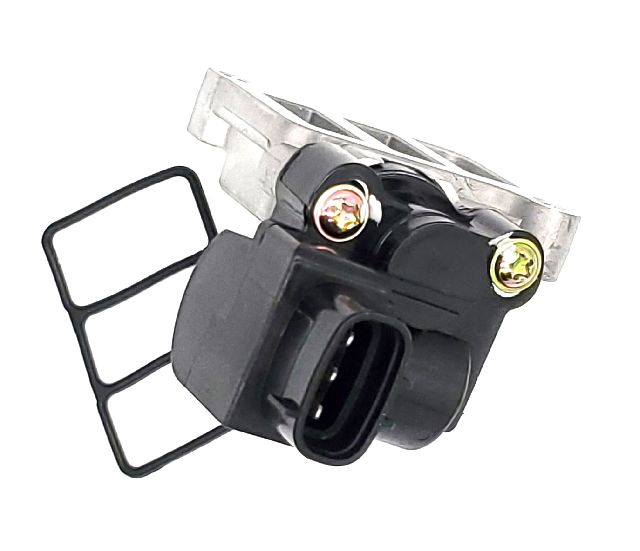
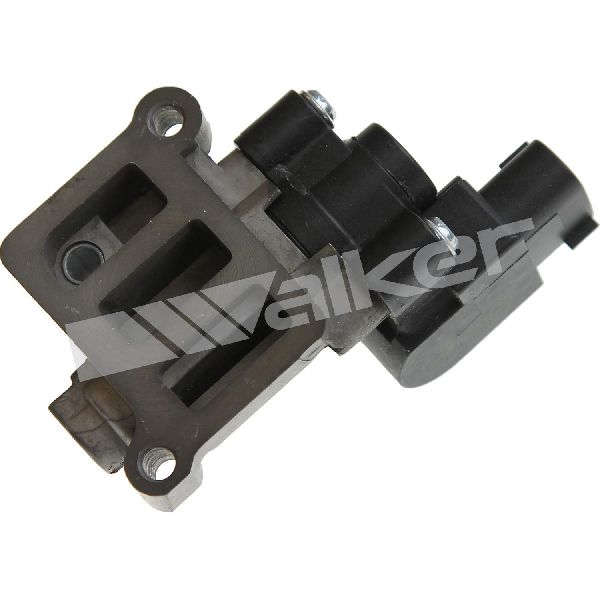
For a 1998-2002 Honda Accord, code P0505 is almost always caused by a dirty or faulty Idle Air Control Valve (IACV). Cleaning the valve and the throttle body often fixes it. If not, a replacement IACV costs around $40-$90 for an aftermarket part or $150-$250 for an OEM part. Other common causes include air in the cooling system or a vacuum leak, especially a cracked throttle body spacer on V6 models. This is a very common and DIY-friendly repair.
- P0505 on this Accord almost always points to the Idle Air Control Valve (IACV).
- Start by cleaning the IACV and throttle body; this is a low-cost fix that often works.
- Always use a new gasket when reinstalling or replacing the IACV to prevent vacuum leaks.
- On V6 models, a cracked intake spacer is a unique and common cause of this code.
- After any repair, you MUST perform an idle relearn procedure for the ECU to adapt to the fix.
What's Unique About the 1998-2002 Honda Accord

The 6th generation Accord's idle system is known for its sensitivity to two specific issues. First, the IAC valve has engine coolant flowing through it to regulate temperature and prevent icing. Any air trapped in the coolant system (often from a low coolant level or incomplete bleeding) can cause the valve to behave erratically, triggering a P0505 code. Second, on the J30A1 V6 engine, a factory-installed plastic spacer between the throttle body and intake manifold is prone to cracking with age, creating a significant vacuum leak that is difficult to diagnose without a smoke test. This failure is a well-documented issue in owner forums.
Symptoms You May Notice

- Erratic or 'hunting' idle, where the RPMs bounce up and down, often between 1,000 and 2,000 RPM.
- Engine stalling when coming to a stop or when at idle.
- Idle speed is consistently too high (above 1,000 RPM).
- Idle speed is consistently too low, causing the engine to shudder.
- Difficulty starting the engine without pressing the gas pedal.
- Check Engine Light is illuminated.
- Car jerks or hesitates at low RPMs, especially when the code is active.
- Replacing spark plugs and wires when they are not the cause.
- Replacing the throttle position sensor (TPS), which rarely causes this specific code. While a bad TPS can cause idle issues, P0505 points specifically to the control system.
- Replacing oxygen sensors, which are unrelated to the idle control system.
- Replacing the IACV with a cheap aftermarket part that is dead on arrival or fails quickly. Some owners report going through multiple aftermarket valves before an OEM one solves the problem.
Most Likely Causes

- Dirty or Sticking Idle Air Control Valve (IACV) 🔴 High Probability Carbon from the crankcase ventilation system builds up over time, causing the rotary valve inside the IACV to stick. The valve needs to turn smoothly to make fine adjustments, and even a small amount of grime can cause it to bind.
How to confirm: Remove the IACV from the back of the intake manifold (I4) or bottom of the throttle body (V6). Inspect the air passages and the internal valve for heavy carbon buildup. You can also test it on a bench with a 12v power source to see if the valve actuates, though this is not a definitive test. A better test is to block the IACV port inside the throttle body with your finger while the engine is hunting; if the idle stabilizes or drops, the IACV is the source of the excess air.
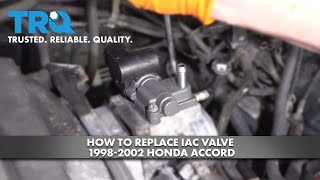
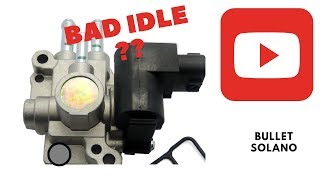
Typical fix: Thoroughly clean the IACV with throttle body cleaner and a small brush, ensuring the rotary valve moves freely. If cleaning doesn't resolve the issue, replace the IACV and its gasket. Many owners report that cleaning is only a temporary fix and replacement is often necessary. 🎬 See this step-by-step guide to replacing a faulty IAC valve.
Est. part cost: $40-$250 - Air in Cooling System / Low Coolant 🟡 Medium Probability The IACV uses coolant temperature to function correctly. Leaks in the cooling system can introduce air pockets that travel to the IACV, causing erratic operation and a 'surging' idle.
How to confirm: Check the coolant level in the radiator (when the engine is cold) and the overflow reservoir. If low, a leak is present. Listen for a gurgling sound from the dashboard area, which indicates air in the heater core. This is a very common suggestion in forums for anyone with a hunting idle.
Typical fix: Top off the coolant and properly bleed the cooling system to remove all air pockets. This involves running the engine with the radiator cap off (or using a spill-free funnel) and the heat on high until no more bubbles appear.
Est. part cost: $15-$30 for Honda Type 2 Coolant - Vacuum Leak 🟡 Medium Probability Aging rubber vacuum hoses become brittle and crack. On V6 models, the intake manifold spacer is a known failure point, often breaking into pieces and creating a massive leak. A leaking EGR valve can also present as a vacuum leak.
How to confirm: Perform a smoke test by introducing smoke into the intake system and watching for where it escapes. Visually inspect all vacuum lines connected to the intake manifold for cracks or loose fittings. For the V6, remove the throttle body to inspect the black plastic spacer for cracks or breaks.
Typical fix: Replace the cracked hose, gasket, or component. For the V6, this may involve replacing the throttle body spacer and its gaskets. Aftermarket aluminum spacers are available which solve the cracking issue permanently.
Est. part cost: $5-$50 for hoses/gaskets, $50-$100 for a new spacer - Dirty Throttle Body ⚪ Low Probability Similar to the IACV, the throttle body bore and plate can accumulate carbon, restricting airflow or preventing the throttle plate from closing completely. The small air ports leading to the IACV within the throttle body are especially prone to clogging.
How to confirm: Remove the air intake tube and visually inspect the throttle body bore and the edges of the throttle plate for black carbon buildup. Pay special attention to the small rectangular port that feeds the IACV.
Typical fix: Clean the throttle body thoroughly with a dedicated throttle body cleaner and a soft cloth or brush. Ensure the IACV ports within the throttle body are also cleaned out completely.
Est. part cost: $10 for cleaner
Rare But Worth Checking
- Faulty EGR Valve: A leaking Exhaust Gas Recirculation (EGR) valve can create a vacuum leak-like symptom, causing a rough or hunting idle. This can be misdiagnosed as an IACV problem. A smoke test may show smoke exiting the top of the EGR valve if its diaphragm has failed.
- Wiring or Connector Issue at IACV: The wiring harness or the 3-pin connector for the IACV can become damaged, causing an open or short in the circuit. This is less common than the valve itself failing but should be checked if a new valve doesn't fix the code. Honda TSB 99-029 describes a known issue on similar-era Civics where the engine harness can rub through on a bracket, causing various electrical issues.
- Faulty Powertrain Control Module (PCM): In very rare cases, the driver circuit within the PCM that controls the IACV can fail. This should only be considered after all other possibilities, including wiring, have been exhaustively ruled out.
Diagnosis Steps

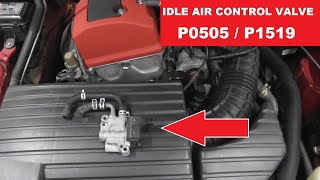
- Check for other codes. If P1519 is present, focus on electrical 🎬 Watch: How to diagnose and fix P0505 and P1519 codes. testing of the IACV first.
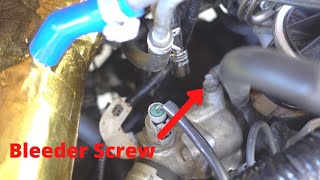
- Inspect coolant level. Ensure the radiator and overflow tank are full. If not, top off and bleed the system before proceeding. A spill-free funnel is highly recommended. 🎬 Watch: How to properly bleed air from your coolant system.
- Visually inspect all vacuum hoses connected to the intake manifold for obvious cracks or disconnections.
- With the engine warm and idling erratically, remove the air intake hose. Carefully place your finger over the lower port inside the throttle body opening (this is the IACV air inlet). If the idle speed drops and stabilizes, the IACV is faulty or stuck open.
- Remove the air intake hose and inspect the throttle body for heavy carbon buildup. Clean if necessary, paying close attention to the IACV ports.
- Remove the Idle Air Control Valve (IACV). It is typically located on the back of the intake manifold (F23A) or the bottom of the throttle body (J30A1), held by two bolts and has two small coolant hoses attached.
- Clean the IACV and its port on the manifold/throttle body using throttle body cleaner. Ensure the rotary valve inside moves without sticking.
- Reinstall the IACV with a new gasket. A leaking old gasket can cause the code to return.
- Reset the ECU by disconnecting the negative battery terminal for 10 minutes.
- Perform an idle relearn procedure: Start the engine with all accessories off and let it warm up completely (until the radiator fan cycles twice). Then, let it idle for at least 5 minutes without touching the throttle.
- If the problem persists, perform a smoke test to definitively check for vacuum leaks, paying close attention to the V6 intake spacer and EGR valve.
- If no vacuum leaks are found, test the IACV circuit. The 3-pin connector should have 12V power on the center pin with the key on. The other two wires are grounds controlled by the ECU. Check for continuity and shorts.
- If all else fails, replacing the IACV with a quality OEM or Denso part is the final step.
Parts You'll Likely Need
- Idle Air Control Valve (2.3L I4)
(OEM #36460-PAA-L21)— This is the most common failure point for P0505. It gets clogged with carbon or fails electrically.
Trusted brands: Honda (OEM), Denso, Standard Motor Products
OEM price range: $180-$250
Aftermarket price range: $40-$90 - Idle Air Control Valve (3.0L V6)
(OEM #16022-P8A-A01 / 16022-P8A-A02 / 16022-P8A-A03)— This is the most common failure point for P0505. The part has been superseded multiple times by Honda. The latest version is 16022-P8A-A03.
Trusted brands: Honda (OEM), Denso (MX136800-1011), Standard Motor Products (AC229)
OEM price range: $150-$220
Aftermarket price range: $50-$100 - IACV Gasket
(OEM #16461-PAA-A00 (I4) / 16176-P8A-A00 (V6))— The gasket must be replaced whenever the IACV is removed to prevent a vacuum leak. It is often sold with the new valve.
Trusted brands: Fel-Pro, Victor Reinz, Honda (OEM)
OEM price range: $5-$10
Aftermarket price range: $2-$5 - Throttle Body Spacer (3.0L V6)
(OEM #17105-P8A-A01)— The original plastic spacer is a known failure point on V6 models, cracking and causing a major vacuum leak.
Trusted brands: Honda (OEM), P2R (Power Rev Racing - Aluminum), aFe Power (Aluminum)
OEM price range: $40-$60
Aftermarket price range: $50-$100
Related Codes That Often Appear With This One
- P1519 — This code specifically indicates an 'Idle Air Control (IAC) Valve Circuit Malfunction.' If P1519 is present with P0505, it points more strongly toward an electrical failure of the IACV or a wiring issue, rather than just a dirty/stuck valve.
- P030x (Misfire Codes) — A severe vacuum leak, such as from the V6 throttle body spacer, can lean out the air-fuel mixture enough to cause random or cylinder-specific misfires alongside the P0505.
Technical Service Bulletins (TSBs) & Recalls
- While no TSB is specific to the Accord for P0505, Honda TSB 99-085 for 1998-2001 V6 Accords addresses code P0401 (EGR Flow) caused by clogged passages, which can present similar rough idle symptoms.
- A TSB for early 2000s Odyssey and Pilot models (which share V6 architecture) notes that a stuck IACV can cause idle fluctuations and code P0505.
Platform-Specific Known Issues
- On V6 models, the plastic throttle body spacer is a very common and unique failure point that directly causes P0505. A video by 'Mr. Jones Automotive Videos' on YouTube clearly shows a broken spacer found during a P0505 diagnosis on a 2002 Accord. Owners often replace it with a more durable aluminum aftermarket version.
- The 6th generation Accord does not have a separate Fast Idle Thermo Valve (FITV) like older Hondas. The FITV's function was integrated into the IACV design around 1996, which can confuse DIYers familiar with older models.
- Some owners on Honda-Tech forums have reported chasing the P0505 code after installing a new aftermarket IACV, only to find the new part was also faulty. Using an OEM or Denso branded valve is highly recommended to avoid this frustration.
Mechanic-Grade Diagnostic Values
- IACV 3-Pin Connector Voltage (Key On, Engine Off) — expected: Pin 2 (YEL/BLK wire): Battery Voltage (approx. 12V). Pin 1 (BLU/BLK wire) and Pin 3 (ORN/BLK wire) are control wires from the ECU.. Failure: No voltage on Pin 2 indicates a power supply issue from the PGM-FI main relay. Incorrect voltage on Pins 1 or 3 can indicate a wiring or ECU issue.
- IACV Coil Resistance (2-wire type, for general reference) — expected: Approximately 10-15Ω between the two terminals.. Failure: A reading significantly outside this range, or an open circuit (infinite resistance), indicates a failed valve coil.
- Continuity from IACV connector to ECU — expected: Less than 1.0 Ω resistance between the IACV connector pins and their corresponding pins at the ECU connector (e.g., Pin B23 on some models).. Failure: High resistance or an open circuit (OL) indicates a broken wire in the harness.
Scan Tool Commands That Help
- Honda Diagnostic System (HDS) or advanced aftermarket scanner: IACV Actuation Test / Idle Adjust — This command attempts to manually open and close the IACV to verify its mechanical and electrical function. However, some aftermarket scan tools may not support this function for this specific vehicle, showing an 'Idle Adjust' function that is not applicable. If the command is available, it's used to confirm if the ECU can control the valve, helping to isolate the fault to the valve itself or the control circuit.
Wiring & Ground Locations
- G101 — The main ECU and sensor ground, typically located on the thermostat housing. On some 6th gen Accords, it may be on the driver's side of the intake manifold.. Corrosion or a loose connection at G101 is a very common Honda issue that can cause erratic sensor readings and incorrect operation of actuators like the IACV, leading to P0505 and other electrical gremlins. It is a critical first check for any unexplained idle or running issue.
- IACV Connector (3-Pin) — Connected to the Idle Air Control Valve, on the back of the intake manifold (I4) or bottom of the throttle body (V6).. This is the primary point for electrical testing. Pin 2 (YEL/BLK) is 12V+ power, Pin 1 (BLU/BLK on some diagrams) is a control line from the ECU, and Pin 3 is the other control line. Checking for power, ground, and signal here is the main electrical diagnostic step.
- ECU Connector B, Pin B23 — At the Powertrain Control Module (PCM/ECU), typically located behind the passenger side kick panel or center console.. This is one of the signal wire terminations for the IACV at the computer. Checking for voltage or continuity at this pin helps determine if a wiring fault exists between the ECU and the IACV, or if the ECU's internal driver has failed.
Real Owner Repair Stories
- KIT'S Auto and Truck Repair YouTube Channel (2000 Honda Accord 3.0L V6) — P0505 code, surging idle only when thoroughly heated up.
❌ Tried (didn't work) Replaced TPS (aftermarket), Replaced IACV (aftermarket), Cleaned throttle body, Replaced MAP sensor (Denso), Replaced throttle body gasket, Replaced EGR valve (aftermarket), Smoke test performed (showed a small leak at the new EGR valve, but was not the primary cause)
✅ What actually fixed it The aftermarket Idle Air Control Valve was faulty out of the box. Replacing it with a known-good used OEM IACV resolved the surging idle and the P0505 code. - ClubCivic.com Forum User (Honda Civic (similar IACV system)) — P0505 code returned after replacing IACV. Idle hovering between 1500-1700 RPM, bogging and jerking.
❌ Tried (didn't work) Cleaning the original IACV, Replacing the IACV with a used part
✅ What actually fixed it The mechanical idle stop screw on the throttle body had been backed out too far during a previous cleaning attempt. Following the service manual procedure to properly set the base idle by turning the screw back in resolved the high idle and cleared the P0505 code. - Honda-Tech Forum User (92 Honda Civic (similar 2-wire IACV circuit)) — OBD1 Code 14 (IACV), extremely low idle at all times.
❌ Tried (didn't work) Cleaned IACV, Replaced IACV twice
✅ What actually fixed it A continuity test revealed a broken wire between the ECU (Pin A9) and the IACV connector. Instead of tracing the break in the harness, the user ran a new, separate wire from the ECU pin to the IACV connector, which permanently fixed the problem. - NHTSA ODI #10195472 — An owner reported that their vehicle was only guaranteed for 80,000 miles, and upon failure, a technician issued codes P0420, P0505, and P1456.
- NHTSA ODI #10533782 — In a report involving a similar Honda model, an owner noted that the check engine light illuminated with codes P0730 and P0505, describing a situation where the vehicle was difficult to control while driving uphill.
"I Checked Everything" — The Actual Cause
- In a documented case, a 2000 Accord V6 passed a smoke test (or showed only a minor, unrelated EGR leak) and had multiple new parts installed, but the P0505 and surging idle persisted. The root cause was a brand new, but faulty, aftermarket IACV. The problem was only solved by replacing it again with a known-good OEM unit.
- A faulty ECU driver circuit can cause P0505 even when the IACV and all wiring test perfectly. This is a rare, last-resort diagnosis where the ECU itself is unable to properly command the IACV, even though the wiring between them is intact.
When the Usual Fixes Don't Work
- While cleaning the IACV is the most common advice, many forum and video repair stories show this to be only a temporary fix, with the problem returning weeks or months later. A significant number of owners report that the only permanent solution was to replace the IACV. Furthermore, many cases document that cheap, aftermarket IACVs were either dead-on-arrival or failed quickly, and the issue was only resolved after installing a genuine OEM Honda/Denso part or a known-good used OEM part.
OEM Part Supersession History
16022-PAA-A01, 16022-PAA-L21→16022-PAA-A02— Standard part revision and consolidation by Honda.
Heads up: The F23A (I4) and J30A1 (V6) engines use different IACV designs. The I4 uses a rotary valve on the back of the intake manifold (e.g., 16022-PAA-A02), while the V6 uses a valve mounted to the bottom of the throttle body (e.g., 16022-P8A-A02). They are not interchangeable.
Model Year Variations Within This Range
- 1998-2002: The primary variation is between the F23A 4-cylinder and J30A1 V6 engines. The I4 IACV is on the intake manifold, while the V6 IACV is on the throttle body. The V6 is uniquely prone to the cracked throttle body spacer issue. Additionally, ULEV (F23A4 engine) vs non-ULEV (F23A1) models may have different ECU programming but generally use the same IACV part for this generation.
Diagnostic Flowchart
Used vs. New Parts: Buying Guide for This Vehicle
When a used part is the smart pick: A used OEM throttle body from a lower-mileage donor car is a smart choice if the original is diagnosed with a worn shaft. A used OEM (Denso) IACV can also be a good option, as it is often more reliable than a new, non-OEM aftermarket part, as demonstrated in multiple repair stories.
Donor-vehicle mileage cap: roughly under 120000 miles for the part to have meaningful remaining life.
What to inspect on the donor part:
- For a throttle body, check for minimal carbon buildup and no scoring on the bore. Wiggle the throttle plate to feel for excessive side-to-side play in the shaft.
- For a used IACV, inspect the electrical connector for corrosion and the coolant ports for heavy scale or blockage.
- Ask the seller if the part was tested or came from a running vehicle without idle issues.
OEM-only on this vehicle (don't cheap out):
- Idle Air Control Valve (IACV) - Aftermarket versions are notoriously unreliable for this vehicle and a common cause of repeat repairs.
Aftermarket brands forum-validated for this vehicle:
- Denso (This is the Original Equipment Manufacturer)
- Standard Motor Products (Often considered a reliable Tier 1 aftermarket supplier)
Brands owners have reported issues with on this vehicle:
- Unbranded, 'white-box' parts from online marketplaces like eBay or Amazon are frequently reported as failing quickly or not working at all.
Real Owner Stories
Aggregated from forums and TSBs cited above. Mileages and costs reflect what owners reported in those sources.
2002 Honda Accord 3.0L V6
Symptoms: Vehicle had a P0505 code.
What fixed it: The diagnosis revealed a broken plastic throttle body spacer, which was causing a large vacuum leak. Replacing the spacer resolved the issue.
Source hint: vehicle_specific_issues section, citing a 'Mr. Jones Automotive Videos' YouTube diagnosis
1998-2002 Honda Accord
Symptoms: The car had a P0505 code and a classic 'hunting' idle where the RPMs would fluctuate up and down.
What fixed it: The owner confirmed the IACV was faulty by blocking its air port inside the throttle body, which stabilized the idle. The implied fix was cleaning or replacing the IACV.
Source hint: Honda-Tech forum thread titled 'P0505 code + high/fluctuating idle'
1998-2002 Honda Accord
Symptoms: The P0505 code and idle problems continued even after installing a brand new aftermarket IACV.
What fixed it: The problem was resolved by replacing the faulty new aftermarket part with a quality OEM or Denso branded IACV.
Source hint: vehicle_specific_issues section, citing reports from Honda-Tech forums
1998 Honda Accord
Symptoms: An owner reported that their vehicle reached 97,596 miles when the maintenance technician issued codes P0420, P0505, and P1456.
What fixed it: While the specific repair was not detailed, the report highlights the common occurrence of P0505 alongside emissions-related codes on high-mileage vehicles.
Source hint: NHTSA ODI #10195472
Related OBD-II Codes
Frequently Asked Questions
My V6 Accord has a P0505 code. I heard about a specific plastic part that fails. What is it?
I replaced the IACV on my Accord with a cheap one from online, but the hunting idle and P0505 code are still there. What's wrong?
My idle is surging up and down, but I'm not sure it's the IACV. What else is a common cause on these Accords?
I'm used to older Hondas. Does my 2000 Accord have a Fast Idle Thermo Valve (FITV) I need to clean for this code?
How do I perform the 'idle relearn' procedure on my Accord after cleaning the throttle body or IACV?
Is there a quick way to test if the IACV is the problem without any special tools?
Are there any official Honda Technical Service Bulletins (TSBs) for code P0505 on the 1998-2002 Accord?
Helpful Videos
Used OEM Parts in Stock

New Aftermarket Parts Available



The information in this article is provided for general reference and educational purposes only. Vehicle specifications, procedures, and part compatibility can vary by production date, trim level, and region. Always consult your vehicle's factory service manual and verify part numbers before purchasing or performing repairs. Safety-critical components such as airbags, seat belts, and braking systems should be installed by a qualified professional.
- Honda Accord:
- 🎬 Helpful Videos
- 🛍️ Shop This Part
- What's Unique About the 1998-2002 Honda Accord
- Symptoms You May Notice
- Most Likely Causes
- Rare But Worth Checking
- Diagnosis Steps
- Parts You'll Likely Need
- Related Codes That Often Appear With This One
- Technical Service Bulletins (TSBs) & Recalls
- Platform-Specific Known Issues
- Mechanic-Grade Diagnostic Values
- Scan Tool Commands That Help
- Wiring & Ground Locations
- Real Owner Repair Stories
- "I Checked Everything" — The Actual Cause
- When the Usual Fixes Don't Work
- OEM Part Supersession History
- Model Year Variations Within This Range
- Diagnostic Flowchart
- Used vs. New Parts: Buying Guide for This Vehicle
- Real Owner Stories
- 2002 Honda Accord 3.0L V6
- 1998-2002 Honda Accord
- 1998-2002 Honda Accord
- 1998 Honda Accord
- Related OBD-II Codes
- Frequently Asked Questions
- 🎟️ Get 5% Off