

P0502 on 1997-2010 Saab 9-5: Vehicle Speed Signal Loss Causes and Fixes
On a 1997-2010 Saab 9-5, code P0502 is almost always caused by a failed ABS control module that is no longer sending a speed signal to the engine computer. Symptoms include an inoperative speedometer and multiple dash lights (ABS, TCS, CEL). The most common fix is to have the original ABS module rebuilt, which costs approximately $150-$300. This is a very common failure on this platform.
- P0502 on a Saab 9-5 is an ABS system problem, not a simple sensor replacement on the transmission.
- The most likely cause is a failed ABS control module, which is a very common issue on this platform.
- Diagnose by scanning the ABS module first. No communication or an internal fault code points directly to the module.
- The most cost-effective repair is to have your existing ABS module rebuilt by a specialist.
- You can drive the car without ABS/TCS while the module is out for repair, but exercise caution as your safety systems will be offline.
What's Unique About the 1997-2010 Saab 9-5
The Saab 9-5's architecture is the key to understanding this code. The Trionic engine management system relies entirely on the Bosch ABS/TCS module for its vehicle speed reading. These specific Bosch 5.3 and 5.4 ABS modules are notoriously prone to internal failure over time due to cracked solder joints on the circuit board, often where the main connector is attached. This makes a failed ABS module the most probable cause for P0502, far more common than on many other vehicles where a simple, inexpensive sensor on the transmission is the culprit.
Generation note: This guide covers the first generation Saab 9-5 (YS3E), including both the original (1997-2005) and the facelifted 'Dame Edna' models (2006-2010). While the fundamental design of the ABS system providing the speed signal remains the same, the specific part numbers for the ABS control module and wheel speed sensors may differ between these years. The ABS module failure is a common issue across the entire model range. Note that some repair services state that modules from 2003-2004 with specific part numbers are not repairable.
Symptoms You May Notice
- Check Engine Light (CEL) is on.
- ABS warning light is on.
- TCS/ESP warning light (a triangle) is on.
- Brake warning light is on.
- Speedometer reads 0 mph or is completely inoperative.
- Cruise control does not work.
- Reduced engine torque or boost pressure (on some models with manual transmission).
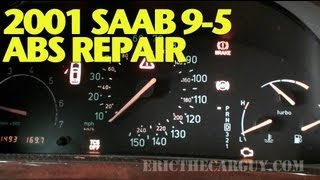
- Symptoms may be intermittent at first, with the lights and speedometer cutting in and out, before failing completely. 🎬 Watch EricTheCarGuy diagnose these exact ABS and speedometer symptoms.
- Replacing the instrument cluster. While a faulty cluster can cause a dead speedometer, it will not set a P0502 code in the engine ECU or trigger ABS/TCS lights.
- Replacing the engine control module (ECU/Trionic). The ECU is simply reporting the lack of a signal it expects to receive. The problem originates upstream at the ABS module or its sensors.
Most Likely Causes
- Failed ABS Control Module 🔴 High Probability The Bosch 5.3 and similar ABS modules used in this era are well-known for developing microscopic cracks in the internal solder joints due to heat cycles and vibration. This interrupts electrical circuits, preventing the module from processing wheel speed data or sending it to the engine ECU. This is the most common cause of a P0502 code on this car.
How to confirm: Use a professional scan tool (like a Tech 2) to check for communication with the ABS module. If the module does not communicate or reports internal fault codes, it has failed. A simple test is to unplug the main electrical connector to the ABS module; if you can then communicate with the engine ECU (when you couldn't before), the ABS module is bad and was crashing the data bus.
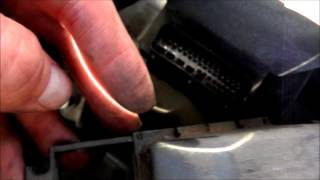
Typical fix: Remove the electronic part of the ABS module and send it to a specialist for rebuilding. This is more cost-effective than buying a new unit. A rebuilt module is plug-and-play and does not require reprogramming. The module is typically held on by six T20 or E5 Torx screws. 🎬 Watch this quick walkthrough of the module removal process.
Est. part cost: $100-$300 for a professional rebuild service from companies like BBA Reman or Module Master. - Failed Wheel Speed Sensor 🟡 Medium Probability Sensors are located at the wheels and are exposed to water, dirt, and potential physical damage. Corrosion of the sensor or its wiring connector is common.
How to confirm: Scan the ABS control module for fault codes. A code will be stored that points to a specific wheel sensor (e.g., 'Front Left Wheel Speed Sensor Circuit Fault'). You can also use live data on a scan tool to monitor the speed of all four wheels while driving; the faulty sensor will not show a reading or will be erratic. A failed wheel speed sensor will typically illuminate the ABS/TCS lights but may not always set a P0502 in the engine computer.
Typical fix: Replace the failed wheel speed sensor. The sensor is typically bolted to the steering knuckle.
Est. part cost: $40-$100 for an aftermarket sensor, $100-$180 for an OEM sensor. - Damaged Wiring or Connectors ⚪ Low Probability The wiring harness leading to the front wheel speed sensors flexes with the suspension and steering, which can cause wires to break over time. The main connector at the ABS module can also develop corrosion. A wiring issue between the ABS module (pin 26) and the ECU (pin 64) can also cause a lone P0502 code.
How to confirm: Visually inspect the wiring harness going to each wheel speed sensor for breaks, chafing, or corrosion at the connector. Check the main connector at the ABS module for clean, tight pins. Perform a continuity test on the signal wire from the ABS module connector to the ECU connector.
Typical fix: Repair the broken section of wire or replace the corroded connector.
Est. part cost: $10-$50 for wiring repair supplies.
Rare But Worth Checking
- Faulty Ignition Switch: A failing electrical portion of the ignition switch can cause intermittent power loss to various modules, including the ABS and instrument cluster, leading to a variety of seemingly unrelated codes and symptoms.
Diagnosis Steps
- Connect an OBD-II scanner and confirm the presence of P0502 in the engine control module.
- Using a more advanced scanner (ideally a Saab Tech 2), attempt to communicate with the ABS/TCS control module.
- If the scanner cannot communicate with the ABS module, or if it reports an 'internal fault' code, the ABS module is almost certainly bad. Proceed to remove it for rebuilding.
- If communication is successful, check for any stored fault codes in the ABS module. Codes for a specific wheel speed sensor will direct you to the faulty sensor.
- If there are no codes in the ABS module, use the scanner's live data function to view the output from all four wheel speed sensors while driving slowly. All four should read consistently. If one reads 0 or is erratic, that sensor or its wiring is the problem.
- If all sensors report speed correctly to the ABS module but P0502 remains in the ECU, this points to an internal fault in the ABS module where it fails to send the final speed signal to the ECU, or a wiring fault between the two modules.
- If a specific sensor is suspected, inspect its wiring and connector for visible damage, corrosion, or breaks before replacing the sensor itself.
- If the ABS module is the suspected cause, it can be removed for repair without opening any brake lines. The car can be driven without the module, but with no ABS, TCS, or speedometer.
Parts You'll Likely Need
- ABS Control Module Rebuild Service
(OEM #Bosch 0 273 004 451, 0 273 004 578, 0 273 004 352 (verify on unit))— This is the most common failure point for this code on the Saab 9-5. The internal electronics fail, cutting off the speed signal to the rest of the car.
Trusted brands: Bosch (Original Unit)
OEM price range: $800-$1200 for a new unit
Aftermarket price range: $100-$300 for a rebuild service - Front Wheel Speed Sensor — The second most likely cause, if diagnostic codes point to a specific sensor failure.
Trusted brands: Bosch, ATE, Genuine Saab
OEM price range: $100-$180
Aftermarket price range: $40-$100
Related Codes That Often Appear With This One
- U0121 — This code means 'Lost Communication with ABS Control Module'. It often appears alongside P0502 and strongly indicates the ABS module itself has failed and is offline.
- P1625 — A Saab-specific code indicating that the ABS module is missing from the vehicle's data bus (P-bus), which is another strong indicator of a failed ABS module.
Platform-Specific Known Issues
- The electronic portion of the ABS module can be removed for repair without opening the hydraulic brake lines, which means no brake bleeding is required 🎬 See how to safely remove the module for repair. for the most common fix. The car can be driven carefully with the module removed, though all ABS/TCS functions will be disabled.
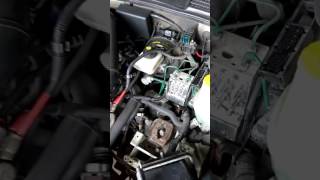
- Accessing the module requires removing the battery and battery tray, and moving the main fuse box aside.
- The module is held on by six Torx screws, often a T20 or an external E5 socket size. These can be difficult to access, especially the lower ones.
Mechanic-Grade Diagnostic Values
- Passive Wheel Speed Sensor Resistance — expected: 800 - 2,000 Ohms. Failure: A reading that is open (infinite resistance), shorted (zero resistance), or fluctuates wildly indicates a failed sensor.
Scan Tool Commands That Help
- Saab Tech 2 or equivalent: Read Live Data (ABS/TCS Module) — Use this function to view the individual speed readings from all four wheels in real-time while the vehicle is moving slowly. This is the definitive way to identify a single faulty wheel speed sensor or its wiring if the ABS module is communicating but still setting faults.
Wiring & Ground Locations
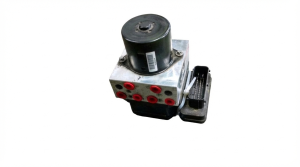
- ABS Control Module (547 or 671 for ESP) — Integrated into the hydraulic unit, located behind the engine bay main fuse box, near the battery.. This is the source of the vehicle speed signal for the ECU. Its failure is the primary cause of P0502.
- Trionic ECU (589) — In the plenum space at the base of the windscreen on the passenger side, under a protective cover.. This is the module that receives the speed signal from the ABS module and sets the P0502 code when the signal is lost.
- G2 / G25 — Main battery grounds. G2 is on the left-hand structural member behind the headlamp. G25 is on the gearbox.. Poor main grounds can cause a host of electrical issues, including module communication errors. While not a direct cause of P0502 alone, ensuring they are clean and tight is a crucial first step in any electrical diagnosis.
- G30 / G31 — Engine bay grounds. G30 is on the side panel in front of the left-hand wheel housing. G31 is on the right-hand structural member behind the headlamp.. These points provide ground for various engine bay components. The ABS module relies on a clean ground connection (via its harness) to operate correctly. Corrosion at these points can contribute to intermittent module faults.
Real Owner Repair Stories
- YouTube user 'HARLEM MACHINES' (2000 Saab 9-3 (system is analogous to the 9-5)) — ABS light, brake warning light, and TCS light were all on.
❌ Tried (didn't work) Replaced both front wheel speed sensors., Performed a visual inspection of all wiring underneath the car.
✅ What actually fixed it Replacing the ABS control module with a used unit purchased from eBay for $100 resolved all the warning lights and the P0502 code. - YouTube channel 'EricTheCarGuy' (2001 Saab 9-5) — ABS, TCS, and Check Engine lights on. Code P1625 (ABS/TCS communication error) was present, which is commonly associated with P0502.
❌ Tried (didn't work) Initial diagnosis pointed away from simple sensors.
✅ What actually fixed it The ABS control module was removed from the vehicle and sent to BBA Remanufacturing for rebuilding. Reinstalling the rebuilt module fixed the problem.
OEM Part Supersession History
Multiple Bosch Part Numbers→N/A - Rebuild Service— Due to the high cost and variety of new units, rebuilding the original module is the standard repair. Many part numbers were used over the production run.
Heads up: It is critical to match the part number on your module if seeking a used replacement. Common Bosch numbers include 0273004223, 0273004451, 0273004578, 0265950372. Always verify the number on your specific unit before ordering a replacement or sending for rebuild.
Model Year Variations Within This Range
- 2002-2010: Later models, especially from 2002 onwards, were increasingly equipped with ESP (Electronic Stability Program) in addition to ABS/TCS. These systems use a more complex control module (e.g., component ID 671) that also processes inputs from a steering angle sensor and a yaw sensor. While the core P0502 failure mechanism (loss of speed signal from the module) is the same, the module itself is a different, more advanced part number.
Diagnostic Flowchart
Other Known Issues on This Vehicle
Issues unrelated to this code that are worth knowing about as an owner of this generation:
- Engine Oil Sludge (B2x5 engines) 🔴 High — Very common on 1999-2003 models due to an inadequate PCV system and long oil change intervals. Can lead to oil starvation and catastrophic engine failure. Less common on later models with the updated PCV kit. (Ref: Saab issued an extended warranty for 1999-2002 models and multiple revisions of the PCV system to mitigate the issue.)
- Direct Ignition Cassette (DIC) Failure 🔴 High — Extremely common failure item across all years. The cassette can fail without warning, causing misfires, stalling, and a no-start condition. Many owners carry a spare. Using incorrect (non-resistor type) spark plugs will destroy a new cassette quickly. (Ref: NHTSA recalls 05V-399 and 06V-410 were issued for 2000-2003 models due to stalling risk.)
- SID (Saab Information Display) Pixel Failure 🟡 Low — Almost guaranteed to happen on 1998-2004 models. The ribbon cable connecting the LCD to the circuit board delaminates, causing lines of pixels or the entire display to become unreadable.
- HVAC Blend Door Arm Failure 🟠 Medium — Common issue where the small plastic arm that controls the blend doors for air distribution breaks, causing loss of control over where air flows (e.g., stuck on defrost). The part is cheap but can be difficult to access for replacement.
Used vs. New Parts: Buying Guide for This Vehicle
When a used part is the smart pick: A used ABS module from a junkyard or online seller is a potentially viable and very cheap option for this repair, as demonstrated by owner success stories. However, it carries the inherent risk that the used part may have the same internal solder joint flaw and could fail in the future. A professional rebuild of your original module is the most reliable long-term solution.
Donor-vehicle mileage cap: roughly under 150000 miles for the part to have meaningful remaining life.
What to inspect on the donor part:
- Match the Bosch part number on the donor module EXACTLY to your original module.
- Visually inspect the main electrical connector port for any bent, broken, or severely corroded pins.
- If possible, source from a seller who guarantees the part was tested or came from a vehicle that did not have ABS/TCS warning lights illuminated.
OEM-only on this vehicle (don't cheap out):
- Not applicable for this repair. A new OEM module is prohibitively expensive and unnecessary when high-quality rebuild services are available.
Aftermarket brands forum-validated for this vehicle:
- For Rebuild Services: BBA Reman, Module Master
- For Wheel Speed Sensors: Bosch, ATE
Brands owners have reported issues with on this vehicle:
- No specific brands are consistently cited as problematic, but for a critical component like the ABS module, choosing an unproven or no-name rebuild service carries a higher risk of failure.
Real Owner Stories
Aggregated from forums and TSBs cited above. Mileages and costs reflect what owners reported in those sources.
Saab 9-5 (1997-2010)
Symptoms: The owner described an intermittent failure where the speedometer would stop working and the ABS warning light would come on.
What fixed it: The problem was identified as a bad solder joint inside the ABS control unit, which was preventing it from processing and sending the vehicle speed signal.
Source hint: Saabclub.fi: P0502
Related OBD-II Codes
Frequently Asked Questions
Can I still drive my Saab 9-5 if I remove the ABS module to send it for repair?
Do I need to bleed the brakes after replacing or repairing the ABS module?
If I buy a rebuilt ABS module, will it need to be programmed to my car?
What specific tools are needed to remove the ABS module on my 9-5?
My speedometer and ABS light are flickering on and off. Is this related to the P0502 code?
How can I tell if the problem is the expensive ABS module or just a cheaper wheel speed sensor?
Besides the Check Engine Light, what other warning lights are typically on with a P0502 code?
Helpful Videos
We Have This Part in Stock


The information in this article is provided for general reference and educational purposes only. Vehicle specifications, procedures, and part compatibility can vary by production date, trim level, and region. Always consult your vehicle's factory service manual and verify part numbers before purchasing or performing repairs. Safety-critical components such as airbags, seat belts, and braking systems should be installed by a qualified professional.
- Saab 9-5:
- 🎬 Helpful Videos
- 🛍️ Shop This Part
- What's Unique About the 1997-2010 Saab 9-5
- Symptoms You May Notice
- Most Likely Causes
- Rare But Worth Checking
- Diagnosis Steps
- Parts You'll Likely Need
- Related Codes That Often Appear With This One
- Platform-Specific Known Issues
- Mechanic-Grade Diagnostic Values
- Scan Tool Commands That Help
- Wiring & Ground Locations
- Real Owner Repair Stories
- OEM Part Supersession History
- Model Year Variations Within This Range
- Diagnostic Flowchart
- Other Known Issues on This Vehicle
- Used vs. New Parts: Buying Guide for This Vehicle
- Real Owner Stories
- Saab 9-5 (1997-2010)
- Related OBD-II Codes
- Frequently Asked Questions
- 🎟️ Get 5% Off