

OBD-II Code C0040: Right Front Wheel Speed Sensor Circuit
The Ultimate 2026 Guide to Diagnosing and Fixing C0040
- Code C0040 disables your ABS and Traction Control, increasing emergency stopping distances by up to 20% on wet surfaces.
- On 2007-2014 GM trucks, an internal break in the sensor wiring pigtail causes the majority of C0040 codes, requiring a $40 harness repair rather than a new sensor.
- For 2013+ Honda models, C0040 indicates a failed $5 brake pedal stopper pad, completely unrelated to the wheel speed sensor.
- Always test for wheel bearing play at the 12 and 6 o'clock positions before replacing a sensor, as a wobbling hub destroys new sensors instantly.
What Does C0040 Mean?

Your vehicle's Anti-lock Brake System (ABS) module detects a missing, erratic, or illogical signal from the right front wheel speed sensor. The computer immediately disables the ABS and stability systems, illuminates the dashboard warning lights, and stores the C0040 trouble code.
Technical definition: The official SAE/ISO definition for C0040 is "Right Front Wheel Speed Sensor Circuit Malfunction." The ABS control module identifies an electrical fault (open, short, or high resistance) in the right front sensor circuit. On certain manufacturers like Honda, this code translates to "Brake Pedal Switch 'A' Circuit Fault."
Can I Drive With C0040?
Yes, But With Caution. You can operate the vehicle, but do so with extreme caution. Your Anti-lock Braking System (ABS), Traction Control, and Stability Control systems are disabled. This increases your stopping distance by up to 20% in panic situations, especially on wet or gravel surfaces, and dramatically raises the risk of losing control during an emergency maneuver. Prompt diagnosis and repair are critical for your safety.
Common Causes

- Internal Wiring Break (No Visible Damage) (Very Common) — Extremely common on GM trucks and SUVs. The copper wire inside the insulation fatigues and breaks from repeated suspension flexing. The outer insulation appears undamaged, resulting in an intermittent code when turning. A 'wiggle test' exposes this. 🎬 Watch: How to perform a wiggle test and repair wiring.
- Damaged or Corroded Wiring/Connector (Very Common) — The wiring harness is exposed to road debris, moisture, and constant movement. Wires chafe through insulation, or connector pins corrode, causing a poor or lost signal.
- Failing Wheel Hub Bearing Assembly (Common) — If the wheel bearing develops excessive play (wobble), it alters the critical air gap between the sensor and the tone ring, causing an erratic signal. A humming or grinding noise while driving confirms this.
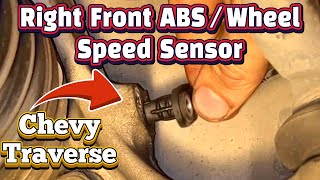
- Failed Right Front Wheel Speed Sensor (Common) — The sensor fails internally from age, heat cycles, or internal short circuits. Being magnetic, they also attract metallic debris that blinds the sensor.
- Damaged Tone Ring or Debris Buildup (Less Common) — The sensor reads a toothed or magnetic ring. If this ring cracks, loses teeth, or is obscured by heavy rust or metallic 'fuzz', it cannot provide a clean signal.
- Faulty ABS Control Module (Rare) — A failed ABS module is the least likely cause. Consider this only after exhaustively testing the sensor, wiring, and hub. It usually triggers multiple wheel speed sensor codes simultaneously.
Symptoms

- ABS and Traction/Stability Warning Lights On — The primary symptom. The ABS, TCS, and ESC lights illuminate and stay on because these systems rely entirely on wheel speed data.
- ABS System Inoperative — During a hard or slippery stop, the wheels lock and skid. The characteristic pulsing of the ABS system is absent.
- Pulsing Brake Pedal at Low Speeds — An erratic signal from a failing sensor or damaged tone ring tricks the ABS module into thinking a wheel is locking up during normal braking, activating the ABS pump unnecessarily.
- Cruise Control Disabled — As a safety measure, the vehicle disables cruise control when an active ABS fault is present.
- Brake Lights Stuck On (Honda Specific) — On 2013+ Hondas, this code points to a brake pedal switch failure. Brake lights stay on, draining the battery, and the vehicle refuses to shift out of Park.
Diagnostic Flowchart

Tap your situation to follow the diagnostic path that matches what you're seeing on this code.
Common Fixes & Costs
- Replace Right Front Wheel Speed Sensor — Parts: $35-$150, Labor: $120-$300, ~1.5 hr book time (DIY)
- Repair or Replace Wiring Harness Pigtail — Parts: $20-$60, Labor: $100-$280, ~2 hr book time (Intermediate)
- Replace Right Front Wheel Hub Bearing Assembly — Parts: $120-$450, Labor: $300-$900, ~2.5 hr book time (Intermediate)
- Clean Sensor Tip and Tone Ring — Parts: $5, Labor: $80-$150, ~1 hr book time (DIY)
- Replace ABS Control Module — Parts: $500-$1500, Labor: $300-$800, ~2 hr book time (Professional)
Used vs. New Parts: Buying Guide
When a used part is worth it: Buying used wheel speed sensors or hub assemblies is strongly discouraged due to safety risks and high labor costs. Only consider a used ABS control module if your vehicle has high mileage and the new part is prohibitively expensive.
Donor-vehicle mileage cap: roughly under 20000 miles for the part to have meaningful remaining life.
Donor quality checklist:
- Avoid used wear items like bearings and sensors entirely.
- Match ABS module part numbers exactly and ensure the donor vehicle lacked ABS issues.
- Prefer donors from dry, salt-free climates to minimize corrosion.
Decision logic:
- If The required part is a wheel speed sensor or wheel hub bearing. → Always buy new from a reputable OEM or aftermarket brand (Timken, SKF, MOOG, NTK, Bosch).
- If The required part is a very expensive ABS control module. → A used module from a low-mileage donor is cost-effective, but verify warranty and programming requirements.
Warranty tradeoff: Used parts offer 30-90 day warranties covering only the part. New aftermarket parts offer 1-year to lifetime warranties. New OEM parts carry 1-2 year warranties.
Worst-case if a used part fails: $300-$900 if a used hub or sensor fails, requiring you to pay labor twice.
What Happens If You Wait — Timeline
- 0-2 Weeks: Code C0040 stores. ABS and Traction Control warning lights illuminate. Safety systems disable. Standard hydraulic brakes function normally, but emergency handling is compromised. (MPG impact: 0%% · Added cost: $0)
- 1-3 Months (If caused by a failing bearing): A faint humming or droning noise begins between 40-60 mph, changing pitch when turning. Bearing wear is now audible. (MPG impact: 0-1%% · Added cost: $0)
- 3-6 Months (If caused by a failing bearing): Bearing noise progresses to a distinct grinding. Significant internal wear causes uneven tire wear and stresses the steering knuckle. (MPG impact: 1-3%% · Added cost: $150-$400 (for a new tire due to uneven wear))
- 6+ Months (If caused by a failing bearing): Catastrophic bearing failure is imminent. The bearing seizes or allows the wheel to separate from the vehicle, causing a complete loss of control. (MPG impact: 3-5%% · Added cost: $1,000-$2,500+ (Cost to replace damaged steering knuckle, CV axle, and hub assembly))
Cost of Not Fixing It
- Immediate: ABS, Traction Control, and Stability Control systems disable. Increased risk of wheel lock-up and loss of control during panic braking. (Added cost: N/A (Safety risk))
- 1-6 months: If caused by a failing wheel bearing, continued driving destroys the bearing, causing uneven tire wear and damaging the steering knuckle. (Added cost: $400-$1000+)
- 6+ months: Catastrophic failure of a neglected wheel bearing causes the wheel to separate from the vehicle while driving, leading to a severe accident. (Added cost: $1500-$5000+)
Diagnosis Steps
- Read Codes and Analyze Live Data
Use an ABS-capable scanner to confirm C0040. Access the live data stream and drive slowly in a straight line (under 15 mph). Monitor all four wheels. If the right front sensor reads 0 mph, is erratic, or lags behind the others, the fault is isolated to that corner.
Tools: ABS-Capable OBD-II Scanner (Beginner) - Perform a Visual Inspection and Wiggle Test
Raise the front end and remove the right front wheel. Trace the sensor wire from the hub into the engine bay. Look for chafing or corrosion. Gently tug on the wire; if it stretches 'like a rubber band', it is broken internally. Flex the harness while watching live data to spot intermittent drops.
Tools: Jack, Jack Stands, Lug Wrench, Flashlight (Intermediate) - Inspect Wheel Bearing and Tone Ring
Grab the tire at the 12 and 6 o'clock positions and rock it back and forth. Any perceptible play or clunking indicates a worn wheel bearing. Visually inspect the tone ring for cracks, missing teeth, or heavy rust.
Tools: Jack, Jack Stands (Intermediate) - Test Sensor Resistance (Passive Sensors Only)
Disconnect the sensor. Set your multimeter to Ohms (Ω) and measure across the sensor's two pins. A healthy passive sensor reads between 800-2,500 Ohms. An open circuit (OL) or short (0 Ω) confirms a bad sensor. Do not perform this on 3-wire active sensors.
Tools: Digital Multimeter (Intermediate) - Test Sensor AC Voltage Output
For 2-wire passive sensors, set your multimeter to AC Volts (V~). Backprobe the sensor wires and spin the wheel by hand at one revolution per second. A good sensor generates a minimum of 100-200mV AC. No voltage points to a failed sensor or excessive air gap.
Tools: Digital Multimeter, Backprobe Pins (Advanced) - Test the Wiring Harness Continuity
With the sensor and ABS module disconnected, check for continuity on both wires from the sensor connector to the module connector. Check each wire for a short to ground and a short to power.
Tools: Digital Multimeter, Vehicle-Specific Wiring Diagram (Advanced) - Advanced: Scope the Sensor Signal
Backprobe the sensor signal wires at the ABS module with an oscilloscope. Spinning the wheel produces a clean sine wave (passive) or square wave (active). Gaps or noise definitively identify a sensor, ring, or air gap problem.
Tools: Oscilloscope, Backprobe Pins (Professional)
When This Code Triggers (Freeze-Frame Conditions)
- Vehicle Speed: 15-45 mph (The fault registers once the vehicle exceeds a 10-15 mph threshold where the ABS module actively compares all four wheel speed signals.)
- Right Front Wheel Speed Signal: 0 mph or Erratic (While other wheels report plausible speed, the right front sensor reports 0 or drops out intermittently.)
Related Codes
- C0035 — Identical fault for the Left Front Wheel Speed Sensor. If C0035 and C0040 appear together, suspect a shared power/ground issue or faulty ABS module, not simultaneous sensor failures.
- C0045 / C0050 — Codes for the Left Rear and Right Rear sensors. Multiple random wheel speed codes point to a faulty ABS control module.
- C0040 with Symptom Bytes (e.g., -0F, -18, -5A) — 'C0040-0F' (Erratic Signal) points to a damaged tone ring or bad bearing. 'C0040-18' (Signal Amplitude Low) suggests a large air gap. 'C0040-5A' (Implausible Signal) means the reading contradicts the steering angle sensor.
- U0073 — 'Control Module Communication Bus A Off'. Seeing this alongside C0040 indicates a broader network problem where the ABS module is dropping off the CAN bus.
Climate & Environmental Factors
- Cold Climates / Road Salt: Salt and moisture accelerate corrosion of wiring connectors and sensor mounting points. Rust 'jacking' pushes the sensor away from the tone ring, increasing the air gap and killing the signal.
- Off-Road / Rough Roads: Harsh vibrations and suspension articulation fatigue and break the sensor wiring internally. Debris physically damages the exposed wiring harness.
How to Talk to a Mechanic About This Code
Say this: "I have an ABS light on and my scanner shows code C0040 for the right front wheel speed sensor circuit. I'd like to book a diagnostic appointment. Please check for a bad wheel bearing or wiring issue before replacing the sensor itself."
This signals you are an informed consumer. It directs the shop to perform a full diagnosis rather than just replacing the most obvious part, showing you understand the code points to a circuit fault.
Avoid saying:
- 'My ABS light is on, can you just fix it?'
- 'I need a new wheel speed sensor, how much is it?'
- 'Just do whatever you think is best.'
Questions to ask before authorizing the repair:
- Did you check for play in the wheel bearing?
- Did you perform a resistance or voltage test on the sensor and check the live data?
- Did you inspect the wiring harness for damage or perform a wiggle test?
- What is the warranty on the parts and labor for this repair?
Where to Take It: Dealer vs Independent vs Chain
- Dealer:
Recommended if you suspect a manufacturer-specific quirk or if other shops failed to diagnose the issue. Otherwise, an independent shop is more cost-effective.
Best for: Vehicles under warranty., Complex manufacturer-specific quirks (e.g., Honda brake switch issue)., Diagnosing rare ABS module failures requiring proprietary software.
Downsides: Highest labor rates., May replace a full hub assembly when only a sensor or wire is needed. (Typical cost: +50% vs. baseline) - Independent Shop:
Best fit for the majority of C0040 repairs. Find a well-reviewed shop with ASE-certified technicians.
Best for: Most C0040 cases on out-of-warranty vehicles., Diagnosing common failures like sensors, wiring, and wheel bearings., Better value for labor costs.
Downsides: Diagnostic capabilities vary. Ensure they have modern scan tools and ABS experience. (Typical cost: +0% vs. baseline) - Chain Shop:
AVOID for initial diagnosis of C0040, as they frequently miss wiring or bearing issues. Acceptable only for a straightforward, pre-diagnosed sensor swap.
Best for: If the diagnosis is already confirmed to be a simple, bolt-on sensor replacement.
Downsides: Technician skill varies dramatically., Often lack advanced diagnostic tools for complex wiring or intermittent faults., High pressure to upsell unnecessary repairs. (Typical cost: -10% vs. baseline)
When to Walk Away From the Repair
If the total estimated repair cost exceeds 40-50% of your car's private-party value, seriously consider selling or trading in the vehicle instead of repairing it.
- Car worth $4000, fix is $2000: Walk away. The repair cost is 50% of the car's value, and other age-related failures are likely.
- Car worth $12000, fix is $900: Fix it. The repair is well below the threshold and restores a critical safety system.
- Car worth $2500, fix is $1500: Walk away. The repair cost is 60% of the vehicle's value, making it a poor investment.
What Scan Tool You Need for This Code

Minimum: A scanner that reads and clears ABS/Chassis ('C') trouble codes and displays live wheel speed sensor data. A basic engine-only code reader will NOT see code C0040.
A basic $20 scanner only reads engine ('P') codes and cannot access the ABS module. Without live data from all four wheels, you are guessing at the problem.
Budget: BlueDriver Pro (~$99) — Connects to your smartphone via Bluetooth. Reads and clears ABS codes and graphs live data from all four wheel speed sensors, essential for diagnosis.
Mid-range: Foxwell NT510 Elite (~$180) — A handheld unit offering full-system diagnostics and ABS live data. Features bi-directional control, allowing you to command the ABS pump and valves to test function.
Professional: Autel MaxiCOM MK808 / MaxiCheck Pro (~$450-600) — Provides professional-level diagnostics with extensive bi-directional controls. Performs advanced functions like ABS automated bleeding after component replacement.
Rent vs buy: Auto parts stores loan basic OBD-II scanners, but these rarely read ABS codes. Buying a budget ABS-capable scanner is a necessary investment for diagnosing C0040.
How to Clear the Code After You Fix It
- Perform the physical repair.
- Use an ABS-capable OBD-II scan tool to erase the C0040 fault code from the ABS module.
- Perform a short test drive to confirm the fix.
Drive cycle (~10 minutes): Start the vehicle, drive in a straight line, and accelerate smoothly over 20 mph. The ABS module performs its self-test immediately. A short trip with a few turns confirms the repair.
Readiness monitors affected: This is a chassis code and does not affect emissions readiness monitors.
Watch out for:
- Using a basic engine scanner that cannot access or clear ABS module codes.
- Clearing the code without repairing the physical fault; the code returns instantly at 15 mph.
Will This Fail Emissions / State Inspection?
No — by itself this code doesn't fail OBD inspection (but it can keep readiness monitors from setting, which causes a separate fail).
- California: An illuminated ABS light does not fail the OBD-II smog test, but it fails the concurrent vehicle safety inspection.
- New York: An illuminated ABS warning light is immediate grounds for failing the annual safety inspection.
- Texas: The ABS warning light must illuminate during the bulb check and turn off. If it stays on, the vehicle fails the safety inspection.
Most Commonly Affected Vehicles
- Chevrolet / GMC Silverado, Sierra, Tahoe, Suburban, Equinox, Impala (2003-2014) — Notorious for internal wiring harness breaks. The wires snap from repeated flexing with no visible external damage. Perform a wiggle test before replacing sensors.
- Honda Accord, Civic, CR-V, City, Jazz (2013-2019) — CRITICAL: On these models, C0040 means 'Brake Lamp Switch Failure.' Do not diagnose the wheel speed sensor. Replace the disintegrated plastic stopper pad under the brake pedal.
- Ford F-150, Explorer (2009-2014) — The integrated hub/sensor/tone ring assembly is a frequent failure point. Check for wheel bearing play immediately.
- Dodge / Ram Ram 1500/2500 (2006-2012) — Corrosion heavily affects the sensor mounting point, increasing the air gap. The wiring harness is also a frequent culprit.
- Hyundai Creta, i20, Venue, Elantra (2015-2021) — Higher-than-average failure rate for the physical front wheel speed sensors. Diagnosis typically points straight to a faulty sensor.
- Nissan Altima, Titan (2007-2017) — Code C0040 points to standard failures in the right front wheel speed sensor circuit (sensor, wiring, hub).
- BMW 3-Series (E90), X3 (E83), X5 (E70) (2006-2013) — Often triggered by rust 'jacking' the sensor out of the knuckle or a failing wheel bearing. Tone rings also delaminate or crack.
- Jeep Grand Cherokee (WK), Wrangler (JK) (2005-2018) — Off-road use accelerates wear on the sensor and wiring. The harness is frequently damaged by debris or suspension articulation.
Manufacturer-Specific Notes
- General Motors (Chevrolet, GMC, Pontiac, etc.): The #1 cause is an internal break in the pigtail harness near the sensor. The EBCM intentionally cuts the 12-volt reference to the sensor if it detects a fault, so measuring 0 volts at the harness does not guarantee a broken wire to the module.
- Honda: CRITICAL: On 2013+ models, C0040 is defined as 'Brake Lamp Switch Failure (Stuck On)'. It is caused by a brittle plastic 'stopper' pad on the brake pedal arm disintegrating, keeping the switch plunger extended.
- Ford: On some models, C0040 associates with a 'Brake Pedal Switch A' fault. For trucks like the F-150, the integrated hub/sensor/tone ring assembly is the most common failure point.
Real Owner Stories
2012 Chevy Impala with Intermittent ABS Light
The ABS and Traction Control lights flashed on and off specifically when turning the steering wheel. The scanner showed code C0040.
What they tried:
- Initially suspected a faulty wheel speed sensor.
- Performed a 'wiggle test' on the wiring harness leading to the right front sensor while watching live scanner data.
- Stretching the wire revealed it felt 'like a rubber band,' indicating a severed internal copper wire despite intact outer insulation.
Outcome: The owner spliced in a new short wiring harness pigtail. After installation, the ABS light stayed off permanently.
Lesson: On GM vehicles, an internal wiring break is the most common cause of C0040. Always perform a 'wiggle test' by flexing the harness before replacing the more expensive sensor or hub.
2015 Honda CR-V with C0040 and Brake Lights Stuck On
The ABS, VSA, and power steering warning lights illuminated. The brake lights stayed on when the car was off, and the shifter was locked in Park.
What they tried:
- Scanned code C0040. Initial searches pointed to the right front wheel speed sensor.
- Honda-specific forums revealed C0040 means 'Brake Lamp Switch Failure' on this platform.
- Inspected the brake pedal and found shattered blue plastic fragments on the floor mat.
Outcome: The owner replaced the disintegrated brake light switch stopper pad (Honda P/N 46505-SA5-000), a $5 part. All warning lights extinguished immediately.
Lesson: For 2013+ Hondas, C0040 is almost always a brake pedal switch issue. Check your floorboards for broken plastic before touching a wheel speed sensor.
2010 Ford F-150 with Grinding Noise and C0040
ABS light illuminated with code C0040, accompanied by a humming noise from the front right wheel that turned into a grind when turning left.
What they tried:
- Replaced the right front wheel speed sensor, but the code and noise remained.
- Watched live scanner data, showing erratic right front wheel speed.
- Jacked up the front right wheel and checked for play at 12 and 6 o'clock. Found significant wobble.
Outcome: The root cause was a failed wheel hub bearing assembly. The excessive play damaged the integrated magnetic tone ring. Replacing the entire hub assembly fixed the noise and the code.
Lesson: A humming or grinding noise accompanying C0040 strongly points to a failing wheel bearing. Always check for wheel play, as a bad bearing quickly destroys a new sensor.
How to Prevent This Code From Triggering
- Apply Dielectric Grease to Connectors (Whenever the connector is disconnected) — Dielectric grease blocks moisture and road salt from entering the electrical connector, preventing pin corrosion that causes high resistance and signal loss.
- Inspect and Clean Sensor and Wiring (Every 5,000-7,500 miles (during tire rotation)) — Visual inspections spot chafing wiring or debris buildup. Wiping metallic 'fuzz' off the magnetic sensor tip prevents signal interference.
- Address Wheel Bearing Noise Promptly (Immediately upon hearing humming/grinding noise) — A humming bearing creates excess play that alters the critical air gap for the wheel speed sensor, triggering C0040. Ignoring it leads to catastrophic hub failure.
Frequently Asked Questions
What's the #1 mistake when diagnosing C0040?
The biggest mistake is immediately replacing the sensor without testing. An internal wiring break or bad wheel bearing causes this code just as often. Throwing parts at it wastes money.
My brake lights are stuck on and I have a C0040 code. What's going on?
On 2013+ Hondas, C0040 indicates a 'Brake Lamp Switch Failure', not a wheel speed sensor issue. Check the driver's floorboard for broken plastic pieces from a disintegrated brake pedal stopper pad. Replace the $5 pad to fix the issue.
Can I just reset the C0040 code and keep driving?
Resetting the code is a temporary measure. The fault is physical or electrical, so the code returns as soon as the ABS module runs its self-test at 10-15 mph. You must repair the underlying issue.
Is it safe to drive with code C0040?
The vehicle brakes normally under standard conditions, but emergency safety systems are disabled. Your risk of wheel lock-up and loss of control during panic braking is significantly higher. Drive cautiously until repaired.
Can a bad alignment cause a C0040 code?
A bad alignment itself does not trigger C0040. However, a severely worn wheel bearing causes both alignment issues and the C0040 code by creating excessive hub wobble.
Do I need a special scanner to read this code?
Yes, basic $20 OBD-II scanners only read engine codes. You need an ABS-capable scanner to read 'C' (chassis) codes and view live wheel speed data.
What's the difference between a passive and active wheel speed sensor?
Passive sensors are 2-wire magnetic pickups generating AC voltage that increases with speed. Active sensors use 2 or 3 wires, require module power, and produce a digital square wave capable of reading down to 0 mph.
Key Takeaways
- Code C0040 disables your ABS and Traction Control, increasing emergency stopping distances by up to 20% on wet surfaces.
- On 2007-2014 GM trucks, an internal break in the sensor wiring pigtail causes the majority of C0040 codes, requiring a $40 harness repair rather than a new sensor.
- For 2013+ Honda models, C0040 indicates a failed $5 brake pedal stopper pad, completely unrelated to the wheel speed sensor.
- Always test for wheel bearing play at the 12 and 6 o'clock positions before replacing a sensor, as a wobbling hub destroys new sensors instantly.
Helpful Videos
![Active ABS Wheel Speed Sensor Testing and Wiring Repair [09 Silverado]](https://img.youtube.com/vi/ErbK7RqNhXw/mqdefault.jpg)

The information in this article is provided for general reference and educational purposes only. Vehicle specifications, procedures, and part compatibility can vary by production date, trim level, and region. Always consult your vehicle's factory service manual and verify part numbers before purchasing or performing repairs. Safety-critical components such as airbags, seat belts, and braking systems should be installed by a qualified professional.
- 🎬 Helpful Videos
- What Does C0040 Mean?
- Can I Drive With C0040?
- Common Causes
- Symptoms
- Diagnostic Flowchart
- Common Fixes & Costs
- Used vs. New Parts: Buying Guide
- What Happens If You Wait — Timeline
- Cost of Not Fixing It
- Diagnosis Steps
- When This Code Triggers (Freeze-Frame Conditions)
- Related Codes
- Climate & Environmental Factors
- How to Talk to a Mechanic About This Code
- Where to Take It: Dealer vs Independent vs Chain
- When to Walk Away From the Repair
- What Scan Tool You Need for This Code
- How to Clear the Code After You Fix It
- Will This Fail Emissions / State Inspection?
- Most Commonly Affected Vehicles
- Manufacturer-Specific Notes
- Real Owner Stories
- 2012 Chevy Impala with Intermittent ABS Light
- 2015 Honda CR-V with C0040 and Brake Lights Stuck On
- 2010 Ford F-150 with Grinding Noise and C0040
- How to Prevent This Code From Triggering
- Frequently Asked Questions
- What's the #1 mistake when diagnosing C0040?
- My brake lights are stuck on and I have a C0040 code. What's going on?
- Can I just reset the C0040 code and keep driving?
- Is it safe to drive with code C0040?
- Can a bad alignment cause a C0040 code?
- Do I need a special scanner to read this code?
- What's the difference between a passive and active wheel speed sensor?
- Key Takeaways
- 🎟️ Get 5% Off