

P0500 on 1998-2010 Saab 9-5: Vehicle Speed Signal Fault Causes and Fixes
On a 1998-2010 Saab 9-5, code P0500 is almost always caused by a faulty ABS control module or a bad wheel speed sensor. The speedometer will likely not work and the ABS/TCS lights will be on. Expect to pay for a rebuilt ABS module (~$125-$350) or a new wheel speed sensor (~$40-$100). This is a very common and well-documented issue for this platform.
- P0500 on a Saab 9-5 is an ABS system fault, not a transmission sensor fault.
- The most common causes are a failed ABS control module or a bad wheel speed sensor.
- Diagnosis requires a scan tool that can read ABS codes; a simple engine code reader is insufficient.
- Rebuilding the existing ABS module is a common and cost-effective repair.
- Symptoms include a dead speedometer, ABS/TCS warning lights, and no cruise control.
What's Unique About the 1998-2010 Saab 9-5
The critical thing to understand about a P0500 on a Saab 9-5 is that it's an ABS system problem, not a transmission sensor issue. The vehicle speed signal originates entirely from the ABS/TCS module, which is a known failure point on this platform. Owners often find that the root cause is not a sensor, but the electronic control module for the ABS system itself, which can suffer from internal electronic faults over time, such as failing solder joints or internal component failure. Diagnosing this code requires checking for ABS-specific codes (C-codes or U-codes), not just engine codes, using a scanner with Saab-specific capabilities like a Tech 2.
Generation note: The 1998-2010 Saab 9-5 covers the first generation (YS3E, 1998-2005) and its significant facelift (2006-2010). While the fundamental design of using the ABS system for vehicle speed is the same, the specific ABS module (e.g., Bosch 5.3, 5.7, or other versions) may differ. The Bosch 5.3 module is common on 1999-2002 models. The diagnostic approach and common failure points (ABS module, wheel speed sensors) are consistent across the entire year range.
Symptoms You May Notice
- Check Engine Light illuminated.
- ABS and/or TCS (Traction Control System) warning lights on the dashboard.
- Speedometer is inoperative or works erratically.
- Cruise control does not function.
- Automatic transmission may shift harshly or erratically.
- The 'distance to empty' function may be disabled.
- Odometer may not accumulate mileage.
- Intermittent failure when hot; symptoms appear after 15-30 minutes of driving and disappear when the car cools down, a classic sign of failing solder joints in the ABS module.
- Replacing the instrument cluster. While a faulty speedometer gauge is possible, it is very rare. The lack of a signal is almost always the root cause, not the gauge itself.
- Looking for a Vehicle Speed Sensor (VSS) on the transmission. On the Saab 9-5, there is no transmission-mounted VSS that provides the primary speed signal to the ECM; the signal comes from the ABS system.
Most Likely Causes
- Faulty ABS Control Module 🔴 High Probability The electronic ABS control module, typically a Bosch 5.3 unit on earlier models, is a well-documented, common failure item on Saabs of this era. Internal solder joints or electronic components fail over time due to heat and vibration, leading to a loss of communication or function. The solder joints for the power and ground pins are particularly common failure points.
How to confirm: Scan the ABS system for codes. Codes like 'U2105' (Lost Communication) or a general inability to communicate with the ABS module strongly point to a failed module. A simple field test is to unplug the main electrical connector from the ABS module with the key off; if communication with the engine control module is restored, the ABS module is faulty. If wheel speed sensors are confirmed to be working via live data, the module is the primary suspect. The module can be sent to a specialist for testing and rebuilding.
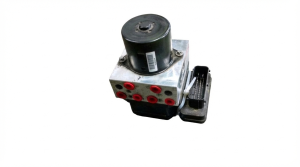
Typical fix: Remove the electronic portion of the ABS module (leaving the hydraulic pump in place) and send it to a specialized repair service (e.g., BBA Reman, ModuleMaster, Cheap-ABS.com) for rebuilding. This is often more cost-effective than a new unit and does not require bleeding the brakes. The removal process involves taking out the battery and battery tray for access and removing six T20 Torx screws.
Est. part cost: $125-$350 for a rebuild service. - Failed Wheel Speed Sensor 🟡 Medium Probability Sensors are exposed to the elements at the wheel hubs and can fail due to corrosion, physical damage from road debris, or internal electronic failure. The wiring leading to the sensor is also vulnerable.
How to confirm: Use a scan tool capable of reading live data to monitor the output from all four wheel speed sensors while driving. A sensor that reads 0 mph while the others are working, or provides an erratic signal, is faulty. A visual inspection of the sensor and its wiring for damage or corrosion is also necessary. With a multimeter, a passive sensor should show a resistance between 800-2000 ohms. When spinning the wheel, it should generate a small AC voltage signal, typically above 0.1-0.25V AC.
Typical fix: Replace the faulty wheel speed sensor. They are located at each wheel hub and are often secured by a single bolt.
Est. part cost: $40-$100 per sensor for aftermarket, $80-$150 for OEM. - Damaged Wiring or Connectors ⚪ Low Probability The wiring harnesses to the wheel speed sensors can become brittle, chafed, or corroded over time, especially the sections near the suspension and wheels. The main connector at the ABS module can also develop corrosion. A break in the circuit to the ground at pin 19 of the ABS module connector will disable the system and prevent communication.
How to confirm: Visually inspect the wiring harness leading to each wheel speed sensor for breaks, chafing, or corrosion. Check the main connector at the ABS module for corrosion, moisture, or bent/loose pins. Perform a continuity test on the sensor wiring from the sensor connector to the corresponding pins at the ABS module connector if a break is suspected.
Typical fix: Repair the damaged section of the wiring harness or replace the connector pigtail.
Est. part cost: $10-$50 for wiring repair supplies.
Diagnosis Steps
- Connect a high-quality OBD-II scanner that can read manufacturer-specific codes for all modules (Engine, ABS, etc.), such as a Tech 2 or equivalent.
- Scan for codes in both the Engine (ECM) and ABS modules. Do not rely only on the P0500 code. Note any 'C' or 'U' codes. The Saab WIS specifically advises checking for DTCs in the ABS module first.
- If specific wheel speed sensor codes (e.g., C0040) are present, start by inspecting that sensor and its wiring.
- If no specific wheel sensor codes are present, use the scanner's live data function to view the speed signal from all four wheel speed sensors simultaneously while driving. A Saab-specific tool may list this parameter as "Vehicle Speed (Wire from ABS)".
- If one sensor reads differently from the others or drops out, that sensor or its wiring is the likely culprit.
- If all wheel speed sensors provide a clean, consistent signal, but P0500 and possibly U-codes (like U2105 or P1625) are present, the ABS control module is the most likely cause.
- Perform a simple module failure test: turn the ignition off and unplug the large electrical connector at the ABS module. Turn the key on and attempt to communicate with the ECM again. If communication is restored, the ABS module has failed internally.
- Inspect the main electrical connector at the ABS module for any signs of corrosion, moisture, or damage. Also check main chassis ground points, such as G2 (behind headlamp) and G25 (on gearbox), for corrosion or looseness.
- If the ABS module is suspected, remove the electronic portion of the module and send it for professional testing and repair. This avoids opening the hydraulic brake lines.
Parts You'll Likely Need
- ABS Control Module (Rebuild Service)
(OEM #Bosch P/N often starts with 0 273, e.g., 0273004451 for a Bosch 5.3 unit. Other numbers include 0273004514, 0273004701, 5060462.)— This is the most common point of failure for this code on the Saab 9-5. The electronic module fails internally, cutting off the speed signal to the rest of the car.
Trusted brands: Bosch (Original), BBA Reman (Rebuilder), ModuleMaster (Rebuilder), Cheap-ABS.com (Rebuilder)
OEM price range: $800-$1200 for new (if available)
Aftermarket price range: $125-$350 for a rebuild service. - ABS Wheel Speed Sensor
(OEM #Front: 5390752, 4686648, 4909966. Rear may differ.)— The second most common cause, these sensors provide the raw data to the ABS module. They can fail from exposure and age.
Trusted brands: Bosch, ATE, Delphi, Standard Motor Products (SMP), Professional Parts Sweden
OEM price range: $80-$150
Aftermarket price range: $40-$100
Related Codes That Often Appear With This One
- U2105 — This Saab-specific code means 'Lost Communication with ECM/PCM' or a similar communication failure. When the ABS module fails internally, it often stops communicating on the vehicle's data bus, triggering this code alongside P0500.
- C0035 - C0050 — These are chassis codes (C-codes) that correspond to specific wheel speed sensor circuits (e.g., C0040 for Right Front Wheel Speed Sensor). They will be stored in the ABS module and are crucial for pinpointing which sensor or circuit is at fault. A standard engine code reader will not see these.
- P1625 — Similar to U2105, this code indicates a communication error between the ABS unit and the Powertrain Control Module (PCM). It is frequently seen when the ABS module fails and is a strong indicator that the module itself is the problem.
Platform-Specific Known Issues
- The high failure rate of the Bosch ABS control module is a widely documented issue in the Saab community. The failure is almost always electronic, not mechanical, making a rebuild a viable and common solution.
- Owner experiences frequently confirm that sending the module for a rebuild is a permanent and cost-effective fix. One owner reported a dealer quote of $3,600 for a new throttle body and ABS unit, but fixed the issue by having the original ABS module tested and rebuilt for a fraction of the cost.
Mechanic-Grade Diagnostic Values
- Passive Wheel Speed Sensor Resistance — expected: 800 - 2,000 Ohms. Failure: A reading of 0 Ohms (short) or infinite/OL (open circuit) indicates a failed sensor.
- Passive Wheel Speed Sensor AC Voltage Output — expected: >0.1V to 0.25V AC (minimum) while spinning the wheel by hand. Failure: No voltage or significantly lower voltage suggests a weak or dead sensor.
- ABS Module Main Power Pins Voltage — expected: Battery Voltage (approx. 12.6V KOEO). Failure: No voltage indicates a problem with the main fuses (often a 60A fuse) or the power wiring to the module.
Scan Tool Commands That Help
- Saab Tech 2 / Equivalent: Read DTCs in ABS/TCS Module — This is the first and most critical step. The P0500 in the ECM is a secondary code; the primary fault (e.g., a specific wheel sensor code like C0040 or a communication code like U2105) will be stored in the ABS module.
- Saab Tech 2 / Equivalent: Live Data > Vehicle Speed (Wire from ABS) — Use this to monitor the final speed signal that the ABS module is sending out to the ECM and instrument cluster. If the individual wheel speeds look correct but this signal is zero or erratic, it points towards an internal module fault.
- Saab Tech 2 / Equivalent: Live Data > Wheel Speed Sensors (FR, FL, RR, RL) — Monitor all four wheel speed signals simultaneously while driving to identify a sensor that is reading incorrectly or dropping out compared to the others.
Wiring & Ground Locations
- ABS Module Connector (Generic Bosch 5.3) — On the ABS module itself, located under the main fuse box behind the battery.. This is the central point for testing. A generic pinout is: Pins 1/2 (RR Sensor), 4/5 (FR Sensor), 6/7 (FL Sensor), 8/9 (RL Sensor), 17/18 (Battery Power), 16/19 (Grounds). Testing sensor circuits here can quickly determine if a fault is in the sensor/wiring or the module itself.
- Ground Point G2 — On the left-hand structural member, behind the headlamp, near the battery.. This is a primary battery ground point. Corrosion or a loose connection here can cause widespread electrical issues, including problems with control modules like the ABS.
- Ground Point G25 — Directly on the gearbox. A main 25mm² battery cable connects here.. This is the main ground for the powertrain. A poor connection can lead to erratic sensor readings and module behavior.
- Ground Point G30 — In the engine bay on the side panel, in front of the left-hand wheel housing.. Wiring diagrams show crimp connections for the ABS system branching off near this ground point, making it relevant to check for corrosion.
- ABS Module Ground Pin 19 — On the main ABS module electrical connector.. A Saab WIS document specifically states that a break in the circuit to pin 19 will disable ABS/TCS functions and make communication with a diagnostic tool impossible.
Real Owner Repair Stories
- EricTheCarGuy on YouTube (2001 Saab 9-5) — Check Engine Light, ABS light, TCS light all on. Code P1625 (ABS/PCM communication error) was present.
❌ Tried (didn't work) Initial diagnosis pointed away from sensors and directly to the module due to the communication code.
✅ What actually fixed it The original ABS control module was removed (electronic part only) and sent to BBA Remanufacturing for a rebuild. After reinstallation, all fault lights were extinguished and ABS function was restored. - Reddit user in r/saab (2001 Saab 9-5) — ABS/TCS lights on and no speedometer.
✅ What actually fixed it Had the ABS module rebuilt by a service found on eBay. The user mailed the module, drove the car without it for 10-14 days, and reinstalled the rebuilt unit which solved the problem. - Kyle Pancis on YouTube (2004 Saab 9-5 Aero) — "Christmas tree" lights on the dashboard, including ABS, TCS, and Check Engine Light with code P1625.
❌ Tried (didn't work) Visual inspection of the module connectors showed no corrosion, ruling out a simple connection problem.
✅ What actually fixed it The ABS module was sent to BBA Reman for a rebuild. After reinstalling the repaired module, all the warning lights on the dash went out and the car functioned normally.
OEM Part Supersession History
Saab P/N: 5060694 (Bosch P/N likely 0273004514)→Saab P/N: 5392782 (Bosch P/N likely 0273004701)— Part update for newer model year.
Heads up: For 2002-2004 9-5s with ESP, a later 2004 module can likely be installed and coded to a 2002-2003 car. However, installing an older 2002-2003 module into a 2004 car is not recommended and may not be possible.
Model Year Variations Within This Range
- 1999-2002: These years commonly use the Bosch 5.3 ABS module, which is widely known to be repairable by rebuilding services.
- 2003-2004: Models with ESP may use different ABS modules (e.g., Bosch P/N 0273004514, 0273004701). At least one rebuilder notes that these specific part numbers are NOT repairable, making diagnosis more critical as replacement may be the only option.
- 2006-2010: Later models continued to use an ESP-based system. The control module is designated as the 'ESP control module' and is still integrated with the hydraulic unit. The fundamental diagnostic principle of checking for wheel sensor codes first remains the same.
Diagnostic Flowchart
Other Known Issues on This Vehicle
Issues unrelated to this code that are worth knowing about as an owner of this generation:
- Engine Oil Sludge (B205/B235 engines, pre-2004) 🔴 High — Very common on 1998-2003 models if oil changes were neglected or incorrect oil was used. Caused by an inadequate PCV system. (Ref: Saab released an updated PCV kit (version 6 being the final) to remedy the issue.)
- Direct Ignition Cassette (DIC) Failure 🔴 High — Extremely common failure item. The DIC is a consumable part with a typical lifespan of 60,000-100,000 miles. Failure causes misfires, rough running, or a no-start condition.
- SID (Saab Information Display) Pixel Failure 🟡 Low — Almost guaranteed to happen on all 1998-2005 models. The ribbon cable connecting the LCD to the board fails, causing pixels and lines to disappear.
- Electronic Throttle Body Failure 🟠 Medium — Common issue, particularly on earlier models, leading to limp-home mode, stalling, and a Check Engine Light.
- Crankshaft Position Sensor (CPS) Failure 🟠 Medium — A relatively common failure that will cause the engine to crank but not start, or stall when hot. Its location on the engine block subjects it to significant heat.
Used vs. New Parts: Buying Guide for This Vehicle
When a used part is the smart pick: For this specific P0500 issue on a Saab 9-5, buying a used ABS module from a junkyard is NOT recommended. The failure rate of these modules is extremely high, so a used part has a high probability of being faulty or failing soon. Furthermore, some modules are paired to the car and a used one may require programming with a Tech 2 scanner, adding complexity and cost.
What to inspect on the donor part:
- Not applicable, as buying used is not advised.
OEM-only on this vehicle (don't cheap out):
- ABS Control Module: The strongly recommended path is not a new OEM part (which is expensive and rare) or a used part, but having your car's ORIGINAL module rebuilt by a reputable specialist. This preserves the original programming and is a permanent fix for the common internal solder joint failure.
Aftermarket brands forum-validated for this vehicle:
- BBA Reman (Rebuild Service)
- ModuleMaster (Rebuild Service)
- Cheap-ABS.com (Rebuild Service)
- Bosch (Wheel Speed Sensors)
- ATE (Wheel Speed Sensors)
Brands owners have reported issues with on this vehicle:
- Unknown or unbranded eBay/Amazon wheel speed sensors may have lower quality and shorter lifespan than reputable brands.
Real Owner Stories
Aggregated from forums and TSBs cited above. Mileages and costs reflect what owners reported in those sources.
Saab 9-5
Symptoms: Owner was quoted $3,600 by a dealer for a new throttle body and ABS unit to address dashboard warnings and performance issues.
What fixed it: The owner had the original ABS module professionally tested and rebuilt for a fraction of the dealer's quote.
Source hint: vehicle_specific_issues
Saab 9-5
Symptoms: P1625 code and communication errors related to the ABS system.
What fixed it: Used a remanufacturing service to repair the ABS control module.
Source hint: saabnet.com thread discussing a P1625 code
Saab 9-5
Symptoms: P0500 code with consensus pointing toward internal electronic failure of the Bosch unit.
What fixed it: Sent the ABS module to rebuilders such as BBA Reman or ModuleMaster.
Source hint: saabcentral.com forum threads
Related OBD-II Codes
Frequently Asked Questions
My 9-5's speedometer only stops working after I've been driving for about 20 minutes. Is this still a P0500 issue?
A dealer quoted me over $3,000 to fix my ABS and throttle issues. Are there cheaper options for a 1998-2010 Saab 9-5?
Do I need to bleed my brakes if I remove the ABS module to fix the P0500 code?
Which ground points should I check on my Saab 9-5 if I suspect a wiring issue is causing the P0500?
Can I use a standard OBD-II scanner to diagnose this on my Saab?
Is there a specific pin on the ABS connector that commonly causes communication failure?
Helpful Videos

We Have This Part in Stock


The information in this article is provided for general reference and educational purposes only. Vehicle specifications, procedures, and part compatibility can vary by production date, trim level, and region. Always consult your vehicle's factory service manual and verify part numbers before purchasing or performing repairs. Safety-critical components such as airbags, seat belts, and braking systems should be installed by a qualified professional.
- Saab 9-5:
- 🎬 Helpful Videos
- 🛍️ Shop This Part
- What's Unique About the 1998-2010 Saab 9-5
- Symptoms You May Notice
- Most Likely Causes
- Diagnosis Steps
- Parts You'll Likely Need
- Related Codes That Often Appear With This One
- Platform-Specific Known Issues
- Mechanic-Grade Diagnostic Values
- Scan Tool Commands That Help
- Wiring & Ground Locations
- Real Owner Repair Stories
- OEM Part Supersession History
- Model Year Variations Within This Range
- Diagnostic Flowchart
- Other Known Issues on This Vehicle
- Used vs. New Parts: Buying Guide for This Vehicle
- Real Owner Stories
- Saab 9-5
- Saab 9-5
- Saab 9-5
- Related OBD-II Codes
- Frequently Asked Questions
- 🎟️ Get 5% Off