

P0463 on 2009-2018 Dodge Ram 1500: Fuel Level Sensor Failure Causes and Fixes
On a 2009-2018 Ram 1500, code P0463 almost always means the fuel level sending unit has failed. This sensor is part of the fuel pump module inside the gas tank. The fix requires replacing the entire fuel pump assembly, which can cost between $500 and $1,400 at a shop. Many owners report the issue starting when the fuel level drops below 1/2 or 3/4 of a tank.
- P0463 on a 2009-2018 Ram 1500 is overwhelmingly caused by a failed fuel level sending unit.
- The sending unit is part of the fuel pump module, so the entire assembly must be replaced for a lasting repair.
- The primary symptom is an erratic fuel gauge that often reads full correctly but drops to empty as the tank level decreases.
- The repair is labor-intensive, requiring either dropping the fuel tank or removing the truck bed, and is best left to professionals or experienced DIYers.
- You can continue to drive the truck, but you must manually track your mileage to avoid running out of fuel.
What's Unique About the 2009-2018 Dodge Ram 1500

The 4th generation Ram 1500 (2009-2018) is known for premature fuel level sensor failures. Owners frequently report the fuel gauge working correctly only when the tank is full, then dropping to empty and triggering the check engine light as fuel is used, often below the half-tank mark. This happens because the resistive contacts on the sensor wear out, creating a 'dead spot' or open circuit in the middle of its travel. While some manufacturers sell the sensor separately, on the Ram 1500 it is integrated into the fuel pump module, making a complete module replacement the standard and most reliable repair. Although some owners have had success with cheap aftermarket sensors, their long-term reliability is questionable.
Generation note: This guide covers the fourth generation of the Dodge Ram 1500 (2009-2018), later branded as Ram 1500. The issue is prevalent across this entire generation, with numerous owner reports from various model years.
Symptoms You May Notice
- Check Engine Light is on
- Fuel gauge reads inaccurately (e.g., stuck on full or empty, or fluctuates wildly)
- Fuel gauge drops to empty after falling below a certain level (e.g., 3/4 or 1/2 tank).
- Low fuel warning light illuminates, even with fuel in the tank
- "Fuel Sensor Fail" message may appear on the instrument cluster.
- Remote start may be disabled, as the truck thinks it has no fuel.
- Check engine light may turn off after refueling to full, only to return as the tank empties.
- Replacing only the fuel gauge in the instrument cluster without testing the sending unit or wiring.
- Replacing the fuel pump for a drivability issue when the only problem is the level sensor.
- Assuming an aftermarket-only sensor replacement will be a permanent fix; some owners report the code returning after a year with non-OEM parts.
Most Likely Causes

- Failed Fuel Level Sending Unit 🔴 High Probability The contacts on the variable resistor card for the fuel level sensor are known to wear out prematurely on this platform, creating an open circuit ('dead spot'). In some cases, a plastic baffle inside the tank can break and damage the sending unit float arm.
How to confirm: Use a multimeter to test the resistance of the sending unit while moving the float arm. The resistance should change smoothly. A reading of open-loop (infinite resistance) or erratic jumps indicates a failed sensor. A good sensor should read approximately 50-52 ohms when full and around 1,000 ohms when empty. 🎬 Watch: How to test the sensor resistance with a multimeter.
Typical fix: Replace the entire fuel pump module, which includes the integrated fuel level sensor. While some attempt to replace only the sensor with aftermarket parts, this can be unreliable.
Est. part cost: $200-$600 - Damaged Wiring or Corroded Connector 🟡 Medium Probability The main wiring harness connector sits on top of the fuel tank, where it is exposed to moisture and road debris, leading to potential corrosion or damage. This can affect the voltage signal from the sensor to the PCM.
How to confirm: Visually inspect the wiring harness and connector leading to the fuel pump module for any signs of corrosion, frayed wires, or loose pins. Check for a solid ground connection.
Typical fix: Clean the connector terminals with electrical contact cleaner or repair/replace the damaged section of the wiring harness.
Est. part cost: $10-$100
Rare But Worth Checking
- Faulty Instrument Cluster: While rare, a malfunctioning instrument cluster can fail to correctly interpret a good signal from the fuel level sensor. This should only be considered after the sending unit and wiring have been confirmed to be in good condition.
- Faulty Powertrain Control Module (PCM): This is a very uncommon cause. The PCM is rarely the point of failure for this specific code and should be the last component to be suspected after all other possibilities are exhausted.
Diagnosis Steps
- Scan the vehicle for all OBD-II codes. Note any other codes that appear with P0463, such as P0460 or U1403.
- Using a scan tool with live data, observe the fuel level sensor voltage. A reading that is stuck high (often near 5 volts) or fluctuates erratically confirms the 'Circuit High' condition.
- Perform a visual inspection of the wiring harness and connector at the top of the fuel tank. Look for any signs of corrosion, damage, or loose connections.
- If wiring appears intact, the next step is to test the fuel level sending unit itself. This requires accessing the top of the fuel tank.
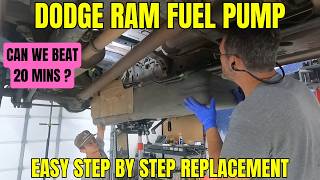
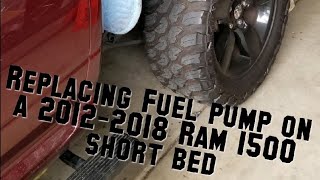
- To access the fuel pump module, either drop the fuel tank or lift the truck bed. Lifting the bed is often considered easier, but may not be possible on short-bed crew cab models where the pump is under the cab. Before dropping the tank, run it as empty as possible 🎬 See this step-by-step guide for dropping the fuel tank. to reduce weight.
- Disconnect the fuel pump module connector and use a multimeter to measure the resistance across the fuel level sensor pins.
- Manually move the float arm from empty to full. The resistance reading should change smoothly throughout its range of motion. On these trucks, a full tank is around 50-52 ohms, and an empty tank is around 1,000 ohms. If the reading is open (infinite resistance) or jumps erratically, especially in the mid-range, the sending unit is faulty.
- If the sending unit tests good, the problem is likely in the wiring between the tank and the PCM, or in a rare case, the PCM itself.
Parts You'll Likely Need

- Fuel Pump Module Assembly
(OEM #68141873AA (This is a common number, but part numbers are highly specific to year, engine, and tank size. Other numbers include 68541368AC. Always verify with VIN).)— This is the most common failure point for code P0463. The fuel level sensor is integrated into the assembly, and replacing the entire module is the standard, most reliable repair.
Trusted brands: Mopar, Delphi, Bosch, Spectra Premium
OEM price range: $400-$600
Aftermarket price range: $150-$350 - Fuel Line Retaining Clips
(OEM #Dorman 800-023 (aftermarket equivalent))— The plastic clips that secure the fuel lines to the pump module are brittle and often break during removal. It is highly recommended to have replacements on hand before starting the job.
Trusted brands: Dorman, Mopar
OEM price range: $10-$20
Aftermarket price range: $4-$10
Related Codes That Often Appear With This One
- P0460 — This code indicates a general fault in the Fuel Level Sensor 'A' Circuit, and often appears alongside the more specific P0463.
- U1403 — This is a manufacturer-specific code for 'Implausible Fuel Level Signal Received', which is set when the data from the fuel level sensor is illogical. It commonly accompanies P0463 on these trucks.
Technical Service Bulletins (TSBs) & Recalls
- While no specific TSB number for P0463 was found in searches, owners on forums mention dealers acknowledging it as a known issue. A related TSB exists for fuel splash-back issues that results in fuel tank replacement, indicating Chrysler is aware of tank-related problems.
Platform-Specific Known Issues
- A known issue involves the internal plastic baffle in the fuel tank breaking loose. This loose piece can physically interfere with or damage the fuel pump module and float arm, causing sensor failure.
- The contacts on the fuel level sensor's resistor board are prone to wearing out, creating an open circuit that triggers the P0463 code. This is a well-documented pattern of failure on 4th Gen Rams.
- On Crew Cab models with the short (5'7") bed, the fuel pump is located directly under the front of the bed/rear of the cab, making access by lifting the bed impossible. On these models, dropping the fuel tank is the only method for replacement.
- Some owners report issues with the fuel tank's rollover/vent valve, which can cause slow filling or fuel splash-back. While not directly related to P0463, it's another known fuel tank issue on this platform that sometimes leads to tank replacement.
Mechanic-Grade Diagnostic Values

- Fuel Level Sensor Resistance (at module connector) — expected: Approx. 50-52 Ohms at Full, up to 1,000 Ohms at Empty. Resistance should sweep smoothly without dropping out (OL).. Failure: Reading of Open Loop (OL), infinite resistance, or erratic jumps as the float arm is moved. A common failure shows a good reading at full, then goes to OL below 3/4 tank.
- Fuel Level Sensor Signal Wire Voltage (Key On, Engine Off, Connector Plugged In) — expected: Approx. 1.0V with a full tank. Voltage increases as fuel level drops, up to ~10.5-11.0V at empty.. Failure: Voltage stays high (near 12V or 5V reference) regardless of fuel level, indicating an open circuit.
- Fuel Level Sensor Signal Wire Voltage (Key On, Engine Off, Connector Unplugged) — expected: Should read battery voltage (approx. 11.8V - 12.2V) or a 5V reference, depending on the year/module. This confirms the PCM/BCM is sending the reference voltage.. Failure: No voltage indicates a break in the wire between the module and the PCM/BCM.
- Fuel Pump Module Connector Pinout (for sensor) — expected: The two center pins on the 4-pin connector are typically for the fuel level sensor. The signal wire is often Dark Blue with a White stripe. The return/ground is a Black wire.. Failure: N/A - This is for identification.
Scan Tool Commands That Help
- AlfaOBD: Activate Fuel Pump — This bidirectional command can be used to run the fuel pump to drain the tank into a safe container before dropping it for service. This is much safer and easier than siphoning or dropping a full, heavy tank.
Wiring & Ground Locations

- Fuel Pump Module Connector — Top of the fuel tank, accessible by dropping the tank or lifting the bed.. This is the primary connection point for the fuel level sensor. Corrosion or damage to the pins, especially the Dark Blue/White stripe (signal) and Black (ground) wires, can cause a P0463 code.
- G300 / G301 — On the frame rail near the fuel tank.. This is a main grounding point for the fuel system. While less common than sensor failure, a corroded or loose ground here can cause high resistance in the circuit, potentially leading to a P0463 code. A technician cleaned this ground as a preventative measure during a fuel pump replacement.
- BCM Connector C5, Pin 17 — At the Body Control Module (BCM).. This is the destination pin for the fuel level sensor signal wire (Dark Blue/White stripe). If voltage is present here but not at the tank connector, it confirms an open in the wiring harness between the BCM and the tank.
Real Owner Repair Stories
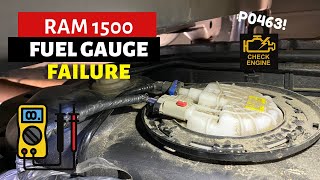
- YouTube video by 'Bo Knows Cars' (Dodge Ram, year not specified but 4th gen body style) — P0463 code, inaccurate fuel gauge.
❌ Tried (didn't work) Initial diagnosis pointed towards the sending unit.
✅ What actually fixed it The old sending unit showed an open circuit at the wire terminals, but would read intermittently when probed directly at the resistor card. This indicated a broken internal connection within the sensor's pigtail wires. Replacing the entire fuel pump module resolved the issue. - YouTube video by 'Gearhead Woodshop' (4th Gen Ram 1500) — P0463, intermittent gas gauge, remote start disabled.
❌ Tried (didn't work) Living with the problem for several years.
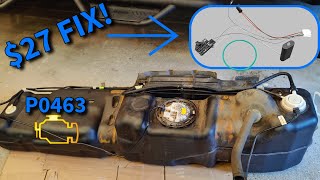
✅ What actually fixed it Replaced the fuel level sensor only with a $27 aftermarket part from Amazon instead of the full OEM pump assembly. The fix was successful, and the gauge worked correctly after installation, though it seemed to read slightly lower than before, possibly due to a bent float arm from shipping.
OEM Part Supersession History
Multiple, e.g., 68399001AA→Multiple, e.g., 68399001AC, then potentially another number.— Mopar frequently updates part numbers to reflect design improvements or supplier changes. For this specific part, changes were likely made to improve the longevity of the sensor contacts.
Heads up: Some newer Mopar replacement pump assemblies may have a different electrical connector than the original factory harness. In these cases, the new Mopar part often includes a pigtail adapter that must be spliced into the vehicle's harness. This is a key indicator of a design update and why using a VIN to get the latest part is critical.
Model Year Variations Within This Range
- 2013-2018: The 2013 model year refresh introduced the 8-speed automatic transmission and other electronic changes. While the fundamental P0463 issue remains the same, wiring diagrams and module communications could have subtle differences from the earlier 2009-2012 models. Always use a wiring diagram specific to the vehicle's year.
- 2019-2024 ("Classic"): The 4th generation body style continued to be sold as the "Ram 1500 Classic" alongside the new 5th generation (DT) truck. These Classic models are mechanically very similar to the 2018 models, and the P0463 issue persists. However, part numbers may have been consolidated or changed again post-2018.
Diagnostic Flowchart
Used vs. New Parts: Buying Guide for This Vehicle
When a used part is the smart pick: For this specific repair, a used part from a junkyard is almost never a smart choice. The primary cause of P0463 is the fuel level sensor, which is a wear-and-tear item. A used module has an unknown amount of wear and is very likely to fail in the same way as the original part, leading to doing the labor-intensive job twice.
Donor-vehicle mileage cap: roughly under 10000 miles for the part to have meaningful remaining life.
What to inspect on the donor part:
- If forced to use a donor part, source it from the lowest-mileage, newest-year vehicle possible.
- Visually inspect the wiring connector for any signs of corrosion or heat damage.
- Ask if the part can be tested for resistance before purchase, though this is unlikely to be accommodated.
OEM-only on this vehicle (don't cheap out):
- Fuel Pump Module Assembly
Aftermarket brands forum-validated for this vehicle:
- Delphi
- Bosch
Brands owners have reported issues with on this vehicle:
- Unbranded, low-cost units from online marketplaces are a gamble. While some users have short-term success, many forum posts report these failing within a year, often with inaccurate readings right out of the box.
Real Owner Stories
Aggregated from forums and TSBs cited above. Mileages and costs reflect what owners reported in those sources.
4th Gen Ram 1500
Symptoms: Gas gauge worked intermittently or not at all, and the remote start would not work because the truck thought it had no fuel.
What fixed it: Replaced only the fuel level sensor with an aftermarket part from Amazon instead of the entire fuel pump assembly.
Cost: $27
Source hint: youtube.com - How I Fixed My Ram 1500 P0463 – Gas Gauge/Fuel Level Sensor
2012 Ram 1500 5.7
Symptoms: Hesitant to accelerate, rough idle, poor gas mileage, and check engine light with codes P0463 and P0456.
What fixed it: The user did not report a final fix. They were still seeking advice after replacing several parts.
Source hint: Reddit r/MechanicAdvice
4th Gen Ram 1500
Symptoms: The fuel gauge fails and drops to empty once the tank is below half full. The remote start is also disabled by the code.
What fixed it: The forum thread discusses dealer quotes for repair, which involves replacing the fuel pump module.
Cost: $500-$1200
Source hint: ramforum.com - Thread 'P0463 - fuel level sensor circuit high'
2014 Ram 1500 — 37000 miles
Symptoms: The fuel gauge dropped to E, triggering the P0463 code.
What fixed it: The forum post describes the symptom at low mileage but does not detail the final repair.
Source hint: ramforum.com - Thread '2014 1500 with P0463 with only 37k miles'
Related OBD-II Codes
Frequently Asked Questions
I need to replace my fuel pump for a P0463 code. Is it easier to lift the bed or drop the tank on my Ram 1500?
Why is the P0463 code so common on 4th Gen Ram 1500s?
Can I just replace the fuel level sensor, or do I have to buy the whole fuel pump module?
My remote start stopped working when my fuel gauge failed. Is this related to the P0463 code?
What resistance values should I look for when testing the fuel level sending unit on my Ram?
Is there a specific Technical Service Bulletin (TSB) for the P0463 code on these trucks?
Helpful Videos
We Have This Part in Stock



The information in this article is provided for general reference and educational purposes only. Vehicle specifications, procedures, and part compatibility can vary by production date, trim level, and region. Always consult your vehicle's factory service manual and verify part numbers before purchasing or performing repairs. Safety-critical components such as airbags, seat belts, and braking systems should be installed by a qualified professional.
- Dodge Ram 1500:
- 🎬 Helpful Videos
- 🛍️ Shop This Part
- What's Unique About the 2009-2018 Dodge Ram 1500
- Symptoms You May Notice
- Most Likely Causes
- Rare But Worth Checking
- Diagnosis Steps
- Parts You'll Likely Need
- Related Codes That Often Appear With This One
- Technical Service Bulletins (TSBs) & Recalls
- Platform-Specific Known Issues
- Mechanic-Grade Diagnostic Values
- Scan Tool Commands That Help
- Wiring & Ground Locations
- Real Owner Repair Stories
- OEM Part Supersession History
- Model Year Variations Within This Range
- Diagnostic Flowchart
- Used vs. New Parts: Buying Guide for This Vehicle
- Real Owner Stories
- 4th Gen Ram 1500
- 2012 Ram 1500 5.7
- 4th Gen Ram 1500
- 2014 Ram 1500 — 37000 miles
- Related OBD-II Codes
- Frequently Asked Questions
- 🎟️ Get 5% Off