

P0456 on 2018-2023 Chevrolet Traverse: Causes and Fixes for a Small EVAP Leak
This code indicates a very small leak in the evaporative emissions system. The most common causes are a loose gas cap or a faulty EVAP purge valve. Checking the gas cap is free, and replacing the purge valve is a relatively easy and inexpensive DIY repair, especially on the 2019 model which has extended warranty coverage for the part.
- P0456 is a minor issue, and your Traverse is safe to drive.
- Always check your gas cap first. Make sure it's tight and the seal is intact.
- The most likely part to have failed on a 2018-2023 Traverse is the EVAP purge valve, located on top of the engine.
- Owners of 2019 models should check with a GM dealer about Special Coverage N232395300 for a potential free purge valve replacement.
- If the gas cap and purge valve are not the cause, a smoke test is the best way to find the leak.
What's Unique About the 2018-2023 Chevrolet Traverse

For the second-generation Traverse with the 3.6L LFY engine, the EVAP purge valve is a known failure point. GM has issued a special coverage program (N232395300) for the 2019 model year that extends the warranty on this specific part to 15 years or 150,000 miles due to a high rate of failure. This is not a formal recall, but a warranty extension for vehicles that experience the specific problem. While this TSB doesn't explicitly name code P0456, a faulty purge valve that fails to close completely is a primary cause for it, making this a highly probable and potentially free fix for owners of affected vehicles.
Symptoms You May Notice

- Check Engine Light is on
- A faint smell of fuel (in rare cases, often near the rear of the vehicle after being parked).
- Slightly rough idle if the purge valve is stuck open
- Difficulty starting after refueling (if purge valve is stuck open)
- Replacing the charcoal canister when the actual problem is a less expensive vent valve or hose.
- Replacing O2 sensors, which are not related to the EVAP system.
Most Likely Causes

- Loose or Faulty Gas Cap 🔴 High Probability The gas cap is a frequently used part and its seal can wear out over time, or it may simply not be tightened correctly after refueling. This is the most common cause for P0456 across all vehicles.
How to confirm: Remove the gas cap and inspect the rubber seal for cracks or damage. Reinstall it and turn it until it clicks at least once. Clear the code and drive for a few days to see if it returns. The EVAP monitor test may take several drive cycles to run.
Typical fix: Replace the gas cap if the seal is damaged or if tightening it doesn't resolve the issue. It is highly recommended to use an OEM (ACDelco) part, as some aftermarket caps may not seal correctly, leading to a persistent code.
Est. part cost: $15-$30 - Faulty EVAP Purge Solenoid Valve 🔴 High Probability This part is a known failure item on this platform. GM issued Special Coverage N232395300 for the 2019 Traverse 3.6L, extending the warranty on the purge valve because it may not fully close. A stuck-open purge valve creates a constant vacuum leak in the EVAP system.
How to confirm: The valve is located on top of the engine's intake manifold and is easy to access. With the engine running at idle, you can disconnect the vapor line from the valve and feel for suction. There should be no vacuum at idle. A bidirectional scan tool can also command the valve to open and close to test its function.
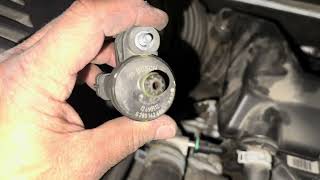
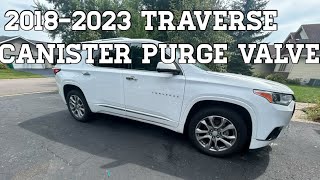
Typical fix: Replace the EVAP purge solenoid valve. This is a simple repair involving one 10mm bolt and two connections (one electrical, one vapor line). 🎬 Watch: Step-by-step 2019 Traverse purge valve replacement tutorial. Some owners find it easier to remove the throttle body (4 bolts) for better access.
Est. part cost: $25-$50 - Cracked or Disconnected EVAP Hoses/Lines 🟡 Medium Probability The plastic and rubber lines that carry fuel vapors can become brittle over time due to heat and age, leading to small cracks, especially at connection points.
How to confirm: A visual inspection may reveal obvious cracks or loose connections, but a very small leak often requires a smoke test. A mechanic uses a machine to fill the EVAP system with low-pressure smoke, which will escape from any leak point and become visible.
Typical fix: Replace the damaged section of the hose. This can range from a simple fix to a more complex repair if the leak is in a hard-to-reach area.
Est. part cost: $10-$100 - Faulty EVAP Vent Solenoid ⚪ Low Probability The vent solenoid is typically located near the charcoal canister at the rear of the vehicle, exposing it to road debris and moisture which can cause it to fail over time, usually by sticking open or failing to close.
How to confirm: This valve is normally open and closes when the system runs its self-test. It can be tested with a bidirectional scan tool to command it closed. A smoke test will also reveal if the valve is failing to seal when commanded shut.
Typical fix: Replace the vent solenoid.
Est. part cost: $30-$70
Rare But Worth Checking
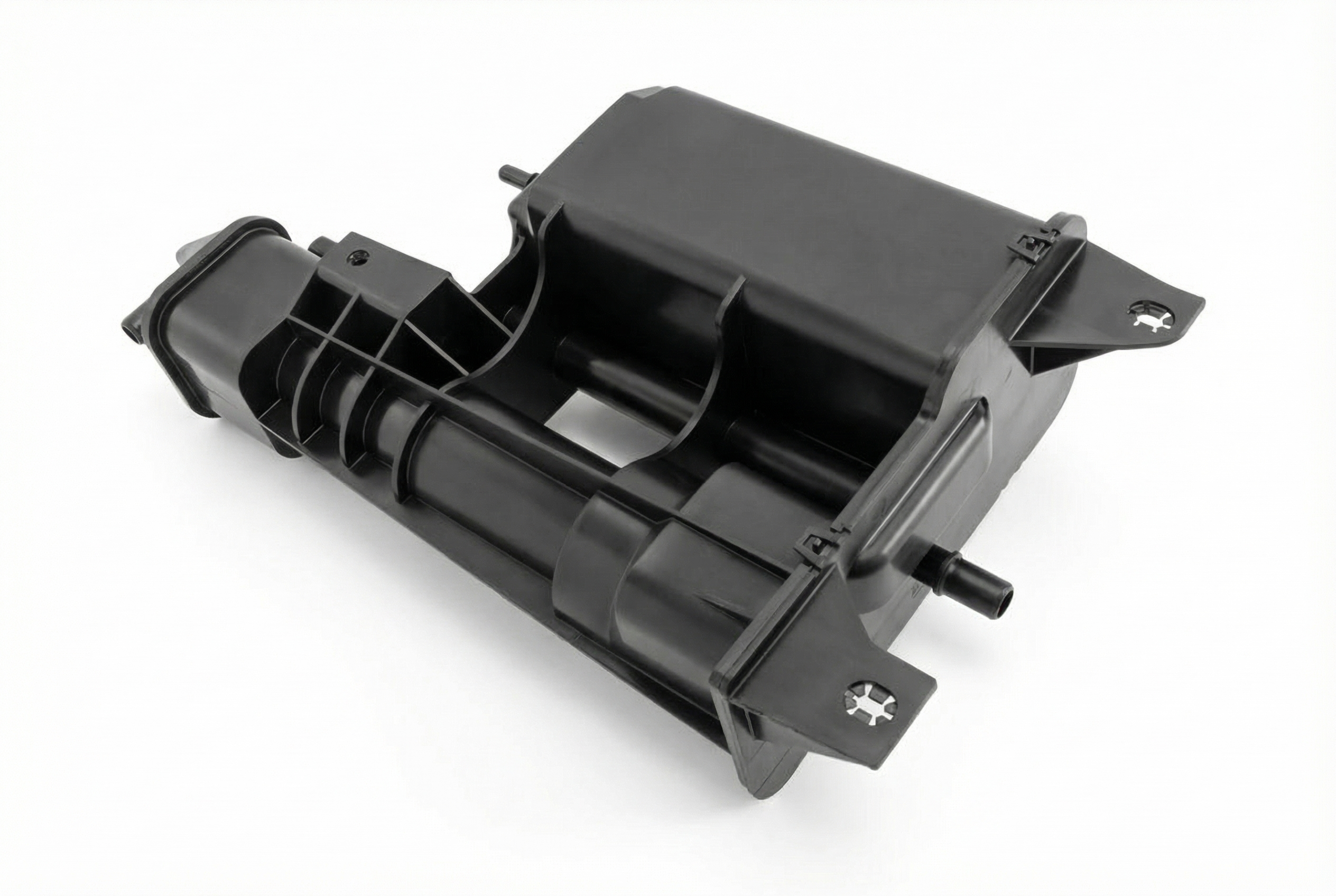
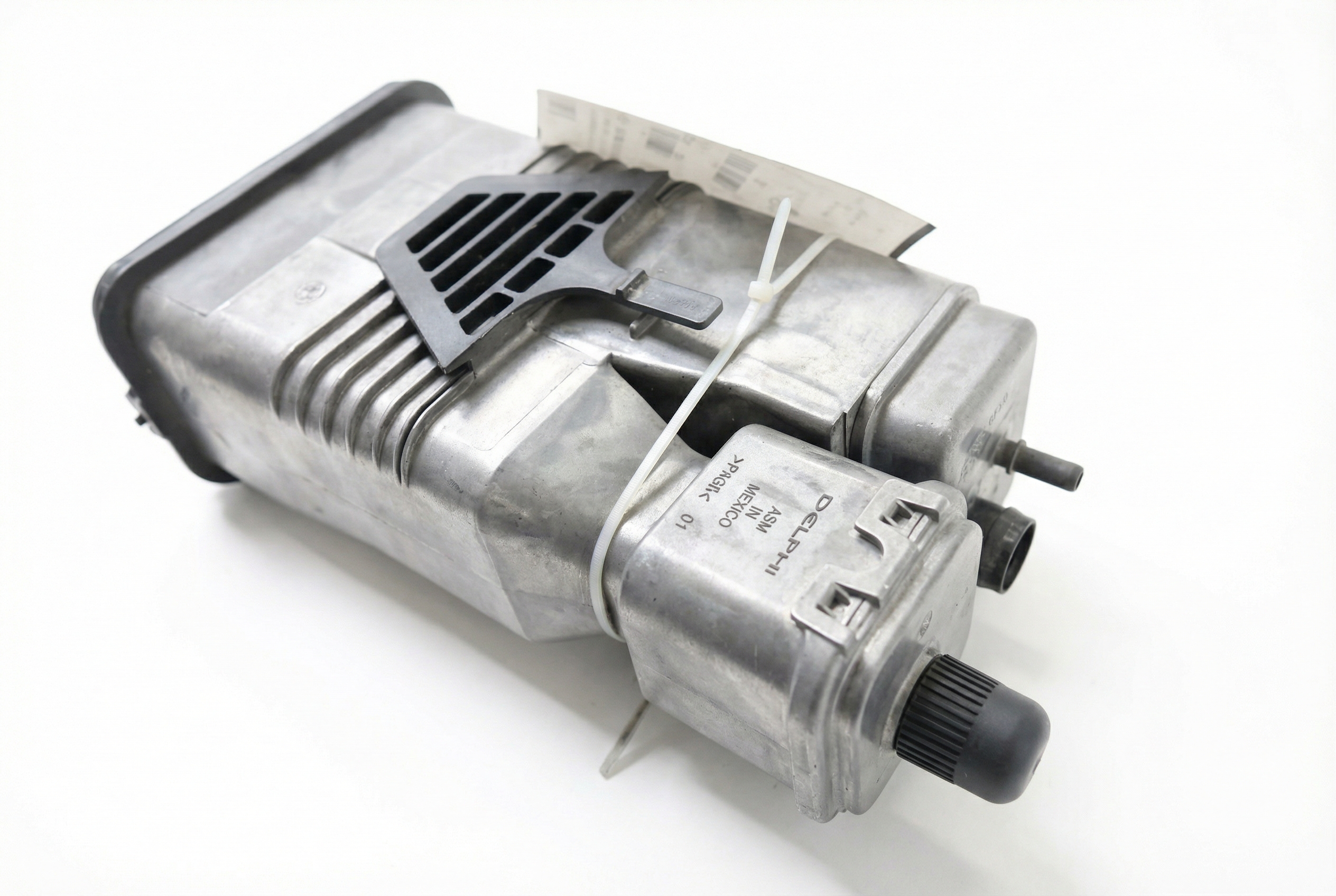
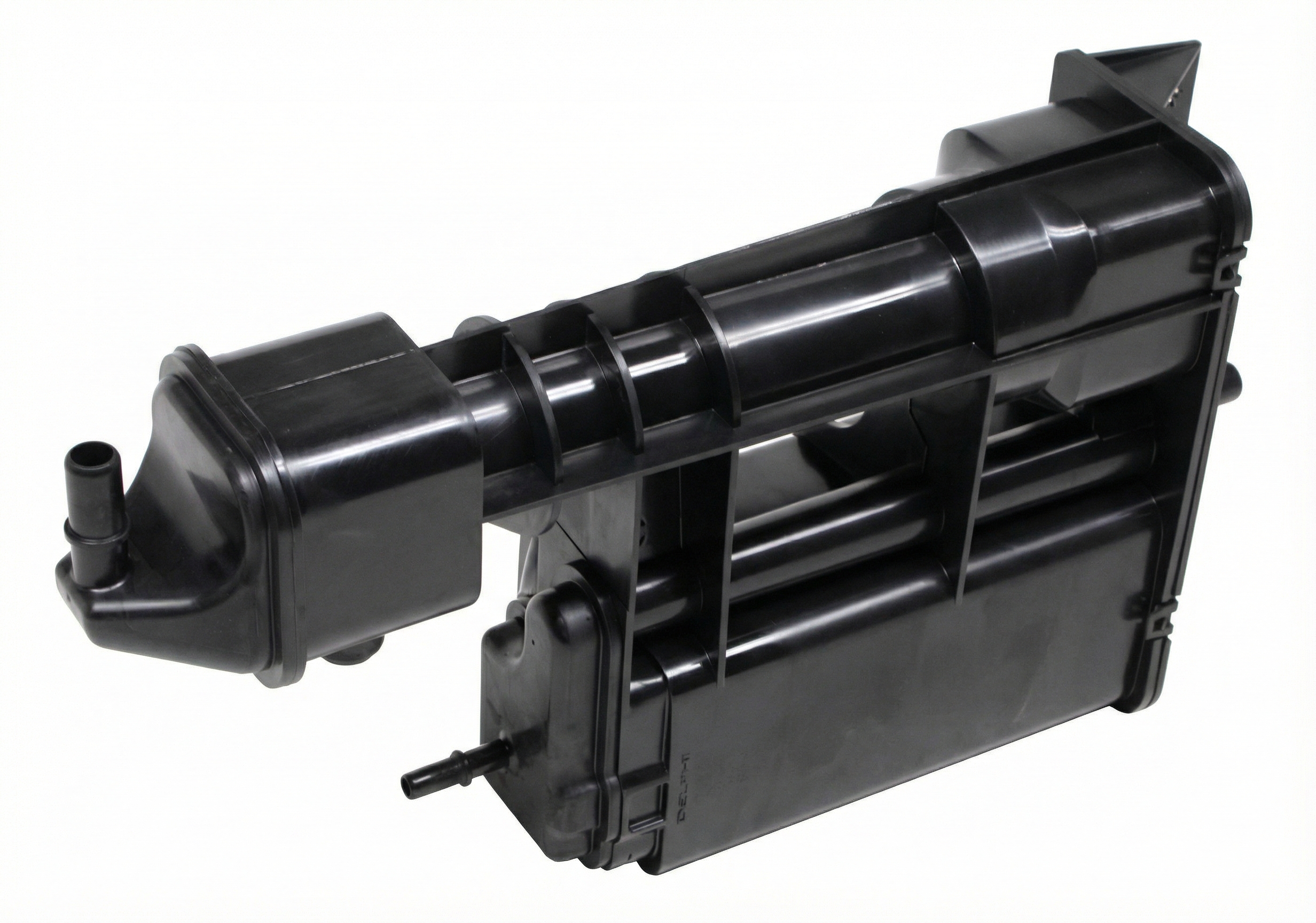
- Leaking Charcoal Canister: The plastic housing of the charcoal canister can develop hairline cracks over time, causing a small leak. This is less common than valve or hose failures but is a possibility.
- Damaged Fuel Filler Neck: Corrosion or damage to the metal tube leading to the gas tank can cause a leak that prevents the gas cap from sealing properly.
Diagnosis Steps

- Read the code with an OBD-II scanner to confirm P0456 is the only code present. If other codes like P0496 are present, it can help narrow the diagnosis.
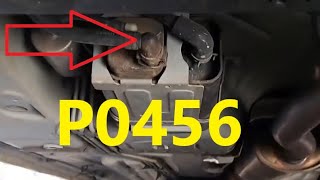
- Inspect the gas cap. Ensure it is tight and the seal is not cracked or worn. If in doubt, it's an inexpensive first step to replace it 🎬 Watch: Two quick DIY methods to fix a P0456 code. with an OEM part.
- Clear the code and drive the vehicle for several days. The EVAP monitor often runs only under specific conditions, so it may take time for the light to return.
- If the code returns, locate the EVAP purge valve on the top of the engine. Visually inspect its connections.
- With the engine idling, disconnect the hose from the purge valve and check for vacuum with your finger. If you feel suction, the valve is stuck open and needs to be replaced.
- If the gas cap and purge valve seem okay, visually inspect all accessible EVAP hoses for obvious cracks, especially around fittings and bends.
- For hard-to-find leaks, the most effective method is a professional smoke test. This involves injecting smoke into the EVAP system to pinpoint the source of the leak.
Parts You'll Likely Need

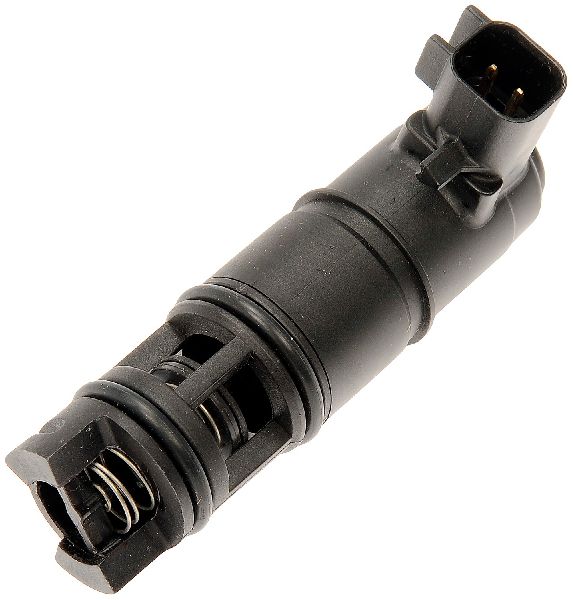
- Vapor Canister Purge Valve / Solenoid
(OEM #12690512)— This is a very common failure point on the 3.6L LFY engine, and is covered by a GM Special Coverage program (N232395300) for the 2019 model year. This part is used across a vast range of GM vehicles.
Trusted brands: ACDelco (OEM), Bosch, Dorman
OEM price range: $35-$50
Aftermarket price range: $25-$40 - Fuel Tank Cap
(OEM #GT330 (ACDelco))— A worn or improperly tightened gas cap is the most frequent cause of all EVAP leak codes.
Trusted brands: ACDelco (OEM)
OEM price range: $20-$30
Aftermarket price range: $15-$25
Related Codes That Often Appear With This One
- P0442 — This code indicates a 'small leak' (larger than P0456). They often share the same causes, and a failing component might initially trigger P0456 and later P0442 as the leak worsens.
- P0455 — This indicates a 'large leak'. If a component like a purge valve fails completely or a hose becomes disconnected, you may see this code along with P0456.
- P0496 — This code indicates 'EVAP Flow During a Non-Purge Condition,' which almost always points directly to a faulty purge valve that is stuck open or leaking. It is very commonly seen when the purge valve is the root cause.
Technical Service Bulletins (TSBs) & Recalls
- N232395300: Special Coverage for Evaporative Emissions Purge Valve on certain 2019 Chevrolet Traverse and Buick Enclave models. Covers replacement of a faulty purge valve that may not fully close.
Platform-Specific Known Issues

- GM Special Coverage N232395300 was issued for the 2019 Traverse 3.6L due to a high failure rate of the EVAP purge valve (Part No. 12690512). Owners of these vehicles may be eligible for a free replacement at a dealership, extending the warranty to 15 years/150,000 miles. This is not a recall; it is an extended warranty for the specific component failure.
Mechanic-Grade Diagnostic Values
- EVAP Purge Valve Solenoid Coil Resistance — expected: 15 to 30 Ohms. Failure: A reading of infinity (open circuit) or near zero (short circuit) indicates a failed coil.
- EVAP Vent Valve Solenoid Coil Resistance — expected: 14 to 21 Ohms. Failure: A reading significantly outside this range suggests the solenoid coil is faulty.
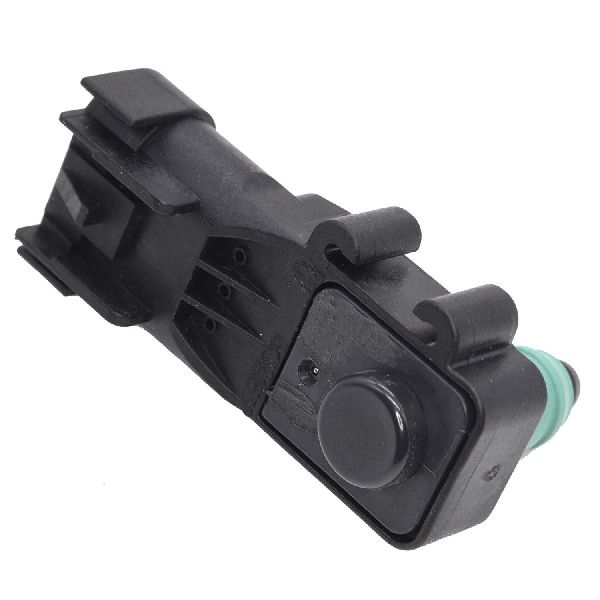
- Fuel Tank Pressure (FTP) Sensor Voltage — expected: ~1.5 Volts with Key On, Engine Off (KOEO) at normal atmospheric pressure.. Failure: Voltage is stuck high (near 5.0V), low (near 0V), or does not change when vacuum/pressure is applied during testing.
- Voltage at Purge Solenoid Connector (Power Pin) — expected: Battery Voltage (~12V) with Key On, Engine Off (KOEO).. Failure: Zero voltage points to a blown fuse (check 'EMISSION 1' fuse) or a break in the power supply wire.
Scan Tool Commands That Help

- GDS2 / Tech2: EVAP Service Bay Test — This is a guided, automated test that forces the EVAP monitor to run. It commands the solenoids to seal the system and monitors the FTP sensor to confirm if a leak is present and its approximate size (large, small, very small). It's the fastest way to verify a repair without a long drive cycle.
- GDS2 / Tech2: Purge/Seal — This function allows the technician to manually command the purge and vent solenoids on and off while watching FTP sensor data live. It is used to isolate a faulty component during diagnosis (e.g., sealing the system and commanding the purge valve to see if it creates a vacuum).
- GDS2 / High-End Bidirectional Scanner: EVAP Vent Solenoid Control (On/Off) — This is used to manually command the normally-open vent solenoid to the closed position. This is critical for performing a smoke test, as it seals the system and allows it to be filled with smoke to find the physical leak location.
Wiring & Ground Locations
- EMISSION 1 Fuse — Located in the under-hood fuse block.. This fuse supplies power to the EVAP purge solenoid. If this fuse is blown, the solenoid will have no power. According to GM TSB #PIT5336, a blown 'EMISSION 1' fuse is a strong indicator of a shorted wire in the engine harness.
- Purge Solenoid Connector — At the EVAP purge solenoid, on top of the intake manifold near the firewall.. The power supply pin (often pink) should have battery voltage with the key on. The other wire is the control wire, which the ECM pulses to ground to activate the solenoid. Checking for voltage here is a primary step in diagnosing a circuit fault (like P0443) vs. a component failure.
- Engine Wiring Harness Chafe Point — The area where the engine wiring harness passes near the A/C hose coupling on the back side of the engine.. This area is a known chafe point where the harness can rub through, causing wires for the EVAP purge solenoid (and other components) to short to ground or break. This can cause persistent circuit codes and intermittent issues.
Real Owner Repair Stories
- Reddit user in r/ChevyTraverse (2018 Chevrolet Traverse) — Check Engine Light with code P0442 (small EVAP leak), which shares the same causes as P0456.
❌ Tried (didn't work) A professional smoke test came back clean, showing no leaks., Replacing the EVAP purge valve.
✅ What actually fixed it Placing an aftermarket, auxiliary gas cap onto the vehicle's capless fuel filler neck. This confirmed the original integrated capless door was not sealing properly, creating a small leak that the smoke test did not detect.
"I Checked Everything" — The Actual Cause
- In some cases, a vehicle can pass a smoke test but still have a persistent P0456 code. One documented cause on a similar platform was a faulty seal on the capless fuel filler door that did not show up during a smoke test but was fixed by adding an auxiliary gas cap.
- Another possibility is that the ECM software logic is too sensitive and is falsely triggering the code. While not documented specifically for the Traverse, other manufacturers have issued software updates to revise the leak detection thresholds for P0456, which resolves the code without any parts replacement. If all physical components and smoke tests check out, investigating potential ECM software updates with a dealer is a valid next step.
OEM Part Supersession History
12690512→12737252— Likely an updated design to improve reliability and prevent sticking, which is the common failure mode.
Heads up: The new part number (12737252) is the correct replacement for previous numbers 12610560, 12661763, and 12690512. When sourcing parts, always use the latest superseded number.
Model Year Variations Within This Range

- 2019 only: The 2019 model year is specifically covered by GM Special Coverage N232395300, which extends the warranty on the EVAP purge valve to 15 years or 150,000 miles. Owners of this specific year should check with a dealer for a potential free repair before purchasing parts.
Diagnostic Flowchart
Other Known Issues on This Vehicle
Issues unrelated to this code that are worth knowing about as an owner of this generation:
- Transmission Shudder (9T65) 🟠 Medium — Common issue, especially in early model years (2018-2020). Can occur at low speeds during light acceleration. Addressed by TSBs 18-NA-091 and 23-NA-072, which often recommend a fluid exchange and/or TCM reprogram. (Ref: 18-NA-091, 23-NA-072)
- Start/Stop Accumulator Failure 🔴 High — Affects 2018-2020 models. Missing bolts on the accumulator can cause a transmission fluid leak, leading to loss of propulsion or, rarely, a fire risk. Covered by safety recall N202313440. (Ref: N202313440)
- Cracked Exhaust Pipe Weld 🟠 Medium — A weld on an exhaust pipe bracket (Bank 2) is known to fail, causing an exhaust leak, noise, and potentially setting lean or catalyst efficiency codes. Addressed by TSB PIP5681A and covered by Special Coverage N212356540 (2019 models) and N222385510 (2021 models). (Ref: PIP5681A, N212356540, N222385510)
- Peeling or Defective Paint 🟡 Low — Multiple class-action lawsuits have been filed against GM for paint delaminating, bubbling, or peeling on various 2015-2020+ trucks and SUVs, including the Traverse. This is a cosmetic but costly issue for owners.
Used vs. New Parts: Buying Guide for This Vehicle
When a used part is the smart pick: For this specific repair, using used parts is generally not recommended. The primary failure points are electronic solenoids (purge and vent valves) that have a finite lifespan and are known to fail on this platform. The cost of new, warrantied OEM parts is low enough that the risk and labor of installing a used part with unknown history is not worth the small savings.
Donor-vehicle mileage cap: roughly under 40000 miles for the part to have meaningful remaining life.
What to inspect on the donor part:
- If sourcing a used part is unavoidable, only consider a purge valve from a low-mileage (under 40k miles) donor vehicle.
- Verify the exact OEM part number stamped on the part itself matches a compatible number (e.g., 12690512, 12610560). Do not trust a listing that says 'fits Traverse' without a part number match.
- Avoid parts from regions with heavy road salt usage, especially for the vent solenoid located under the vehicle.
OEM-only on this vehicle (don't cheap out):
- EVAP Purge Valve / Solenoid
- Gas Cap
Aftermarket brands forum-validated for this vehicle:
- ACDelco (OEM)
- Bosch (Often the original manufacturer for the GM-branded part)
Brands owners have reported issues with on this vehicle:
- Dorman: While Dorman makes many quality parts, their aftermarket purge valves for this application have been reported by technicians to have incorrect internal spring tension, leading to a quick return of EVAP codes.
Real Owner Stories
Aggregated from forums and TSBs cited above. Mileages and costs reflect what owners reported in those sources.
2019 Chevrolet Traverse 3.6L — ~150000 miles
Symptoms: The purge valve may not fully close, causing an evaporative emissions fault.
What fixed it: Replacement of the EVAP purge valve under GM Special Coverage N232395300.
Source hint: GM Special Coverage N232395300
2019 Chevrolet Traverse 3.6L
Symptoms: Difficulty disconnecting the tricky white clip on the purge valve while it is still mounted in the engine bay.
What fixed it: Left the airbox in, disconnected the intake hose, and removed the entire purge valve with its hose attached to disconnect the clip more easily outside of the vehicle.
Source hint: YouTube video 'Fix 2019 traverse purge valve solenoid in 60 seconds.'
2019 Chevrolet Traverse 3.6L
Symptoms: Check engine light on with P0456; limited space to reach the purge valve mounting bolt.
What fixed it: Removed the throttle body (4 bolts) to gain easier access to the purge valve bolt and connections.
Source hint: YouTube video '2019 Chevy Traverse Purge Valve Replacement - Full Tutorial'
Related OBD-II Codes
Frequently Asked Questions
Is there a special warranty for the purge valve on my 2019 Chevrolet Traverse?
Why does my Traverse have trouble starting specifically after I fill up the gas tank?
Should I use an aftermarket gas cap to fix the P0456 code?
I'm seeing P0456 and P0496 together; what does that mean for my 3.6L LFY engine?
Is the P0456 code related to the transmission shudder or start/stop recall on my Traverse?
How can I make it easier to reach the purge valve bolt on the 3.6L V6?
Helpful Videos
![How to Fix P0456 Engine Code in 3 Minutes [2 DIY Methods / Only $4.44]](https://img.youtube.com/vi/v_QDSjd1-Lw/mqdefault.jpg)
Used OEM Parts in Stock



New Aftermarket Parts Available



The information in this article is provided for general reference and educational purposes only. Vehicle specifications, procedures, and part compatibility can vary by production date, trim level, and region. Always consult your vehicle's factory service manual and verify part numbers before purchasing or performing repairs. Safety-critical components such as airbags, seat belts, and braking systems should be installed by a qualified professional.
- Chevrolet Traverse:
- 🎬 Helpful Videos
- 🛍️ Shop This Part
- What's Unique About the 2018-2023 Chevrolet Traverse
- Symptoms You May Notice
- Most Likely Causes
- Rare But Worth Checking
- Diagnosis Steps
- Parts You'll Likely Need
- Related Codes That Often Appear With This One
- Technical Service Bulletins (TSBs) & Recalls
- Platform-Specific Known Issues
- Mechanic-Grade Diagnostic Values
- Scan Tool Commands That Help
- Wiring & Ground Locations
- Real Owner Repair Stories
- "I Checked Everything" — The Actual Cause
- OEM Part Supersession History
- Model Year Variations Within This Range
- Diagnostic Flowchart
- Other Known Issues on This Vehicle
- Used vs. New Parts: Buying Guide for This Vehicle
- Real Owner Stories
- 2019 Chevrolet Traverse 3.6L — ~150000 miles
- 2019 Chevrolet Traverse 3.6L
- 2019 Chevrolet Traverse 3.6L
- Related OBD-II Codes
- Frequently Asked Questions
- 🎟️ Get 5% Off