

P0443 on 2007-2013 Chevrolet Silverado 1500: EVAP Purge Valve Circuit Causes and Fixes
On a 2007-2013 Silverado, code P0443 almost always points to a bad EVAP purge solenoid valve on the engine. It's an easy and affordable DIY fix, with the part costing between $25 and $70. The second most common cause is a broken wire in the pigtail connector leading to the valve.
- P0443 is an electrical circuit code, not an EVAP system leak code. Don't replace the gas cap.
- The most common fix is replacing the EVAP purge solenoid valve on the intake manifold (ACDelco P/N 12690512).
- If a new valve doesn't fix it, the second most common cause is a broken wire in the connector pigtail leading to the valve.
- This is a simple and inexpensive DIY repair for most owners.
What's Unique About the 2007-2013 Chevrolet Silverado 1500

For the GMT900 generation of Silverado trucks, the P0443 code is a very common and typically straightforward issue. The purge solenoid valve is conveniently located right on top of the engine's intake manifold, making it one of the easier emissions-related parts to access and replace. While the part itself is the most frequent failure point, the wiring harness routed over the hot engine can also become brittle and break, a lesson learned from the previous GMT800 generation where this was also a common issue. Owners frequently find the break right at the connector pigtail.
Generation note: The 2007 model year is a transition period. Chevrolet sold both the new GMT900 platform (2007-2013) and the previous generation GMT800 platform, branded as the "Silverado Classic". While the P0443 code has the same meaning and similar causes for both, the exact part and location can differ slightly. This guide focuses primarily on the more common GMT900 models.
Symptoms You May Notice
- Check Engine Light is on
- Slightly rough idle or engine shudder, particularly between 1500 and 2500 RPMs.
- Difficulty starting the engine immediately after refueling (less common with this specific circuit code, but possible if the valve is mechanically stuck open, often setting a P0496 as well).
- Slight decrease in fuel economy.
- Noticeable fuel odor near the vehicle if the valve is stuck open.
- Replacing the gas cap. A bad gas cap typically causes EVAP leak codes (like P0442 or P0455), not a circuit code like P0443.
- Replacing the EVAP Vent Solenoid. This is a different part located near the fuel tank and charcoal canister. P0443 specifically points to the purge valve circuit on the engine.
Most Likely Causes

- Faulty EVAP Purge Solenoid Valve 🔴 High Probability The solenoid is an electronic component that operates frequently and is exposed to high engine bay temperatures, leading to eventual electrical failure of its internal coil. It can also get stuck open or closed internally.
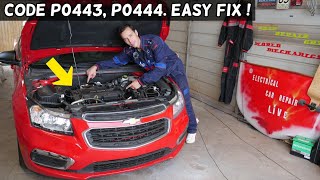
How to confirm: With the engine off, disconnect the electrical connector and test the resistance across the two pins on the solenoid with a multimeter. A reading outside the manufacturer's specified range (typically 20-30 ohms) or an open circuit (infinite resistance) indicates a bad solenoid. You can also apply 12V and a ground directly to the pins to see if it audibly clicks open and closed. If you can blow through the valve when 🎬 See how to test and fix P0443 circuit codes it is not energized, it is stuck open and faulty.
Typical fix: Replace the EVAP purge solenoid valve. It is located on the driver's side of the intake manifold and is typically held on by a small bracket or a single 10mm bolt.
Est. part cost: $25-$70 - Damaged Wiring or Connector 🟡 Medium Probability The wiring harness is routed over the top of the engine, where heat and vibration can cause wires to become brittle and break over time, especially near the connector. Forum users frequently report finding a broken wire right at the pigtail after replacing the valve did not fix the code.
How to confirm: Visually inspect the wiring harness leading to the purge solenoid for any signs of cracking, fraying, or breaks. Pay close attention to the area right at the connector. Gently tug on the wires. With the key on, engine off, use a multimeter to check for 12V power at the connector's power wire (typically pink). The other wire (often green/white) is the ground control wire from the PCM.
Typical fix: Repair the broken wire(s) using a butt connector or by soldering, and protect the repair with heat shrink tubing. If the connector itself is damaged, it can be replaced with a new pigtail connector (Dorman part 645-800 is a common example).
Est. part cost: $10-$30 - Blown Fuse ⚪ Low Probability
How to confirm: Check the underhood fuse box for any blown fuses related to the emissions system. On GMT900 trucks, this is often the 'ECM 1' fuse (a 15A fuse) which powers multiple components, including the purge solenoid. Refer to your owner's manual for the specific fuse location.
Typical fix: Replace the blown fuse. If the fuse blows again immediately, it indicates a short circuit in the wiring that must be found and repaired.
Est. part cost: $1-$5
Rare But Worth Checking
- Faulty Powertrain Control Module (PCM): This is very rare. The PCM should only be considered after all other possibilities, including the valve and the entire circuit wiring, have been thoroughly tested and ruled out.
Diagnosis Steps

- Confirm the code P0443 is present using an OBD-II scanner.
- Remove the plastic engine cover to access the top of the intake manifold.
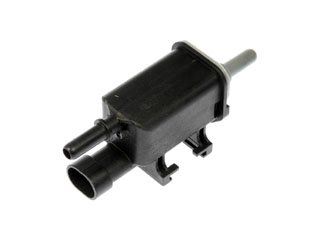
- Locate the EVAP purge solenoid on the driver's side of the manifold. It's a small black valve with an electrical connector and two EVAP lines attached.
- Visually inspect the electrical connector and wiring harness for any obvious damage, corrosion, or loose connections.
- Gently tug on the wires near the connector to check for internal breaks inside the insulation. This is a very common failure point.
- If wiring looks good, disconnect the connector. With the ignition in the 'ON' position, use a multimeter or test light to verify 12-volt power at the pink wire in the connector.
- If power is present, test the solenoid itself. Use a multimeter to check the resistance between the two pins on the valve. An open circuit (infinite resistance) or a reading far outside the typical 20-30 ohm range means the valve is bad.
- Alternatively, use jumper wires to apply 12V and ground directly to the solenoid's pins. A healthy solenoid will make an audible 'click'.
- If the valve and wiring test good, check the 'ECM 1' fuse in the underhood fuse block.
- If all tests pass, the issue may be an intermittent connection or, in very rare cases, a fault in the PCM's driver circuit.
Parts You'll Likely Need
- Vapor Canister Purge Solenoid Valve
(OEM #12690512 (supersedes 12597567))— This is the most common failure point for code P0443. The internal electronics of the solenoid fail over time. Part number 12597567 was the original, but has been superseded by 12690512.
Trusted brands: ACDelco (OEM), Dorman, Standard Motor Products (SMP)
OEM price range: $40-$70
Aftermarket price range: $25-$50 - EVAP Purge Valve Connector Pigtail
(OEM #Dorman 645-800)— If the wiring is broken right at the connector, replacing the pigtail is the 🎬 Watch: How to repair a broken electrical connector easiest and most durable repair.
Trusted brands: Dorman, ACDelco
OEM price range: $20-$35
Aftermarket price range: $10-$25
Related Codes That Often Appear With This One
- P0444 — This code indicates 'Purge Control Valve Circuit Open,' which is a more specific version of the P0443 general circuit fault. It often points directly to a broken wire or a failed open solenoid coil.
- P0445 — This code indicates 'Purge Control Valve Circuit Shorted.' It points to a short to ground or a short to voltage in the circuit, which could be a wiring issue or a failed solenoid.
- P0496 — This code means 'EVAP Flow During a Non-Purge Condition.' It is often caused by a purge valve that is mechanically stuck open, which can sometimes trigger the P0443 electrical code as well. Many owners report having both codes.
Technical Service Bulletins (TSBs) & Recalls
- Bulletin #PIT5336 — This manufacturer bulletin notes that a technician may find the Emission 1 Fuse is open along with code P0443. It advises that the technician will need to inspect and repair any wire damage on the engine harness.
- Bulletin #PIP5552 — A manufacturer preliminary information bulletin indicates that engineering has investigated conditions where a MIL is on with P0443 setting.
Platform-Specific Known Issues
- The wiring for the purge solenoid is known to become brittle and break right at the connector due to engine heat and vibration. Many owners have fixed the P0443 code by repairing this wire after a new solenoid did not solve the problem.
Mechanic-Grade Diagnostic Values
- EVAP Purge Solenoid Coil Resistance — expected: 20-40 Ohms. Failure: Infinite resistance (open circuit) or near-zero resistance (short circuit).
- Voltage at Purge Solenoid Connector (Key On, Engine Off) — expected: Battery Voltage (~12.6V) on the Pink wire (power supply).. Failure: No voltage on the pink wire indicates a power supply issue, likely a blown 'ECM 1' fuse or a break in the wire.
- Voltage on Control Wire (Key On, Engine Off) — expected: Near battery voltage when disconnected from solenoid.. Failure: 0V could indicate a short to ground in the harness or a faulty PCM driver.
- Voltage on Control Wire (Commanded ON with Scan Tool) — expected: Near 0V.. Failure: If voltage does not drop to near 0V when commanded ON, it indicates a break in the control wire back to the PCM or a faulty PCM driver.
Scan Tool Commands That Help
- Tech 2 / GDS2 (GM Dealer Tools) or high-end aftermarket scanner: EVAP Purge/Seal or Purge Solenoid Output Control — This bidirectional command allows the technician to manually command the purge solenoid ON and OFF (or to a specific percentage). This is used to verify the solenoid clicks audibly, and to check if the control circuit voltage at the connector drops to ground as expected when commanded ON. It's a definitive way to test the entire circuit, from the PCM to the valve, without running the engine.
Wiring & Ground Locations

- Purge Solenoid Connector Pin A — On the two-pin connector at the purge solenoid valve itself.. This is the control wire, typically Dark Green with a White stripe. It runs directly to the PCM. A break or short on this wire is a common cause of P0443.
- Purge Solenoid Connector Pin B — On the two-pin connector at the purge solenoid valve itself.. This is the 12V ignition power supply wire, typically Pink. Loss of power here will set the code. It is powered by the 'ECM 1' fuse in the underhood fuse block.
- G103 — On the passenger side cylinder head, towards the front.. This is a primary engine and PCM ground point. While the purge solenoid is ground-side switched by the PCM, a poor main ground at G103 can cause a variety of electrical issues and codes, including erratic behavior of PCM-controlled components.
- G102 — Located at the left rear of the engine.. This ground serves the ignition coils, but ensuring all major engine grounds are clean and tight is a critical step when diagnosing any electrical fault.
- PCM Connector X1, Pin 72 — At the Powertrain Control Module (PCM), which is located near the fan shroud on the driver's side.. Based on wiring diagrams for similar year models, this is the pin for the EVAP Canister Purge Solenoid Valve Control. Verifying continuity from the solenoid connector (Dk Grn/Wht wire) to this pin can confirm if the wire is broken.
Real Owner Repair Stories
- GM-Trucks.com user 'MileHiSierra' (2005 GMC Sierra (GMT800, but same issue applies)) — Check Engine Light with code P0443.
❌ Tried (didn't work) Initial diagnosis pointed to the solenoid, but testing showed it was functional.
✅ What actually fixed it The ground wire in the pigtail connector for the purge solenoid was found to be brittle and corroded. It snapped when moved. The final fix was replacing the connector pigtail. - ChevroletForum.com user 'newbi' (2002 Chevy Silverado 1500 (GMT800, but same diagnostic logic)) — Failed inspection due to P0443.
❌ Tried (didn't work) Bench-tested the purge solenoid, which clicked and held vacuum perfectly., Verified 12V power at the connector.
✅ What actually fixed it The user traced the ground control wire back to the PCM, manually grounding it to confirm the valve and wiring were good up to that point. The story implies a likely PCM driver failure, as all other components and wiring were methodically ruled out. This demonstrates the diagnostic process when the common fixes don't work.
Documented NHTSA Reports
- NHTSA ODI #11632222 — An owner reported a "Reduced Propulsion" message and a blown fuse [F03] for the EGR valve, which was found alongside code P0443.
- NHTSA ODI #11448862 — A report describes a console message stating "engine offline" with a series of error codes including P0443, despite the vehicle having low mileage.
- NHTSA ODI #11681144 — A complaint noted a failure to circulate coolant properly accompanied by a list of CEL codes including P0443.
OEM Part Supersession History
12597567→12690512— Standard part evolution and supplier changes.12690512→12737252— Further part consolidation and updates by GM.
Heads up: Part 12737252 is the latest number that replaces 12690512, 12661763, and 12610560, confirming broad compatibility across many GM platforms.
Diagnostic Flowchart
Other Known Issues on This Vehicle
Issues unrelated to this code that are worth knowing about as an owner of this generation:
- Cracked Dashboard 🟠 Medium — Extremely common across all GMT900 trucks and SUVs, especially in warmer climates. Cracks typically appear on the driver's side above the instrument cluster or on the passenger side near the airbag. Can occur at any mileage.
- Active Fuel Management (AFM) Lifter Failure 🔴 High — Common on 5.3L (LC9, LY5) and 6.0L V8 engines. Often occurs between 75,000 and 150,000 miles. Can lead to misfires (P0300), engine noise, and eventually catastrophic engine damage if not addressed. Excessive oil consumption is an early symptom. (Ref: Multiple TSBs exist, but no universal recall. TSB 10-06-01-008G is one of many related to oil consumption and AFM issues.)
- Excessive Oil Consumption 🟠 Medium — Closely related to AFM issues, but can also be caused by a faulty PCV system in the driver-side valve cover. An updated valve cover design was released to address this. (Ref: TSB 10-06-01-008G)
- Rear Wheel Well / Cab Corner / Rocker Panel Rust 🟠 Medium — Very common in regions that use road salt. The design of the rear wheel wells traps moisture and debris, leading to rust-through from the inside out.
- Faulty Oil Pressure Sensor/Sender 🟡 Low — Common failure leading to erratic or zero oil pressure readings on the gauge, often triggering a 'Low Oil Pressure - Stop Engine' warning despite having correct oil pressure. The sensor is located in a difficult-to-reach spot behind the intake manifold.
- Service 4WD Message / Faulty Transfer Case Position Sensor 🟡 Low — The position sensor inside the transfer case shift motor fails, causing a 'Service 4WD' message. The truck is unable to switch between 2WD and 4WD modes. The entire shift motor assembly usually needs to be replaced.
Used vs. New Parts: Buying Guide for This Vehicle
When a used part is the smart pick: For the EVAP purge solenoid, buying used is generally not recommended. It's an inexpensive, high-wear electrical part. The cost savings are minimal compared to the risk of getting a part that is already near the end of its service life. A used pigtail connector from a junkyard can be a good option if the wiring is in excellent condition, as it provides OEM-grade wire colors and terminals.
Donor-vehicle mileage cap: roughly under 60000 miles for the part to have meaningful remaining life.
What to inspect on the donor part:
- For a pigtail connector: check for flexible, non-brittle wiring.
- Ensure the plastic connector body is not cracked and the locking tab is intact.
- Look for zero signs of corrosion (green crust) on the metal pins inside the connector.
Aftermarket brands forum-validated for this vehicle:
- ACDelco (OEM)
- Standard Motor Products (SMP)
- Dorman (often a reliable choice for this specific part and related connectors)
Brands owners have reported issues with on this vehicle:
- No-name, unbranded parts from online marketplaces should be avoided. Failure rates are high, and while they may work initially, they often lack the durability of reputable brands.
Real Owner Stories
Aggregated from forums and TSBs cited above. Mileages and costs reflect what owners reported in those sources.
2017 GMC Sierra (GMT900 Platform)
Symptoms: Chasing a P0443 code; after replacing parts, found a wire that snapped when moved around.
What fixed it: Repairing a corroded and broken ground wire at the pigtail connector.
Source hint: GM-Trucks.com: A user named 'MileHiSierra' posted in 2017 about chasing a P0443 code. URL: https://www.gm-trucks.com/forums/topic/208754-code-p0443/
Silverado (GMT900 Platform)
Symptoms: Extensive troubleshooting of P0443, including testing the valve and checking for 12V power.
What fixed it: Tracing the ground control wire back to the PCM to eliminate components.
Source hint: ChevroletForum.com: A 2014 thread details a user's extensive troubleshooting of P0443 on an older Silverado. URL: https://chevroletforum.com/forum/silverado-sierra-fullsize-pick-ups-21/p0443-troubleshooting-67319/
Related OBD-II Codes
Frequently Asked Questions
I replaced the purge valve on my Silverado but the P0443 code is still there. What else should I check?
Is there a specific fuse I should check for the EVAP system on my GMT900 truck?
What is the resistance specification for a 2007-2013 Silverado purge solenoid?
Are there any specific TSBs for engine issues on this model year Silverado?
Can I use a specific aftermarket pigtail if my connector is damaged?
Where is the EVAP purge solenoid located on my 5.3L Silverado?
Helpful Videos
Used OEM Parts in Stock




New Aftermarket Parts Available


The information in this article is provided for general reference and educational purposes only. Vehicle specifications, procedures, and part compatibility can vary by production date, trim level, and region. Always consult your vehicle's factory service manual and verify part numbers before purchasing or performing repairs. Safety-critical components such as airbags, seat belts, and braking systems should be installed by a qualified professional.
- Chevrolet Silverado 1500:
- 🎬 Helpful Videos
- 🛍️ Shop This Part
- What's Unique About the 2007-2013 Chevrolet Silverado 1500
- Symptoms You May Notice
- Most Likely Causes
- Rare But Worth Checking
- Diagnosis Steps
- Parts You'll Likely Need
- Related Codes That Often Appear With This One
- Technical Service Bulletins (TSBs) & Recalls
- Platform-Specific Known Issues
- Mechanic-Grade Diagnostic Values
- Scan Tool Commands That Help
- Wiring & Ground Locations
- Real Owner Repair Stories
- Documented NHTSA Reports
- OEM Part Supersession History
- Diagnostic Flowchart
- Other Known Issues on This Vehicle
- Used vs. New Parts: Buying Guide for This Vehicle
- Real Owner Stories
- 2017 GMC Sierra (GMT900 Platform)
- Silverado (GMT900 Platform)
- Related OBD-II Codes
- Frequently Asked Questions
- 🎟️ Get 5% Off