

P0443 on 2003-2017 BMW X3: EVAP Purge Valve Circuit Malfunction Causes and Fixes
On a 2003-2017 BMW X3, code P0443 almost always points to a failed EVAP purge valve (solenoid). It's a common and simple DIY fix, with the part costing between $30 and $100. The second most likely cause is a wiring issue near the valve's connector. The issue is rarely a leak, but an electrical fault detected by the DME.
- P0443 on a BMW X3 points to an electrical problem with the EVAP purge valve, not a leak.
- The most likely cause by a wide margin is a failed purge valve solenoid.
- This is a simple and inexpensive DIY repair that usually takes less than 30 minutes.
- Before buying parts, use a multimeter to quickly test the resistance of the old valve to confirm it has failed. Expect a reading between 20-35 ohms.
- Do not confuse this code with EVAP leak codes (like P0455/P0456), which are caused by issues like a loose gas cap.
- In some cases, only a Genuine BMW replacement part will extinguish the code, even if aftermarket parts test as functional.
What's Unique About the 2003-2017 BMW X3
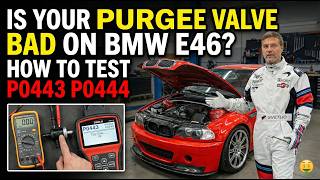
The BMW X3, spanning the E83 and F25 generations, uses a common EVAP purge valve design shared across many other BMW models from the era. While the code's meaning is standard, the purge valve itself is a frequent failure point on BMWs of this vintage. The issue is almost always electrical (the valve's internal solenoid fails) rather than mechanical (sticking), making diagnosis straightforward. The location of the valve is generally accessible on the engine, making it a popular DIY repair for X3 owners. 🎬 Watch: A complete P0444 purge valve replacement walkthrough. Some owners report that only a Genuine BMW replacement part will resolve the code, even if aftermarket parts test correctly with a multimeter.
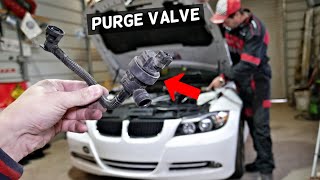
Generation note: This guide covers two generations of the BMW X3: the E83 (2003-2010) and the F25 (2010-2017). The function and failure of the EVAP purge valve are identical for both generations. The specific part number and location on the engine may vary slightly depending on the installed engine. For M54 engines (E83), the valve is near the intake manifold. For N52 engines (E83/F25), it is also on the intake manifold. 🎬 See: How to locate the valve on N52 engines. For N20 engines (F25), it is mounted behind the intake manifold near the firewall on the driver's side.
Symptoms You May Notice
- Check Engine Light is on
- Slightly rough idle in some cases
- A faint fuel odor is possible but not common with this specific circuit code
- Failure to pass a vehicle emissions test
- Replacing the gas cap. A faulty gas cap typically causes a P0455 or P0456 (EVAP leak) code, not a P0443 circuit code.
- Replacing the charcoal canister. This is a component of the EVAP system but is not related to the electrical circuit of the purge valve.
Most Likely Causes
- Failed EVAP Purge Valve (Solenoid) 🔴 High Probability The internal coil of the solenoid is a known common failure item on many BMW models of this era, including the X3. Some owners report that even new aftermarket valves that test within spec can fail to clear the code, and only a Genuine BMW part resolves the issue.
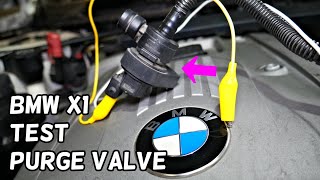
How to confirm: With the engine off, disconnect the electrical connector and measure the resistance across the two pins on the valve with a multimeter. A healthy valve will typically have a resistance between 20-35 ohms. One owner measured a new, working valve at 26 ohms and a faulty one at 31 ohms, indicating a narrow tolerance. An open circuit (infinite resistance) or a dead short (zero resistance) confirms the valve has failed. You can also apply 12V directly to the pins and listen for a 'click' and verify air can pass through. 🎬 Watch: How to bench test your purge valve for flow. No click or no airflow when energized indicates failure.
Typical fix: Replace the EVAP purge valve. It is typically mounted on or near the intake manifold and held by a simple bracket and two hoses.
Est. part cost: $30-$120 - Damaged Wiring or Connector 🟡 Medium Probability Engine heat and vibration can make the wiring and plastic connector brittle over time, leading to cracks, breaks, or poor pin contact.
How to confirm: Visually inspect the wiring harness leading to the purge valve for any signs of cracking, fraying, or breaks. Wiggle the connector with the engine running to see if it induces a change in idle or triggers the code. Use a multimeter to check for 12V power on one pin of the connector with the key on, and check for continuity on the other wire back to the DME.
Typical fix: Repair the damaged section of wire or replace the connector pigtail.
Est. part cost: $5-$25 - Blown Fuse ⚪ Low Probability
How to confirm: Consult the vehicle's fuse diagram to identify the fuse for the emissions system components. Visually inspect the fuse and test for continuity with a multimeter.
Typical fix: Replace the blown fuse. If it blows again, it indicates a short circuit in the system that needs to be traced.
Est. part cost: $1-$5
Rare But Worth Checking
- Faulty Engine Control Module (DME): This is extremely rare. The DME driver for the valve can fail, but this should be the absolute last component to suspect. All other possibilities, including the valve and wiring, must be exhaustively tested and ruled out before considering a faulty DME.
Diagnosis Steps
- Scan the vehicle with an OBD-II scanner to confirm P0443 is the primary code present.
- Locate the EVAP purge valve. On M54/N52 engines, it's near the intake manifold; on N20 engines, it's behind the manifold near the firewall.
- Inspect the electrical connector and wiring going to the valve for any visible damage, corrosion, or loose connections.
- With the ignition on (engine off), disconnect the connector and use a multimeter to verify that one of the pins has 12-volt power.
- With the connector still disconnected, measure the resistance across the two pins on the purge valve itself. A healthy valve will have a specific resistance, typically between 20-35 ohms. An open circuit (OL) or short circuit (near 0 ohms) indicates a bad valve.
- If voltage and resistance tests are inconclusive, use a scan tool with bidirectional controls to command the valve to open and close. You should hear an audible click from the valve. Note that a click doesn't guarantee it's opening; a flow test may be needed.
- If the valve clicks and the wiring is good, the problem may be intermittent or the valve may be out of the DME's expected resistance tolerance. Some owners have found that only a Genuine BMW part will fix the issue.
- If the valve is confirmed bad, replace it.
Parts You'll Likely Need
- EVAP Purge Valve (Tank Vent Valve)
(OEM #13907618643 (supersedes 13907572234, 13904588396 - check by VIN))— This is the most common failure point for a P0443 code on these vehicles due to internal solenoid failure.
Trusted brands: Bosch, Pierburg, Standard Motor Products, Genuine BMW
OEM price range: $80-$120
Aftermarket price range: $30-$70
Related Codes That Often Appear With This One
- P0444 — P0444 indicates 'EVAP Purge Control Valve Circuit Open'. It's a more specific version of the P0443 fault and often points directly to a failed valve solenoid or a complete break in the wiring.
Platform-Specific Known Issues
- On Xoutpost.com, a user with a 2001 X5 (sharing engine architecture) reported chasing a P0444 code. His old valve tested at 27.8 Ohms and appeared to function perfectly with a 12V source and scan tool activation, yet the code persisted. Replacing it with a Genuine BMW part was the only solution, suggesting the DME may have very tight tolerances for the valve's electrical characteristics.
Mechanic-Grade Diagnostic Values
- EVAP Purge Valve (TEV) Solenoid Resistance — expected: 25 to 30 Ohms. One source cites a new, good valve measuring 28.1 Ohms.. Failure: A reading significantly outside the 25-30 Ohm range, such as a very high reading (e.g., 190 Ohms) or an open circuit (OL), indicates a failed solenoid coil.
- Voltage at Purge Valve Connector, Pin 1 (Supply) — expected: Battery voltage (approx. 12V) with ignition on, engine off.. Failure: No voltage indicates a problem with the power supply, likely a blown fuse or a break in the wire from the fuse box.
- Signal at Purge Valve Connector, Pin 2 (DME Control) — expected: This is a ground-side switched, pulse-width modulated (PWM) signal from the DME. When testing with a multimeter, it may show a fluctuating voltage. When the DME commands the valve open, it provides a path to ground.. Failure: A constant ground or constant open on this pin when the valve should be activating (viewed with a scan tool) can indicate a wiring fault or a failed DME driver.
Hidden / Shadow Codes Worth Checking
- 2A15: DMTL, tank-venting valve, activation: short circuit to B+ or open circuit. This is a BMW-specific code for an electrical fault in the purge valve circuit, often corresponding to P0443 or P0444. (see via BMW-specific diagnostic software like ISTA or INPA, or advanced professional scan tools.)
- 2A16: DMTL, tank-venting valve, activation: short circuit to ground. This is another BMW-specific fault pointing to a short in the purge valve control circuit. (see via BMW-specific diagnostic software like ISTA or INPA, or advanced professional scan tools.)
Scan Tool Commands That Help
- ISTA (Rheingold): Vehicle Test -> DME -> Call up ECU functions -> Component activation -> Tank-venting valve (TEV) — Use this to command the purge valve to open and close while the engine is off or running. You should hear an audible clicking from the valve. This directly tests the wiring from the DME and the valve's solenoid functionality. Lack of a click when activated points to a bad valve or wiring.
- INPA: Select Engine -> F6 (Activate) -> F1 (Group 1) -> F3 (Fuel tank vent valve). — This allows for manual activation of the fuel tank vent valve (purge valve) to check for audible clicking and to monitor system response. It is a quick way for a technician familiar with INPA to verify the electrical integrity of the circuit and valve.
Wiring & Ground Locations
- Purge Valve Connector (X6354 on N52) — Connected directly to the EVAP purge valve, which is located under the intake manifold on N52 engines.. This is the primary point of failure for wiring. Pin 1 is typically the 12V supply (often a Red/White wire), and Pin 2 is the ground-side control from the DME (often a Brown/Green wire). Checking for voltage and signal integrity here is a key diagnostic step.
- Engine Ground Strap — Varies by engine, but commonly runs from the engine block or an engine mount bracket to a stud on the vehicle's chassis/frame rail. On E90-based vehicles (sharing N52 architecture), one is on the driver's side engine mount bracket.. A corroded or broken main engine ground strap can cause a host of intermittent and bizarre electrical issues. While not a direct cause of P0443, it can create unstable voltage and ground references for the DME and its sensors, potentially leading to false circuit codes. It should be inspected for corrosion (green crust) and integrity, especially on higher-mileage or salt-belt vehicles.
Real Owner Repair Stories
- XBimmers.com user (2003 BMW X5 4.4i (E53, shares engine architecture and EVAP components)) — Intermittent Service Engine Soon light with code P0443.
❌ Tried (didn't work) Replacing the gas cap, Replacing the EVAP purge control valve
✅ What actually fixed it The user was still diagnosing at the time of the post, having tried the two most common fixes without success. The thread highlights that even after replacing the primary components, the electrical circuit fault can persist, pointing towards a wiring issue or, rarely, the DME itself.
OEM Part Supersession History
13904588396→13907572234, then 13907618643— Standard part evolution for improved reliability or manufacturing changes.
Heads up: No known incompatibilities; the latest part number (13907618643) is the correct replacement for the N52-engined X3 models. Always verify fitment with the vehicle's VIN.
Diagnostic Flowchart
Other Known Issues on This Vehicle
Issues unrelated to this code that are worth knowing about as an owner of this generation:
- E83: Transfer Case Actuator Gear Failure 🔴 High — Very common, typically occurs around 80,000-120,000 miles. Symptoms include 4x4, ABS, and Brake warning lights, and clicking/jerking on acceleration.
- F25: N20 Engine Timing Chain Guide Failure 🔴 High — Common on 2012-early 2015 models. Plastic guides break, causing a distinct whining noise that can lead to catastrophic engine failure if ignored. (Ref: BMW issued an extended warranty (7 years/70,000 miles) for this issue, but it has now expired for most vehicles.)
- E83/F25: Electric Water Pump Failure 🔴 High — Common on N52, N54, N55 engines, typically failing between 60,000-100,000 miles. Failure is often sudden, causing rapid overheating and limp mode.
- E83/F25: Valve Cover & Oil Filter Housing Gasket Leaks 🟠 Medium — Extremely common on most BMW engines of this era, including M54 and N52. Leaks typically start after 60,000 miles, causing oil drips and a burning oil smell.
- F25: Sunroof Drain Clogging and Water Leaks 🟠 Medium — Common issue where sunroof drainage channels get blocked with debris, causing water to leak into the cabin, potentially damaging electronics.
Used vs. New Parts: Buying Guide for This Vehicle
When a used part is the smart pick: For this specific repair, a used part is not recommended. The EVAP purge valve is an inexpensive electronic component with a known wear pattern. The cost savings of a used part are minimal compared to the risk of receiving a part that has already failed or is near the end of its service life.
Donor-vehicle mileage cap: roughly under 150000 miles for the part to have meaningful remaining life.
What to inspect on the donor part:
- If forced to buy used, inspect the plastic housing for cracks or heat damage.
- Check the electrical connector pins for any corrosion or damage.
- Test the resistance with a multimeter before purchase; it should be within the 25-30 Ohm range.
OEM-only on this vehicle (don't cheap out):
- EVAP Purge Valve (recommended). While aftermarket options exist, some forum members report that only the Genuine BMW or OEM supplier (Bosch/Pierburg) part will clear the code, suggesting the DME has very tight electrical tolerances for this component.
Aftermarket brands forum-validated for this vehicle:
- Bosch (often the OEM supplier)
- Pierburg
Brands owners have reported issues with on this vehicle:
- Generic, unbranded parts from online marketplaces have a higher reported failure rate or may not meet the DME's precise electrical specifications.
Real Owner Stories
Aggregated from forums and TSBs cited above. Mileages and costs reflect what owners reported in those sources.
2001 BMW X5 M54 (Shared Architecture)
Symptoms: The owner was chasing a P0444 code (related to P0443). The old valve tested at 27.8 Ohms and appeared to function perfectly when activated with a 12V source and a scan tool.
What fixed it: Replacing the unit with a Genuine BMW part was the only solution, as the DME likely had very tight tolerances for the valve's electrical characteristics.
Source hint: xoutpost.com/bmw-sav-forums/x5-e53-forum/109841-p0443-error-what-voltage-should-i-have-sensor.html
Related OBD-II Codes
Frequently Asked Questions
I found an aftermarket purge valve for my X3 for $30; should I use it to fix P0443?
Where is the EVAP purge valve located on my 2013-2017 X3 with the N20 engine?
What resistance should I see when testing the purge valve on my E83 X3?
Can a blown fuse cause the P0443 code on my BMW?
Is the P0443 code related to the timing chain guide issues on my F25 X3?
Will a faulty purge valve cause my X3 to fail an emissions test?
Helpful Videos
We Have This Part in Stock


The information in this article is provided for general reference and educational purposes only. Vehicle specifications, procedures, and part compatibility can vary by production date, trim level, and region. Always consult your vehicle's factory service manual and verify part numbers before purchasing or performing repairs. Safety-critical components such as airbags, seat belts, and braking systems should be installed by a qualified professional.
- BMW X3:
- 🎬 Helpful Videos
- 🛍️ Shop This Part
- What's Unique About the 2003-2017 BMW X3
- Symptoms You May Notice
- Most Likely Causes
- Rare But Worth Checking
- Diagnosis Steps
- Parts You'll Likely Need
- Related Codes That Often Appear With This One
- Platform-Specific Known Issues
- Mechanic-Grade Diagnostic Values
- Hidden / Shadow Codes Worth Checking
- Scan Tool Commands That Help
- Wiring & Ground Locations
- Real Owner Repair Stories
- OEM Part Supersession History
- Diagnostic Flowchart
- Other Known Issues on This Vehicle
- Used vs. New Parts: Buying Guide for This Vehicle
- Real Owner Stories
- 2001 BMW X5 M54 (Shared Architecture)
- Related OBD-II Codes
- Frequently Asked Questions
- 🎟️ Get 5% Off