

P0443 on 2005-2013 BMW 3-Series: EVAP Purge Valve Circuit Causes and Fixes
On a 2005-2013 BMW 3-Series (E9x), code P0443 almost always means the fuel tank breather valve (EVAP purge valve) has failed due to an internal electrical fault. It is a common and straightforward DIY replacement located on the intake manifold. The part costs between $70 for a quality aftermarket replacement and $130 for an OEM part.
- P0443 on an E9x BMW 3-Series points to an electrical failure in the EVAP purge valve circuit, not a system leak.
- The most likely culprit, by a large margin, is a failed fuel tank breather valve (the purge valve itself).
- Diagnosis is straightforward: check for 12V power and test the valve's resistance (15-30 Ohms).
- It's a common DIY repair that takes less than an hour with basic tools.
- N51 SULEV engines may have this part covered under a 15-year/150,000-mile extended warranty.
What's Unique About the 2005-2013 BMW 3-Series
For the E9x generation 3-Series (E90, E91, E92, E93), the P0443 code is a very common and well-documented issue. The cause is overwhelmingly a simple failure of the purge valve solenoid over time. Unlike some vehicles where wiring chafe is a primary concern, on the E9x platform, the valve itself is the most frequent point of failure. The repair is consistent across the various gasoline engines used in this chassis, including the popular N51, N52, and N54. For vehicles with the N51 (SULEV) engine, this part may be covered under an extended emissions warranty (15 years/150,000 miles).
Generation note: The 2005-2013 year range covers the entire E9x generation of the BMW 3-Series, which includes the E90 (Sedan), E91 (Wagon), E92 (Coupe), and E93 (Convertible). The cause and repair for code P0443 are consistent across all of these body styles and their associated gasoline engines (e.g., N51, N52, N54).
Symptoms You May Notice
- Check Engine Light is on
- Possible slightly rough idle, especially after refueling, if the valve is stuck open
- Potential for a faint fuel odor if the valve is stuck open
- Slightly reduced fuel economy
- Guaranteed failure of an emissions test
- Replacing the gas cap. A bad gas cap typically causes a large leak code, such as P0455 or P0456, not an electrical circuit code like P0443.
Most Likely Causes
- Faulty EVAP Purge Valve (Fuel Tank Breather Valve) 🔴 High Probability The internal solenoid coil in the valve is a common failure item due to age and heat cycles in the engine bay. It fails electrically, creating an open or short circuit.
How to confirm: Use a multimeter to check for resistance across the two pins on the valve; a reading between 15-30 ohms is expected. An open circuit (infinite resistance/OL) or a short (near-zero resistance) indicates a bad valve. Alternatively, use a scan tool to command the valve to activate; a lack of an audible 'click' suggests it has failed.
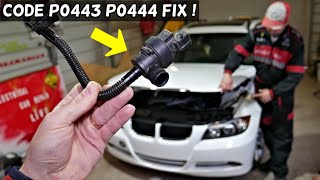
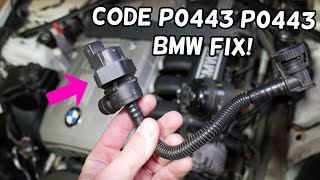
Typical fix: Replace the fuel tank breather valve. It is typically located on the side of the engine near the intake manifold, sometimes under the engine cover.
Est. part cost: $70-$130 - Damaged Wiring or Connector ⚪ Low Probability While less common than valve failure, the wiring harness connector can become brittle from engine heat, and the wires can be damaged during other engine service.
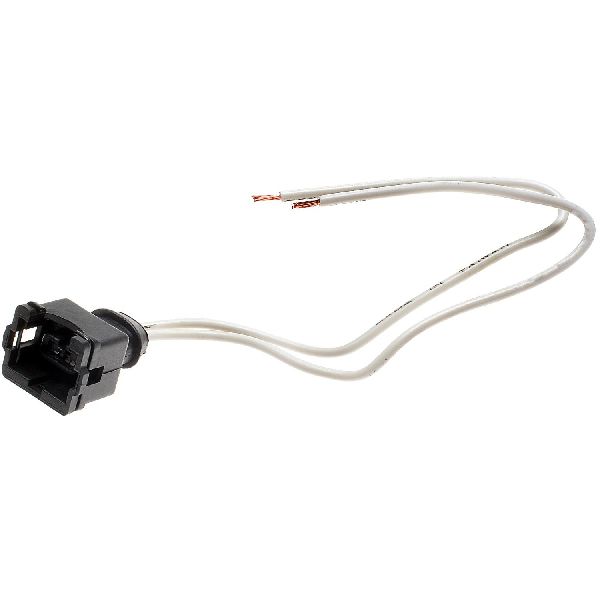
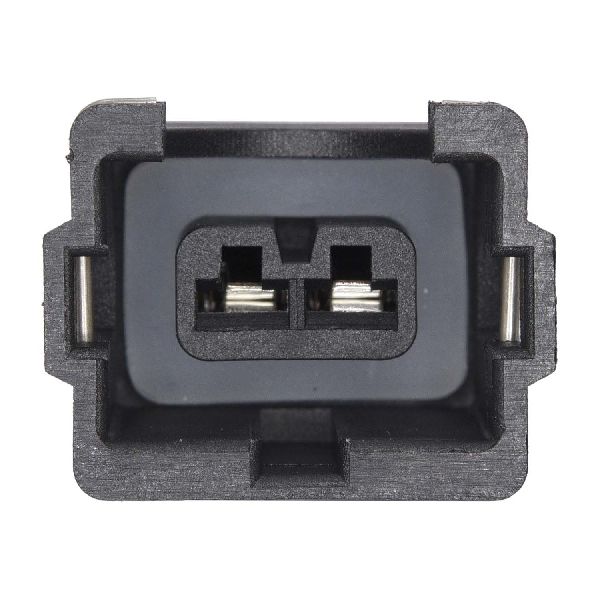
How to confirm: Visually inspect the wiring harness leading to the purge valve for any signs of cracking, fraying, or heat damage. Check the connector for corrosion or bent pins. Use a multimeter to confirm 12V power at one pin of the connector with the ignition on.
Typical fix: Repair the damaged section of the wiring harness or clean/replace the electrical connector.
Est. part cost: $5-$25 - Blown Fuse ⚪ Low Probability
How to confirm: Consult your vehicle's fuse diagram, located on a paper card behind the glove box panel, and locate the fuse for the engine electronics or emissions components. Visually inspect the fuse or test it for continuity with a multimeter. On many E9x models, this circuit is powered by fuse F37 in the Junction Box Electronics (JBE) module.
Typical fix: Replace the blown fuse. If the fuse blows again, it indicates a short circuit in the system that needs to be diagnosed, likely a shorted purge valve or wiring.
Est. part cost: $1-$5
Rare But Worth Checking
- Faulty Engine Control Module (DME/PCM): This is extremely rare. The DME contains the driver circuit that controls the valve. This should only be considered a potential cause after the valve, wiring, and fuses have all been thoroughly tested and confirmed to be good.
Diagnosis Steps
- Read the codes with an OBD-II scanner to confirm P0443 and/or P0444 is present.
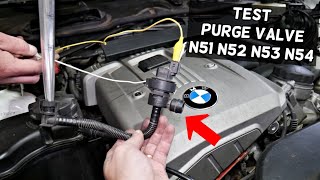
- Locate the EVAP purge valve (fuel tank breather valve). On N52 and N54 engines, it is mounted on a bracket on the driver's side of the intake manifold.
- Inspect the electrical connector and wiring going to the valve for any visible damage, corrosion, or looseness.
- Check the associated fuse. The fuse box is behind the glove compartment. Check the fuse diagram for the specific fuse related to engine electronics (often F37).
- Disconnect the valve's electrical connector. With the ignition on (engine off), use a multimeter to verify that one of the pins in the connector has battery voltage (approx. 12V).
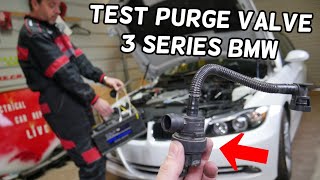
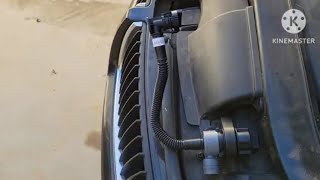
- Test the valve itself. Set your multimeter to Ohms (Ω) and measure the resistance between the two pins on the valve. A good valve should read between 15 and 30 Ohms. A reading of 'OL' (Over Limit/Open Loop) or near 0 Ohms indicates a failed valve. 🎬 Watch: How to test the purge valve on BMW N52 and N54 engines
- If you have a capable scan tool, perform an activation test to command the valve to click. If it has power but doesn't click, the valve is bad.
- If the valve tests good and the wiring has power, check the other wire (the signal wire) for continuity back to the DME. This step is advanced and usually unnecessary as the valve is the common failure point.
Parts You'll Likely Need
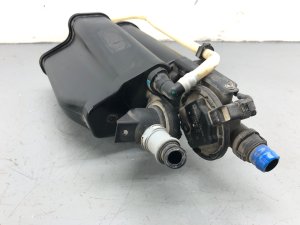
- Fuel Tank Breather Valve (EVAP Purge Valve)
(OEM #13907618643)— This is the most common failure point for the P0443 code on this platform. The internal solenoid fails electrically. The original part number has been superseded multiple times.
Trusted brands: Genuine BMW, Bosch (OEM), Febi-Bilstein, URO Parts
OEM price range: $110-$140
Aftermarket price range: $60-$90
Related Codes That Often Appear With This One
- P0444 — P0444 indicates 'EVAP Purge Control Valve Circuit Open'. This is a more specific version of the P0443 fault and often appears alongside it or instead of it, pointing directly to a failed valve solenoid or a break in the wiring.
Platform-Specific Known Issues
- N51 SULEV Warranty Coverage: Owners of vehicles with the N51 engine (a Super Ultra Low Emission Vehicle variant sold in certain states) should check with a BMW dealer if their car is under 15 years old and has fewer than 150,000 miles. The fuel tank breather valve is listed as a covered component under this extended emissions warranty, potentially making the repair free of charge.
- Owner Experience: Simple DIY Fix: Numerous owners on forums like e90post.com and bimmerfest.com report P0443 as a straightforward DIY fix. A typical story involves scanning the code, ordering the Bosch OEM valve (part no. 13907618643), and replacing it in under 30 minutes using basic tools, which resolves the check engine light immediately after clearing the code.
Mechanic-Grade Diagnostic Values
- EVAP Purge Valve Solenoid Resistance — expected: 27-29 Ohms. Failure: A significantly higher reading, such as ~190 Ohms, indicates an internal short. An 'OL' or infinite reading indicates an open circuit.
- Purge Valve Connector Voltage (Ignition On, Engine Off) — expected: One pin should show constant battery voltage (~12V). The other pin is the control wire and will show 0V or fluctuating voltage.. Failure: No voltage on the power pin indicates a fuse or wiring issue upstream. The control signal is a Pulse-Width Modulated (PWM) ground from the DME, so a simple multimeter reading on this pin is not definitive; an oscilloscope is needed to properly view the signal.
Hidden / Shadow Codes Worth Checking
- 2A1A: Tank ventilation system, function. This is the BMW-specific hexadecimal code that corresponds to the generic P0443 OBD-II code. Seeing this code on a BMW-specific scanner like ISTA or with apps like MHD confirms the fault is with the purge valve system. (see via BMW-specific diagnostic software (ISTA, INPA) or advanced OBD-II scanners and mobile apps (MHD, ProTool).)
Scan Tool Commands That Help
- ISTA (BMW Dealer Software): Component Triggering -> DME -> Activate Tank Ventilation Valve (TEV) — This function allows you to directly command the purge valve to open and close. You should hear an audible click from the valve each time it's activated. A lack of a click, assuming power is present at the connector, confirms a failed valve solenoid.
- Advanced Generic Scan Tool: EVAP System Test / Bidirectional Control — Used to test for a stuck-open valve. With the engine running, command the purge valve OFF and the vent valve ON (closed). Monitor the Fuel Tank Pressure (FTP) sensor data. If the pressure begins to drop into a vacuum, it indicates the purge valve is leaking and not fully closing when commanded off.
Wiring & Ground Locations
- X60005, Pin 23 — This is one of the main connectors at the Engine Control Module (DME), located in the electronics box (E-box) in the engine bay.. Pin 23 is the specific signal wire that the DME uses to control the fuel tank vent (purge) valve. If the valve and its power supply test good, a continuity test from this pin to the valve's connector can identify a break in the signal wire.
- Main Engine Ground Strap — Connects the engine block to the chassis. On the E9x, it is located on the driver's side of the engine, running from the engine mount/oil pan area to the chassis frame rail, often visible after removing the under-tray or fender liner.. While a bad ground strap typically causes more severe issues like a no-start condition, a corroded or loose ground can create floating voltages and unpredictable behavior for all DME-controlled components, including the purge valve driver. It should be inspected for corrosion as part of any electrical diagnosis.
Real Owner Repair Stories
- e90post.com user 'thepianotamer' (BMW E90 (model year not specified)) — Check Engine Light with code 2A1A, hard starts, and poor acceleration above 3,000 RPM.
❌ Tried (didn't work) Replaced the purge valve with an aftermarket part, but the code returned quickly., Replaced the purge valve a second time with another aftermarket part, which also failed.
✅ What actually fixed it Replacing the purge valve for a third time with a different, presumably higher-quality or OEM, part finally resolved the issue. The user reported the fix was successful for nearly four years, suggesting the previous replacement parts were either defective or out of specification for the vehicle.
OEM Part Supersession History
13907572234→13907618643— Typically for design improvements, material changes, or supplier updates to increase reliability.13904588396→13907572234— Typically for design improvements, material changes, or supplier updates to increase reliability.
Model Year Variations Within This Range
- 2007-2011: Manual transmission models produced up to March 2011 may trigger a false P0443 (2A1A) due to a DME software error, as outlined in BMW Service Information bulletin SI B12 01 11. The fix is a vehicle software update, not a hardware replacement.
Diagnostic Flowchart
Other Known Issues on This Vehicle
Issues unrelated to this code that are worth knowing about as an owner of this generation:
- Electric Water Pump & Thermostat Failure 🔴 High — Common failure between 60,000-100,000 miles. Can cause sudden overheating and leave you stranded.
- Oil Filter Housing Gasket (OFHG) & Oil Cooler Gasket Leaks 🟠 Medium — Very common leak point. Oil drips onto the serpentine belt, causing it to degrade, slip, or shred, which can lead to the belt being ingested into the engine's front main seal, causing catastrophic engine failure.
- Valve Cover & Gasket Leaks 🟠 Medium — The plastic valve cover can crack and the gasket becomes brittle, leading to oil leaks onto the exhaust manifold (causing a burning smell) and into the spark plug wells. Common around 80,000-120,000 miles.
- N54: High-Pressure Fuel Pump (HPFP) Failure 🔴 High — A notorious issue on the twin-turbo N54 engine, causing long cranks, rough idle, and sudden loss of power ('limp mode'). Subject to recalls and extended warranties. (Ref: NHTSA Action Number: PE10037, BMW Recalls)
- N54: Turbocharger Wastegate Rattle 🟠 Medium — Wear in the wastegate actuator rod/bushing causes a rattling noise on deceleration. Can eventually lead to low boost fault codes and reduced power. (Ref: BMW extended the warranty on turbochargers for this issue to 8 years/82,000 miles.)
- Oil Pan Gasket Leak 🟡 Low — A common but less critical oil leak. The repair is very labor-intensive (and thus expensive) as the front subframe must be lowered for access, especially on AWD (xi) models.
Used vs. New Parts: Buying Guide for This Vehicle
When a used part is the smart pick: Buying a used purge valve is not recommended. It is an electronic solenoid and a common wear-and-tear item that fails from heat and age. The cost savings are minimal compared to the high risk of receiving a part that is already near the end of its service life.
What to inspect on the donor part:
- Not applicable as used purchase is not advised.
OEM-only on this vehicle (don't cheap out):
- While not strictly 'OEM-only', using the OEM supplier (Bosch) for the Fuel Tank Breather Valve is highly recommended for this platform to avoid premature failure and compatibility issues reported with cheaper aftermarket brands.
Aftermarket brands forum-validated for this vehicle:
- Bosch (OEM supplier)
- Febi-Bilstein
Brands owners have reported issues with on this vehicle:
- URO Parts (frequently cited for poor quality and fitment issues across many BMW components)
- Unbranded, low-cost parts from online marketplaces (as they may be out-of-spec and cause recurring codes)
Real Owner Stories
Aggregated from forums and TSBs cited above. Mileages and costs reflect what owners reported in those sources.
BMW E90 3-Series
Symptoms: Check engine light on; owners report this as a straightforward issue often resolved in under 30 minutes.
What fixed it: Replacing the fuel tank breather valve with Bosch OEM part no. 13907618643 and clearing the code.
Source hint: e90post.com and bimmerfest.com forum threads cited in 'Owner Experience: Simple DIY Fix'
BMW E53 X5
Symptoms: Code P0443 persisted even after the owner attempted to fix it by replacing the gas cap and the purge valve.
What fixed it: The owner highlighted that while the valve is common, wiring issues can also be the culprit when a new valve doesn't solve the code.
Source hint: XBimmers.com user report
Related OBD-II Codes
Frequently Asked Questions
Will my emissions warranty cover the fuel tank breather valve on my N51 SULEV 3-Series?
Where is the EVAP purge valve located on the N52 or N54 engine?
What resistance should I see when testing the BMW fuel tank breather valve with a multimeter?
Which fuse should I check for P0443 on an E9x 3-Series?
Can I just replace the gas cap to fix code P0443 on my BMW?
What is the specific Bosch OEM part number for the replacement valve?
Helpful Videos
Used OEM Parts in Stock


New Aftermarket Parts Available


The information in this article is provided for general reference and educational purposes only. Vehicle specifications, procedures, and part compatibility can vary by production date, trim level, and region. Always consult your vehicle's factory service manual and verify part numbers before purchasing or performing repairs. Safety-critical components such as airbags, seat belts, and braking systems should be installed by a qualified professional.
- BMW 3-Series:
- 🎬 Helpful Videos
- 🛍️ Shop This Part
- What's Unique About the 2005-2013 BMW 3-Series
- Symptoms You May Notice
- Most Likely Causes
- Rare But Worth Checking
- Diagnosis Steps
- Parts You'll Likely Need
- Related Codes That Often Appear With This One
- Platform-Specific Known Issues
- Mechanic-Grade Diagnostic Values
- Hidden / Shadow Codes Worth Checking
- Scan Tool Commands That Help
- Wiring & Ground Locations
- Real Owner Repair Stories
- OEM Part Supersession History
- Model Year Variations Within This Range
- Diagnostic Flowchart
- Other Known Issues on This Vehicle
- Used vs. New Parts: Buying Guide for This Vehicle
- Real Owner Stories
- BMW E90 3-Series
- BMW E53 X5
- Related OBD-II Codes
- Frequently Asked Questions
- 🎟️ Get 5% Off