

P0430 on 2010-2014 Subaru Legacy 3.6L H6: Catalyst Efficiency Causes and Fixes
P0430 on a 2010-2014 Subaru Legacy 3.6L almost always points to a failing Bank 2 (driver's side) catalytic converter, especially on vehicles with over 100,000 miles. While an exhaust leak or a faulty oxygen sensor are possible secondary causes, the converter itself is the most common failure point. Expect to spend $500+ for an aftermarket converter and over $1,500 for an OEM replacement.
- P0430 on your 3.6L Legacy means the driver's side catalytic converter is likely failing.
- Before buying an expensive new converter, perform a thorough inspection for exhaust leaks, especially around gaskets.
- Diagnose properly using a scan tool to watch O2 sensor data; don't just replace sensors hoping for a fix.
- If you have any engine misfire codes, you MUST fix that problem first, or you will destroy the new converter.
What's Unique About the 2010-2014 Subaru Legacy
The Subaru H6 (EZ36D) engine, paired with a 5-speed automatic transmission (5EAT) in this generation, has two separate exhaust manifolds and two corresponding catalytic converters, one for each bank of cylinders. P0430 specifically isolates the issue to the driver's side (Bank 2). While the underlying causes are common across many vehicles, Subarus are known for having exhaust gasket leaks, which can introduce oxygen into the exhaust and trigger this code. However, numerous owner experiences show that the catalytic converter itself is the most frequent point of failure on these models, often after 100,000 miles.
Symptoms You May Notice
- Check Engine Light is on.
- Failure to pass an emissions test.
- Reduced engine power and sluggish acceleration, especially if the converter is becoming clogged.
- A rattling noise from under the vehicle if the internal ceramic monolith of the converter has broken apart.
- A sulfur or 'rotten egg' smell from the exhaust, indicating the converter is not processing sulfur in the fuel correctly.
- Replacing the oxygen sensors immediately. This is a common 'parts cannon' approach that often fails to fix the code. A bad catalytic converter requires good, functioning oxygen sensors to be diagnosed by the ECM. While sensors can fail, they are statistically less likely to be the root cause than the converter itself on a higher-mileage vehicle.
Most Likely Causes
- Failing Bank 2 Catalytic Converter 🔴 High Probability Catalytic converters have a finite lifespan and typically fail from age and mileage (often over 100k miles). Contamination from burning oil (a known issue on some Subaru engines) or coolant, or damage from persistent engine misfires, can significantly accelerate this failure.
How to confirm: After ruling out exhaust leaks and sensor issues, this is the most likely cause. A definitive test involves comparing the upstream and downstream oxygen sensor readings on a scan tool at a steady RPM (e.g., 2,500). A healthy converter shows a steady downstream sensor voltage, while a bad one shows a rapidly fluctuating voltage that mirrors the upstream sensor. 🎬 Watch this quick diagnostic to see how to test your converter. A temperature gun can also be used; the outlet of a working converter should be significantly hotter (at least 100°F) than the inlet.
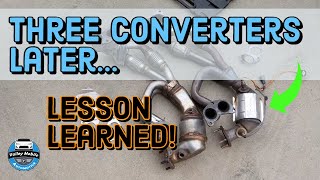
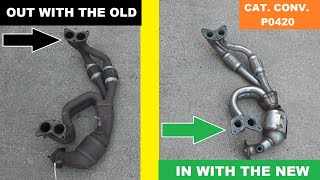
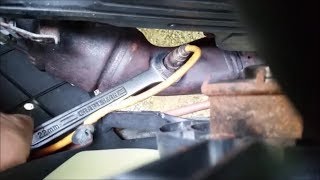
Typical fix: Replace the Bank 2 (driver's side) catalytic converter assembly. It is often integrated with the exhaust manifold. 🎬 Watch: How to replace the catalytic converter with basic hand tools.
Est. part cost: $500-$2200 - Exhaust System Leak 🟡 Medium Probability Subaru exhaust systems, particularly the gaskets between the manifold and head or at flange connections, can develop leaks over time due to rust and thermal cycles. A leak upstream of or near the catalytic converter can introduce un-metered oxygen, fooling the sensors into reporting a false efficiency code.
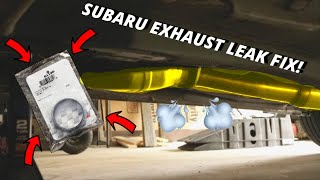
How to confirm: Perform a visual inspection of the exhaust system from the engine to the rear of the car, looking for black soot trails, cracks, or heavy rust at the flanges. Listen for an audible ticking or hissing noise, especially when the engine is cold. A smoke test is the most effective professional method to pinpoint a small leak. 🎬 See how to fix a Subaru exhaust leak for under $20.
Typical fix: Replace the leaking gasket or repair/replace the cracked section of the exhaust pipe.
Est. part cost: $20-$200 - Faulty Oxygen Sensor (Rear/Downstream) ⚪ Low Probability
How to confirm: A lazy or biased downstream O2 sensor can fail to report the correct catalyst efficiency. Graph the sensor's voltage with a scan tool. It should be relatively stable (around 0.6-0.8V) on a warm, running engine at steady RPM. If it's stuck or fluctuating wildly like the front sensor, it may be faulty. However, this symptom is identical to a bad converter, making it a tricky diagnosis. It's a common misdiagnosis to replace the sensor when the converter is the real issue.
Typical fix: Replace the Bank 2 downstream oxygen sensor. One owner on legacygt.com reported this fixed their P0430 code.
Est. part cost: $80-$180 - Faulty Air/Fuel Ratio Sensor (Front/Upstream) ⚪ Low Probability
How to confirm: A faulty front A/F sensor can cause an incorrect air/fuel mixture, which can either damage the catalytic converter over time or lead to incorrect efficiency calculations by the ECM. This will usually be accompanied by fuel trim codes like P0172 (Rich) or P0175 (Rich, Bank 2).
Typical fix: Replace the Bank 2 upstream Air/Fuel ratio sensor.
Est. part cost: $150-$250
Rare But Worth Checking
- Underlying Engine Issues: An engine that is burning oil (due to worn piston rings or valve seals) or leaking coolant into the combustion chamber (head gasket issue) will contaminate and destroy a new catalytic converter quickly. Misfires can also send unburnt fuel into the exhaust, overheating and melting the converter substrate. Always resolve any misfire (P030x) or fuel trim codes before replacing a converter.
- ECM Software Issue: While no specific TSB for this P0430 code on this model was found, other manufacturers have issued software updates to change the sensitivity of the catalyst monitor. This is a very rare possibility but worth considering if all hardware checks out perfectly.
Diagnosis Steps
- Check for other DTCs. If any misfire (P030x), fuel trim (P017x), or other sensor codes are present, diagnose and fix them first, as they are the likely root cause of catalyst failure.
- Inspect the exhaust system thoroughly. Start the engine when cold and listen for any ticking or hissing sounds that would indicate a leak, especially around the exhaust manifold gaskets and flanges. Visually inspect all gaskets and pipe welds for black soot trails or cracks.
- Use a scan tool to monitor live data. With the engine fully warmed up and held at a steady 2,500 RPM, observe the voltage graphs for the Bank 2 upstream (A/F Sensor 2) and downstream (Rear O2 Sensor 2) sensors.
- Analyze sensor data: A good catalytic converter will show the upstream sensor fluctuating rapidly, while the downstream sensor remains relatively steady and high (e.g., >0.6V). If the downstream sensor's graph mirrors the upstream sensor's fluctuations, the converter is not storing oxygen and has failed.
- Test for a clogged converter (optional). If experiencing significant power loss, you can use an infrared thermometer to measure the temperature of the pipe just before and just after the converter. The outlet should be at least 100°F hotter than the inlet. If it's cooler or the same temperature, it may be clogged or chemically inactive.
- If exhaust leaks are ruled out and the sensor data confirms low efficiency, the Bank 2 catalytic converter is the faulty component and requires replacement.
Parts You'll Likely Need
- Bank 2 Catalytic Converter Assembly (Driver's Side) — This is the most common cause of P0430 on higher-mileage vehicles. The internal catalyst materials degrade over time and lose their ability to convert exhaust gases.
Trusted brands: Subaru (OEM), Walker, MagnaFlow, Davico
OEM price range: $1500-$2200
Aftermarket price range: $500-$900 - Bank 2 Upstream Air/Fuel Ratio Sensor (Driver's Side, Pre-Cat)
(OEM #22641AA53A)— This sensor provides crucial data for fuel trim. A faulty one can lead to conditions that damage the converter. It's often replaced with a new converter as good practice. This part number fits the 3.6L H6 engine.
Trusted brands: Subaru (OEM), Denso (e.g., 234-9092)
OEM price range: $180-$250
Aftermarket price range: $100-$160 - Bank 2 Downstream Oxygen Sensor (Driver's Side, Post-Cat) — This sensor's job is to monitor the converter. While less likely to be the cause than the converter itself, it can fail. It's often recommended to replace the O2 sensors when replacing a high-mileage catalytic converter to ensure proper monitoring.
Trusted brands: Subaru (OEM), Denso
OEM price range: $120-$180
Aftermarket price range: $80-$130
Related Codes That Often Appear With This One
- P0420 — This is the identical code but for Bank 1 (passenger side). Seeing both P0420 and P0430 at once strongly suggests a systemic issue like advanced age, contaminated fuel, or an engine problem (like oil consumption) affecting both banks equally.
- P0300, P0302, P0304, P0306 — These are misfire codes for Bank 2 cylinders (2, 4, and 6). An engine misfire allows unburnt fuel to enter the exhaust, which will rapidly overheat and destroy the catalytic converter. A misfire must be diagnosed and fixed before replacing the converter to prevent repeat failure.
Technical Service Bulletins (TSBs) & Recalls
- TSB 11-131-13R: ECM reprogramming for an extended engine cranking condition on 2013 2.5L models, not directly related to P0430 on the 3.6L.
Mechanic-Grade Diagnostic Values
- Short-Term Fuel Trim (STFT) — expected: Within +/- 5% at idle and steady cruise.. Failure: Consistently high positive or negative fuel trims (e.g., > +/- 10%) suggest an underlying issue like a vacuum leak or sensor problem that could lead to catalyst damage.
Scan Tool Commands That Help
- Subaru Select Monitor (SSM): Read Current Data / OBD System / Catalyst Diagnosis — The Subaru dealer-level tool can be used to view the status of the catalyst monitor self-test. It will show as 'Complete' or 'Incomplete'. This is useful to confirm if the drive cycle criteria have been met for the ECM to even run the catalyst efficiency test.
- Subaru Select Monitor (SSM): Clear Memory Mode — After a repair, this function is used to clear all learned values and diagnostic trouble codes from the ECM. This is a necessary step before performing a drive cycle to verify the fix.
Wiring & Ground Locations
- Engine Ground (GE) — On the left rear of the engine for the 3.6L model.. A poor engine ground can cause a host of electrical issues, including incorrect readings from the A/F and O2 sensors that are grounded through the engine block and harness. This can lead to false P0430 codes or improper fuel mixture that damages the converter.
- ECM Ground — The ECM is located on the right side of the dash. It receives its ground through various points, including GB-5 (right kick panel) and GB-6 (left kick panel).. The ECM compares the signals from the upstream and downstream O2 sensors. A fault in the ECM's own grounding can disrupt this sensitive measurement and lead to an incorrect P0430 diagnosis.
- Bank 2 O2 Sensor Connectors — The Bank 2 (driver's side) upstream A/F sensor is in the left cylinder head exhaust manifold. The downstream O2 sensor is located after the catalytic converter on the same side.. Corrosion or damage at these connectors is a common point of failure. A 'wiggle test' on the harness connector while watching live sensor data can reveal an intermittent connection that could trigger the P0430 code.
Real Owner Repair Stories
- Reddit user on r/subaruoutback (2011 Legacy with aftermarket exhaust) — Occasional check engine light with code P0430.
✅ What actually fixed it The user suspected the aftermarket exhaust or O2 sensors were the cause of the intermittent P0430 code, highlighting that modifications to the exhaust system can themselves be a cause for the code to appear, even if the catalytic converter is functional. The user was still in the troubleshooting phase but pointed to the aftermarket part as the likely origin.
OEM Part Supersession History
44620AD15A→44620AD15B— Part revision or supplier change.44620AD17A→44620AD17B— Part revision or supplier change. This part is noted for California emissions 2.5L models but illustrates the common part number progression.44612AA92A→44612AA92B— Part revision or supplier change.
Diagnostic Flowchart
Other Known Issues on This Vehicle
Issues unrelated to this code that are worth knowing about as an owner of this generation:
- 5EAT Transmission Torque Converter Shudder 🟠 Medium — Commonly reported by owners, typically manifests as a vibration or 'rumble strip' feeling during light acceleration between 35-45 MPH or around 1500-2000 RPM. (Ref: A TSB existed for earlier model years with the 5EAT transmission, but owners of 2010+ models still report the issue.)
- Engine Oil Leaks (Timing Chain Cover / Oil Pan) 🟠 Medium — The EZ36 is generally robust, but as it ages (typically over 100,000 miles), it is known to develop oil leaks from the large front timing chain cover seal and the two-piece oil pan gasket.
- Serpentine Belt Idler/Tensioner Pulley Failure 🟡 Low — The bearings within the serpentine belt idler and tensioner pulleys can wear out, causing noise or potential belt issues. This is a common maintenance item on higher-mileage (around 100k miles) engines.
Used vs. New Parts: Buying Guide for This Vehicle
When a used part is the smart pick: Used parts are generally not recommended for the catalytic converter itself due to its nature as a wear item and the high likelihood of a used part having limited remaining life. Used sensors are also a gamble. A used exhaust pipe or manifold (if separate from the converter) from a low-mileage, rust-free donor could be a viable option if the original is cracked or leaking.
Donor-vehicle mileage cap: roughly under 60000 miles for the part to have meaningful remaining life.
What to inspect on the donor part:
- For exhaust components, check for severe rust, especially at welds and flanges.
- Look for any signs of physical impact or damage.
- Avoid parts from regions with heavy road salt usage if possible.
OEM-only on this vehicle (don't cheap out):
- Catalytic Converter: Many forum users and mechanics report that aftermarket catalytic converters for Subarus, particularly Walker, may not have enough precious metal loading to satisfy the ECM's strict monitoring parameters, leading to the P0420/P0430 codes returning even with a new part. OEM is strongly recommended for a lasting fix.
Aftermarket brands forum-validated for this vehicle:
- Denso: Widely regarded as the OEM supplier for Subaru's A/F and O2 sensors. Sticking with Denso is a safe bet for sensor replacements.
- NTK: Also a reputable brand for oxygen sensors.
- MagnaFlow: Sometimes considered a higher-quality aftermarket converter option, but check for CARB compliance if required in your state.
Brands owners have reported issues with on this vehicle:
- Walker: While Walker exhaust components are generally well-regarded, multiple sources indicate their catalytic converters can be problematic on Subarus and may not resolve efficiency codes.
- Unbranded/eBay converters: These very cheap options almost universally lack the necessary catalyst materials and will not fix the code long-term.
Real Owner Stories
Aggregated from forums and TSBs cited above. Mileages and costs reflect what owners reported in those sources.
2010 Subaru Outback 3.6R (EZ36D)
Symptoms: P0430 code triggered; data logging showed erratic behavior from the rear oxygen sensors.
What fixed it: Replacing the rear oxygen sensors.
Source hint: legacygt.com - 'Catalytic Converter???' (Jan 2020)
2016 Subaru Outback 3.6R (EZ36D) — 139000 miles
Symptoms: P0430 code, a rotten-egg smell from the exhaust, and smoke on startup.
What fixed it: Replacement of the driver's side catalytic converter.
Source hint: reddit.com/r/subaru - '2016 3.6r cat replace' (Sep 2024)
2010-2014 Subaru Legacy 3.6R (EZ36D) — ~115000 miles
Symptoms: P0430 or P0420 codes appearing after reaching high mileage.
What fixed it: Replacing the catalytic converter after determining O2 sensor replacement did not work.
Source hint: subaruoutback.org - General P0420/P0430 discussions
Related OBD-II Codes
Frequently Asked Questions
Does TSB 11-131-13R regarding extended engine cranking apply to my 3.6L Legacy's P0430 code?
Is it common for the 3.6L EZ36D engine to have catalytic converter failure before 100,000 miles?
Could my P0430 code be caused by an exhaust leak instead of a bad converter?
I have a vibration like a 'rumble strip' at 40 MPH; is this related to my P0430 code?
Can I just replace the rear O2 sensor to fix P0430 on my Legacy 3.6R?
Where is the Bank 2 catalytic converter located on my 3.6L H6?
Helpful Videos
We Have This Part in Stock



The information in this article is provided for general reference and educational purposes only. Vehicle specifications, procedures, and part compatibility can vary by production date, trim level, and region. Always consult your vehicle's factory service manual and verify part numbers before purchasing or performing repairs. Safety-critical components such as airbags, seat belts, and braking systems should be installed by a qualified professional.
- Subaru Legacy:
- 🎬 Helpful Videos
- 🛍️ Shop This Part
- What's Unique About the 2010-2014 Subaru Legacy
- Symptoms You May Notice
- Most Likely Causes
- Rare But Worth Checking
- Diagnosis Steps
- Parts You'll Likely Need
- Related Codes That Often Appear With This One
- Technical Service Bulletins (TSBs) & Recalls
- Mechanic-Grade Diagnostic Values
- Scan Tool Commands That Help
- Wiring & Ground Locations
- Real Owner Repair Stories
- OEM Part Supersession History
- Diagnostic Flowchart
- Other Known Issues on This Vehicle
- Used vs. New Parts: Buying Guide for This Vehicle
- Real Owner Stories
- 2010 Subaru Outback 3.6R (EZ36D)
- 2016 Subaru Outback 3.6R (EZ36D) — 139000 miles
- 2010-2014 Subaru Legacy 3.6R (EZ36D) — ~115000 miles
- Related OBD-II Codes
- Frequently Asked Questions
- 🎟️ Get 5% Off