

P0422 on 2005-2010 Scion tC: Main Catalyst Failure Causes and Fixes
Code P0422 on a Scion tC almost always means the main catalytic converter has failed, often due to the 2AZ-FE engine's notorious oil consumption problem. Before replacing the expensive converter, you must verify if your engine is burning oil. The fix may require new pistons and rings.
- P0422 on a 2005-2010 Scion tC is a strong indicator of a failed catalytic converter.
- The most likely root cause, especially on 2007-2010 models, is the engine's known oil consumption defect which destroys the converter.
- You MUST check for and address excessive oil consumption before replacing the catalytic converter, otherwise the new part will fail again.
- Replacing just the oxygen sensors is a common mistake and is unlikely to fix the code.
- Use high-quality or OEM (Toyota/Denso) parts for the best chance of a lasting repair, as this platform can be sensitive to aftermarket emissions components.
What's Unique About the 2005-2010 Scion tC
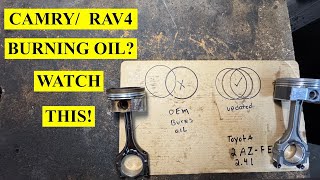
The story of P0422 on the first-generation Scion tC is dominated by a well-documented factory engine defect. The 2.4L 2AZ-FE engine in 2007-2010 models is known for excessive oil consumption due to a flawed piston and ring design. This burning oil contaminates and ultimately destroys the catalytic converter, making converter failure a very common and often recurring problem. Toyota/Scion issued Technical Service Bulletins (TSBs), like S-SB-0031-14 and S-SB-0024-11, outlining an oil consumption test and a fix involving new pistons and rings. Toyota also launched a Warranty Enhancement Program (ZE7) 🎬 Watch: Why these 2.4L engines burn so much oil that extended coverage for this specific issue for up to 10 years or 150,000 miles, but this program has since expired for all affected vehicles. Therefore, a P0422 code on this car is frequently a symptom of this much larger, and now out-of-warranty, engine issue.
Symptoms You May Notice
- Check Engine Light is on
- Reduced engine power and acceleration, especially when going uphill
- Failure to pass an emissions/smog test
- In severe cases of a clogged converter, the engine may hesitate, stall when stopping, or fail to start
- A rotten egg (sulfur) smell from the exhaust, indicating the converter is struggling
- Noticeable drop in fuel economy
- Replacing the oxygen sensors when the catalytic converter is actually bad. While sensors can fail, a catalyst efficiency code on this specific car is most often due to a failed converter. Many owners replace sensors first only to have the code return.
- Replacing the catalytic converter without addressing the engine's oil consumption problem. The new converter will be quickly destroyed by the burning oil, and the P0422 code will return.
- Using a cheap, non-CARB compliant catalytic converter in states that require them (like CA, NY, CO, ME), which can cause the code to return even if the part is new.
Most Likely Causes
- Failed Catalytic Converter 🔴 High Probability The primary catalytic converter is often destroyed by excessive oil consumption, a known defect in the 2AZ-FE engine for model years 2007-2010. Burning oil contaminates the precious metals (platinum, palladium, rhodium) inside the converter, coating them and preventing them from catalyzing exhaust gases.
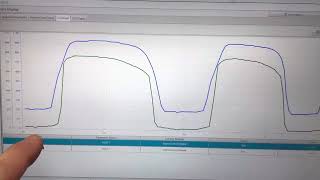
How to confirm: After ruling out other causes, a technician can use a scan tool to graph the upstream and downstream O2 sensor data. If the downstream sensor's voltage switches rapidly, mimicking the upstream sensor, 🎬 See how to diagnose a bad converter using scan tool data the converter is not working. An exhaust backpressure test can also confirm a clog. A physical inspection may reveal a melted or physically damaged internal honeycomb structure.
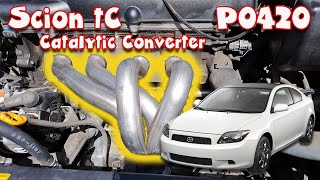
Typical fix: Replace the exhaust manifold with the integrated catalytic converter. It is critical to fix the underlying cause (especially oil consumption) before replacing the converter, or the new part will fail quickly. A YouTube video by 'Cars You Can Fix' provides a detailed replacement guide.
Est. part cost: $450-$1200 - Excessive Engine Oil Consumption 🔴 High Probability A design flaw with the pistons and piston rings in 2007-2010 2AZ-FE engines causes oil to bypass them and burn in the combustion chamber. The oil return holes in the original pistons were too small and would clog with carbon, leading to oil being scraped into the combustion chamber instead of returning to the crankcase.
How to confirm: Perform an oil consumption test as detailed in Scion TSB S-SB-0031-14. This involves the dealer topping off the oil, sealing the dipstick and fill cap, and having you return after 1,100-1,300 miles to measure the oil loss. Consuming more than 1 quart in this period is considered excessive. Many owners simply confirm by noting a significant drop in oil level between changes with no visible external leaks.
Typical fix: The official fix is an engine overhaul to replace the pistons and piston rings with updated parts, as detailed in TSB S-SB-0024-11. This is a very expensive, labor-intensive repair now that the Warranty Enhancement Program (ZE7) has expired.
Est. part cost: $1500-$4000+ - Failed Oxygen (O2) / Air-Fuel (A/F) Sensor ⚪ Low Probability While sensor failure is possible on any car, it's a less common cause for an isolated P0422/P0420 on this platform compared to the converter itself. Owners on forums often replace sensors first, only to have the code return.
How to confirm: Use a diagnostic scan tool to monitor live voltage data from the sensors. The upstream A/F sensor should fluctuate rapidly around 3.3V. The downstream O2 sensor (on a good converter) should have a relatively steady voltage above 0.5V. If a sensor is stuck, slow to respond, or has erratic readings, it has likely failed. Check wiring for damage.
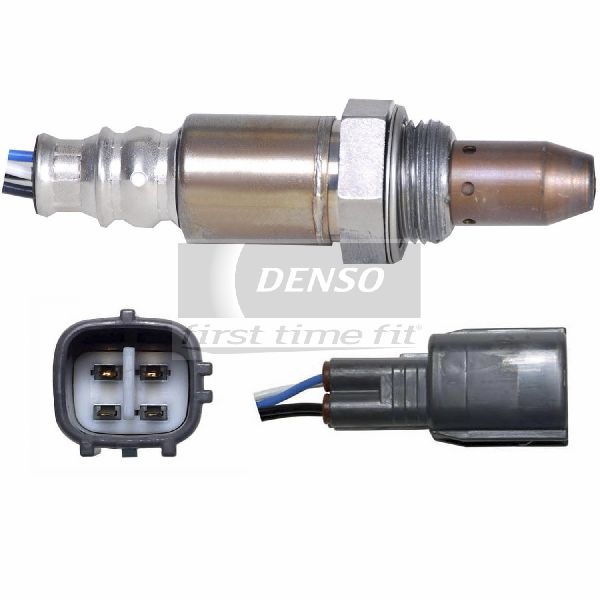
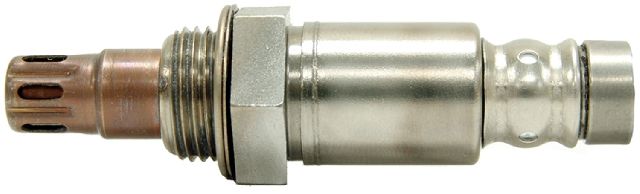
Typical fix: Replace the faulty sensor. The upstream sensor is the Air/Fuel Ratio Sensor, and the downstream is the Heated Oxygen Sensor. Using the OEM brand, Denso, is highly recommended to avoid compatibility issues. Upstream is Denso p/n 234-9049, Downstream is Denso p/n 234-4261. 🎬 Watch: How to replace the downstream oxygen sensor
Est. part cost: $80-$220 per sensor - Exhaust System Leak ⚪ Low Probability
How to confirm: Visually inspect the exhaust manifold, gaskets, and the pipe connecting to the converter for cracks or black soot trails indicating a leak. A common failure point is the donut gasket between the manifold and the mid-pipe. A shop can also perform a smoke test to pinpoint hard-to-see leaks.
Typical fix: Replace the leaking gasket or repair/replace the cracked component. A user on Reddit described ruining the threads on the manifold while trying to replace an O2 sensor, creating a significant leak.
Est. part cost: $20-$100
Rare But Worth Checking
- Engine Misfires or Fuel System Issues: Unburned fuel from persistent misfires or a leaking fuel injector can enter the exhaust and overheat the catalytic converter, causing it to melt internally. Oil consumption itself can foul spark plugs, leading to misfires (P030x codes). If you have other codes like P030x (misfire) or fuel trim codes, they must be addressed first.
Diagnosis Steps
- Check for Other Codes: Scan the PCM for any other stored trouble codes. Misfire (P030x) or fuel system codes must be diagnosed and fixed first, as they can cause converter failure.
- Check for Excessive Oil Consumption: Before spending any money on parts, check the engine oil level. If it is low, suspect the 2AZ-FE oil consumption issue. Initiate an oil consumption test to confirm the root cause. This is the most critical step for this vehicle.
- Inspect for Exhaust Leaks: Visually inspect the exhaust manifold, gaskets (especially the donut gasket), and front pipe for any signs of cracks, rust, or black soot that would indicate a leak. Listen for any unusual hissing or ticking sounds from the exhaust when the engine is running.
- Analyze Oxygen Sensor Data: Using a scan tool with live data graphing capabilities, observe the voltage signals from the upstream (Bank 1, Sensor 1) and downstream (Bank 1, Sensor 2) sensors. With the engine at operating temperature and held around 2,500 RPM, the upstream sensor should show rapid switching. A good converter will result in a slow, relatively steady downstream sensor reading. If the downstream sensor mimics the upstream sensor's rapid switching, the converter has failed.
- Test Oxygen Sensors: If the sensor data is inconclusive (e.g., a sensor is flatlined), test the sensor's heater circuit and wiring to rule out a sensor failure before condemning the converter.
- Condemn the Catalytic Converter: If oil consumption is not an issue, there are no exhaust leaks, and the O2 sensors are functioning correctly, the catalytic converter is the faulty component.
Parts You'll Likely Need
- Exhaust Manifold with Integrated Catalytic Converter
(OEM #25051-28350)— This is the most common failure item for code P0422, especially on vehicles with high mileage or oil consumption issues.
Trusted brands: Toyota (OEM), MagnaFlow, Walker Exhaust, AP Exhaust
OEM price range: $600-$800
Aftermarket price range: $450-$950 (Note: CARB-compliant versions for states like CA, NY, CO are significantly more expensive) - Upstream Air/Fuel Ratio Sensor (Bank 1, Sensor 1)
(OEM #89467-21020)— Sometimes replaced as a preventative measure or if it fails testing. It is crucial for correct fuel trim, and a lazy sensor can contribute to conditions that harm the converter over time.
Related Codes That Often Appear With This One
- P0420 — P0420 is a very similar code for 'Catalyst System Efficiency Below Threshold'. While P0422 points to the 'Main Catalyst', they are often used interchangeably by generic scan tools and indicate the same fundamental problem with the primary converter on this vehicle.
- P0300, P0301, P0302, P0303, P0304 — These are misfire codes. Excessive oil consumption can foul spark plugs, leading to misfires. A misfire can also cause a catalytic converter to fail, so these codes often appear together.
Technical Service Bulletins (TSBs) & Recalls
- S-SB-0031-14: 2AZ-FE Engine Oil Consumption Inspection Procedure
- S-SB-0024-11: 2AZ-FE Engine Oil Consumption Repair Procedure
- ZE7: Warranty Enhancement Program for 2AZ-FE Excessive Oil Consumption
Platform-Specific Known Issues
- Owner Experience with Warranty Enhancement Program (ZE7): An owner of a 2007 Scion tC on CarKiller.com mentions having the oil consumption recall work done, where new pistons were installed by the dealer. This corroborates the official fix outlined in TSBs.
- DIY Non-Fouler Trick: In older forum threads, some owners discuss using a spark plug non-fouler to pull the downstream O2 sensor out of the direct exhaust stream. This is an attempt to trick the ECU into thinking the catalyst is working and clear a P0420/P0422 code to pass inspection. This does not fix the underlying problem and is not a legal or recommended repair, especially in emissions-strict states.
Mechanic-Grade Diagnostic Values
- Upstream Air/Fuel (A/F) Sensor Voltage (A/FS B1 S1) — expected: Fluctuating around a central value of 3.3V at 2,500 RPM.. Failure: A static voltage or one that does not respond to changes in engine load indicates a failed sensor.
- Downstream Heated Oxygen Sensor (O2S B1 S2) Voltage — expected: Relatively steady, slow switching between 0.1V and 0.9V with a healthy converter. Should oscillate more than 8 times in 10 seconds during a 2,500 RPM hold test.. Failure: Rapid switching that mimics the upstream A/F sensor's pattern indicates a failed catalytic converter.
- Upstream Air/Fuel (A/F) Sensor Heater Resistance — expected: Standard resistance values are specified in service manuals, typically checked between the +B and HT terminals of the sensor connector.. Failure: An open or short in the heater circuit will result in a reading outside the specified range and can trigger its own set of DTCs (P0031, etc.).
- Fuel Pressure — expected: 304 to 343 kPa (44 to 50 psi).. Failure: Incorrect fuel pressure can lead to a rich or lean condition that damages the catalytic converter over time.
- Long Term and Short Term Fuel Trims — expected: Should ideally be within +/- 10% at idle and steady RPM.. Failure: Consistently high positive or negative trims (e.g., >15%) indicate an underlying air/fuel mixture problem (vacuum leak, bad MAF, injector issue) that must be fixed before replacing the converter.
Hidden / Shadow Codes Worth Checking
- Mode $06, Test ID $21 (TID $21): This is not a DTC, but a specific monitor within the OBD-II system that tracks catalyst efficiency. It records the switching ratio of the front and rear oxygen sensors. A value approaching or exceeding the maximum limit indicates the catalyst is failing, often before the P0422 code is set permanently. (see via A professional scan tool capable of viewing Mode $06 data, such as Toyota's Techstream software.)
Scan Tool Commands That Help
- Toyota Techstream: Active Test: 'Control the Injection Volume' — This can be used to manually alter the air-fuel mixture to test the response of the A/F and O2 sensors. Forcing the mixture rich or lean and observing the sensor voltage change can confirm if the sensors are responsive.
- Toyota Techstream: Data List: Graphing 'A/FS B1 S1' and 'O2S B1 S2' — This is the primary diagnostic method. Graphing both sensors simultaneously at a steady 2,500 RPM provides a clear visual confirmation of catalyst efficiency. A good cat shows a rapidly switching upstream sensor and a slow, steady downstream sensor. A bad cat shows both sensors switching rapidly.
Wiring & Ground Locations
- ECM Connector B30, Pin 112 (A1A+) — At the Engine Control Module (ECM), which is typically located behind the glove box.. This is the signal wire for the upstream Air/Fuel Ratio sensor. Checking for 3.3V with the ignition on can verify the reference voltage from the ECM.
- ECM Connector B30, Pin 64 (OX1B) — At the Engine Control Module (ECM) behind the glove box.. This is the signal wire for the downstream Heated Oxygen Sensor. Back-probing this pin allows a technician to see the sensor's voltage directly at the computer, ruling out wiring issues between the sensor and the ECM.
- ECM Connector B30, Pin 87 (EX1B) — At the Engine Control Module (ECM) behind the glove box.. This is the ground wire for the downstream Heated Oxygen Sensor signal. Verifying continuity to ground from this pin is essential for an accurate sensor reading.
- Engine Ground Points — Key grounds for the engine harness are typically located on the cylinder head, intake manifold, and on the chassis near the battery. A 2007 Scion tC wiring manual shows multiple ground points throughout the engine bay.. A poor engine ground can introduce noise and voltage offsets into the O2 sensor signals, leading to an incorrect P0422 code even with a good converter and sensors.
Real Owner Repair Stories
- Reddit user in r/SciontC (First Generation Scion tC) — Check Engine Light with code P0420 (functionally identical to P0422 for this issue).
❌ Tried (didn't work) Using CataClean fuel additive., Replacing the downstream O2 sensor., Replacing the upstream Air/Fuel sensor., Replacing the catalytic converter with a used one (which also turned out to be bad).
✅ What actually fixed it Replacing the catalytic converter with a new unit finally resolved the code and allowed the car to pass a California smog test.
OEM Part Supersession History
25051-0H070→25051-28340, 25051-28360, and finally 25051-28350— Standard part revisions and updates by the manufacturer.
Model Year Variations Within This Range
- 2007-2010: Engines from 2007 onward have a slightly higher compression ratio (9.8:1 vs 9.6:1), a more aggressive intake cam profile, and piston oil squirters. These changes coincide with the model years most affected by the TSB for excessive oil consumption, which is the primary killer of the catalytic converter.
- 2005-2006: These earlier models used a 9.6:1 compression ratio and are not officially covered by the oil consumption TSB. While they can still suffer from a failed catalytic converter due to age or other issues, the systemic problem of oil contamination is less prevalent than in the 2007-2010 models.
Diagnostic Flowchart
Other Known Issues on This Vehicle
Issues unrelated to this code that are worth knowing about as an owner of this generation:
- Excessive Oil Consumption 🔴 High — Very common on 2007-2010 models with the 2AZ-FE engine, often starting around 60,000-100,000 miles. (Ref: TSB S-SB-0024-11, S-SB-0031-14; Warranty Enhancement ZE7)
- Water Pump Failure 🟠 Medium — Prone to leaking or bearing failure, leading to overheating. Can occur at various mileages.
- Melting/Deteriorating Rear Hatch Handle 🟡 Low — Extremely common; the rubber on the hatch release switch melts and becomes sticky or breaks down over time. (Ref: A limited warranty extension was offered but has expired.)
- Automatic Transmission (U241E) Shift Issues 🟠 Medium — Some owners report harsh shifting, particularly between 2nd and 3rd gear when the vehicle is cold, or delayed engagement.
- Power Window Regulator/Motor Failure 🟡 Low — The window may get stuck, move slowly, or drop suddenly. A common point of failure on high-use windows.
Used vs. New Parts: Buying Guide for This Vehicle
When a used part is the smart pick: For this specific repair, buying a used catalytic converter is highly discouraged. The 2AZ-FE engine's oil consumption issue means that a high percentage of used converters from donor vehicles are likely already contaminated and near the end of their service life. A used part may clear the code temporarily but is very likely to fail again in a short period, as documented by owners.
Donor-vehicle mileage cap: roughly under 60000 miles for the part to have meaningful remaining life.
What to inspect on the donor part:
- If considering a used converter despite the risk, demand proof of the donor vehicle's mileage.
- Visually inspect the honeycomb structure from both ends with a bright light. Look for any signs of melting, blockage, or heavy black soot.
- Ask for the vehicle's history to see if it was from a 2005-2006 model, which is slightly less likely to have severe oil consumption than a 2007-2010 model.
OEM-only on this vehicle (don't cheap out):
- Catalytic Converter: While not strictly OEM-only, many owners report that cheap, non-certified aftermarket converters fail to meet the ECU's strict monitoring parameters, causing the P0422/P0420 code to return. Using an OEM or a high-quality, CARB-compliant aftermarket unit is strongly recommended for a lasting repair.
- Air/Fuel Ratio Sensor: Using the OEM brand (Denso) is critical. Forum users and mechanics report that other brands like Bosch can cause persistent codes or compatibility issues on this platform.
Aftermarket brands forum-validated for this vehicle:
- MagnaFlow (for catalytic converters)
- Walker Exhaust (for catalytic converters)
- Denso (for O2 / A/F sensors - considered OEM equivalent)
Brands owners have reported issues with on this vehicle:
- Universal or unbranded, exceptionally cheap catalytic converters found on sites like eBay are frequently cited as failing quickly.
- Bosch (for O2 / A/F sensors, due to reported compatibility issues on this specific platform)
Real Owner Stories
Aggregated from forums and TSBs cited above. Mileages and costs reflect what owners reported in those sources.
2007 Scion tC 2AZ-FE 2.4L
Symptoms: Owner experienced the known excessive oil consumption issue which leads to catalytic converter failure.
What fixed it: The dealer performed the official fix under the Warranty Enhancement Program (ZE7), which involved installing new, updated pistons and piston rings.
Source hint: Owner Experience with Warranty Enhancement Program (ZE7) from CarKiller.com
2005 Scion tC 2AZ-FE 2.4L — 80000 miles
Symptoms: Owner of a recently purchased tC got a P0420 code.
What fixed it: Forum discussion pointed towards the catalytic converter being bad and recommended using Denso brand O2 sensors if they were also replaced.
Source hint: ScionLife.com thread titled 'Catalytic converter bad at 80k miles? p0420'
Scion tC 2AZ-FE 2.4L
Symptoms: An exhaust leak was created when the owner ruined the threads on the exhaust manifold while attempting to replace an O2 sensor.
What fixed it: The necessary repair discussed was the replacement of the entire integrated exhaust manifold and catalytic converter assembly.
Source hint: Reddit r/SciontC thread titled 'I messed up my girlfriend's scion tC catalytic converter. What can I do to fix it?'
Related OBD-II Codes
Frequently Asked Questions
My 2008 Scion tC is burning a lot of oil and just threw a P0422 code. Is this a known issue?
What is the first thing I should check for a P0422 code on my tC before buying parts?
I need to replace the oxygen sensors on my Scion tC. Is there a specific brand I should use?
Can I just replace the O2 sensors to fix code P0422?
Is the catalytic converter on the 2005-2010 tC a simple bolt-on part under the car?
I read about a 'non-fouler trick' to pass emissions. Will this fix my P0422 code?
Helpful Videos
We Have This Part in Stock


The information in this article is provided for general reference and educational purposes only. Vehicle specifications, procedures, and part compatibility can vary by production date, trim level, and region. Always consult your vehicle's factory service manual and verify part numbers before purchasing or performing repairs. Safety-critical components such as airbags, seat belts, and braking systems should be installed by a qualified professional.
- Scion tC:
- 🎬 Helpful Videos
- 🛍️ Shop This Part
- What's Unique About the 2005-2010 Scion tC
- Symptoms You May Notice
- Most Likely Causes
- Rare But Worth Checking
- Diagnosis Steps
- Parts You'll Likely Need
- Related Codes That Often Appear With This One
- Technical Service Bulletins (TSBs) & Recalls
- Platform-Specific Known Issues
- Mechanic-Grade Diagnostic Values
- Hidden / Shadow Codes Worth Checking
- Scan Tool Commands That Help
- Wiring & Ground Locations
- Real Owner Repair Stories
- OEM Part Supersession History
- Model Year Variations Within This Range
- Diagnostic Flowchart
- Other Known Issues on This Vehicle
- Used vs. New Parts: Buying Guide for This Vehicle
- Real Owner Stories
- 2007 Scion tC 2AZ-FE 2.4L
- 2005 Scion tC 2AZ-FE 2.4L — 80000 miles
- Scion tC 2AZ-FE 2.4L
- Related OBD-II Codes
- Frequently Asked Questions
- 🎟️ Get 5% Off