

P0420 on 2010-2017 Honda Accord: Catalytic Converter, O2 Sensor, or Something Else?
P0420 on a 2010-2017 Honda Accord means the catalytic converter's efficiency is low. While it can be a bad oxygen sensor (~$80-$180) or an exhaust leak, it often indicates a failing catalytic converter, a more expensive repair ($900-$2,400+). For 8th generation models (2010-2012) with the 2.4L engine, this is frequently caused by excessive oil consumption contaminating the converter. Proper diagnosis is crucial to avoid replacing the wrong parts.
- P0420 means the catalytic converter on Bank 1 is not working efficiently.
- Do not immediately replace the catalytic converter. First, rule out cheaper and simpler problems like exhaust leaks and faulty oxygen sensors through proper diagnosis.
- Use a scan tool to watch live O2 sensor data; this is the best way to determine if the converter is truly bad.
- The 2010 4-cylinder Accord was subject to a specific investigation by Honda for this code, suggesting a higher likelihood of converter issues for that model.
- Always fix any engine misfires or fuel system problems before replacing the catalytic converter, or the new one will be damaged as well.
What's Unique About the 2010-2017 Honda ACCORD

This year range spans two Accord generations, the 8th (2010-2012) and 9th (2013-2017). Notably, Honda issued several Technical Service Bulletins (TSBs) specifically investigating P0420 on the 2010 Accord with the 4-cylinder (L4) engine, suggesting a known issue with that model year. The 8th generation's 2.4L K24Z-series engine is also known for potential oil consumption issues, which can saturate and destroy the catalytic converter over time, making P0420 a very common code on these models as they age. The 9th generation (2013-2017) uses different engines (K24W1 "Earth Dreams" and updated J35 V6) which may not have the same oil consumption propensity, but can still experience P0420 due to normal wear.
Diagnostic Flowchart

Tap your situation to follow the diagnostic path that matches what you're seeing on this vehicle.
Generation note: The 2010-2017 range covers the end of the 8th generation (2010-2012) and the full 9th generation (2013-2017). The provided NHTSA TSBs specifically mention investigations into the 2010 4-cylinder model, pointing to a potential weakness in the catalytic converter for that specific 8th-gen powertrain. This is often linked to oil contamination on the K24Z3 engine. The 9th-gen models can also experience this code, but the causes may be more related to general wear and tear or, in some cases, a faulty downstream O2 sensor.
Symptoms You May Notice
- Check Engine Light is on.
- Vehicle fails emissions testing.
- Reduced fuel economy.
- Sluggish acceleration or lack of power, especially if the converter is clogged.
- A rotten egg or sulfur smell from the exhaust.
- Replacing the downstream O2 sensor without diagnosis. While the sensor can be the cause, it is more often correctly reporting the failure of the catalytic converter.
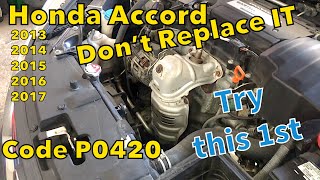
- Using a fuel additive or "catalytic converter cleaner". While some users report temporary success clearing the light, these products rarely fix a physically damaged or chemically contaminated converter and often just delay the necessary repair. 🎬 Watch: The first thing you should check before buying parts.
- Replacing the catalytic converter without addressing the root cause. If the engine is burning oil, misfiring, or has a fuel mixture problem, the new converter will be damaged quickly.
Most Likely Causes

- Failing Catalytic Converter 🔴 High Probability Catalytic converters fail from age or contamination. TSBs for the 2010 L4 model suggest a potential for premature failure. For 2010-2012 models, excessive oil consumption from the K24Z engine is a primary cause of contamination, leading to P0420. Unaddressed engine misfires are another common killer of converters.
How to confirm: Use a scan tool to graph the upstream and downstream O2 sensor data. If the downstream sensor's voltage pattern mimics the upstream sensor's, the converter is not working. An infrared thermometer can also be used to check temperatures; the outlet should be at least 100°F hotter than the inlet on a working converter. Shaking the converter (when cool) may reveal a rattling sound, indicating a broken internal substrate.
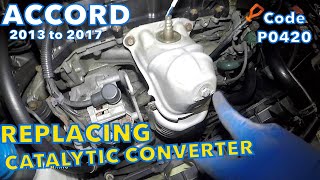
Typical fix: Replace the catalytic converter. It is critical to fix any underlying engine problems (e.g., misfires, oil consumption) first, or the new converter will also fail. OEM parts are recommended for longevity.
Est. part cost: $700-$2000+ - Faulty Downstream Oxygen (O2) Sensor 🟡 Medium Probability O2 sensors wear out over time and can send incorrect readings. People often replace this sensor hoping for a cheap fix. Several owner accounts suggest that for the 9th generation (2013-2017) Accords, replacing the downstream sensor can sometimes resolve the code, even without other symptoms.
How to confirm: Test the sensor's response time and voltage output with a scan tool. A lazy or biased sensor will not respond correctly to changes in the exhaust stream. However, a perfectly functioning sensor will correctly report a bad catalytic converter, making diagnosis tricky. Often, replacement is a calculated gamble.
Typical fix: Replace the downstream O2 sensor (Bank 1, Sensor 2). Denso is the OEM supplier for Honda. The specific part number for the 2008-2012 Accord 2.4L is Denso 234-4462.
Est. part cost: $80-$180 - Exhaust Leak 🟡 Medium Probability Rust and corrosion can cause leaks at gaskets or flex pipes, especially in regions that use road salt. An owner complaint for a 2013 Accord mentioned this code appearing after a high-pressure wash, which could have disturbed a weak exhaust seal. Leaks ahead of or near the O2 sensors are particularly problematic.
How to confirm: Visually inspect the exhaust system from the engine to the tailpipe for black soot marks, cracks, or holes. Listen for hissing or ticking sounds that get louder with engine RPM. A smoke test is the most definitive way to find small leaks; this can be simulated with a shop-vac on its blower setting and soapy water.
Typical fix: Replace the leaking gasket or repair/replace the damaged section of the exhaust pipe.
Est. part cost: $20-$300 - Faulty Upstream Air/Fuel (A/F) Ratio Sensor ⚪ Low Probability A failing upstream sensor can cause an incorrect air/fuel mixture. A rich condition can overheat and damage the catalytic converter over time, leading to a P0420 code. While less common than the downstream sensor or the converter itself, it's a crucial input for the entire system.
How to confirm: Monitor short-term and long-term fuel trims with a scan tool. Consistently high positive or negative fuel trims can indicate a problem with the A/F sensor. The sensor's voltage should fluctuate rapidly on a graph.
Typical fix: Replace the upstream Air/Fuel Ratio sensor (Bank 1, Sensor 1).
Est. part cost: $100-$250
Rare But Worth Checking
- Engine Misfires or Rich/Lean Running Condition: If you have other codes like P030x (misfire) or fuel system codes, they MUST be addressed first. Unburnt fuel from a misfire will quickly destroy a new catalytic converter.
- ECU Software Issue: A Honda TSB for different models (18-023) mentions that in some cases, the ECU can misinterpret sensor inputs and trigger P0420, requiring a software update. While this specific TSB doesn't explicitly cover the 2010-2017 Accord, a forum user mentioned a dealer performing an ECM/PCM update for a P0420 issue on a 4-cylinder model, suggesting it's a known, albeit rare, fix. TSB 12-036 for the related Acura TSX also points to a fuel level-related lean condition that could damage the converter and trigger P0420.
- Excessive Oil Consumption: Specifically for the 8th generation (2010-2012) 2.4L K24Z3 engine, excessive oil consumption is a known issue that can lead to oil contamination of the catalytic converter, causing it to fail and trigger P0420. This is a root cause that must be monitored or addressed before replacing the converter.
Diagnosis Steps
- Scan for any other trouble codes. If other codes are present (especially misfire or fuel trim codes), diagnose and fix them first.
- Perform a thorough visual inspection of the exhaust system for any leaks, damage, or loose connections between the engine and the downstream O2 sensor. Pay close attention to gaskets and the flex pipe.
- Use a scan tool with live data capability. Graph the voltage signals from the upstream (Bank 1, Sensor 1) and downstream (Bank 1, Sensor 2) O2 sensors at a steady 2,500 RPM.
- Analyze the graph: The upstream sensor should show rapid, frequent fluctuations (e.g., 0.1V to 0.9V). A healthy catalytic converter will result in a downstream sensor signal that is relatively flat and steady (e.g., above 0.5V).
- If the downstream sensor's graph mirrors the upstream sensor's fluctuations, the catalytic converter has failed.
- If the downstream sensor's signal is stuck high, low, or is slow to respond, the sensor itself is likely faulty.
- If no definitive conclusion can be made from the sensor data, test for a clogged converter by checking exhaust backpressure. An infrared thermometer can also show if the converter is heating up properly (outlet should be at least 100°F hotter than the inlet).
- Check for known TSBs or software updates related to P0420 for your specific model year and engine.
Parts You'll Likely Need
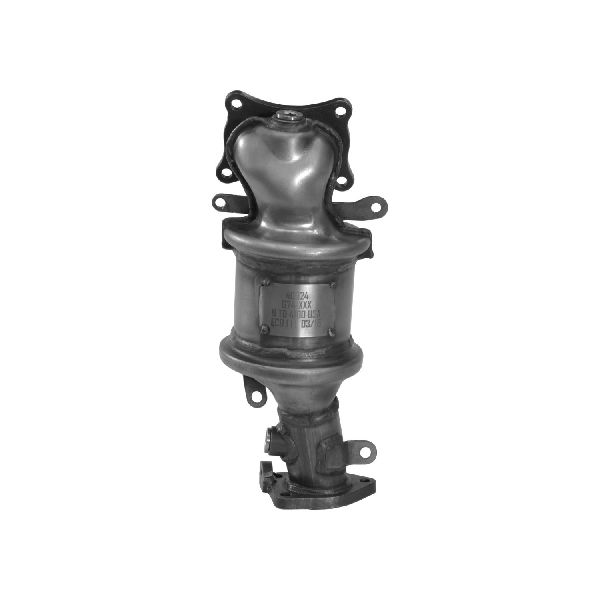
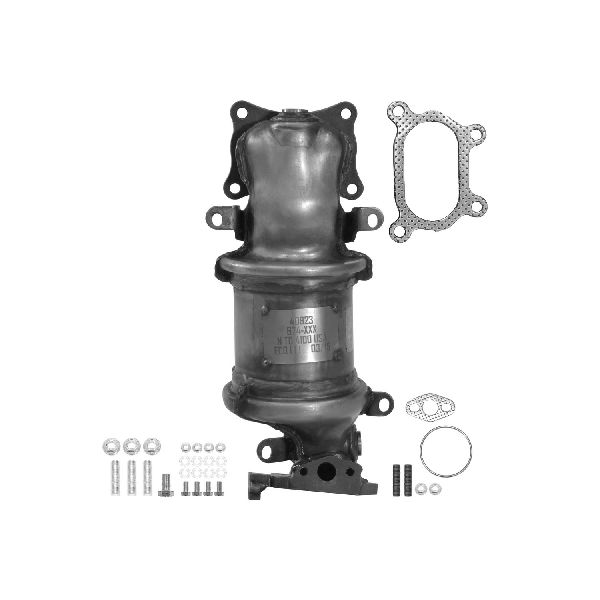
- Catalytic Converter (Bank 1)
(OEM #18190-R40-A00)
Related Codes That Often Appear With This One
- P0137, P0138, P0139 — These codes relate to the downstream O2 sensor (Bank 1, Sensor 2) circuit, indicating a potential sensor failure as the root cause.
- P0300-P0304 — These are misfire codes. An engine misfire allows unburnt fuel to enter the exhaust, which can overheat and destroy the catalytic converter, causing the P0420 code.
- P0171, P0172 — These codes indicate a lean (P0171) or rich (P0172) condition. A persistent incorrect fuel mixture can either overheat (rich) or contaminate (lean) the catalytic converter, leading to its failure.
Technical Service Bulletins (TSBs) & Recalls

- Bulletin #DLR MSG - RFV, R (2010 ELECTRICAL SYSTEM, dated 2014-07-25): AHM investigating 2010 Accord L4 for MIL on with DTC P0420.
- Bulletin #DLR MSG - RFV RF (2010 ELECTRICAL SYSTEM, dated 2014-07-24): AHM investigating 2010 Accord L4 for MIL on with DTC P0420.
- Bulletin #DLR MSG - RFV, R (2010 ENGINE AND ENGINE COOLING, dated 2014-06-19): AHM investigating 2010 Accord L4 for MIL on with DTC P0420.
- Bulletin #ENG REQ - AER140 (2010 ENGINE AND ENGINE COOLING, dated 2014-05-29): AHM investigating 2010 Accord L4 for MIL on with DTC P0420.
Platform-Specific Known Issues
- 8th Gen (2010-2012) 2.4L Oil Consumption: The K24Z3 engine used in the 2010-2012 Accords can be prone to excessive oil consumption. This is a critical factor for P0420, as burning oil contaminates the precious metals inside the catalytic converter, rendering it ineffective. Before replacing a catalytic converter on these models, it is essential to verify that the engine is not consuming an excessive amount of oil, otherwise the new converter will fail prematurely.
- 9th Gen (2013-2017) O2 Sensor vs. Cat: For the 9th generation Accords with the 'Earth Dreams' engine, there are multiple owner and mechanic reports suggesting that replacing the downstream (Bank 1, Sensor 2) oxygen sensor is a viable first step that often resolves the P0420 code without needing to replace the much more expensive catalytic converter.
- 2010 L4 Model Investigation: Honda issued multiple dealer messages in 2014 specifically to investigate the cause of P0420 on the 2010 Accord L4 models, indicating a higher-than-normal failure rate or a specific defect for that model year that the manufacturer was tracking.
Mechanic-Grade Diagnostic Values
- Upstream Air/Fuel (A/F) Sensor Voltage (9th Gen, 2.4L) — expected: ~2.0V at idle, ~2.5-3.0V when accelerating.. Failure: No response or voltage outside of expected range.
- Downstream Oxygen (O2) Sensor Voltage (9th Gen, 2.4L) — expected: Relatively steady voltage, typically ~0.5V or higher. One user reported 0.3-0.7V when revving.. Failure: Voltage fluctuates rapidly, mimicking the upstream sensor's pattern, indicating a bad converter. A flatline or very low reading (e.g., 0.05-0.1V) could indicate a bad sensor.
- Long-Term Fuel Trim (LTFT) — expected: Close to 0% (+/- 5%).. Failure: High positive or negative values (e.g., > 10%) indicate an underlying fuel mixture problem that must be fixed before addressing the P0420.
- Oxygen Sensor Installation Torque — expected: 25-33 ft-lbs.. Failure: Under-torquing can cause exhaust leaks; over-torquing can damage the sensor or threads.
Hidden / Shadow Codes Worth Checking
- Mode $06, TID $01: This is not a DTC but a test result from the onboard diagnostic monitor for the catalyst system. It reflects the converter's oxygen storage capacity. A scan tool can read this value. (see via Use a scan tool that supports Mode $06 data. Compare the reported 'value' against the 'min' threshold. If the value is very close to the minimum, the converter is marginal and likely to fail soon.)
Scan Tool Commands That Help
- Honda HDS (or equivalent professional scanner): ECM/PCM Idle Learn Procedure — After replacing a major engine or emissions component like the catalytic converter or sensors, or after resetting the ECU, to allow the engine computer to relearn baseline parameters.
- Honda HDS (or equivalent professional scanner): Monitor OBD STATUS for P0420 — During a specific drive cycle after a repair, to see if the catalyst monitor test is 'EXECUTING' or if it has 'FAILED', confirming if the fix was successful without waiting for the check engine light to return.
Wiring & Ground Locations
- Upstream A/F Sensor (Bank 1 Sensor 1) — On the 2.4L engine, it is located on the front of the engine, screwed into the exhaust manifold portion of the catalytic converter, before the main catalyst body.. This is the primary sensor used for fuel control. A failure here can lead to fuel mixture issues that damage the converter and cause P0420.
- Downstream O2 Sensor (Bank 1 Sensor 2) — Located underneath the vehicle, screwed into the exhaust pipe after the primary catalytic converter.. This sensor's sole purpose is to monitor the catalytic converter's efficiency. Its signal is what the ECU uses to trigger the P0420 code.
Real Owner Repair Stories
- YouTube channel 'First Thing To Do' (2014 Honda Accord, 260,000 miles) — Check Engine Light with code P0420.
❌ Tried (didn't work) Initially feared needing to replace O2 sensors or the catalytic converter.
✅ What actually fixed it Poured one bottle of Cataclean fuel system cleaner into the gas tank and drove for 100-200 miles. The check engine light turned off on its own. - YouTube channel 'RB The Mechanic' (2013-2017 Honda Accord (multiple vehicles)) — Check Engine Light with code P0420.
❌ Tried (didn't work) Replacing the catalytic converter first.
✅ What actually fixed it Replaced the downstream (Bank 1, Sensor 2) oxygen sensor with a Denso brand part. The mechanic states this has fixed the code on multiple Accords and is the first thing he now does for this code. - Honda Accord Forum user (High-mileage (~225k miles) four-cylinder Accord) — P0420 code.
❌ Tried (didn't work) Implied consideration of O2 sensors.
✅ What actually fixed it A new catalytic converter fixed the issue. The user noted that at high mileage, 'They just get old.'
When the Usual Fixes Don't Work
- While the most common professional advice is that P0420 indicates a failed catalytic converter, multiple real-world owner and mechanic reports for the 9th generation (2013-2017) Accord state that simply replacing the downstream Denso O2 sensor resolved the code permanently. This suggests that for this specific generation, a faulty sensor may be a more frequent cause than on prior models, and can be a cost-effective first step in diagnosis before condemning the expensive catalytic converter.
OEM Part Supersession History
18190-R41-L00→18190-R41-L01— Unknown, but part number changes often indicate a revision for durability, material change, or manufacturing process improvement.
Heads up: Applies to 2008-2012 Accord 2.4L models.18190-R40-A00→— N/A
Heads up: This is the primary converter for many 2010-2012 2.4L Accords (non-California emissions).18190-R70-A10→— N/A
Heads up: This is the front primary converter for the 3.5L V6 engine, not interchangeable with the 4-cylinder.
Model Year Variations Within This Range
- 2010-2012 (8th Generation): Uses the K24Z-series 2.4L engine. The upstream oxygen sensor is a traditional narrow-band type. These models are noted in TSBs for P0420 investigations and are known for potential oil consumption that contaminates the converter.
- 2013-2017 (9th Generation): Uses the K24W1 'Earth Dreams' 2.4L engine or J35Y-series V6. The upstream sensor is a wideband Air/Fuel (A/F) Ratio sensor, which operates on a different voltage scale (~2-3V) than a narrow-band sensor. The diagnostic logic in the ECU is different, and some anecdotal evidence suggests the downstream O2 sensor is a more common failure point for P0420 on these models.
Real Owner Stories
Aggregated from forums and TSBs cited above. Mileages and costs reflect what owners reported in those sources.
2013 Honda Accord
Symptoms: The P0420 code appeared immediately following a high-pressure car wash.
What fixed it: Identified and repaired an exhaust leak, as the high-pressure wash had disturbed a weak exhaust seal.
Source hint: Owner complaint cited in the Exhaust Leak section
2013-2017 Honda Accord (Earth Dreams)
Symptoms: P0420 code triggered with no other noticeable drivability symptoms.
What fixed it: Replaced the downstream (Bank 1, Sensor 2) oxygen sensor, which resolved the code without needing a new catalytic converter.
Source hint: 9th Gen (2013-2017) O2 Sensor vs. Cat owner and mechanic reports
Related OBD-II Codes
Frequently Asked Questions
Why is my 2010-2012 Honda Accord 2.4L prone to catalytic converter failure and the P0420 code?
I have a 9th Gen (2013-2017) Accord with the Earth Dreams engine. Do I definitely need a new catalytic converter?
Are there any known manufacturer communications about P0420 for the 2010 Accord L4?
What is the correct OEM downstream O2 sensor part number for a 2008-2012 Accord 2.4L?
Can washing my Accord cause a P0420 code to appear?
Helpful Videos
We Have This Part in Stock



The information in this article is provided for general reference and educational purposes only. Vehicle specifications, procedures, and part compatibility can vary by production date, trim level, and region. Always consult your vehicle's factory service manual and verify part numbers before purchasing or performing repairs. Safety-critical components such as airbags, seat belts, and braking systems should be installed by a qualified professional.
- Honda ACCORD:
- 🎬 Helpful Videos
- 🛍️ Shop This Part
- What's Unique About the 2010-2017 Honda ACCORD
- Diagnostic Flowchart
- Symptoms You May Notice
- Most Likely Causes
- Rare But Worth Checking
- Diagnosis Steps
- Parts You'll Likely Need
- Related Codes That Often Appear With This One
- Technical Service Bulletins (TSBs) & Recalls
- Platform-Specific Known Issues
- Mechanic-Grade Diagnostic Values
- Hidden / Shadow Codes Worth Checking
- Scan Tool Commands That Help
- Wiring & Ground Locations
- Real Owner Repair Stories
- When the Usual Fixes Don't Work
- OEM Part Supersession History
- Model Year Variations Within This Range
- Real Owner Stories
- 2013 Honda Accord
- 2013-2017 Honda Accord (Earth Dreams)
- Related OBD-II Codes
- Frequently Asked Questions
- 🎟️ Get 5% Off