

P0302 on 2006-2010 Lexus IS 250: Cylinder 2 Misfire Causes and Fixes
P0302 on a Lexus IS 250 indicates a misfire in cylinder 2. While a bad ignition coil or spark plug is possible, the most notorious cause for this engine is severe carbon buildup on the intake valves, a known issue that often requires professional cleaning.
- P0302 on a 2006-2010 IS 250 is a misfire on cylinder 2, located on the driver's side of the engine.
- Always perform basic diagnostics first: swap the ignition coil and then the spark plug with another cylinder to rule out these common, cheaper fixes.
- Be aware that the root cause for persistent, hard-to-diagnose misfires on this specific engine is almost always carbon buildup on the intake valves.
- Accessing the spark plugs and coils for cylinder 2 requires removing the upper intake manifold, so it's wise to replace all three driver-side plugs and intake gaskets at the same time.
- Preventative measures like using quality fuel and performing an 'Italian tune-up' (driving at high RPMs safely) may help slow carbon accumulation.
What's Unique About the 2006-2010 Lexus IS 250
The 2006-2010 Lexus IS 250 uses the 4GR-FSE engine, which features a direct injection (GDI) fuel system. In this design, fuel is injected directly into the combustion chamber, bypassing the intake valves. Unlike traditional port injection systems, this means there is no fuel to wash over and clean the valves, making them highly susceptible to carbon buildup from oil vapors and exhaust gases. This buildup restricts airflow, leading to the exact misfire symptoms described in multiple Lexus Technical Service Bulletins.
🎬 Watch: A complete guide to diagnosing Lexus IS misfire codes.Diagnostic Flowchart
Tap your situation to follow the diagnostic path that matches what you're seeing on this vehicle.
Symptoms You May Notice
- Rough idle, especially when the engine is warm after a drive.
- Hesitation or stumbling during acceleration.
- Flashing or solid Check Engine Light.
- Noticeable loss of power.
- Vehicle may stall when coming to a stop.
- Replacing only the spark plugs without checking for carbon buildup. If the misfire persists, especially when warm, the root cause is likely carbon deposits.
- Replacing an oxygen sensor. While other codes might point to an O2 sensor, a solitary P0302 code is almost never caused by one.
Most Likely Causes
- Carbon Buildup on Intake Valves 🔴 High Probability The 4GR-FSE is a direct-injection engine, which lacks the valve-cleaning effect of port injection, leading to deposit accumulation. This is a widely documented issue and the subject of Lexus Customer Support Programs.
How to confirm: After ruling out ignition and fuel issues, a visual inspection with a borescope camera inserted into the intake manifold is the definitive way to confirm carbon buildup on the valves.
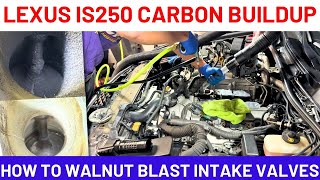
Typical fix: The intake valves need to be cleaned. This is often done through a process called 'walnut blasting,' where crushed walnut shells are used as a media to safely blast the carbon off the valves without damaging the engine.
Est. part cost: $20-$50 for intake gaskets - Failed Ignition Coil 🟡 Medium Probability
How to confirm: Swap the ignition coil from cylinder 2 with another cylinder (e.g., cylinder 4, which is also on the driver's side). Clear the codes and drive. If the code changes to P0304, the ignition coil is faulty.
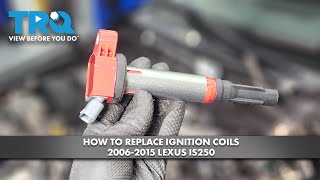
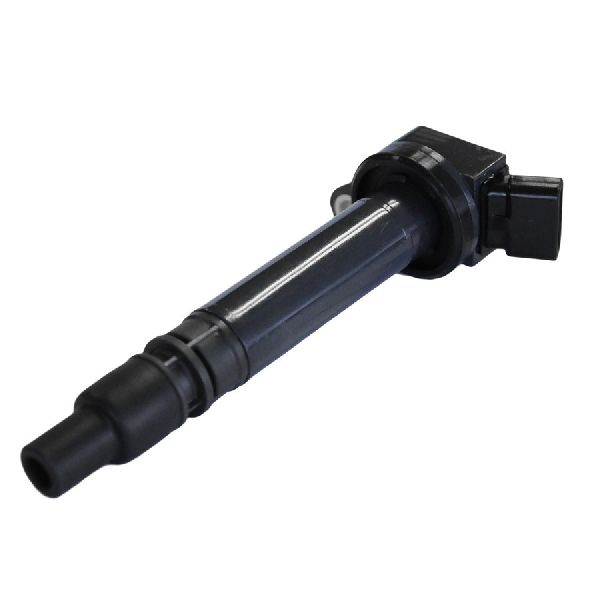
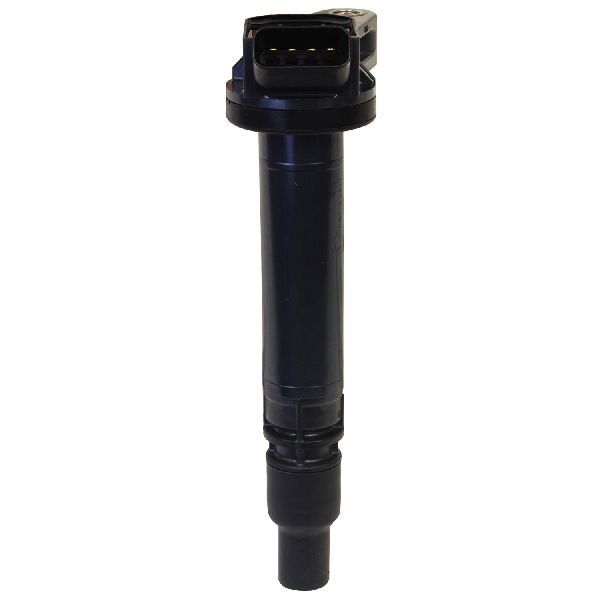
Typical fix: Replace the faulty ignition coil. It is often recommended to replace all coils on the same bank or all six if they are original and high-mileage.
Est. part cost: $40-$90 per coil - Worn or Faulty Spark Plug 🟡 Medium Probability
How to confirm: After confirming the coil is good, swap the spark plug from cylinder 2 with another cylinder. If the misfire code follows the plug, the spark plug is the issue. Visually inspect the removed plug for wear, oil fouling, or damage.
Typical fix: Replace the faulty spark plug. It is best practice to replace all six spark plugs at the same time with high-quality Iridium plugs (e.g., Denso FK20HBR11) to maintain performance.
Est. part cost: $10-$20 per plug
Rare But Worth Checking
- Clogged or Faulty Fuel Injector: While less common than carbon buildup or ignition issues, a direct injector can fail or become clogged, leading to a misfire in a single cylinder.
- Low Engine Compression: In very high-mileage engines or cases of severe overheating, internal engine damage like worn piston rings or burnt valves could cause a misfire. This is a worst-case scenario and should be confirmed with a compression test.
Diagnosis Steps
- Read the code with an OBD-II scanner to confirm P0302 and check for any other codes.
- As a simple first step, swap the ignition coil from cylinder 2 with cylinder 4 (the middle cylinder on the same driver's side bank). Clear codes, drive the car, and see if the misfire moves to cylinder 4 (P0304). If it does, you have a bad coil.
- If the misfire remains on cylinder 2, perform the same swap test with the spark plug. Move the plug from cylinder 2 to cylinder 4. If the code becomes P0304, the spark plug is bad.
- If the misfire still stays on cylinder 2, inspect the ignition coil connector and wiring for any damage.
- At this point, the most likely cause is carbon buildup. The next step is to remove the intake manifold to gain access for a visual inspection of the intake valves for cylinder 2 using a borescope.
- If significant carbon is found, perform a valve cleaning service (e.g., walnut blasting).
- If no significant carbon is found, further diagnostics for the fuel injector or engine compression may be needed.
Parts You'll Likely Need
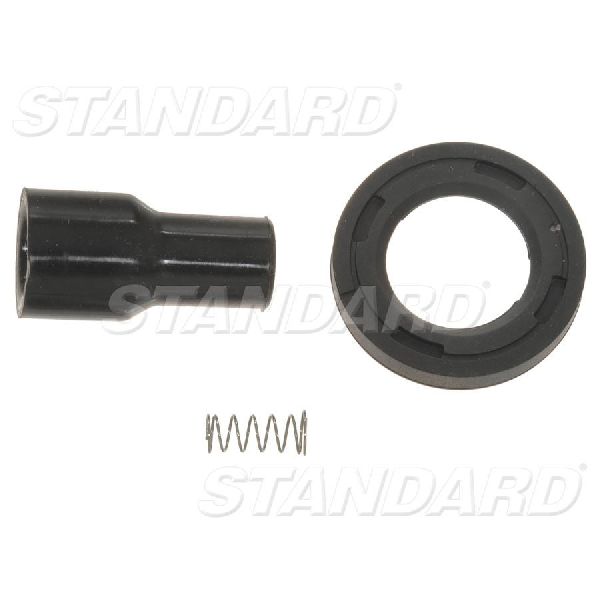
- Ignition Coil
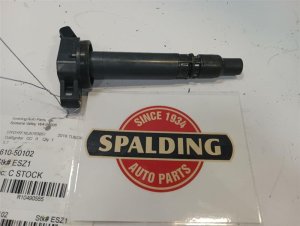
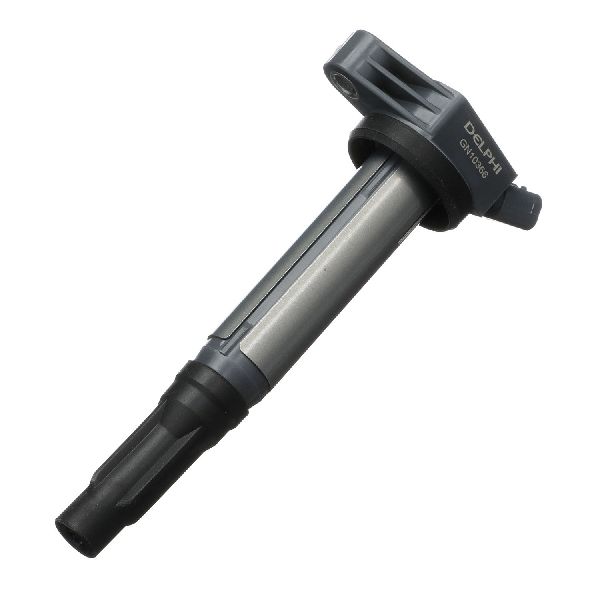
(OEM #90919-A2004)— A common failure item for misfires. Easy to diagnose by swapping between cylinders.
Trusted brands: Denso, NGK
OEM price range: $90-$120
Aftermarket price range: $40-$70 - Iridium Spark Plug
(OEM #90919-01249)— A routine maintenance item that can fail and cause a misfire. Should be replaced as a set.
Trusted brands: Denso (FK20HBR11), NGK
OEM price range: $18-$25
Aftermarket price range: $12-$18 - Intake Manifold Gasket Set — Required for re-assembly when performing a carbon cleaning service or replacing driver-side spark plugs/coils, as the intake manifold must be removed.
Trusted brands: Fel-Pro, Mahle
OEM price range: $40-$60
Aftermarket price range: $20-$40
Related Codes That Often Appear With This One
- P0300 — This is a 'Random/Multiple Cylinder Misfire' code. It often appears alongside specific cylinder codes like P0302 when the underlying issue, such as carbon buildup, begins to affect multiple cylinders.
- P0301, P0303, P0304, P0305, P0306 — These codes indicate misfires in other cylinders. Seeing them together with P0302 strongly points to a systemic problem like carbon buildup or a major vacuum leak, rather than a single component failure.
Technical Service Bulletins (TSBs) & Recalls
- L-TT-0192-15: Notes that IS250s may exhibit MIL ON with P030x codes and an intermittent rough run when warm.
- L-TT-0093-12: An earlier bulletin describing the same conditions of rough running and P030x codes on the IS250.
Platform-Specific Known Issues
- Carbon Buildup Customer Support Program: Lexus acknowledged the carbon buildup issue and issued a Customer Support Program (CSP) that extended the warranty for this specific problem to 9 years with unlimited mileage. While this program has expired for all 2006-2010 models, its existence confirms the prevalence of the issue.
- TSB-Documented Symptoms: Technical Service Bulletins L-TT-0192-15 and L-TT-0093-12 describe the exact symptoms associated with this problem: a MIL 'ON' with P030x codes and an intermittent rough run after stopping with the engine at operating temperature.
Mechanic-Grade Diagnostic Values
- Direct Fuel Injector Resistance — expected: 11.6 to 12.4 Ω at 20°C (68°F). Failure: Resistance outside of this range indicates a faulty injector.
- Low-Pressure Fuel System Pressure — expected: 196 to 588 kPa (28 to 85 psi). Failure: Pressure below this range can indicate a weak in-tank fuel pump.
- High-Pressure Fuel System Pressure (at idle) — expected: 3.5 to 4.5 MPa (508 to 653 psi). Failure: Pressure outside this range can indicate a problem with the high-pressure fuel pump or sensor.
- Spark Plug Insulation Resistance — expected: 10 MΩ or more. Failure: Resistance below 10 MΩ suggests the spark plug is fouled or faulty and should be replaced.
Hidden / Shadow Codes Worth Checking
- Mode $06 Misfire Counts: While not a hidden code, professional scan tools like Techstream can access Mode $06 data to view raw misfire counts per cylinder before they are high enough to trigger a P030x code. This is invaluable for diagnosing intermittent misfires. (see via Toyota Techstream or other advanced OBD-II scanners with Mode $06 capability.)
Scan Tool Commands That Help
- Toyota Techstream: Active Test: Control the Injector — This function allows a technician to individually disable fuel injectors one by one. When the injector for cylinder 2 is disabled, if there is no change in engine RPM or smoothness, it confirms that cylinder 2 was not contributing, pointing to a problem with that cylinder's ignition, fuel, or compression.
- Toyota Techstream: Active Test: Control the Fuel Pump Speed — Used to command the in-tank fuel pump to operate, allowing a technician to measure the low-side fuel pressure without the engine running.
- Toyota Techstream: Data List: Misfire RPM & Misfire Load — This allows a technician to see the exact engine speed and load conditions under which the misfire occurred, which can help replicate the issue during a test drive. This is especially useful for the common warm-idle misfire scenario.
Wiring & Ground Locations
- ECM (Engine Control Module) — Located in the engine compartment, on the right (passenger) side.. The ECM is the source of the trouble code and controls both the ignition coil and fuel injector for cylinder 2. Poor connections or corrosion at the ECM connectors could theoretically cause a misfire.
- Ground Points: J/C A7, A8 — Located at the right kick panel.. These junction connectors serve as ground points for various engine and body components. A loose or corroded ground in this area could potentially affect systems related to engine management.
- Injector Driver (EDU) — The Injector Driver is a separate module that controls the high-pressure fuel injectors. Its specific location is typically near the ECM in the engine bay.. The ECM sends a signal (INJF) to the Injector Driver, which then provides the high voltage pulse to fire the injector. A fault in the EDU or its wiring could cause a single cylinder misfire.
Real Owner Repair Stories
- ClubLexus.com Forum User (2006 IS250 AWD with 147k miles) — Crank no-start, followed by detected misfires in cylinders 4 & 6 after getting the car started. Later, after 2 weeks of normal driving, experienced flashing MIL and limp mode under heavy acceleration.
❌ Tried (didn't work) New battery, New spark plugs, New fuel pressure sensor
✅ What actually fixed it The user's symptoms (intermittent misfire under load after warm) are classic signs of carbon buildup. While the thread ends with the user asking about top-end cleaning procedures, this story is a perfect example of the diagnostic path where common parts are replaced without success, strongly pointing towards the underlying carbon issue as the final culprit. - YouTube video by 'Tuner with Kids' (Lexus IS250 (year not specified)) — Sluggish performance, poor acceleration, engine making unbalanced sounds, P0301 code (Cylinder 1 Misfire).
❌ Tried (didn't work) Swapping ignition coils between cylinders (misfire did not move).
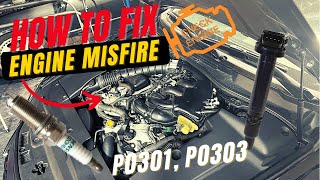
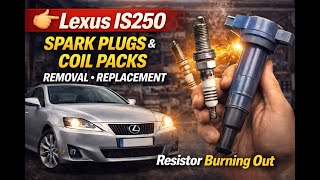
✅ What actually fixed it The misfire code moved to a different cylinder only after swapping the spark plugs. The final fix was replacing a single faulty Denso Iridium spark plug (FK20HBR11), which resolved the misfire counts shown on Techstream. The creator noted some of the plugs were also found to be loose.
OEM Part Supersession History
90919-A2004→90919-A2013— Part has been updated by the manufacturer. Supersessions often involve minor improvements in materials or internal construction.
Heads up: The new part number 90919-A2013 is a direct replacement for 90919-A2004, 90919-A2002, and 90919-A2007. There are no known incompatibility issues.
Helpful Videos
Used OEM Parts in Stock
New Aftermarket Parts Available


The information in this article is provided for general reference and educational purposes only. Vehicle specifications, procedures, and part compatibility can vary by production date, trim level, and region. Always consult your vehicle's factory service manual and verify part numbers before purchasing or performing repairs. Safety-critical components such as airbags, seat belts, and braking systems should be installed by a qualified professional.
- Lexus IS 250:
- 🎬 Helpful Videos
- 🛍️ Shop This Part
- What's Unique About the 2006-2010 Lexus IS 250
- Diagnostic Flowchart
- Symptoms You May Notice
- Most Likely Causes
- Rare But Worth Checking
- Diagnosis Steps
- Parts You'll Likely Need
- Related Codes That Often Appear With This One
- Technical Service Bulletins (TSBs) & Recalls
- Platform-Specific Known Issues
- Mechanic-Grade Diagnostic Values
- Hidden / Shadow Codes Worth Checking
- Scan Tool Commands That Help
- Wiring & Ground Locations
- Real Owner Repair Stories
- OEM Part Supersession History
- 🎟️ Get 5% Off