

P0299 on 2009-2021 Opel Astra: Turbo Underboost Causes and Fixes
On diesel Astras, P0299 is often caused by a soot-clogged MAP/boost sensor or a split intercooler hose. On 1.4L Turbo petrol models, suspect a failed PCV system (valve cover or intake manifold check valve), a faulty turbo diverter valve, or a sticking wastegate. A sensor cleaning is free; a new hose is about $50-$100.
- P0299 on an Opel Astra means the turbo isn't making enough boost.
- For diesel engines (1.6/1.7 CDTi), the first and cheapest check is to remove and clean the MAP/boost pressure sensor.
- For petrol engines (1.4 Turbo), inspect the diverter valve and wastegate actuator for proper function.
- For all engines, thoroughly inspect all charge air hoses for splits or loose clamps, as this is a very common cause.
- Do not immediately assume the expensive turbocharger has failed; the cause is often a much cheaper component.
What's Unique About the 2009-2021 Opel Astra

For the Opel Astra, the most likely cause of P0299 depends heavily on the engine. The 1.6L and 1.7L CDTi diesel engines are highly prone to the MAP (boost pressure) sensor getting clogged with soot, leading to incorrect readings and an underboost code. In contrast, the 1.4L petrol turbo engine (A14NET family), sharing architecture with the Chevrolet Cruze and Sonic, is most likely to suffer from a failed PCV system. This involves a check valve inside the intake manifold failing, which then causes a diaphragm in the valve cover to rupture, creating a massive vacuum leak that the ECU interprets as an underboost condition.
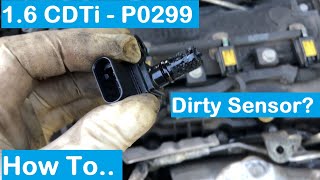
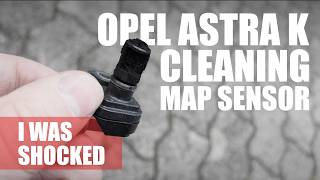
Generation note: This range covers the Opel Astra J (2009-2015) and Astra K (2015-2021). The causes for P0299 are broadly similar as they relate to fundamental turbo system design. However, the 1.6L CDTi 'Whisper Diesel' (B16DTH) used in both generations is particularly known for the MAP sensor issue. 🎬 Watch: How to diagnose and clean the diesel MAP sensor. The 1.4L Turbo (A14NET/B14NET) also spans both generations with similar known issues, especially the systemic PCV system failures and wastegate problems.
Symptoms You May Notice
- Check Engine Light illuminated
- Significant loss of power and sluggish acceleration
- Vehicle entering 'limp mode'
- Hissing or whistling sound from the engine bay, especially on 1.4T models (indicates a boost leak or failed PCV diaphragm)
- Poor fuel economy
- Black smoke from the exhaust (more common on diesel models)
- Rattling from the turbo area (can indicate a loose wastegate actuator arm)
- Replacing the turbocharger when the actual fault is a simple vacuum leak, a cheap sensor, or a failed PCV system.
- Replacing the MAP sensor on a diesel without first attempting to clean it thoroughly.
- Ignoring small, hard-to-see cracks in intercooler hoses that only open under pressure.
- On 1.4T models, replacing only the valve cover when the root cause was the failed check valve in the intake manifold, leading to a repeat failure of the new valve cover diaphragm.
Most Likely Causes


- Failed PCV System (Intake Manifold Check Valve / Valve Cover Diaphragm) Very High Probability This is the most common cause for P0299 on the 1.4L Turbo engine. A non-return check valve in the plastic intake manifold fails, allowing boost pressure into the crankcase. This pressure then ruptures a rubber diaphragm in the valve cover, creating a large unmetered air leak.
How to confirm: Check for a loud sucking or whistling noise from the engine at idle. Remove the oil filler cap; if there is strong vacuum holding it down, the diaphragm is likely ruptured. The intake manifold check valve can be inspected by removing the PCV hose and looking inside the port for a small orange/red nipple. If it's missing, the manifold has failed.
Typical fix: If the diaphragm is torn, the entire valve cover must be replaced. If the check valve is missing, the intake manifold must be replaced. Often, both are replaced together to provide a permanent fix. Aftermarket kits exist to bypass this flawed design.
Est. part cost: $50-$100 for a valve cover, $150-$300 for an intake manifold - Clogged or faulty MAP/Boost Pressure Sensor 🔴 High Probability On CDTi diesel engines, the MAP sensor is located on the intake manifold where it is exposed to EGR gases and crankcase vapors. This causes a thick layer of soot to build up, insulating the sensor and causing it to read pressure inaccurately.
How to confirm: Remove the sensor (typically held by one Torx screw) and visually inspect it. If the tip is covered in thick black soot, it is the likely culprit. You can compare its readings to atmospheric pressure with a scan tool before and after cleaning.
Typical fix: Carefully clean the sensor tip with a dedicated electronics or MAF sensor cleaner and a soft brush. Do not poke the sensing element. If cleaning doesn't work, replace the sensor.
Est. part cost: $30-$80 - Split, loose, or cracked boost/intercooler hose 🔴 High Probability Rubber and plastic hoses are exposed to high temperatures and pressure fluctuations, causing them to degrade, split, or pop off over time. This is a very common failure on all turbocharged vehicles.
How to confirm: Visually inspect all hoses from the turbo to the intercooler and from the intercooler to the intake manifold. Look for obvious splits, cracks, or oily residue (which indicates a leak). A smoke test can pressurize the system to reveal hard-to-see leaks.
Typical fix: Replace the damaged hose and clamps.
Est. part cost: $50-$150 - Faulty Turbo Wastegate Actuator or Sticking Wastegate 🟡 Medium Probability The actuator (which can be vacuum or electronically controlled) can fail, or the wastegate arm itself can bind or develop excessive play. On 1.4T models, the small retaining clip on the actuator arm is known to fall off, or the plastic vacuum nipple on the turbo can break, leaving the wastegate uncontrolled.
How to confirm: With the engine off, check if the actuator arm is securely connected and try to move it by hand or with a vacuum pump. It should move smoothly without excessive play. A scan tool can sometimes command the actuator to move for testing.
Typical fix: If the actuator is faulty, it can sometimes be replaced separately. A missing clip can be replaced for a few dollars. If the wastegate itself is binding or worn inside the turbo housing, the entire turbocharger assembly often needs to be replaced.
Est. part cost: $100-$250 for an actuator; $600-$1500+ for a turbocharger - Faulty Turbocharger Diverter Valve (Bypass Valve) 🟡 Medium Probability On the 1.4L Turbo engine, this valve is often integrated into the turbo compressor housing. The rubber diaphragm inside can tear, creating a constant boost leak.
How to confirm: The valve must be removed and inspected for tears in the diaphragm. Sometimes an audible 'flutter' can be heard when letting off the throttle.
Typical fix: Replace the diverter valve. Upgraded, more durable aftermarket valves with piston designs are available.
Est. part cost: $60-$120
Rare But Worth Checking
- Blocked Diesel Particulate Filter (DPF) or Catalytic Converter: If the exhaust is restricted, the turbo cannot spool up effectively. This usually comes with other codes related to DPF pressure or catalyst efficiency.
- Worn or Damaged Turbocharger Internals: If the turbine or compressor wheels are damaged or the bearings have failed, the turbo will not spin freely enough to create boost. This is usually accompanied by a loud whining or grinding noise and is a last-resort diagnosis after all other causes are eliminated.
- Faulty Turbo Boost Control Solenoid: This solenoid modulates the vacuum sent to the wastegate actuator. If it fails, it can prevent the wastegate from closing properly, 🎬 Watch: Testing and replacing the turbo boost control solenoid. causing an underboost condition.
- Restricted Air Intake: A severely clogged engine air filter can starve the turbo of air, preventing it from making boost. This is a simple check that should be performed first.
Diagnosis Steps

- Read the fault codes with an OBD-II scanner to confirm P0299 and check for accompanying codes like P0171 or P1101, which strongly point to a PCV issue on 1.4T models.
- Perform a thorough visual inspection of the engine bay. Check the air filter to ensure it's clean.
- On 1.4L Turbo models, check the PCV system first. Listen for hissing at idle. With the engine running, try to remove the oil cap. If it's held on by strong vacuum, the valve cover diaphragm is torn.
- Inspect all air intake and charge hoses between the air filter, turbo, intercooler, and intake manifold for cracks, splits, or loose connections. Pay close attention to connection points.
- If you have a diesel model, locate and remove the MAP/Boost Pressure sensor. Inspect for heavy soot buildup and clean if necessary with an appropriate cleaner.
- Locate the turbo wastegate actuator. Check that the arm is connected and the retaining clip is present. Check if its linkage moves freely. If it's vacuum-operated, check the vacuum lines for leaks.
- If no obvious faults are found, perform a boost leak test (smoke test) to identify hidden leaks in the intake tract, intercooler, or gaskets.
- Using a scan tool with live data, monitor 'commanded boost' vs. 'actual boost' while driving. A large discrepancy confirms the underboost condition.
- If all else fails, the issue may be with the turbocharger itself (internal wastegate wear, bearing failure) or a blocked exhaust, which may require professional diagnosis.
Parts You'll Likely Need

- MAP / Boost Pressure Sensor
(OEM #Bosch 0 281 002 437 (Verify for specific diesel engine))— On diesel engines, this sensor frequently gets clogged with soot, causing incorrect readings. It's a primary suspect for P0299 on CDTi models.
Trusted brands: Bosch, Delphi
OEM price range: $60-$100
Aftermarket price range: $30-$80 - Valve Cover / Cam Cover Assembly (1.4L Turbo)
(OEM #GM 25198874 (Verify for specific year))— The integrated PCV diaphragm ruptures due to a failed intake manifold check valve, causing a massive vacuum leak. The entire cover must be replaced.
Trusted brands: ACDelco, Dorman
OEM price range: $80-$120
Aftermarket price range: $50-$90 - Intercooler / Turbo Hose
(OEM #GM 13265273 (Example, verify for specific model/engine))— These hoses are under constant pressure and heat, making them a common failure point. A split hose is a very common cause of a sudden P0299 code.
Trusted brands: Gates, ACDelco
OEM price range: $80-$200
Aftermarket price range: $50-$150 - Intake Manifold (1.4L Turbo)
(OEM #GM 25200449 (Verify for specific year))— The internal, non-serviceable PCV check valve fails and gets ingested by the engine. This is the root cause of the subsequent valve cover failure.
Trusted brands: ACDelco, Dorman
OEM price range: $200-$300
Aftermarket price range: $150-$250
Related Codes That Often Appear With This One
- P0171 - System Too Lean (Bank 1): On 1.4L Turbo models, this code is a strong indicator of a failed PCV system, as the ruptured diaphragm creates a large vacuum leak.
- P1101 - Intake Air Flow System Performance: Also very common with P0299 on the 1.4L Turbo, this GM-specific code is triggered by the same unmetered air from a PCV failure.
Platform-Specific Known Issues
- On 1.6L and 1.7L CDTi engines, the location of the MAP sensor makes it a magnet for soot. Cleaning it during regular service intervals (like an oil change) can be a preventative measure.
- For the 1.4L Turbo, the PCV system failure is almost a certainty. Owners report that replacing the valve cover is only a temporary fix if the intake manifold's check valve isn't addressed simultaneously.
- A known failure point on the 1.4L Turbo wastegate actuator is the small E-clip that holds the arm to the wastegate lever. If this clip falls off, the arm detaches, leaving the wastegate open. This can be fixed with a sub-$1 part if caught early.
Mechanic-Grade Diagnostic Values
- MAP Sensor Voltage (Key On, Engine Off) — expected: ~4.5 - 5.0 Volts. Failure: Significantly lower voltage suggests a sensor or wiring issue.
- MAP Sensor Pressure (Key On, Engine Off) — expected: ~100 kPa (should match atmospheric pressure). Failure: A reading significantly different from ambient air pressure indicates a faulty sensor.
- MAP Sensor Pressure (Engine at Idle) — expected: 30 - 40 kPa. Failure: A reading close to atmospheric pressure (e.g., above 90 kPa) at idle suggests the sensor is clogged or has failed.
- Long Term and Short Term Fuel Trims (LTFT/STFT) on 1.4T models — expected: Within +/- 10%. Failure: High positive fuel trims (e.g., >15-20%) suggest a vacuum leak, strongly pointing to a failed PCV system when P0299 is also present.
Scan Tool Commands That Help
- GDS2 / Tech2 or equivalent professional scanner: Turbocharger Boost Control Solenoid Valve Test — To command the wastegate actuator on and off to verify its mechanical movement and the solenoid's electronic function, helping to isolate a sticky wastegate from a failed control solenoid.
- GDS2 / Tech2 or equivalent professional scanner: Live Data Monitoring: 'Desired Boost Pressure' vs 'Actual Boost Pressure' — During a test drive under load, this is the primary method to confirm the underboost condition in real-time and observe the magnitude of the deviation.
- Any OBD-II Scanner or Battery Disconnect: Reset ECU Learned Fuel Trims — After replacing a MAP sensor or fixing a major vacuum leak, this procedure should be performed to clear the old adaptive values and allow the ECU to relearn with the new, correct sensor data.
Wiring & Ground Locations
- MAP Sensor Connector — On the intake manifold, typically held by a single Torx screw.. The sensor uses a 3-wire harness: a 5V reference, a ground, and the signal wire. Corrosion or damage to this connector or its wiring can cause incorrect readings that trigger P0299.
- Boost Control Solenoid Valve — On some models, located at the front of the engine bay, behind the right-hand side of the front bumper.. This solenoid controls the vacuum to the wastegate actuator. Knowing its location is critical for testing the vacuum lines running to it and checking its electrical connector for faults.
Real Owner Repair Stories
- AstraKlub.pl forum user (Opel Astra J 1.4T with LPG) — P0299 and P0171 codes, turbo cut-off, and sluggish performance, occurring mostly during hot weather or on shorter trips after a long drive.
❌ Tried (didn't work) Turbocharger regeneration/replacement (due to a separate crack), New valve cover (odma), New ignition coil and spark plugs, New EVAP valve, LPG system adjustment
✅ What actually fixed it The user found play in the connection where a boost pipe enters the intercooler. Replacing a small, inexpensive O-ring on that pipe connection completely solved the intermittent underboost issue that had persisted for two years. - YouTube video by 'fix it Angel' (2014 Vauxhall Astra 1.6 Diesel) — Management light on, limp mode, P0299 engine underboost, and engine bay covered in soot.
❌ Tried (didn't work) Initially just replacing the exhaust manifold.
✅ What actually fixed it The root cause was a split exhaust manifold, which prevented exhaust gases from spooling the turbo. After replacing the manifold, the P0299 code remained. The secondary, resulting fault was a MAP sensor completely clogged with soot from the engine running poorly. Cleaning the MAP sensor after the manifold replacement resolved the code. - Reddit user 'CashBruv' (Vauxhall Astra J 1.4T) — Lean condition (often triggers P0171, which is commonly seen with P0299 on this engine).
❌ Tried (didn't work) Initial diagnosis pointed towards the common PCV system failure (valve cover/intake manifold).
✅ What actually fixed it The actual cause was a faulty EVAP purge valve, which also creates a vacuum leak but is a separate component from the more notorious PCV system.
"I Checked Everything" — The Actual Cause
- In one documented case on an Astra J 1.4T, the owner chased an intermittent P0299 code for two years, which primarily occurred in hot weather. While a smoke test may have been performed or considered, the issue was so intermittent that a leak was ruled out. The final cause was a faulty O-ring on an intercooler pipe that would only leak under specific temperature and pressure conditions, which a static smoke test at atmospheric pressure would likely miss.
OEM Part Supersession History
55573746, 55561426 (Plastic OEM Valve Cover)→Aftermarket Aluminum Valve Covers (e.g., 25198877, 25198498)— The original plastic valve cover on the 1.4L Turbo engine is prone to warping and, more importantly, houses a PCV diaphragm that frequently ruptures. Aftermarket manufacturers developed more durable aluminum versions to provide a permanent fix.
Heads up: While many aluminum covers are sold as direct replacements, buyers should verify fitment for their specific engine code (A14NET, B14NET, etc.) as minor casting or port differences may exist.
Model Year Variations Within This Range
- 2009-2015 (Astra J): The 1.4L Turbo (A14NEL, A14NET) in this generation is famous for the PCV system failure involving the intake manifold check valve and valve cover diaphragm, which is the number one cause of P0299 combined with P0171/P1101.
- 2015-2021 (Astra K): This generation heavily features the 1.6L CDTi 'Whisper Diesel' engine (B16DTH, B16DTL). On this engine, P0299 is most frequently caused by the MAP sensor becoming completely clogged with soot, a problem exacerbated by short-trip driving cycles.
Diagnostic Flowchart
Other Known Issues on This Vehicle
Issues unrelated to this code that are worth knowing about as an owner of this generation:
- M32 Manual Gearbox Bearing Failure 🔴 High — Common after 50,000 miles (80,000 km), especially on Astra J. Symptoms include whining in 5th/6th gear and gearstick movement. (Ref: No official recall, but updated bearings were introduced in post-2012 gearboxes.)
- 1.6L CDTi ('Whisper Diesel') Timing Chain Rattle/Stretch 🔴 High — Can occur at various mileages, often noted by a 2-5 second rattle on cold starts. Caused by a tensioner design that loses oil pressure. (Ref: No recall, but an uprated tensioner kit with a gasket is the recommended permanent fix.)
- 1.4L Turbo Water Pump & Thermostat Housing Leaks 🟠 Medium — Components are plastic and prone to cracking/leaking, often needing replacement before 100,000 km.
- Failed PCV System (Valve Cover/Intake Manifold) 🔴 High — Extremely common on 1.4L Turbo engines. The intake manifold check valve fails, which then over-pressurizes and ruptures the valve cover diaphragm, causing codes P0299, P0171, and P1101.
- Cracked Clutch Pedal Return Spring Bracket 🟡 Low — The plastic bracket for the clutch return spring can break, causing the pedal to not return fully. A common nuisance issue on manual Astra J models.
Used vs. New Parts: Buying Guide for This Vehicle
When a used part is the smart pick: Used parts can be a smart choice for non-wear, structural components. This includes the intercooler (if not leaking), charge pipes (if not cracked), and potentially the turbo manifold from a verified low-mileage, non-crashed vehicle.
Donor-vehicle mileage cap: roughly under 60000 miles for the part to have meaningful remaining life.
What to inspect on the donor part:
- For a used turbocharger: Check for zero in-and-out (axial) shaft play and minimal side-to-side (radial) play. Spin the compressor wheel by hand; it should be smooth with no grinding. Inspect blades for any signs of impact or chipping.
- For hoses/pipes: Squeeze the rubber to ensure it's still pliable and not brittle. Check for any oily residue, which indicates a past leak.
- For a used valve cover (1.4T): Not recommended due to the integrated PCV diaphragm, which is a primary failure point. If you must, ensure it's from a very low-mileage car and the plastic isn't brittle.
OEM-only on this vehicle (don't cheap out):
- MAP/Boost Pressure Sensor: Cheap, unbranded aftermarket sensors are notorious for incorrect calibration, leading to persistent codes or poor performance. Stick with OEM (Bosch) or a top-tier OEM supplier.
- Boost Control Solenoid: As a critical electronic control component, OEM or an OEM supplier is recommended to ensure correct operation and longevity.
Aftermarket brands forum-validated for this vehicle:
- Valve Cover (1.4T): Aftermarket **aluminum** valve covers are widely seen as an upgrade over the failure-prone OEM plastic part. Brands are numerous and often unbranded, but the material change is the key benefit.
- Dorman: Known for re-engineering common failure parts and may offer improved versions of the valve cover or intake manifold.
Brands owners have reported issues with on this vehicle:
- Unbranded electronic sensors (MAP, MAF) from marketplaces like eBay/AliExpress. While tempting due to low cost, they are a frequent cause of repeat repairs.
Real Owner Stories
Aggregated from forums and TSBs cited above. Mileages and costs reflect what owners reported in those sources.
2011 Opel Astra J GTC 1.4L Turbo
Symptoms: P0299 code and questioning if the wastegate actuator should move during startup.
What fixed it: Investigation of the wastegate actuator movement and PCV system components.
Source hint: Reddit r/Vauxhall: 'P0299 - Should the wastegate actuator move during startup? - Astra J, GTC 1.4 2011'
Opel Astra J 1.4L Turbo
Symptoms: Error P0299 and a squeaking/whistling sound upon starting the vehicle.
What fixed it: Replacement of the membrane in the valve cover and the valve in the intake manifold.
Source hint: elektroda.pl: 'Opel Astra J - Błąd P0299 i piszczy przy odpaleniu'
Related OBD-II Codes
Frequently Asked Questions
I hear a loud whistling noise from my 1.4L Turbo engine at idle. Is this related to the P0299 code?
Can I just replace the valve cover on my Astra 1.4T to fix the P0299 code permanently?
My Astra CDTi diesel has a P0299 code and black smoke. What should I check first?
Is there a simple mechanical check for the P0299 code on the 1.4L Turbo engine?
How can I tell if my Astra's intake manifold check valve has failed?
Helpful Videos

The information in this article is provided for general reference and educational purposes only. Vehicle specifications, procedures, and part compatibility can vary by production date, trim level, and region. Always consult your vehicle's factory service manual and verify part numbers before purchasing or performing repairs. Safety-critical components such as airbags, seat belts, and braking systems should be installed by a qualified professional.
- Opel Astra:
- 🎬 Helpful Videos
- What's Unique About the 2009-2021 Opel Astra
- Symptoms You May Notice
- Most Likely Causes
- Rare But Worth Checking
- Diagnosis Steps
- Parts You'll Likely Need
- Related Codes That Often Appear With This One
- Platform-Specific Known Issues
- Mechanic-Grade Diagnostic Values
- Scan Tool Commands That Help
- Wiring & Ground Locations
- Real Owner Repair Stories
- "I Checked Everything" — The Actual Cause
- OEM Part Supersession History
- Model Year Variations Within This Range
- Diagnostic Flowchart
- Other Known Issues on This Vehicle
- Used vs. New Parts: Buying Guide for This Vehicle
- Real Owner Stories
- 2011 Opel Astra J GTC 1.4L Turbo
- Opel Astra J 1.4L Turbo
- Related OBD-II Codes
- Frequently Asked Questions
- 🎟️ Get 5% Off