

P0299 on 2010-2019 Ford Flex 3.5L EcoBoost: Turbo Underboost Causes and Fixes
On a 2010-2019 Ford Flex with the 3.5L EcoBoost, code P0299 is most often caused by a boost leak from a torn turbocharger bypass valve (BOV) or a loose charge pipe. Before suspecting expensive turbo failure, inspect the electronic BOV (Part #AA5Z-9U465-A), which costs about $60-$90 and is a very common DIY fix. Also, check for broken vacuum nipples on the wastegate control solenoids on the intake manifold (Part #BL3E-9K378-BA).
- Do not assume you need new turbos. P0299 on the 3.5L EcoBoost is most often caused by a much cheaper part.
- The most likely cause is a failed Turbocharger Bypass Valve (BOV) with a torn rubber diaphragm. This should be the first part you physically inspect.
- Thoroughly check all charge pipes and hoses for loose clamps or disconnections. A large boost leak is a very common and simple fix.
- If the BOV and pipes are fine, inspect the two wastegate control solenoids on the intake manifold for broken plastic nipples.
- Only after ruling out all leaks and faulty valves should you investigate the wastegates or the turbochargers themselves.
What's Unique About the 2010-2019 Ford Flex

The 3.5L EcoBoost V6 in the Ford Flex is a twin-turbocharged engine shared with many other Ford products like the F-150, Explorer Sport, and Taurus SHO. This complexity introduces several common failure points that lead to P0299. Unlike some other turbocharged vehicles, issues with the electronic bypass valve (BOV), boost leaks from charge pipes, and wastegate control solenoids are frequent culprits that should always be investigated before assuming the turbochargers themselves have failed. Owner and technician experiences show that these less expensive external components are the cause of the underboost condition in the vast majority of cases. A user on a Ford Flex forum specifically noted that a disconnected charge pipe after a dealer service caused their P0299 code.
Symptoms You May Notice
- Significant loss of engine power and sluggish acceleration
- Check Engine Light is on
- Vehicle may enter a reduced-power 'limp mode', sometimes with a wrench icon on the dash
- Hissing, whooshing, or whistling sounds from the engine bay during acceleration
- A surging sensation that can feel like a misfire
- Reduced fuel economy
- In some cases, the 'Service AdvanceTrac' light may illuminate along with the P0299 code.
- Replacing one or both turbochargers without first checking for boost leaks from pipes or failed bypass/diverter valves. This is a very expensive and often unnecessary repair.
- Replacing the bypass valve (BOV) without checking the much simpler and cheaper wastegate control solenoid vacuum lines and nipples on top of the intake manifold.
Most Likely Causes


- Faulty Turbocharger Bypass Valve (Blow-Off Valve) 🔴 High Probability The rubber diaphragm inside the electronic valve is a very common failure point that tears, or the plunger shaft can stick open due to rust or debris, creating an internal boost leak. This is one of the most frequent causes of P0299 on this engine across multiple platforms.
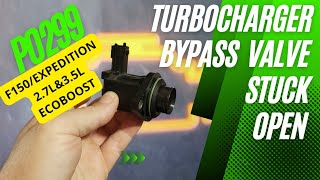
How to confirm: Remove the valve, which is mounted on the charge air cooler (intercooler), and inspect the orange rubber diaphragm for any rips or holes. 🎬 Watch: How to inspect and replace a torn bypass valve diaphragm. The valve should be normally closed; if the plunger is stuck open, it has failed. It is held on by three 8mm bolts.
Typical fix: Replace the entire bypass valve assembly. It is held on by a few bolts and has one electrical connector. The OEM part is made by Bosch.
Est. part cost: $60-$90 - Boost Leak from Hoses or Pipes 🔴 High Probability The engine uses numerous plastic and rubber pipes for the charge air system. Clamps can loosen over time, or pipes can crack or pop off their connections entirely, causing a major leak. This can happen after other service work where pipes were disconnected.
How to confirm: Perform a thorough visual inspection of all air intake and charge pipes between the turbos, intercooler, and throttle body. Look for disconnected hoses, loose clamps, or visible cracks. A high-pressure smoke test is the most effective way to find small leaks.
Typical fix: Tighten loose clamps or replace the cracked/split hose or pipe. A common failure point is the connection at the intercooler or throttle body. A Ford Flex owner reported this exact issue fixed their P0299 code.
Est. part cost: $10-$200 depending on the specific hose - Failed Turbocharger Wastegate Control Solenoid 🟡 Medium Probability The 3.5L EcoBoost uses two of these solenoids on the intake manifold to control the turbo wastegates via vacuum lines. The plastic nipples on these solenoids can become brittle and break, causing a vacuum leak that prevents proper wastegate control. An owner reported in NHTSA ODI #11561976 that they replaced the turbocharger overboost solenoid to address a P0299 code.
How to confirm: Visually inspect the two solenoids on top of the intake manifold. Check for any broken plastic nipples or loose/disconnected vacuum lines connected to them. A YouTube video by 'Tunnell Custom Garage' shows a clear example of a broken nipple being the cause of P0299. 🎬 See this walkthrough on fixing the wastegate control solenoid.
Typical fix: Replace the failed solenoid (Part #BL3E-9K378-BA). This is a relatively simple repair involving disconnecting hoses and an electrical connector.
Est. part cost: $25-$50 - Sticking Turbocharger Wastegate or Faulty Actuator ⚪ Low Probability The wastegate diverts exhaust gas to control turbo speed. If the wastegate or its actuator rod gets stuck open due to carbon buildup or mechanical failure, the turbo cannot build sufficient pressure. Manufacturer Bulletin #SSM 50485 notes that P0299 may be caused by an inoperative wastegate actuator, a missing wastegate actuator e-clip, or non-visible damage.
How to confirm: This is more difficult to diagnose. It may require using a handheld vacuum pump on the actuator to see if it moves freely and holds vacuum. A scan tool can also be used to command the actuator while observing its movement.
Typical fix: Sometimes the linkage can be freed up. In many cases, the wastegate is integral to the turbocharger, and a faulty wastegate requires replacing the entire turbocharger assembly.
Est. part cost: $500-$1500+
Rare But Worth Checking
- Cracked Exhaust Manifold: The exhaust manifolds on the 3.5L EcoBoost are known to warp or crack. This allows exhaust gas to leak before it reaches the turbo, preventing the turbo from spooling up correctly and causing an underboost condition.
- Faulty Boost Pressure Sensor (MAP/TIP Sensor): A sensor providing incorrect data to the PCM can trigger the code, but this is less common and usually accompanied by other sensor-specific fault codes.
- Complete Turbocharger Failure: While this is the most expensive repair, it's often misdiagnosed. Actual internal failure (e.g., worn bearings, damaged turbine wheels causing white smoke) should only be considered after all potential boost leaks and valve issues have been ruled out. NHTSA ODI #11567565 describes a situation where rubber and oil were found in vacuum lines along with buildup inside, leading to a recurring P0299 code and turbo failure.
- Stretched Timing Chain: On first-generation 3.5L EcoBoost engines, a stretched timing chain can set a P0016 code, which can sometimes be accompanied by a P0299 code as the engine's performance is compromised and the PCM limits boost to prevent damage.
Diagnosis Steps

- Read all fault codes with an OBD-II scanner. Note any other codes that may point to a specific circuit (e.g., boost sensor, wastegate solenoid, or cam/crank correlation like P0016).
- Perform a thorough visual inspection of the engine bay. Remove the engine appearance cover. Look for any charge pipes that have popped off, especially near the throttle body and intercooler. Check for obviously loose clamps or cracked plastic/rubber hoses.
- Inspect the two wastegate control solenoids on top of the intake manifold. Check for broken plastic vacuum nipples or disconnected/cracked rubber lines, which is a common and easy-to-spot failure point.
- Remove and inspect the Turbocharger Bypass Valve (BOV), located on the driver's side of the intercooler. It is held on by three 8mm bolts. Check the orange rubber diaphragm inside for any tears or rips.
- If no obvious faults are found, perform a high-pressure smoke test. This involves feeding low-pressure smoke into the intake system to reveal small, hard-to-see leaks in hoses, 🎬 Watch: Professional tips for properly diagnosing turbo boost leaks. the intercooler, or gaskets. An owner reported in NHTSA ODI #11522199 that they had to pay for a repair after a P0299 code was deemed to be caused by a vacuum leak.
- If no leaks are present, test the wastegate actuators. Use a handheld vacuum pump to ensure they move freely and hold vacuum. A scan tool may also be used to command them to move.
- As a final step, if all other components are confirmed to be working, inspect the turbochargers for excessive shaft play or signs of damage to the turbine wheels (indicated by noise or smoke), which would indicate turbo failure.
Parts You'll Likely Need
- Turbocharger Bypass Valve (Blow-Off Valve)
(OEM #AA5Z-9U465-A)— This is the most common failure point for P0299 on the 3.5L EcoBoost. The internal rubber diaphragm tears, causing a significant boost leak.
Trusted brands: Motorcraft, Bosch (OEM supplier)
OEM price range: $70-$90
Aftermarket price range: $40-$60 - Turbocharger Wastegate Control Solenoid
(OEM #BL3E-9K378-BA)— The plastic nipples on these solenoids, located on top of the intake manifold, become brittle and break, causing a vacuum leak that prevents proper wastegate control.
Related Codes That Often Appear With This One
- P0235-P0242 — These codes relate to the boost sensor circuit and can indicate a problem with the sensor itself, which could be the root cause of the P0299 reading.
- P0243-P0250 — These codes point to issues with the wastegate solenoid circuit, which directly impacts the turbo's ability to build boost.
- P0016, P0017, P0018, P0019 — On EcoBoost engines, timing chain issues can sometimes manifest with a P0299 code if the engine's timing is off enough to affect overall performance. The PCM may command reduced boost as a protective measure.
Technical Service Bulletins (TSBs) & Recalls
- TSB 14-0194: Addresses timing chain stretch on early 3.5L EcoBoost engines, which can be related to a P0299 code appearing alongside a P0016 code.
- TSB 20-2246: While for the 2.3L Explorer, it shows a precedent for Ford addressing P0299 with software updates for false triggers.
- Bulletin #SSM 50485: Notes that EcoBoost engines may exhibit a lack of power and a P0299 code due to an inoperative wastegate actuator or a missing wastegate actuator e-clip.
Platform-Specific Known Issues
- Intercooler Condensation: Early 3.5L EcoBoost engines were known for accumulating condensation inside the intercooler, which could be ingested by the engine during hard acceleration, causing a shudder. While this typically sets misfire codes, a damaged or leaking intercooler from this issue could also cause P0299.
Mechanic-Grade Diagnostic Values
- Turbocharger Wastegate Regulating Valve Solenoid Resistance — expected: 10 - 30 Ohms (general specification). Failure: A reading near 0 Ohms (short circuit) or infinite/OL (open circuit) indicates a failed solenoid.
- Wastegate Solenoid Connector Power Pin Voltage (Key On, Engine Off) — expected: ~12V (Battery Voltage). Failure: Voltage below 11V suggests a problem in the power supply circuit or fuse.
- Wastegate Actuator Vacuum Test (2010-2012 models) — expected: The actuator rod should move smoothly and hold vacuum when tested with a handheld pump.. Failure: No movement or failure to hold vacuum indicates a ruptured diaphragm in the actuator.
- Exhaust Backpressure — expected: Below 3 psi at idle and below 8 psi at wide-open throttle.. Failure: Higher readings indicate a restriction, likely a clogged catalytic converter, which can prevent the turbo from spooling correctly.
Scan Tool Commands That Help
- Ford IDS (or equivalent professional scan tool): Turbocharger Wastegate Regulating Valve Solenoid On/Off Command — This bidirectional control is used to command the solenoid open at idle while monitoring a vacuum gauge on the wastegate line. The gauge should read full engine vacuum when the solenoid is commanded on. If it doesn't, and voltage is present at the connector, the solenoid is faulty.
- Ford IDS: PCM Reprogramming — On some other Ford models and years, a P0299 code could be triggered by software glitches. Ford has issued TSBs for other vehicles (like the 2019 Ranger and 2020 Explorer) where a PCM software update was the specified fix. While not specific to the Flex, it's a possibility if all mechanical and electrical checks pass.
Wiring & Ground Locations
- G104 / G108 (example identifiers) — Key engine and chassis ground points are located on the engine block, near the battery tray on the inner fender, and on the firewall. A 2011 Flex service manual shows ground points on the left side of the engine compartment.. Poor ground connections for the PCM or critical sensors (like the MAP or boost pressure sensors) can cause incorrect readings, leading the PCM to falsely detect an underboost condition. Ensuring all engine-to-chassis grounds are clean and tight is a crucial step in diagnosing electronic faults.
- Wastegate Solenoid Connector (C1672 on some Fords) — The two solenoids are located on top of the intake manifold.. Technicians can test for battery voltage between the power and ground wires at this connector while commanding the solenoid on with a scan tool to verify the integrity of the control circuit.
Real Owner Repair Stories
- Ford F150 Forum user (2013 F-150 3.5L EcoBoost, 110k miles) — P0299 code, bogging down and loss of turbo noise primarily when towing, but eventually when unloaded too. Power would return after restarting the engine.
❌ Tried (didn't work) Dealer diagnosed and replaced a bad catalytic converter on bank 2, which did not solve the P0299 under load.
✅ What actually fixed it The user's story ended with the problem unresolved after replacing the catalytic converters. However, another user suggested the issue could be related to a stretched timing chain (which can cause P0016 alongside P0299) as the PCM reduces boost when timing is off. NHTSA ODI #11139177 confirms that a dealer advised an owner that a stretched timing chain was the cause of simultaneous P0016 and P0299 codes. - YouTube user 'That Expat Mechanic' (2014 Ford F-150 3.5L EcoBoost) — P0299 code present after an engine replacement.
❌ Tried (didn't work) Checking for common boost leaks in charge pipes.
✅ What actually fixed it A vacuum hose nipple located under the air filter box was found broken off, likely damaged during the engine installation. Repairing the vacuum leak resolved the code. - YouTube user 'Tunnell Custom Garage' (Ford F-150 3.5L EcoBoost) — P0299 code, particularly when pulling a camper.
❌ Tried (didn't work) The user had previously replaced the bypass valve (BOV) which did not permanently solve the issue.
✅ What actually fixed it The final fix was tightening a loose clamp on a charge pipe. The user noted that checking all clamps is a critical step.
"I Checked Everything" — The Actual Cause
- In some cases, a smoke test may not reveal a leak if the leak only opens under high pressure. The most common 'smoke test clean' culprit is a faulty component rather than a leak. This includes a torn diaphragm in the bypass valve (BOV) which may appear sealed at low pressure, a sticking wastegate actuator that isn't moving correctly, or a faulty wastegate control solenoid with a broken (but still attached) vacuum nipple that leaks intermittently.
OEM Part Supersession History
AA5Z-9U465-A→No direct supersession found, this part number appears to be consistent for the application.— N/A
Heads up: This part number (AA5Z-9U465-A) is listed for the 2010-2019 Ford Flex and many other 3.5L and 2.7L EcoBoost applications.BL3E-9K378-BA→No direct supersession found, this part number appears to be the correct one for the application.— N/A
Model Year Variations Within This Range
- 2013-2019: For the 2013 model year, the Ford Flex received a facelift. The 3.5L EcoBoost engine's output was increased from 355 to 365 horsepower. The underlying turbo system architecture and common failure points for P0299 remained largely the same.
- 2010-2012: Early (pre-2013) 3.5L EcoBoost engines used a different direct injection system and had slightly smaller turbos compared to the 2013+ models. However, the pneumatically controlled wastegates and electronic bypass valve design, which are common sources of P0299, are conceptually similar.
Diagnostic Flowchart
Other Known Issues on This Vehicle
Issues unrelated to this code that are worth knowing about as an owner of this generation:
- Internal Water Pump Failure 🔴 High — Common on transverse-mounted 3.5L engines (like the Flex) typically after 80,000-120,000 miles. When it fails, it leaks coolant directly into the crankcase, mixing with the engine oil.
- Power Transfer Unit (PTU) Overheating/Failure 🔴 High — The PTU (on AWD models) is located near the hot exhaust with no drain plug and insufficient fluid capacity, leading to fluid breakdown and failure. Symptoms include a grinding/whining noise or a smell of propane/natural gas as fluid vents onto the exhaust.
- Timing Chain Stretch 🟠 Medium — Primarily affects earlier 1st-gen 3.5L EcoBoost engines (approx. 2010-2015). The primary symptom is a distinct rattling noise from the front of the engine on cold starts that lasts for a few seconds. (Ref: TSB 17-0026)
- Intake Valve Carbon Buildup 🟠 Medium — As a direct-injection-only engine, the 1st-gen 3.5L EcoBoost is prone to carbon buildup on the intake valves over time, which can lead to reduced performance and misfires. This typically becomes a concern after 70,000+ miles.
- Cracked Plastic Valve Covers 🟡 Low — The plastic valve covers can become brittle from heat cycles and develop cracks, leading to oil leaks.
Used vs. New Parts: Buying Guide for This Vehicle
When a used part is the smart pick: Used parts can be a cost-effective option for non-wear items like charge pipes, intake plumbing, and brackets. If a specific hose or pipe is cracked, a used replacement from a reputable salvage yard is a viable repair.
Donor-vehicle mileage cap: roughly under 100000 miles for the part to have meaningful remaining life.
What to inspect on the donor part:
- For hoses and pipes, inspect for any signs of cracking, brittleness, or oil saturation.
- For electronic parts like sensors or solenoids, try to source from a lower-mileage, accident-damaged vehicle rather than one scrapped for engine failure.
- Never buy used turbochargers unless their history is known and shaft play can be inspected in person. A failed turbo from a donor car is a common reason for it to be in the junkyard.
OEM-only on this vehicle (don't cheap out):
- Turbocharger Wastegate Control Solenoid: While aftermarket versions exist, the OEM Motorcraft part is relatively inexpensive and known to be reliable. Given the low cost, OEM is recommended to avoid repeat failures.
- Turbochargers: Due to the high precision and extreme operating conditions, rebuilt or new OEM/OEM-supplier (BorgWarner) turbos are strongly recommended over cheap, unbranded aftermarket units.
Aftermarket brands forum-validated for this vehicle:
- Bosch: Bosch is the original equipment manufacturer for the Turbocharger Bypass Valve (BOV), so purchasing a Bosch-branded part is equivalent to getting an OEM part, often at a lower price.
Brands owners have reported issues with on this vehicle:
- Unbranded/No-Name BOVs: While extremely cheap ($20-$30) bypass valves are available online, forum discussions frequently mention premature failures. Given the labor to access the part, it's worth spending more for a quality Bosch or Motorcraft unit.
Real Owner Stories
Aggregated from forums and TSBs cited above. Mileages and costs reflect what owners reported in those sources.
2011 Ford Flex 3.5L EcoBoost
Symptoms: The vehicle was throwing a P0299 low boost code after being serviced at a dealership.
What fixed it: A technician discovered a charge pipe had not been reconnected properly during the previous service.
Source hint: YouTube video by FordTechMakuloco titled 'Ford Flex 3.5L GTDI Ecoboost Engine P0299 Low Boost FIX'
2013 Ford Taurus SHO 3.5L EcoBoost
Symptoms: Experienced a P0299 code accompanied by a 'Service AdvanceTrac' message on the dashboard.
What fixed it: Checking for and repairing boost leaks in the intake system.
Source hint: Reddit r/TaurusSHO thread 'P0299 code'
2013 Ford F-150 3.5L EcoBoost
Symptoms: The truck was experiencing both P0016 (timing) and P0299 (underboost) codes simultaneously.
What fixed it: Addressing a stretched timing chain, which was causing the secondary underboost code.
Source hint: Ford F150 Forum thread 'P0016 and P0299 codes 2013 3.5 Ecoboost'
Ford Taurus 3.5L EcoBoost SHO
Symptoms: P0299:00-68 fault code.
What fixed it: Inspecting and securing the small, unclamped vacuum hoses attached to the wastegate controller on top of the intake manifold.
Source hint: SHO Forum thread 'p0299:00-68 3.5 ford Taurus 3.5 ecoboost sho'
Documented NHTSA Reports

NHTSA ODI #11522199
Symptoms: An owner reported having to pull over and restart the vehicle when the check engine light came on with code P0299.
What fixed it: The repair was identified as a vacuum leak, which was not covered under the vehicle's warranty.
NHTSA ODI #11561976
Symptoms: P0234 and P0299 OBD codes appeared without dashboard warning messages.
What fixed it: The owner replaced the turbocharger overboost solenoid, although they noted the code eventually returned.
NHTSA ODI #11139177
Symptoms: Check engine light with error codes P0016 and P0299 at 58,000 miles.
What fixed it: A dealer advised that the timing chain was stretched and required replacement.
Related OBD-II Codes
Frequently Asked Questions
I have a P0299 and a P0016 on my 2013 Ford Flex. Does TSB 14-0194 apply to me?
Where is the Turbocharger Bypass Valve located on the Ford Flex 3.5L EcoBoost?
My Flex is showing a 'Service AdvanceTrac' light along with the P0299 code. Are they related?
What part number do I need to fix a broken vacuum nipple on the wastegate control solenoid?
Can a simple loose hose cause the P0299 code on my Ford Flex?
Is there a specific component inside the bypass valve that fails?
Helpful Videos
Used OEM Parts in Stock


New Aftermarket Parts Available


The information in this article is provided for general reference and educational purposes only. Vehicle specifications, procedures, and part compatibility can vary by production date, trim level, and region. Always consult your vehicle's factory service manual and verify part numbers before purchasing or performing repairs. Safety-critical components such as airbags, seat belts, and braking systems should be installed by a qualified professional.
- Ford Flex:
- 🎬 Helpful Videos
- 🛍️ Shop This Part
- What's Unique About the 2010-2019 Ford Flex
- Symptoms You May Notice
- Most Likely Causes
- Rare But Worth Checking
- Diagnosis Steps
- Parts You'll Likely Need
- Related Codes That Often Appear With This One
- Technical Service Bulletins (TSBs) & Recalls
- Platform-Specific Known Issues
- Mechanic-Grade Diagnostic Values
- Scan Tool Commands That Help
- Wiring & Ground Locations
- Real Owner Repair Stories
- "I Checked Everything" — The Actual Cause
- OEM Part Supersession History
- Model Year Variations Within This Range
- Diagnostic Flowchart
- Other Known Issues on This Vehicle
- Used vs. New Parts: Buying Guide for This Vehicle
- Real Owner Stories
- 2011 Ford Flex 3.5L EcoBoost
- 2013 Ford Taurus SHO 3.5L EcoBoost
- 2013 Ford F-150 3.5L EcoBoost
- Ford Taurus 3.5L EcoBoost SHO
- Documented NHTSA Reports
- NHTSA ODI #11522199
- NHTSA ODI #11561976
- NHTSA ODI #11139177
- Related OBD-II Codes
- Frequently Asked Questions
- 🎟️ Get 5% Off