

P0299 on 2008-2016 Audi A5 2.0T: Underboost Causes and Fixes
For the Audi A5 2.0T, P0299 is most often caused by a failed turbocharger diverter valve, a common and relatively inexpensive DIY fix (~$100-$150). If that's not the cause, suspect a worn turbo wastegate, which is a more complex and costly repair. A failed PCV valve is another frequent culprit.
- P0299 on an Audi A5 2.0T almost always means you have a boost leak.
- The first and most likely part to fail is the turbocharger diverter valve. Always inspect this part before considering more expensive repairs.
- When replacing the diverter valve, use the updated piston-style OEM part (06H145710D) to prevent repeat failures.
- The second most likely cause is a worn wastegate on the turbocharger, identifiable by a distinct rattle. A simple clip may fix it, but severe wear requires a new turbo.
- A failed PCV valve is another common issue on this engine and can also trigger this code.
What's Unique About the 2008-2016 Audi A5
The EA888 engine in this generation of A5 is known for specific weak points in its boost control system. The original factory-installed diverter valve uses a rubber diaphragm that is prone to tearing, making it a very common failure that triggers P0299. Audi later released multiple revisions, culminating in the durable piston-style 'Rev D' valve. Additionally, Audi has issued a Technical Service Bulletin (TSB 2031245/5) acknowledging that excessive wear in the turbocharger's wastegate linkage and flap can cause boost to escape, directly leading to this code. These two issues, along with a failure-prone PCV valve, account for the vast majority of P0299 faults on this specific vehicle.
Generation note: This range covers the B8 (2008-2012) and B8.5 (2013-2016) generations. Both use the 2.0T EA888 engine (Gen 2) and share the same common causes for P0299, particularly the diverter valve and wastegate issues. The TSB for wastegate play specifically covers 2009-2012 models, but the issue is known to occur on later models as well. Early B8 models were more likely to have the failure-prone diaphragm-style diverter valve from the factory.
Symptoms You May Notice
- Significant loss of engine power and poor acceleration.
- Check Engine Light is on.
- Engine enters a reduced-power "limp mode".
- Hissing or whistling sounds from the engine bay under acceleration (indicates a boost leak).
- A metallic rattling noise from the turbo area, especially when letting off the throttle or at idle (a classic sign of a loose wastegate flap).
- A loud squealing or howling sound at idle, which may disappear when the oil cap is removed (a strong indicator of a failed PCV valve diaphragm).
- Increased oil consumption.
- Replacing the turbocharger without first checking the much cheaper and more common diverter valve.
- Replacing boost pressure sensors when the issue is a simple mechanical leak from a hose or the diverter valve.
- Assuming the turbo is bad due to wastegate rattle without first trying the inexpensive wastegate clip. 🎬 See how to diagnose and fix common underboost causes.
Most Likely Causes
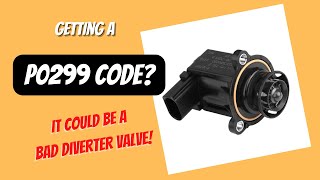
- Failed Turbocharger Diverter Valve (DV) 🔴 High Probability The original OEM diverter valve (revisions prior to 'D') uses a rubber diaphragm that is notorious for tearing, causing a direct loss of boost pressure. Audi later released an updated, more durable piston-style valve to solve this.
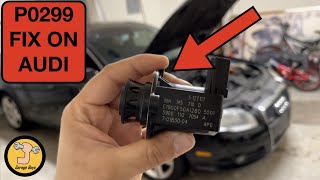
How to confirm: Remove the diverter valve from the turbocharger (held by three T30 Torx bolts 🎬 Watch: Step-by-step guide to replacing your diverter valve.) and inspect the rubber diaphragm for tears or ruptures. Any visible damage confirms failure. The part is located on the underside of the turbo and is accessible from below the car.
Typical fix: Replace the failed valve with a new unit. It is highly recommended to use the updated OEM piston-style valve (Part # 06H145710D) or a quality aftermarket equivalent like the GFB DV+.
Est. part cost: $80-$150 - Worn Turbocharger Wastegate 🟡 Medium Probability The actuator rod, linkage pivot point, and internal flap of the wastegate on the IHI K03 turbocharger can wear over time. This creates excessive play ('rattle'), preventing the wastegate flap from sealing properly and allowing exhaust gas (and therefore boost) to leak. This is a well-documented issue cited in Audi TSB 2031245.
How to confirm: With the engine off and cool, reach down to the turbocharger and attempt to move the wastegate actuator rod. If there is significant free play or a rattling sound, the linkage is worn. A more definitive check involves removing the catalytic converter to visually inspect the internal flap's seating for looseness and wear.
Typical fix: For minor play, an inexpensive OEM wastegate actuator rod clip (Part # 06J145220A or the updated 'B' version, 06J145220B) can be installed to add tension. If wear is severe on the internal flap or its bushing, the official fix is to replace the entire turbocharger assembly. Some specialists offer repairs by bending the actuator rod with heat to restore tension.
Est. part cost: $15 (clip) - $1800+ (turbocharger) - Failed PCV Valve / Oil Separator 🟡 Medium Probability The Positive Crankcase Ventilation (PCV) valve is a known failure point on the EA888 engine, with a diaphragm that commonly fails. A failed PCV creates a large, unmetered vacuum leak, which the ECU can interpret as an underboost condition, triggering P0299.
How to confirm: A failed PCV often causes a loud squealing or whistling noise from the engine at idle. A definitive test is to try removing the oil cap while the engine is running; if there is strong vacuum holding it down, the PCV has likely failed. High positive fuel trims can also be an indicator.
Typical fix: Replace the entire PCV valve assembly. It is located on top of the valve cover. Use an updated OEM part number (e.g., 06H103495AK) to prevent recurrence.
Est. part cost: $150-$250 - Boost/Vacuum Leak ⚪ Low Probability While less common than the DV or wastegate, plastic and rubber hoses in the intake and vacuum system can crack or become disconnected over time due to heat and age. Common leak points include charge pipes, intercooler connections, and the intake manifold.
How to confirm: Perform a smoke test. This involves injecting pressurized smoke into the intake system and looking for smoke escaping from cracked hoses, loose clamps, or a leaking intercooler.
Typical fix: Replace the specific hose, gasket, or clamp that is leaking.
Est. part cost: $20-$200
Rare But Worth Checking
- Clogged Catalytic Converter: In some cases, a clogged catalytic converter can create enough exhaust backpressure to prevent the turbo from spooling up correctly, leading to an underboost code. This can sometimes happen if a failing turbo sends debris into the exhaust. This should be considered if all other common causes have been ruled out.
- Faulty Boost Pressure Control Solenoid (N75 Valve): While uncommon, the solenoid that controls the wastegate actuator can fail, preventing proper boost management. This is less likely than a mechanical fault like a leak, but can be a cause if the valve becomes stuck or electronically fails.
- Cracked Turbocharger Housing: In a documented case on an Audi A4 with the same engine, a physical crack in the cast iron exhaust housing of the turbocharger was the root cause of the P0299 code after other diagnoses failed. The fix required a new turbocharger.
Diagnosis Steps
- Read the fault codes with an OBD-II scanner to confirm P0299 and check for any other related codes like P2279 or P0171.
- Visually and physically inspect the turbocharger diverter valve. From under the car, remove it (3x T30 bolts) and check the diaphragm for tears. This is the most common point of failure.
- Check the turbocharger wastegate actuator rod for excessive play. With the engine cool, try to wiggle the rod. If it rattles or moves more than a few millimeters, the linkage is worn. This is a strong indicator of a worn wastegate.
- Inspect the PCV valve. Listen for a high-pitched squeal at idle. With the engine running, try to remove the oil cap; if strong vacuum holds it on, the PCV has failed.
- If the above checks do not reveal the issue, perform a smoke test on the entire intake system to check for leaks from hoses, the intercooler, or gaskets.
- If no leaks are found, use a scan tool to log requested vs. actual boost pressure while driving. 🎬 Watch: Professional diagnosis of the P0299 underboost condition. A large, consistent deviation under load points to a mechanical turbo issue.
- As a final step, inspect the turbocharger's turbine wheels for damage and check for exhaust restrictions, such as a clogged catalytic converter, by measuring backpressure.
Parts You'll Likely Need

- Turbocharger Diverter Valve (Piston Style)
(OEM #06H145710D)— This is the most common failure point for P0299 on the 2.0T engine. The original diaphragm version tears easily; this updated piston-style part is the permanent fix.
Trusted brands: Audi (OEM), Bosch, Pierburg, GFB (Go Fast Bits) DV+
OEM price range: $120-$160
Aftermarket price range: $80-$120 - PCV Valve / Oil Separator
(OEM #06H103495 (multiple revisions exist, e.g., AE, AK, AN))— Another very common failure on the EA888 engine that can cause various pressure-related codes, including P0299. Always use the latest revision available.
Related Codes That Often Appear With This One
- P2279 — This code indicates an 'Intake Air System Leak.' It often appears with P0299 because the root cause (like a failed PCV or torn hose) creates both an unmetered air leak and a loss of boost pressure.
- P0171 — This code for 'System Too Lean (Bank 1)' can be triggered alongside P0299 if a failed PCV valve is the culprit, as it introduces a large amount of unmetered air, causing a lean condition.
Technical Service Bulletins (TSBs) & Recalls
- Audi TSB 2031245/5 (21 13 14): 'Mil on - P0299 Negative pressure deviation, turbocharger excessive wastegate play'. This TSB, updated June 7, 2013, applies to 2009-2012 A4, A5, and Q5 models with the CAEB engine. It identifies excessive wear in the wastegate flap linkage as a cause for P0299 and provides the service solution of installing clip part # 06J145220B to reduce the play.
- Manufacturer TSB Bulletin #131420312455 notes that turbocharger actuation can encounter excessive wear which leads to play at the waste gate flap, allowing boost to escape through a loose flap and setting DTC P0299.
Platform-Specific Known Issues
- A Technical Service Bulletin (TSB 2031245/5) was issued by Audi specifically for 'turbocharger excessive wastegate play' causing P0299 on 2009-2012 models with the CAEB engine.
- Another TSB (2070349) notes that a leaking coolant pump can contaminate the N249 switch valve (part of the boost control system), leading to a P0299 code as a secondary failure.
Mechanic-Grade Diagnostic Values
- N75 Valve (Charge Pressure Control Solenoid) Resistance — expected: ~24-25 Ohms. Failure: A significantly higher or lower reading, or an open circuit, indicates a faulty solenoid coil.
- G31 Sensor (Boost Pressure Sensor) Voltage, Key On Engine Off — expected: Approx. 0.5 V at atmospheric pressure. Failure: A value significantly outside the expected range suggests a faulty sensor or wiring issue.
- G31 Sensor (Boost Pressure Sensor) Power Supply — expected: 4.5 to 5.0 Volts from the ECU. Failure: Lack of proper voltage indicates a wiring or ECU problem, not a sensor failure.
- Catalytic Converter Backpressure — expected: Near 0 PSI at idle and steady 2500 RPM. Failure: Any significant positive pressure reading indicates a blockage in the exhaust system.
- N75 Valve System Vacuum at Idle — expected: Approximately 24-25 inHg (inches of Mercury). Failure: Low or no vacuum points to a leak in the supply lines or a faulty vacuum pump.
Hidden / Shadow Codes Worth Checking
- 16683 / 000665: This is the manufacturer-specific fault code that directly corresponds to the generic P0299 code. The description is 'Boost Pressure Regulation: Control Range Not Reached.' (see via Requires a VAG-specific scan tool like VCDS (VAG-COM), OBDeleven, or other professional VW/Audi diagnostic systems.)
Scan Tool Commands That Help
- VCDS (VAG-COM) / OBDeleven: Live Data Logging - Measuring Block 115 — This is the primary method for confirming an underboost condition. It allows the technician to graph 'Charge Pressure (Specified)' vs. 'Charge Pressure (Actual)' during a test drive (e.g., a 3rd gear pull). A visible, sustained gap between the two values confirms the fault.
- VCDS (VAG-COM) / OBDeleven: Output Test - N75 Valve (Charge Pressure Control Solenoid) — This command manually cycles the N75 valve, which should produce an audible clicking sound. It helps confirm if the valve is mechanically functional and can be commanded by the ECU, isolating the valve itself from potential wiring or vacuum supply issues.
Real Owner Repair Stories
- HumbleMechanic YouTube Commenter (VW MK6 GTI (with similar 2.0T TSI engine)) — P0299 code and lack of performance.
❌ Tried (didn't work) Checked for boost leaks, Checked wastegate rod, Replaced the entire turbocharger with a new one
✅ What actually fixed it The P0299 code persisted even after the new turbo. A borescope inspection through the O2 sensor port revealed a clogged catalytic converter. Replacing the downpipe (which contains the primary cat) finally resolved the code. - AudiForums.com user (Audi A4 B6 2.0T with 207,000 miles) — P0299 and P0420 codes.
❌ Tried (didn't work) Replaced turbocharger, Replaced diverter valve, Replaced N75 valve, Replaced boost sensor, Performed smoke test and fixed found leaks
✅ What actually fixed it The final fix was a combination of replacing the clogged catalytic converter and adjusting the wastegate flapper nuts on the turbo to ensure it was sealing correctly. - Reddit user on r/Audi (2014 Audi Q5 with 115,000 miles) — Intermittent P0299 code, especially in hot weather or when accelerating up a hill, with no noticeable lack of performance or strange noises.
❌ Tried (didn't work) Visual inspection for leaks (none found)
✅ What actually fixed it Believing the issue was minor turbo inefficiency due to age/wear (a boost loss just over the 2 PSI threshold), the owner built a small electronic signal amplifier for the boost pressure sensor. By increasing the sensor's output voltage by a small percentage (~5%), the ECU read a pressure within the acceptable range, preventing the code from triggering without a costly turbo replacement.
"I Checked Everything" — The Actual Cause
- A clogged catalytic converter. A smoke test pressurizes the intake system to find leaks before the engine, but it cannot detect a restriction in the exhaust system after the engine. This blockage prevents the turbo from spooling up effectively, causing underboost, but will not show up as a leak.
- A faulty N75 boost pressure control valve. This is an electro-mechanical solenoid that controls vacuum to the wastegate. If it fails electronically or is unable to properly regulate vacuum, it can cause underboost. Since this is a control system failure and not a physical leak in a hose, a smoke test will come back clean.
- A cracked intercooler end tank. In some cases, a hairline crack in the plastic end tanks of the intercooler may not leak under the low pressure of a typical smoke test, but will open up and leak significantly under the much higher pressures of real-world driving when the turbo is under full load.
When the Usual Fixes Don't Work
- In several documented cases, replacing the turbocharger—the most expensive and common 'final' fix—did not resolve the P0299 code. In one instance, the actual cause was a clogged catalytic converter creating so much exhaust backpressure that even a new turbo could not spool correctly. This highlights that even after addressing the most common causes like the diverter valve and wastegate wear, downstream restrictions in the exhaust must be considered before assuming the repair is complete.
OEM Part Supersession History
06F145710B, 06F145710C, 06F145710G→06H145710D— The original diverter valves used a rubber diaphragm that was highly prone to tearing, causing a direct and common boost leak. The 'D' revision (and later) uses a far more durable piston-style design to permanently fix this weak point.06H103495A, 06H103495E, 06H103495B→06H103495AC, AE, AH, AJ, AK (and later)— The diaphragm inside the PCV valve assembly was prone to rupturing, creating a large vacuum leak that could trigger P0299 and other codes. Multiple revisions were released to improve diaphragm material and durability. It is critical to use the latest available revision.
Heads up: While many revisions are physically interchangeable, using an older revision is likely to lead to premature failure.N/A→06J145220A / 06J145220B— This is not a supersession, but an OEM-approved fix. This clip is added to the wastegate actuator rod to add tension, compensating for wear in the linkage and bushing. It is designed to reduce wastegate rattle and help the flap seal properly, often resolving minor underboost issues without turbo replacement.
Heads up: Per TSB, this clip should not be installed on a turbo that is already pre-damaged.
Model Year Variations Within This Range
- 2008-2016: The entire 2008-2016 A5 range uses the EA888 Gen 2 engine (e.g., CAEB engine code) in the North American market. While there were many running part revisions (PCV, DV, etc.), the fundamental causes of P0299 remain consistent. Earlier models (approx. 2008-2012) were more likely to be equipped from the factory with the failure-prone diaphragm-style diverter valve and are specifically mentioned in the TSB for wastegate play.
Diagnostic Flowchart
Real Owner Stories
Aggregated from forums and TSBs cited above. Mileages and costs reflect what owners reported in those sources.
2012 Audi A4 Avant
Symptoms: Experienced a persistent P0299 code that was not caused by the typical diverter valve or wastegate linkage wear.
What fixed it: Required a full turbocharger replacement after discovering a physical crack in the cast iron exhaust housing of the turbo.
Source hint: Reddit r/AskMechanics - 2012 Audi A4 Avant with P0299
2012 Audi A5
Symptoms: Received a P0299 code and attempted to fix it by replacing the diverter valve, control valve, and installing a used turbocharger, but the code remained.
What fixed it: The owner learned that installing a used turbocharger often fails to resolve the issue because used units typically carry the exact same wastegate wear; a new turbo or ruling out other leaks is required.
Source hint: AudiForums.com - 2012 Audi A5 need turbo - P0299
Audi 2.0L TFSI
Symptoms: Triggered a P0299 code due to a ruptured rubber diaphragm inside the diverter valve.
What fixed it: Accessed the diverter valve from underneath the car and replaced the failed diaphragm-style valve using a T30 Torx tool.
Source hint: YouTube - Audi P0299 Fix - Turbo Diverter valve
Mk6 VW GTI
Symptoms: Experienced underboost issues common to the shared EA888 engine platform.
What fixed it: Replaced the diverter valve diaphragm and inspected the turbo wastegate, noting that checking the inexpensive diverter valve first is the best approach.
Source hint: Reddit r/GolfGTI - Mk6 GTI P0299
Related OBD-II Codes
Frequently Asked Questions
Does Audi TSB 2031245 apply to my A5 for the P0299 code?
Should I upgrade my diverter valve if I have a 2010 Audi A5 with an underboost code?
My engine is making a loud squealing noise at idle along with the P0299 code. What does this mean?
Can a coolant leak cause a P0299 code on my 2.0L TFSI engine?
I hear a metallic rattling noise from the turbo area when I let off the throttle. Is this related to my check engine light?
Is it a good idea to buy a used turbocharger to fix my worn wastegate?
Helpful Videos
Used OEM Parts in Stock


New Aftermarket Parts Available


The information in this article is provided for general reference and educational purposes only. Vehicle specifications, procedures, and part compatibility can vary by production date, trim level, and region. Always consult your vehicle's factory service manual and verify part numbers before purchasing or performing repairs. Safety-critical components such as airbags, seat belts, and braking systems should be installed by a qualified professional.
- Audi A5:
- 🎬 Helpful Videos
- 🛍️ Shop This Part
- What's Unique About the 2008-2016 Audi A5
- Symptoms You May Notice
- Most Likely Causes
- Rare But Worth Checking
- Diagnosis Steps
- Parts You'll Likely Need
- Related Codes That Often Appear With This One
- Technical Service Bulletins (TSBs) & Recalls
- Platform-Specific Known Issues
- Mechanic-Grade Diagnostic Values
- Hidden / Shadow Codes Worth Checking
- Scan Tool Commands That Help
- Real Owner Repair Stories
- "I Checked Everything" — The Actual Cause
- When the Usual Fixes Don't Work
- OEM Part Supersession History
- Model Year Variations Within This Range
- Diagnostic Flowchart
- Real Owner Stories
- 2012 Audi A4 Avant
- 2012 Audi A5
- Audi 2.0L TFSI
- Mk6 VW GTI
- Related OBD-II Codes
- Frequently Asked Questions
- 🎟️ Get 5% Off