

P0245 on 2018-2023 Kia Stinger 2.0T & 2.5T: Wastegate Actuator 'A' Circuit Low Causes and Fixes
On a 2018-2023 Kia Stinger with the 2.0L or 2.5L turbo engine, code P0245 almost always points to a failed Electronic Wastegate Actuator (EWGA). The vehicle will have severely reduced power and enter 'limp mode'. The fix is to replace the actuator, not the entire turbocharger. Expect the part to cost between $150 and $300, and a scan tool calibration to set the proper voltage is mandatory after replacement.
- P0245 on your Stinger almost certainly means the Electronic Wastegate Actuator (EWGA) has an electrical fault.
- Do NOT let a shop replace the entire turbocharger. The actuator is a separate, much cheaper part.
- The vehicle will be in a low-power 'limp mode' until the repair is made.
- After replacing the actuator, it MUST be calibrated with a compatible scan tool for the repair to be successful.
What's Unique About the 2018-2023 Kia Stinger
The Theta II 2.0L and Smartstream 2.5L turbo engines in the Stinger use a fully Electronic Wastegate Actuator (EWGA) for precise boost control. While efficient, this specific component is a known high-failure point across the Hyundai/Kia family of vehicles that use these engines, often due to internal electronic failure from heat and vibration. Unlike many turbo cars where boost issues might stem from various vacuum leaks, the P0245 code on this platform points very specifically to an electrical failure of the EWGA itself, making diagnosis more direct. A critical, non-skippable step after replacing the actuator is the electronic calibration to set the correct operating voltage, often referred to as the 'Adaptation value for the lower mechanical stop of EWGA' procedure.
Symptoms You May Notice
- Check Engine Light illuminated
- Significant loss of engine power and sluggish acceleration
- Vehicle enters 'limp mode' with restricted RPM
- Little to no turbo boost
- Abnormal noise from the turbocharger area (less common)
- Replacing the entire turbocharger assembly. P0245 is an electrical code for the actuator circuit. Dealers or shops may suggest replacing the whole turbo, which is significantly more expensive and often unnecessary as the actuator can be replaced separately. Hyundai/Kia has issued TSBs for other models with this engine that explicitly warn against this unnecessary repair.
- Replacing the boost pressure sensor. A faulty boost sensor would typically trigger different codes related to sensor performance or under/overboost conditions (like P0299 or P0234), not a circuit-low code for the wastegate solenoid.
Most Likely Causes
- Faulty Electronic Wastegate Actuator (EWGA) 🔴 High Probability The EWGA is a documented high-failure component on the Theta II and Smartstream engine families due to heat exposure and internal electronic failure. This issue is shared with platform mates like the Genesis G70, Hyundai Santa Fe, and Kia K5.
How to confirm: Use a multimeter to test the actuator's internal resistance; an open or shorted reading indicates failure. A bi-directional scan tool can also command the actuator to move; if it doesn't respond, it has failed. Check the actuator's position sensor voltage with the Key On, Engine Off (KOEO). While specifications can vary, a common target range is 3.9V-4.3V. A Kia/Hyundai specific scan tool can read the 'Adaptation value for the lower mechanical stop of EWGA', which is the most precise diagnostic measure.
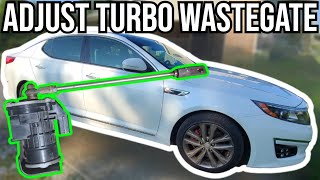
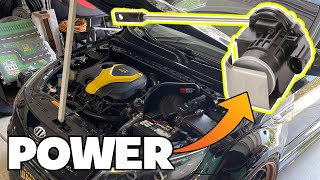
Typical fix: Replace the Electronic Wastegate Actuator. It is crucial to note that the actuator is a separate, serviceable part and the entire turbocharger does not need to be replaced. 🎬 Watch: How to replace and fix the wastegate actuator After replacement, the new actuator must be calibrated using a scan tool to perform the voltage learning procedure.
Est. part cost: $150 - $300 - Damaged Wiring or Connector 🟡 Medium Probability The wiring harness for the actuator is routed near the hot turbocharger and exhaust manifold, making it susceptible to melting, chafing, and heat-related degradation over time.
How to confirm: Visually inspect the wiring harness leading to the EWGA for any signs of melting, cracks, or breaks. Check the connector for corrosion, backed-out pins, or a loose connection. Perform a continuity test on the wires between the ECM and the actuator connector.
Typical fix: Repair the damaged section of the wiring harness or replace the connector pigtail.
Est. part cost: $20 - $100
Rare But Worth Checking
- Powertrain Control Module (PCM) Fault: This is very rare. Before condemning the PCM, all other possibilities, including the actuator and its entire circuit, must be exhaustively tested and ruled out. A faulty PCM driver can mimic the symptoms of a failed actuator.
Diagnosis Steps
- Scan the ECM for trouble codes. Confirm that P0245 is present and note any other codes, especially P2562.
- Perform a thorough visual inspection of the Electronic Wastegate Actuator (EWGA) and its wiring harness. Look for any signs of heat damage, chafing, or loose connections at the connector.
- With the ignition off, disconnect the EWGA connector. Check for corrosion or damage to the pins.
- Test the internal resistance of the EWGA motor with a multimeter. Compare the reading to the manufacturer's specification. An open circuit (infinite resistance) or a short circuit (near-zero resistance) indicates a failed actuator.
- If you have a capable scan tool (like a Kia KDS), connect it to the vehicle. With the Key On, Engine Off (KOEO), monitor the 'Adaptation value for the lower mechanical stop of EWGA'. This value is voltage-based and is the most accurate way to assess actuator health.
- To get a stable reading, cycle the ignition ON for 5 seconds, then OFF for 5 seconds, repeating 5 times before checking the value with the key ON.
- Use the scan tool's bi-directional controls to command the EWGA to move. Observe if the actuator arm moves smoothly through its range of motion and if the position sensor voltage changes accordingly. A lack of movement indicates a failed actuator.
- If the actuator seems unresponsive, check for power and ground at the actuator connector using a multimeter to rule out a wiring issue.
- If the actuator and wiring are confirmed to be good, the issue may lie with the PCM, but this is extremely rare and should be the last consideration.
- After replacing the EWGA, it is mandatory to perform the 'Adaptation value for the lower mechanical stop of EWGA' procedure using a Kia-specific scan tool (KDS) or equivalent to calibrate the new part. This involves adjusting the actuator rod length until the voltage is within the specified range.
Parts You'll Likely Need
- Electronic Wastegate Actuator (EWGA)
(OEM #39400-2CTA0)— This is the most common failure part for code P0245 on the 2.0L Theta II engine due to its design and location in a high-heat area.
Trusted brands: Kia/Hyundai (OEM)
OEM price range: $150 - $300
Aftermarket price range: $100 - $200 - Electronic Wastegate Actuator (EWGA)
(OEM #39400-2T000)— This is the most common failure part for code P0245 on the 2.5L Smartstream engine due to its design and location in a high-heat area.
Trusted brands: Kia/Hyundai (OEM)
OEM price range: $250 - $400
Aftermarket price range: $150 - $250
Related Codes That Often Appear With This One
- P2562 — This code for 'Turbocharger Boost Control Position Sensor 'A' Circuit' often appears with wastegate actuator faults 🎬 See how to diagnose a P2562 code and loss of power as the position sensor is integrated into the actuator assembly.
- P0299 — If the actuator fails in a way that it cannot fully close the wastegate, it can lead to an underboost condition, triggering code P0299.
Technical Service Bulletins (TSBs) & Recalls
- Hyundai TSB 22-EM-004H: While not a Kia TSB, this document for Hyundai models with the Theta-II 2.0T engine provides detailed diagnostic and replacement procedures for the EWGA, which is directly applicable to the Stinger 2.0T. It confirms the actuator is a serviceable part separate from the turbocharger and was issued to address frequent failures.
Platform-Specific Known Issues
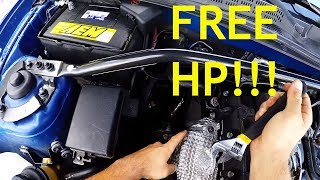
- Owner Experience: DIY Replacement and Calibration: An owner on YouTube demonstrated the adjustment process on a similar Kia/Hyundai 2.0T engine for a P2562 code. The process involved loosening the 10mm lock nut on the actuator rod, removing the clip, and making small rotations to the rod to change the voltage reading. They used a mobile app scan tool to monitor the voltage in real-time, aiming for a specific value (e.g., 4.2V). 🎬 Watch: Step-by-step guide to adjusting wastegate voltage This confirms that with the right tools, fine-tuning and replacement are possible for a skilled DIYer.
Mechanic-Grade Diagnostic Values
- EWGA Motor Coil Resistance (Smartstream 2.5T) — expected: 1.44 - 1.96 Ω at approx. 70°F (21°C). Failure: An infinite reading (open circuit), near-zero reading (short circuit), or a reading that jumps significantly when moving the actuator rod indicates failure.
- EWGA Motor Coil Resistance (Theta II 2.0T) — expected: Approximately 10 - 20 Ω. Failure: An open circuit (OL) or a short circuit (near 0 Ohms) reading indicates the internal motor has failed.
- EWGA Position Sensor Voltage (KOEO, at rest) — expected: 3.9V - 4.3V (Community sources cite 4.1-4.3V for Stinger, while service data for platform mates often specifies 3.9-4.1V). Failure: A voltage reading significantly outside this range, particularly above 4.3V, indicates a misadjusted or failed actuator.
Scan Tool Commands That Help
- Kia GDS (Global Diagnostic System) or equivalent: Current Data > 'Adaptation value for the lower mechanical stop of EWGA' — This is the primary live data parameter to read the actuator's calibrated position voltage with Key On, Engine Off. It is the most accurate way to diagnose a misadjusted or failing position sensor within the EWGA and is required for calibrating a new part.
- Kia GDS (Global Diagnostic System) or equivalent: Actuation Test > EWGA Control — This bi-directional command allows the technician to command the actuator to move through its full range of motion. A lack of movement or jerky operation confirms a mechanical or electrical failure within the actuator motor.
Wiring & Ground Locations
- EWGA Connector — On the Electronic Wastegate Actuator, mounted to the turbocharger assembly on the right side of the engine.. This is the primary connection point for all power, ground, and signal wires for the actuator. It is susceptible to heat damage and corrosion, and is the main point for electrical testing (resistance, voltage).
- EWGA Motor Pins (on connector) — On similar Hyundai/Kia platforms, pins 5 and 6 of the EWGA connector are for the internal motor.. Testing resistance across these two specific pins is the direct method to confirm if the internal motor coil of the actuator has shorted or opened, which is the most common failure mode causing P0245.
Model Year Variations Within This Range
- 2018-2021: These model years use the Theta II 2.0L Turbo engine. The corresponding EWGA is part number 39400-2CTA0. The motor coil resistance specification is approximately 10-20 Ohms.
- 2022-2023: These model years (part of the mid-cycle refresh) use the newer Smartstream 2.5L Turbo engine. The EWGA is a different part (e.g., 39400-2T000) with a much lower motor coil resistance specification of 1.44 - 1.96 Ohms.
Diagnostic Flowchart
Other Known Issues on This Vehicle
Issues unrelated to this code that are worth knowing about as an owner of this generation:
- Theta II 2.0T Engine Connecting Rod Bearing Failure 🔴 High — A widespread and well-documented issue across the Hyundai/Kia lineup using this engine family, leading to class-action lawsuits and extended warranties. Failure can occur at various mileages. (Ref: Multiple recalls and warranty extensions (e.g., TXXC) have been issued for various Hyundai/Kia models.)
- Sunset Yellow Paint Chipping/Cracking (2018 models) 🟠 Medium — Specific to the 'Sunset Yellow' color on early 2018 models. An error in the factory paint process led to poor adhesion. (Ref: Kia issued a voluntary service campaign (SC166) to repaint affected vehicles.)
- Brake Rotor Warping and Vibration 🟡 Low — A common complaint from owners is premature brake rotor warping, leading to vibration or shaking during braking.
- Interior Rattles (Trunk/Sunroof Area) 🟡 Low — Owners frequently report persistent rattling noises from the trunk lid area or sunroof assembly.
- Theta II 2.0T Excessive Oil Consumption 🟠 Medium — Related to the broader Theta II engine issues, excessive oil consumption is a common symptom that can precede more catastrophic failures. (Ref: Covered under various engine-related TSBs and warranty extensions.)
Used vs. New Parts: Buying Guide for This Vehicle
When a used part is the smart pick: A used EWGA from a low-mileage, reputable salvage yard can be a cost-effective option, as the part is a simple bolt-on electronic component. Given the high failure rate, it's a gamble, but can save significant money over a new OEM part if the donor vehicle's history is known.
Donor-vehicle mileage cap: roughly under 50000 miles for the part to have meaningful remaining life.
What to inspect on the donor part:
- Verify the part number exactly matches your original (2.0T vs 2.5T parts are different).
- Inspect the connector for any signs of melted plastic, corrosion, or bent pins.
- Check the actuator arm for smooth, free movement without binding.
- If possible, test the motor coil resistance with a multimeter before purchase to ensure it's within spec for the specific engine (1.44-1.96 Ω for 2.5T, 10-20 Ω for 2.0T).
OEM-only on this vehicle (don't cheap out):
- Electronic Wastegate Actuator (EWGA) - While some aftermarket options exist, their long-term reliability under the high-heat conditions is not as well-documented as the OEM part. Given the criticality of this component for engine performance and safety, OEM is strongly recommended.
Brands owners have reported issues with on this vehicle:
- Unbranded, no-name actuators from online marketplaces should be avoided due to inconsistent quality control and high likelihood of premature failure or incorrect calibration.
Real Owner Stories
Aggregated from forums and TSBs cited above. Mileages and costs reflect what owners reported in those sources.
Kia/Hyundai 2.0T Engine
Symptoms: The owner experienced a P2562 code (related to P0245) and needed to calibrate the wastegate. They observed the voltage reading was out of spec for the actuator's position.
What fixed it: Loosened the 10mm lock nut on the actuator rod, removed the clip, and made small rotations to the rod to adjust the voltage to 4.2V using a mobile scan tool.
Source hint: vehicle_specific_issues: Owner Experience: DIY Replacement and Calibration
2018-2023 Kia Stinger
Symptoms: Boost issues and loss of power.
What fixed it: Checking and adjusting the EWGA voltage to the specified range of 4.1-4.3V.
Source hint: StingerForum.org
2021-2024 Hyundai Santa Fe 2.5T
Symptoms: Common failure of the EWGA triggering P0245.
What fixed it: Replacement of the Electronic Wastegate Actuator and performing a calibration to a target voltage of 3.9V-4.1V.
Source hint: Go-Parts.com (Repair Database)
Related OBD-II Codes
Frequently Asked Questions
Does Hyundai TSB 22-EM-004H apply to my Kia Stinger 2.0T?
Do I need to replace the entire turbocharger on my Stinger to fix P0245?
What is the correct voltage for the EWGA calibration on a Stinger?
Can I calibrate the new actuator without a Kia KDS scan tool?
Is the P0245 code related to the Theta II engine recall for connecting rod bearings?
Why did my Stinger enter 'limp mode' with this code?
Helpful Videos
We Have This Part in Stock



The information in this article is provided for general reference and educational purposes only. Vehicle specifications, procedures, and part compatibility can vary by production date, trim level, and region. Always consult your vehicle's factory service manual and verify part numbers before purchasing or performing repairs. Safety-critical components such as airbags, seat belts, and braking systems should be installed by a qualified professional.
- Kia Stinger:
- 🎬 Helpful Videos
- 🛍️ Shop This Part
- What's Unique About the 2018-2023 Kia Stinger
- Symptoms You May Notice
- Most Likely Causes
- Rare But Worth Checking
- Diagnosis Steps
- Parts You'll Likely Need
- Related Codes That Often Appear With This One
- Technical Service Bulletins (TSBs) & Recalls
- Platform-Specific Known Issues
- Mechanic-Grade Diagnostic Values
- Scan Tool Commands That Help
- Wiring & Ground Locations
- Model Year Variations Within This Range
- Diagnostic Flowchart
- Other Known Issues on This Vehicle
- Used vs. New Parts: Buying Guide for This Vehicle
- Real Owner Stories
- Kia/Hyundai 2.0T Engine
- 2018-2023 Kia Stinger
- 2021-2024 Hyundai Santa Fe 2.5T
- Related OBD-II Codes
- Frequently Asked Questions
- 🎟️ Get 5% Off