

P0234 on 2013-2019 Ford Kuga 1.6L EcoBoost: Overboost Causes and Fixes
On a 2013-2019 Ford Kuga with the 1.6L EcoBoost engine, code P0234 is almost always caused by a failing turbocharger wastegate regulating solenoid. This is a well-documented issue acknowledged by a Ford TSB. Replacing the solenoid is a common DIY fix costing around $50-$150 for the part.
- P0234 on your Kuga 1.6L EcoBoost means the turbo is creating too much pressure, and the engine's computer has cut power to protect it.
- Do not immediately assume you need an expensive new turbocharger. The problem is almost always the much cheaper and easier-to-replace wastegate regulating solenoid.
- Reference Ford TSB 15-0162, which directly addresses this common problem.
- The correct OEM part number for the solenoid is CJ5Z-9K378-B.
- Avoid heavy acceleration until the issue is fixed to prevent the risk of serious and expensive engine damage.
What's Unique About the 2013-2019 Ford Kuga
The 1.6L EcoBoost engine, used in the Kuga and its North American counterparts like the Ford Escape and Fusion, has a known weakness in its boost control system. The turbocharger wastegate regulating solenoid is a very common failure point, so much so that Ford issued a Technical Service Bulletin (TSB 15-0162) for this exact issue across multiple vehicle models using this engine. While an overboost code can have many causes on other vehicles, on this specific platform, the diagnosis almost always leads to this single, relatively inexpensive solenoid.
Symptoms You May Notice
- Check Engine Light is on
- Drastic loss of engine power (vehicle enters 'limp mode')
- Sluggish or slow acceleration
- Code appears during hard acceleration, often around 3000 RPM
- Hesitation or surging during acceleration
- Intermittent issue, may only occur in cold weather
- Excessive turbo noise during operation, as noted in manufacturer bulletin SSM 53328.
- Replacing the entire turbocharger assembly. This is an expensive and often unnecessary repair, as the root cause is almost always the separate, much cheaper wastegate solenoid. Always diagnose and replace the solenoid first.
Most Likely Causes
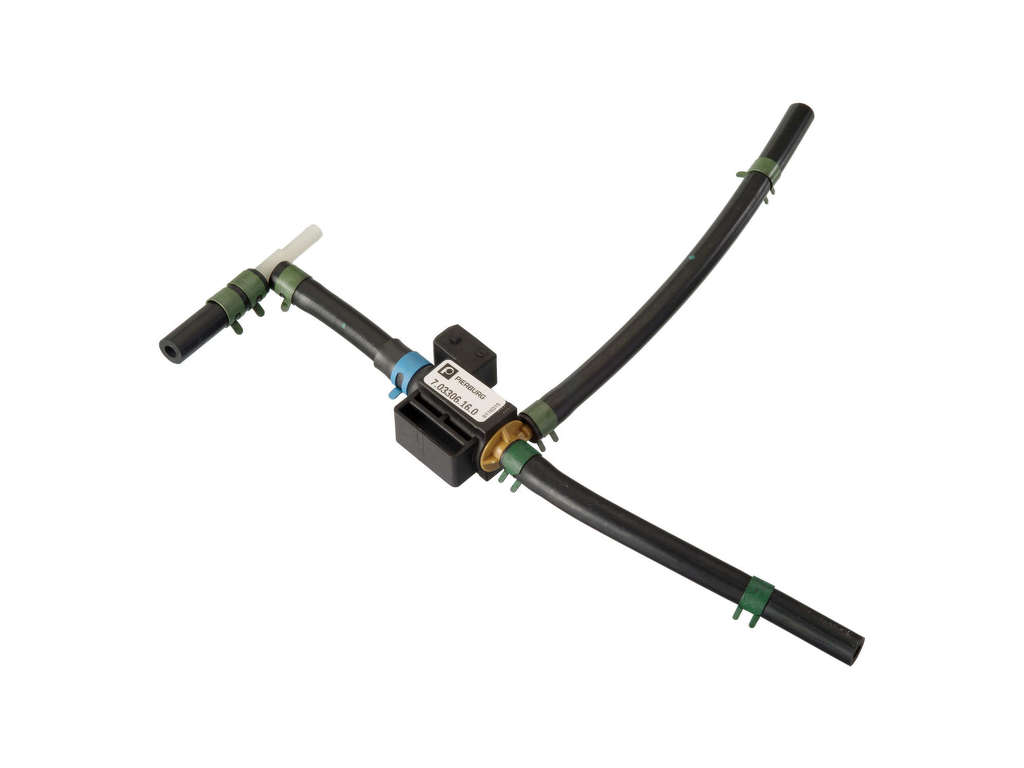
- Faulty Turbocharger Wastegate Regulating Solenoid 🔴 High Probability This is a widely documented failure point on the 1.6L EcoBoost engine, as acknowledged by Ford's Technical Service Bulletin 15-0162 🎬 Watch: A detailed breakdown of TSB 15-0162 and the solenoid fix. which covers the Kuga's platform mates (Escape, Fusion, Fiesta ST). The solenoid, often a Pierburg-made part, fails electrically or mechanically due to constant heat and vibration, causing it to stick and no longer properly regulate the vacuum supplied to the wastegate actuator.
How to confirm: Check for related codes like P0245 (Solenoid Circuit Low) or P0246 (Solenoid Circuit High), which are also mentioned in TSB 15-0162. Before testing the solenoid, check the relevant fuse. A technician can use a scan tool to command the solenoid on and off while monitoring its function. A simple DIY test involves applying 12V power to the solenoid's pins and listening for a 'click' to confirm the internal valve is moving. 🎬 See how to easily test for an overboost condition yourself. A more definitive test is to check the solenoid's resistance with a multimeter; a general specification for this type of part is 10-30 Ohms.
Typical fix: Replace the turbocharger wastegate regulating solenoid. The part is typically accessed by removing the front passenger-side wheel and the plastic wheel well liner. The solenoid slides off a metal tab on the engine block. 🎬 Watch this walkthrough on how to replace the wastegate solenoid.
Est. part cost: $50-$150 - Leaking, Blocked, or Disconnected Vacuum Hoses ⚪ Low Probability
How to confirm: Visually inspect all three vacuum lines connected to the wastegate solenoid for cracks, brittleness, or loose connections. Check the connections at the solenoid, the wastegate actuator, and the intake system. The TSB instructs technicians to check these lines before replacing the solenoid.
Typical fix: Replace any damaged vacuum lines. Ensure all connections are secure.
Est. part cost: $10-$30 - Sticking Turbocharger Wastegate Actuator ⚪ Low Probability
How to confirm: With the engine off and cool, attempt to move the wastegate actuator arm by hand or with a hand-held vacuum pump applied to its port. It should move freely without binding or sticking.
Typical fix: If the actuator is sticking, it may sometimes be freed up with lubricant, but often the entire turbocharger assembly needs to be replaced as the actuator is frequently integrated.
Est. part cost: $800-$1500+
Rare But Worth Checking
- Faulty Manifold Absolute Pressure (MAP) Sensor: A MAP sensor that is reading incorrectly (lower than actual pressure) can trick the PCM into not opening the wastegate, causing an overboost. This is less common than the solenoid failure and would likely be accompanied by other sensor-specific codes.
Diagnosis Steps
- Scan the PCM for trouble codes. Confirm P0234 is present. Note any other codes, especially P0299, P0245, or P0246, as they strongly point to the wastegate solenoid.
- Visually inspect the vacuum hoses connected to the wastegate solenoid. Look for any cracks, splits, or loose connections. Ensure they are routed correctly.
- Based on the high probability and the official TSB, the next logical step is to test the wastegate regulating solenoid. This can be done by checking its resistance with a multimeter (expecting 10-30 Ohms) or by applying 12V power to its terminals and listening for a click.
- If the solenoid clicks, a more advanced test involves checking if it properly passes and holds vacuum/pressure when activated and deactivated.
- If the solenoid is confirmed to be faulty or is highly suspected, replace it. This is the fix in over 90% of cases for this specific vehicle and engine.
- If a new solenoid does not resolve the issue, inspect the wastegate actuator arm on the turbocharger for free movement. It should not be seized or binding.
- As a final, less likely step, check the live data from the MAP sensor with a scan tool to ensure it is reading boost pressure correctly.
Parts You'll Likely Need
- Turbocharger Wastegate Regulating Solenoid
(OEM #CJ5Z-9K378-B)— This is the most common failure part for a P0234 code on the 1.6L EcoBoost engine, as documented in Ford TSB 15-0162. This part number supersedes the older CJ5Z-9K378-A.
Trusted brands: Motorcraft (Ford OEM), Pierburg
OEM price range: $80-$150
Aftermarket price range: $40-$90
Related Codes That Often Appear With This One
- P0299 — This code for 'Turbocharger Underboost' is also listed in TSB 15-0162. A failing wastegate solenoid can get stuck in either the open or closed position, leading to either an underboost or overboost condition.
- P0245 — This code for 'Wastegate Solenoid 'A' Circuit Low' points directly to an electrical fault in the solenoid, which is the most common cause of P0234 on this engine.
- P0246 — Similar to P0245, this code for 'Wastegate Solenoid 'A' Circuit High' indicates a specific electrical failure in the solenoid circuit.
- P0420 — Catalyst System Efficiency Below Threshold; an owner reported this code appearing alongside P0234 in NHTSA ODI #11688277, suggesting mechanical failures can affect multiple systems.
Technical Service Bulletins (TSBs) & Recalls
- TSB 15-0162: Addresses a lack of power with DTCs P0234, P0245, P0246, and/or P0299 by replacing the turbocharger wastegate regulating valve solenoid on 2013-2016 Escape, 2014-2016 Fiesta ST, and 2013-2014 Fusion vehicles with the 1.6L GTDI engine.
- SSM 53328: A manufacturer bulletin notes that P0234 may be stored in the powertrain control module along with symptoms such as a lack of power or excessive turbo noise.
Platform-Specific Known Issues
- Ford Technical Service Bulletin TSB 15-0162 was issued for the 1.6L GTDI engine, which includes the Kuga (and its platform mates Escape, Fusion, Fiesta ST), for DTCs P0234, P0299, P0245, and P0246, instructing technicians to replace the turbocharger wastegate regulating valve solenoid.
Mechanic-Grade Diagnostic Values
- Wastegate Solenoid Resistance — expected: 10 - 30 Ohms (General Specification). Failure: Infinite resistance (open circuit) or near-zero resistance (short circuit) indicates a failed solenoid.
- Wastegate Solenoid Power Pin Voltage (Key On, Engine Off) — expected: 12 V ± 0.5 V. Failure: A reading below 11V suggests a problem in the power supply circuit, like a corroded wire or fuse connection.
- Wastegate Solenoid Control Wire Voltage (Key On, Engine Off) — expected: 0 Volts. Failure: Any significant voltage reading points to a short to voltage, possibly within the wiring harness or the PCM itself.
Scan Tool Commands That Help
- Ford IDS / FORScan: VGT Actuator Sweep Test / Turbo Test — This active command cycles the wastegate through its full range of motion to verify if the solenoid is functional and if the actuator arm can move freely without sticking. A lack of audible change or no change in related sensor data (PIDs) indicates a problem. While more commonly cited for VGT turbos, the principle applies to testing the control system's response.
Wiring & Ground Locations
- Wastegate Solenoid Connector Pigtail — Connects to the wastegate solenoid (CJ5Z-9K378-B) on the side of the engine block.. If the connector or its wiring is damaged due to heat or vibration, it can cause intermittent open or short circuits, leading to codes P0245, P0246, and the resulting P0234. The replacement pigtail part number is WPT-1275.
Real Owner Repair Stories
- Reddit user Benji_qeu on r/fordescape (2014 Ford Escape SE 1.6L EcoBoost) — Initially had a P0299 (Underboost), which was replaced with a P0234 (Overboost) after a repair attempt.
❌ Tried (didn't work) Replaced the original Pierburg wastegate solenoid with an aftermarket brand ('NATOFOX' from Amazon) to fix a P0299 code. This resulted in a new P0234 code appearing shortly after.
✅ What actually fixed it The user identified that the aftermarket solenoid was the likely cause of the new P0234 code. The community advised that replacing the faulty aftermarket part with a genuine OEM (Motorcraft) or OEM-supplier (Pierburg) solenoid would resolve the issue, as aftermarket quality can be inconsistent for this specific component. - Reddit user u/l7j1j3 on r/fordescape (2015 Ford Escape SE 1.6L 4WD) — Intermittent Check Engine Light for P0234, occurring only in winter when accelerating and holding RPMs around 3000 for 5-10 seconds. No noticeable loss of power or fuel economy.
❌ Tried (didn't work) Initial online research and observation of intermittent symptoms.
✅ What actually fixed it Replacing the wastegate solenoid resolved the intermittent P0234 code. The user's final update confirmed: 'It was the wastegate solenoid in my case. Replaced it and it was fine after that.' - NHTSA ODI #11561976 — An owner reported obtaining P0234 and P0299 codes for the turbocharger overboost solenoid. Although the solenoid was replaced, the owner noted the codes returned in conjunction with transmission problems.
OEM Part Supersession History
CJ5Z-9K378-A→CJ5Z-9K378-B— Standard part revision by the manufacturer. The new part is a direct replacement for the old one.
Model Year Variations Within This Range
- 2013-2016: The 1.6L EcoBoost was the primary small-displacement turbo engine. TSB 15-0162 specifically covers these years for the Ford Escape (the Kuga's North American twin).
- 2017-2019: For the 2017 model year facelift, Ford began phasing out the 1.6L EcoBoost in the Kuga/Escape in favor of a new 1.5L EcoBoost engine. While the 1.6L was still available in some configurations, many vehicles in this later period have the 1.5L, which may have different components or known issues. It's critical to confirm which engine is in the vehicle before ordering parts.
Diagnostic Flowchart
Other Known Issues on This Vehicle
Issues unrelated to this code that are worth knowing about as an owner of this generation:
- Engine Overheating and Fire Risk from Coolant System Failure 🔴 High — Common enough to trigger multiple recalls (e.g., 13S12, 17S09) on early models (approx. 2012-2014). The issue is a lack of coolant circulation leading to cylinder head cracking, oil leaks, and potential fire. (Ref: Recall 17S09, Recall 13S12, Recall 12S39)
- Coolant Intrusion into Cylinders / Cracked Cylinder Head 🔴 High — A design flaw in the engine block/head between cylinders allows coolant to leak into the combustion chamber, causing misfires, white smoke, and eventual engine failure. Can occur at relatively low mileage (e.g., 30,000 miles). (Ref: TSB 19-2346 (for 2.0L, but indicative of platform-wide EcoBoost issues), numerous owner complaints.)
- Leaking Coolant Expansion Tank 🟠 Medium — Some examples have suffered from faulty coolant expansion tanks, leading to coolant loss. If not caught early, this can lead to the more severe overheating and cracked head issue.
Used vs. New Parts: Buying Guide for This Vehicle
When a used part is the smart pick: A used part is NOT recommended for this repair. The wastegate solenoid is a known high-failure-rate electronic and mechanical part. The cost savings of a used part are minimal compared to the high risk of it failing again shortly after installation, requiring the labor to be repeated.
Donor-vehicle mileage cap: roughly under 80000 miles for the part to have meaningful remaining life.
What to inspect on the donor part:
- If buying used is unavoidable, inspect the plastic housing for cracks or signs of excessive heat.
- Ensure the vacuum nipples are intact and not brittle.
- Check the electrical connector for corrosion or damage.
OEM-only on this vehicle (don't cheap out):
- Turbocharger Wastegate Regulating Solenoid
Aftermarket brands forum-validated for this vehicle:
- Pierburg (often the Original Equipment Manufacturer)
Brands owners have reported issues with on this vehicle:
- Unnamed or generic brands from online marketplaces (e.g., 'NATOFOX' mentioned in a forum post) have been reported to fail or cause new, different codes immediately after installation.
Documented NHTSA Reports
NHTSA ODI #11062911
Symptoms: The vehicle displayed a "See Manual" light. A dealership diagnosis confirmed code P0234 for turbocharger overboosting.
What fixed it: The dealership reset the computer but performed no other repairs at that time.
NHTSA ODI #11427314
Symptoms: Multiple codes were reported, including P0234 and P0299, alongside mechanical damage to the cam and bottom end of the motor.
What fixed it: The owner attempted repairs but remained without a functional vehicle due to the extent of the damage.
Real Owner Stories
Aggregated from forums and TSBs cited above. Mileages and costs reflect what owners reported in those sources.
2015 Ford Escape 1.6L EcoBoost — 135000 miles
Symptoms: Check engine light came on after experiencing smoke and the odor of burning in the car the week prior. The wastegate solenoid had failed, allowing the turbo to overboost.
What fixed it: Replacement of the wastegate solenoid.
Source hint: owner_reports / Reddit r/fordescape
2015 Ford Escape 1.6L EcoBoost
Symptoms: Intermittent P0234 code that appeared only during winter when accelerating around 3000 RPM.
What fixed it: Replaced the wastegate solenoid.
Source hint: Reddit r/fordescape
2009 Ford Kuga
Symptoms: Intermittent power loss after hard acceleration, triggering the P0234 code.
What fixed it: Not specified, but confirmed symptoms match the classic P0234 behavior on the Kuga platform.
Source hint: Ford Owners Club
Related OBD-II Codes
Frequently Asked Questions
Does TSB 15-0162 apply to my Ford Kuga 1.6L EcoBoost?
Is there a specific part number I should look for when replacing the wastegate solenoid?
Why does my Kuga only trigger the P0234 code during cold weather or winter?
Can a faulty wastegate solenoid cause my Kuga to enter 'limp mode'?
Are there other serious engine issues I should be aware of on the 2013-2019 Kuga 1.6L?
Where is the wastegate solenoid located on the 1.6L EcoBoost?
Helpful Videos
Used OEM Parts in Stock
New Aftermarket Parts Available


The information in this article is provided for general reference and educational purposes only. Vehicle specifications, procedures, and part compatibility can vary by production date, trim level, and region. Always consult your vehicle's factory service manual and verify part numbers before purchasing or performing repairs. Safety-critical components such as airbags, seat belts, and braking systems should be installed by a qualified professional.
- Ford Kuga:
- 🎬 Helpful Videos
- 🛍️ Shop This Part
- What's Unique About the 2013-2019 Ford Kuga
- Symptoms You May Notice
- Most Likely Causes
- Rare But Worth Checking
- Diagnosis Steps
- Parts You'll Likely Need
- Related Codes That Often Appear With This One
- Technical Service Bulletins (TSBs) & Recalls
- Platform-Specific Known Issues
- Mechanic-Grade Diagnostic Values
- Scan Tool Commands That Help
- Wiring & Ground Locations
- Real Owner Repair Stories
- OEM Part Supersession History
- Model Year Variations Within This Range
- Diagnostic Flowchart
- Other Known Issues on This Vehicle
- Used vs. New Parts: Buying Guide for This Vehicle
- Documented NHTSA Reports
- NHTSA ODI #11062911
- NHTSA ODI #11427314
- Real Owner Stories
- 2015 Ford Escape 1.6L EcoBoost — 135000 miles
- 2015 Ford Escape 1.6L EcoBoost
- 2009 Ford Kuga
- Related OBD-II Codes
- Frequently Asked Questions
- 🎟️ Get 5% Off