

P0234 on 2004-2011 Audi A6 2.0L TDI: Overboost Condition Causes and Fixes
On the Audi A6 2.0L TDI, code P0234 is almost always caused by sticking variable vanes (VNT) inside the turbocharger due to carbon buildup. This triggers a sudden loss of power ('limp mode'). The fix usually involves removing and cleaning the turbo, or replacing it in severe cases. Ruling out cheaper issues like a faulty N75 valve or vacuum leaks first is crucial.
- P0234 on your A6 2.0L TDI is a serious code that triggers 'limp mode' to prevent engine damage from excessive turbo boost.
- The most likely cause by far is not a 'bad turbo,' but sticking variable vanes (VNT) inside the turbo due to carbon buildup. This is very common on this engine.
- Before considering an expensive turbo replacement, always diagnose the cheaper and simpler components first: check all vacuum lines for leaks and test the N75 boost control valve.
- A handheld vacuum pump is the best tool for diagnosing this issue, as it can directly test the movement of the turbo actuator and VNT mechanism.
- Regularly driving the car at highway speeds to get the exhaust system hot can help burn off carbon deposits and prevent the issue from recurring.
What's Unique About the 2004-2011 Audi A6
The 2.0L TDI Pumpe Düse (PD) engines (like the BKD and BRE) from this era are well-known for this specific problem. The issue is rarely a catastrophic turbo failure, but rather the variable nozzle turbine (VNT) mechanism inside the Garrett GT1749V turbo getting clogged with carbon soot. This is especially common on cars used for frequent short trips, where the engine and exhaust don't get hot enough to burn the deposits away, causing the vanes to stick in a position that generates maximum boost. This leads to the overboost condition when the driver demands power.
Symptoms You May Notice
- Sudden and dramatic loss of engine power (entering 'limp mode'), often during acceleration or climbing a hill.
- Flashing glow plug light on the dashboard.
- Check Engine Light is on.
- Power is temporarily restored after restarting the engine, but the fault returns under sustained load, typically above 3,000 RPM.
- Whining or whistling noises from the turbo area, especially when the overboost occurs.
- Black smoke from the exhaust during acceleration.
- A noticeable 'lumpy' or hesitant engine performance right before limp mode is triggered.
- Replacing the turbocharger without first thoroughly testing the N75 valve and all associated vacuum lines. These cheaper parts are common culprits and should be ruled out first.
- Replacing the Mass Airflow (MAF) sensor, which is not a primary cause of an overboost condition and typically sets different codes.
- Assuming an in-situ chemical turbo clean will be a permanent fix. While sometimes effective, it often fails to completely clear the heavy carbon deposits, leading to a recurrence of the problem.
Most Likely Causes
- Sticking Turbocharger VNT (Variable Nozzle Turbine) Vanes 🔴 High Probability The 2.0L TDI PD engine is highly susceptible to carbon buildup in the turbo's VNT mechanism, especially with short-trip driving patterns where exhaust temperatures remain low. The carbon physically restricts the movement of the vanes that regulate exhaust flow and, consequently, boost pressure.
How to confirm: Connect a handheld vacuum pump to the turbo's actuator nipple. Apply vacuum (around 20 inHg) and observe the actuator rod. It should move smoothly about 10-15mm and hold the vacuum. If it's sticky, jerky, doesn't move its full range, or moves but doesn't return smoothly when vacuum is released, the vanes are seized with carbon.
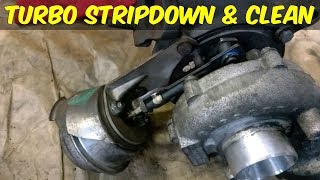
Typical fix: The most effective fix is to remove the turbocharger, disassemble the turbine housing, and thoroughly clean the carbon deposits from the VNT vanes and housing using a carbon cleaner and a wire brush. In-situ chemical cleaners (like Mr. Muscle oven cleaner, sprayed into the EGR port) are a popular DIY attempt but are often a temporary fix that may not clean the entire mechanism. 🎬 Watch: Sticking VNT vanes cleaned using the Mr Muscle method If cleaning is unsuccessful or the turbo is worn, it must be replaced.
Est. part cost: $20 (cleaning supplies) - $1200 (new turbo) - Faulty N75 Boost Pressure Control Valve 🟡 Medium Probability This solenoid is a common failure point on VAG vehicles. It can fail electronically, get clogged with debris, or have a leaking internal diaphragm, leading to incorrect vacuum signals being sent to the turbo actuator.
How to confirm: Test the valve's resistance with a multimeter; it should be between 14-20 Ohms or 25-35 Ohms depending on the specific valve version. Use a vacuum pump to test if it holds vacuum; a faulty valve will not. A scan tool can also perform an output test. Check the vacuum lines to and from the valve for leaks.
Typical fix: Replacement of the N75 valve. It is a relatively accessible and inexpensive part, often made by Pierburg for the OEM. 🎬 See how to diagnose and replace the N75 valve
Est. part cost: $40-$100 - Leaking or Damaged Vacuum Hoses 🟡 Medium Probability
How to confirm: Visually inspect all small, cloth-braided vacuum lines running between the N75 valve, vacuum reservoir, and the turbo actuator. They become brittle and crack over time. Look for cracks, splits, or loose connections. A smoke test or a handheld vacuum pump can identify hard-to-see leaks.
Typical fix: Replace the damaged sections of vacuum hose. It's often recommended to replace all of them at once with silicone hose for longevity.
Est. part cost: $10-$30 - Failed Turbocharger Actuator ⚪ Low Probability
How to confirm: When testing with a handheld vacuum pump, if the actuator rod moves but does not hold vacuum, the internal diaphragm has failed. You will hear a hissing sound as the vacuum leaks.
Typical fix: Replace the actuator. This part can often be purchased separately and calibrated, but sometimes it is sold as an integrated part of a new/remanufactured turbocharger.
Est. part cost: $80-$200
Rare But Worth Checking
- Faulty Boost Pressure (MAP) Sensor: While less common than mechanical or vacuum issues, a faulty MAP sensor can send incorrect high-pressure readings to the ECM, falsely triggering the P0234 code. This can be checked by comparing its readings at idle and under load to specified values using a scan tool.
Technical Service Bulletins (TSBs) & Recalls
- TSB Bulletin #01133020270825: This manufacturer bulletin notes that DTC P0234 (Turbo/Super Charger Overboost Condition) may be stored in the engine control module J623 (address word 01) without any other accompanying fault codes. While originally documented for the Audi Q5, this technical background is highly relevant to the diagnostic logic used for the A6's engine control module.
Diagnosis Steps
- Read fault codes using an OBD-II scanner. Note P0234 and any other codes present, such as P0299 or P0243.
- Perform a thorough visual inspection of all vacuum lines connected to the N75 valve and the turbo actuator. Look for any signs of cracking, splitting, or loose connections.
- With the engine off, connect a handheld vacuum pump to the turbo actuator's vacuum nipple. Apply ~20-25 inHg of vacuum and watch the actuator rod. It should move smoothly and hold the vacuum. If it is jerky, doesn't move, or won't hold vacuum, you have found a problem with the actuator or the VNT mechanism.
- If the actuator moves freely, inspect the N75 valve. Test its resistance with a multimeter (should be 14-35 ohms depending on version). Test its ability to hold vacuum. Use a scan tool's output test mode if available.
- Using a scan tool, log requested boost pressure versus actual boost pressure during a controlled test drive (with a helper). This will confirm if a genuine overboost condition is occurring and at what RPM.
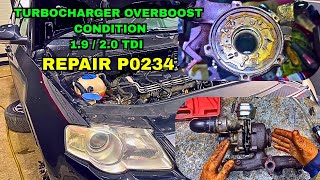
- If all control components (N75, actuator, vacuum lines) are working correctly, the cause is almost certainly internal carbon buildup on the turbo's VNT mechanism, requiring removal and cleaning or replacement. 🎬 Watch: Step-by-step guide to repairing a VAG turbo overboost fault
Parts You'll Likely Need
- Turbocharger / VNT Cleaning
(OEM #03G253019A, 03G253010J, 03G253014H)— This is the most common cause. Carbon buildup physically jams the boost control mechanism. Cleaning is the primary fix, with replacement being the alternative if cleaning fails or the turbo is damaged.
Trusted brands: Garrett (OEM, model GT1749V)
OEM price range: $900-$1500
Aftermarket price range: $400-$800 - Boost Pressure Control Solenoid (N75 Valve)
(OEM #1K0906627A (or 1K0906627B/E))— A very common failure point that controls the turbo actuator. If it fails, it cannot regulate boost pressure correctly.
Trusted brands: Pierburg (OEM Supplier), Bosch, Topran
OEM price range: $70-$120
Aftermarket price range: $40-$80 - Vacuum Hose — The rubber hoses become brittle and crack over time, causing vacuum leaks that prevent the turbo actuator from being controlled properly. Typically 3mm or 5mm inner diameter.
Trusted brands: Generic silicone or braided rubber hose
OEM price range: $10-$30
Aftermarket price range: $5-$20
Related Codes That Often Appear With This One
- P0299 — This code for 'Underboost Condition' can appear alongside P0234 if the sticking VNT mechanism is behaving erratically, sometimes getting stuck open (causing underboost) and sometimes stuck closed (causing overboost).
- P0243 — This indicates a malfunction in the wastegate solenoid 'A' circuit, pointing directly to an electrical problem with the N75 valve or its wiring, which is a primary cause of P0234.
Platform-Specific Known Issues
- The 2.0L TDI BKD engine is widely documented in owner forums as being highly susceptible to carbon buildup on the turbocharger's variable vanes, making P0234 a very common code. This is exacerbated by short-trip driving cycles.
- A popular, though temporary, DIY fix discussed in forums involves injecting oven cleaner (e.g., Mr. Muscle) into the turbo via the EGR port to dissolve carbon without removing the turbo. Success is mixed.
Mechanic-Grade Diagnostic Values
- N75 Valve Solenoid Resistance — expected: 14-20 Ohms (some sources also cite 25-35 Ohms for different revisions). Failure: A reading significantly outside the expected range, or an open/short circuit, indicates a failed coil.
- VCDS Measuring Block 011 - Boost Pressure — expected: During a full-throttle pull in 3rd gear from ~2000-3500 RPM, the 'Actual MAP' should closely track the 'Specified MAP'.. Failure: If 'Actual MAP' consistently exceeds 'Specified MAP' by more than 200-250 mbar for several seconds, it confirms the overboost condition.
- VCDS Measuring Block 011 - N75 Duty Cycle — expected: The duty cycle should vary rapidly, typically between 20% and 80%, as the ECU modulates the valve to control boost.. Failure: If the duty cycle is commanded to its maximum (e.g., >95%) while 'Actual MAP' still significantly exceeds 'Specified MAP', it confirms the ECU is attempting to reduce boost but a mechanical fault (like stuck vanes) is preventing it.
Scan Tool Commands That Help
- VCDS (VAG-COM): Engine (01) -> Measuring Blocks (08) -> Group 011 — This is the primary function for diagnosing P0234. It allows a technician to log and graph Specified vs. Actual boost pressure and the N75 valve duty cycle during a test drive to confirm the overboost event in real-time.
- VCDS (VAG-COM): Engine (01) -> Output Tests (03) -> N75 Boost Pressure Valve — This test cycles the N75 valve on and off, allowing you to hear it click and watch for corresponding movement of the turbo actuator rod. It's a quick way to verify the electrical integrity of the valve and its control circuit from the ECU.
Real Owner Repair Stories
- Audi-Sport.net forum user (Audi A3 with 2.0 TDI BKD engine (same as in the A6)) — Car went into limp mode about an hour into a journey. After restarting, it was fine, but the issue returned under load around 3,000 RPM in 3rd gear, accompanied by a P0234 code.
❌ Tried (didn't work) Initial garage inspection found no obvious cause.
✅ What actually fixed it The user had the turbo replaced less than a year prior. Forum consensus pointed to the new turbo's VNT vanes having already become sticky due to carbon buildup, a common issue even with newer parts if driving habits don't change. The recommended fix was to remove and physically clean the turbo, check the N75 valve, and inspect all vacuum lines. One user who had the same issue for two years ultimately had their turbo professionally cleaned, which resolved the problem. - YouTube video by Gerard Burke (Audi A6 2.0 TDI with multiple issues including P0234) — Erratic idle, cutting out, loss of power, limp mode limited to 3,000 RPM, and heavy smoke.
❌ Tried (didn't work) The presenter first addressed an airflow issue that solved the erratic idle but the P0234 overboost remained.
✅ What actually fixed it The presenter confirmed the N75 valve and boost pressure sensor were potential causes but focused on the turbo. A vacuum pump test showed the actuator was completely stuck. The turbo was removed and disassembled, revealing the VNT vanes were completely seized with heavy carbon buildup. After a thorough manual cleaning of the vanes and housing, the actuator moved freely, and the problem was resolved.
OEM Part Supersession History
1J0906627B→1K0906627A— Part revision and update by the manufacturer. The newer part is a common replacement for a wide range of VAG TDI engines.
Heads up: The primary difference between various N75 valves is the shape of the electrical connector plug. The 1K0... part number uses a D-shaped plug, while some older VAG vehicles used a square-shaped plug. Ensure the connector matches the vehicle's harness.
Model Year Variations Within This Range
- 2004-2008 vs 2008-2011: The BKD engine is a Pumpe Düse (PD) unit without a DPF, primarily used in the earlier part of the generation. The BRE engine is very similar but was adapted for longitudinal mounting in the A6. Later in the C6 generation (around 2008), Audi transitioned to Common Rail (CR) TDI engines (e.g., CAHA, CAGA). While the P0234 fault can occur on CR engines, the extreme prevalence of carbon-related VNT issues is a hallmark of the earlier PD BKD/BRE engines.
Diagnostic Flowchart
Other Known Issues on This Vehicle
Issues unrelated to this code that are worth knowing about as an owner of this generation:
- Oil Pump / Balance Shaft Module Failure 🔴 High — Very common, typically occurs between 80,000 and 150,000 miles. Affects longitudinally mounted engines with balance shafts (like the A6's BRE) more than transverse ones (BKD). (Ref: No recall, but multiple design revisions of the module and hex drive key exist. The failure involves a small hexagonal key that drives the oil pump rounding off, leading to a sudden and total loss of oil pressure, which can cause catastrophic engine failure if not shut down immediately.)
- Siemens Piezo Injector Failure 🔴 High — Common on the 170hp BMN/BRD variants, but can also affect the 140hp versions. Can cause rough running, misfires, or a non-start condition. (Ref: There was a service campaign in some regions for certain injector batches.)
- Dual-Mass Flywheel (DMF) Failure 🟠 Medium — Common on manual transmission models, often noticeable after 100,000 miles. Symptoms include rattling or knocking noises at idle (which disappear when the clutch is pressed) and excessive vibration during acceleration or deceleration.
- Cracked Cylinder Head 🔴 High — Early BKD engines were known to develop porous or cracked cylinder heads, leading to coolant loss and overheating. This was more prevalent in pre-2006 models.
Used vs. New Parts: Buying Guide for This Vehicle
When a used part is the smart pick: A used turbocharger is a significant gamble. It only makes sense if it comes from a very low-mileage, verified donor vehicle and includes a warranty. Given that the primary failure is carbon buildup from driving habits, a used turbo may have the same or worse problem. Other components like the N75 valve or MAP sensor are inexpensive enough new that buying used is not recommended.
Donor-vehicle mileage cap: roughly under 50000 miles for the part to have meaningful remaining life.
What to inspect on the donor part:
- For a used turbo, insist on inspecting it before purchase.
- Check for excessive shaft play (in-and-out and side-to-side movement of the turbine wheel). A tiny amount of side-to-side play is normal, but any in-and-out play is a red flag.
- Manually move the actuator arm; it should travel smoothly without any sticking or binding.
- Look for signs of oil leaks or damage to the compressor/turbine wheels.
OEM-only on this vehicle (don't cheap out):
- Turbocharger: While remanufactured units can be a good compromise, extremely cheap 'new' aftermarket turbos from unknown brands have a very high failure rate and should be avoided. A genuine Garrett (OEM) or a professionally remanufactured unit from a reputable specialist is the safest bet.
- N75 Valve: While cheaper aftermarket versions exist, many forum users report premature failure. Sticking with the OEM supplier, Pierburg, is strongly recommended for reliability.
Aftermarket brands forum-validated for this vehicle:
- Pierburg (for N75 valve - OEM supplier)
- Garrett (for Turbocharger - OEM)
- Bosch (for N75 valve and sensors)
Brands owners have reported issues with on this vehicle:
- Unbranded, low-cost N75 valves from online marketplaces are frequently cited as failing quickly.
- Cheap, unbranded 'new' turbochargers from eBay/Amazon are known for poor build quality and high failure rates.
Real Owner Stories
Aggregated from forums and TSBs cited above. Mileages and costs reflect what owners reported in those sources.
2005 Audi A3 2.0 TDI BKD
Symptoms: Limp mode occurring around 3,000 RPM under load; the user experienced the classic P0234 overboost symptoms.
What fixed it: The issue was attributed to a sticky VNT mechanism needing a clean, a faulty N75 valve, or vacuum leaks. The community noted that even new turbos can fail if driving habits lead to carbon buildup.
Source hint: Audi-Sport.net: 2.0 tdi P0234 Overboost
Related OBD-II Codes
Frequently Asked Questions
My Audi A6 2.0L TDI loses all power when I hit 3,000 RPM, but it resets when I restart the car. Is this a permanent engine failure?
I've heard the 2.0L TDI BRE engine in the A6 has a major oil pump issue. Is that related to my P0234 overboost code?
Can I use oven cleaner to fix the P0234 code on my Audi A6 without removing the turbo?
How can I tell if the N75 valve is the cause of the overboost on my BKD/BRE engine?
Why is my Audi A6 2.0L TDI more prone to P0234 than other cars?
Helpful Videos

We Have This Part in Stock



The information in this article is provided for general reference and educational purposes only. Vehicle specifications, procedures, and part compatibility can vary by production date, trim level, and region. Always consult your vehicle's factory service manual and verify part numbers before purchasing or performing repairs. Safety-critical components such as airbags, seat belts, and braking systems should be installed by a qualified professional.
- Audi A6:
- 🎬 Helpful Videos
- 🛍️ Shop This Part
- What's Unique About the 2004-2011 Audi A6
- Symptoms You May Notice
- Most Likely Causes
- Rare But Worth Checking
- Technical Service Bulletins (TSBs) & Recalls
- Diagnosis Steps
- Parts You'll Likely Need
- Related Codes That Often Appear With This One
- Platform-Specific Known Issues
- Mechanic-Grade Diagnostic Values
- Scan Tool Commands That Help
- Real Owner Repair Stories
- OEM Part Supersession History
- Model Year Variations Within This Range
- Diagnostic Flowchart
- Other Known Issues on This Vehicle
- Used vs. New Parts: Buying Guide for This Vehicle
- Real Owner Stories
- 2005 Audi A3 2.0 TDI BKD
- Related OBD-II Codes
- Frequently Asked Questions
- 🎟️ Get 5% Off