

P0205 on 2009-2019 Ford Flex 3.5L: Cylinder 5 Injector Circuit Fixes
This code means there's an electrical problem with the fuel injector circuit for cylinder 5. Most often, the fuel injector itself has failed internally. Expect to pay $40-$90 for an aftermarket injector or $100-$150 for an OEM Motorcraft part. It can also be caused by a wiring issue, such as a loose connector or damaged wire.
- P0205 points to an electrical problem with the cylinder 5 fuel injector, not a fuel mixture or ignition problem.
- The most likely cause is a failed fuel injector on cylinder 5.
- A simple way to confirm a bad injector is to swap it with an adjacent one and see if the trouble code follows the injector.
- Do not ignore this code. Driving with a misfiring cylinder can cause expensive damage to your catalytic converter.
- Always check the wiring and connector to the injector before replacing parts, as a damaged wire can mimic a failed injector.
What's Unique About the 2009-2019 Ford Flex
On the Ford Flex with the naturally aspirated 3.5L Cyclone V6, a P0205 code is a straightforward electrical fault. Unlike its EcoBoost counterpart, this engine uses a simpler port fuel injection system, which makes diagnosis less complex. The cylinder 5 injector is located on the front bank (radiator side), making it more accessible than the rear injectors. While the injectors themselves can fail, it's also crucial to inspect the wiring harness, as chafing or loose connectors can be a common point of failure. The issue is almost always the injector or its direct wiring, with PCM failure being very rare.
Symptoms You May Notice
- Check Engine Light is on (may be flashing if the misfire is severe)
- Rough or shaking idle
- Engine misfire, which can feel like a stumble or hesitation during acceleration.
- Reduced engine power and poor acceleration.
- Decreased fuel economy.
- A smell of raw fuel from the exhaust
- Engine may stall or be hard to start
- Replacing the spark plug or ignition coil for cylinder 5. While these can cause a misfire code (P0305), they will not cause an injector circuit code like P0205. The P0205 code is specifically for an electrical fault in the injector circuit, not a combustion problem, although the electrical fault will lead to a combustion problem.
Most Likely Causes
- Failed Cylinder 5 Fuel Injector 🔴 High Probability Fuel injectors are wear-and-tear components. Over many cycles and miles, the internal electronic coil can short out or develop an open circuit, which is what the PCM detects. Some owner experiences suggest these injectors can fail intermittently, especially when cold, and then begin to function normally as the engine warms up.
How to confirm: The most definitive test is to swap the cylinder 5 injector with an adjacent one (e.g., cylinder 4 or 6). Clear the codes and drive the vehicle. If the code changes to P0204 or P0206, the injector is faulty. You can also test the injector's resistance with a multimeter; a typical reading for a good injector is between 11-18 ohms, but you should compare it to a known good injector on the same engine. An open circuit (infinite resistance) or a short (near-zero resistance) confirms failure.
Typical fix: Replace the failed fuel injector. It is often recommended to replace all injectors on that bank (4, 5, 6), or all six, if they are high-mileage originals to prevent future failures.
Est. part cost: $40-$150 - Wiring Harness or Connector Issue 🟡 Medium Probability The engine wiring harness is exposed to constant heat and vibration, which can cause wires to become brittle, chafe against engine components, or break internally. The connector at the injector can also become loose, corroded, or contaminated with oil, leading to a poor connection.
How to confirm: Visually inspect the wiring leading to the cylinder 5 injector for any signs of damage, melting, or chafing. Unplug the connector and check for corrosion or bent pins. Use a 'noid light' plugged into the injector connector; it should flash rhythmically when the engine is cranked, indicating the PCM is sending a signal. If the noid light doesn't flash, the problem is in the wiring or the PCM. You can also use a multimeter to check for 12V power on one pin of the connector with the key on.
Typical fix: Repair the damaged section of wire or replace the injector pigtail connector.
Est. part cost: $10-$30 - Faulty Powertrain Control Module (PCM) ⚪ Low Probability This is rare. The internal driver circuit in the PCM that controls the injector can fail, but this should only be considered after all other possibilities have been exhausted. PCM failure is more common on other Ford models but less so for this specific issue on the Flex.
How to confirm: This is a process of elimination. If the injector and the wiring have both been tested and confirmed to be good (e.g., injector resistance is in spec, and a noid light shows no pulse at the connector), the PCM is the likely culprit. This diagnosis is best left to a professional.
Typical fix: The PCM must be replaced and programmed to the vehicle, or sent to a specialist for repair.
Est. part cost: $300-$800
Diagnosis Steps
- Read the trouble codes with an OBD-II scanner. Note P0205 and any other codes present, like P0305 or P0174.
- Locate cylinder 5. On the transverse 3.5L V6, the cylinders are numbered 1-2-3 on the rear bank (firewall side) and 4-5-6 on the front bank (radiator side), from right to left (passenger to driver). Cylinder 5 is the middle cylinder on the front bank, which is relatively easy to access.
- Inspect the wiring harness and connector for cylinder 5's fuel injector. Look for obvious signs of damage, melting, corrosion, or loose connections. Perform a 'wiggle test' on the harness while the engine is running to see if it affects the idle.
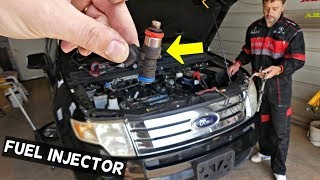
- Perform an injector swap. This is a highly effective real-world test. Swap the fuel injector from cylinder 5 with the one from cylinder 4 or 6. 🎬 See how to replace fuel injectors on a Ford 3.5L V6 This requires removing the upper intake manifold. Clear the codes, start the engine, and see if the fault code 'moves' to the other cylinder (e.g., P0204 or P0206). If it does, the injector is bad.
- If the code remains P0205 after the swap, the problem is in the wiring or PCM. Use a noid light on the cylinder 5 injector connector. Crank the engine and watch the light. A steady, rhythmic flash means the wiring and PCM driver are working. No flash or a steady-on light points to a wiring or PCM issue.
- If the noid light test fails, check for constant 12V power on one wire of the connector with the key on. Then, check for continuity on the ground/signal wire between the injector connector and the PCM connector to rule out a broken wire.
- As a final check, measure the resistance of the suspect injector using a multimeter. It should be between 11-18 ohms. An 'OL' (Over Limit/Open) reading indicates a failed injector coil. A video on a 2011 Lincoln MKS with the related 3.7L engine shows an intermittent P0205 where the injector only failed (read open) when cold and read normal after being warmed with a heat gun.
- If the injector and wiring are confirmed good, the PCM is the most likely remaining cause, though this is rare.
Parts You'll Likely Need
- Fuel Injector
(OEM #BR3Z-9F593-B (Motorcraft CM5167))— This is the most common cause of a P0205 code. The internal coil fails, creating an open or short circuit.
Trusted brands: Motorcraft, Bosch, Standard Motor Products (SMP)
OEM price range: $100-$150
Aftermarket price range: $40-$90 - Fuel Injector Connector Pigtail
(OEM #Motorcraft WPT-1188)— If the wiring or connector at the injector is damaged from heat or vibration, replacing the pigtail is the standard repair.
Trusted brands: Motorcraft, Dorman
OEM price range: $25-$40
Aftermarket price range: $10-$20 - Upper Intake Manifold Gaskets — Accessing the fuel injectors on the 3.5L Cyclone V6 requires removing the upper intake manifold. The gaskets are single-use and must be replaced to prevent vacuum leaks.
Trusted brands: Fel-Pro, Mahle, Motorcraft
OEM price range: $20-$40
Aftermarket price range: $10-$25
Related Codes That Often Appear With This One
- P0305 — P0305 means 'Cylinder 5 Misfire Detected.' Since a P0205 fault prevents the injector from firing correctly, the cylinder will not have proper combustion, leading to a detected misfire.
- P0300 — This code means 'Random/Multiple Cylinder Misfire Detected.' Sometimes, a severe misfire in one cylinder can cause crankshaft speed variations that the PCM misinterprets as misfires on other cylinders as well.
- P0174 — This code means 'System Too Lean (Bank 2).' If the injector is failing but not completely dead, it might deliver less fuel than commanded. The oxygen sensor for Bank 2 (which includes cylinder 5) detects the excess oxygen and sets a lean code.
Technical Service Bulletins (TSBs) & Recalls
- SSM 49759: While for the Ford Expedition, this bulletin
Platform-Specific Known Issues
- Intermittent Cold Failure: A documented case on a similar Ford/Lincoln 3.7L engine showed a P0205 code where the injector would only malfunction when the engine was cold. The resistance would test as an open circuit when cold but return to normal specifications once warmed up. This can make diagnosis tricky if the vehicle is tested after it has been running.
Mechanic-Grade Diagnostic Values
- Fuel Injector Coil Resistance — expected: 12-16 Ohms. Failure: A reading of 0 Ohms (short circuit) or infinite/OL (open circuit).
- Injector Connector Power Supply (Key On, Engine Off) — expected: 12V+ (Battery Voltage). Failure: Low or no voltage indicates a problem with the power supply wire from the fuse/relay.
- Injector Control Circuit Inductive Kick (Voltage Spike) — expected: A sharp voltage spike up to 50V+ when the injector closes.. Failure: Absence of this spike on an oscilloscope indicates a problem with the injector coil or the PCM driver.
- Wiring Continuity (PCM to Injector Connector) — expected: < 0.5 Ohms. Failure: High resistance or an 'OL' reading indicates a break or corrosion in the wire.
Scan Tool Commands That Help
- Ford IDS (or equivalent bidirectional scanner): Power Balance Test — This test graphically displays the power contribution of each cylinder. A significant drop for cylinder 5 would confirm the impact of the P0205 fault on engine performance and help verify the repair.
- High-end Bidirectional Scanner (e.g., ANCEL X7): Injector Click Test / Buzz Test — This command allows the technician to manually activate the cylinder 5 injector. An audible click confirms the injector's solenoid is mechanically responding to the PCM's command, helping to isolate the issue to the injector itself versus a wiring problem.
Wiring & Ground Locations
- PCM Connector C175B, Pin B20 — At the Powertrain Control Module (PCM), which is typically located in the engine bay near the firewall or battery.. This is a potential pin for the injector control circuit. Checking for continuity from this pin to the injector connector helps diagnose a broken wire without having to trace the entire harness.
- G100 / G101 — G100 is at the right front of the engine compartment; G101 is at the left front.. These are primary engine bay ground points. A corroded or loose ground at these locations can cause a host of electrical issues, including unstable voltage for the fuel injection system, potentially triggering a P0205 code.
- G108 / G109 — G108 is on the left rear of the engine; G109 is at the center rear of the engine compartment.. These grounds are critical for components mounted on the engine itself. A poor connection here can directly affect sensor and actuator performance, including the fuel injectors.
Real Owner Repair Stories
- Ford Edge Forum (Ford Edge with 3.5L V6 (same engine family)) — Flashing Check Engine Light with codes P0206 and P0306 (Cylinder 6 injector circuit and misfire).
❌ Tried (didn't work) Initial assumption was a major failure.
✅ What actually fixed it The owner unplugged the fuel injector electrical connector, noticed no visible corrosion but plugged it back in firmly. After clearing the codes, the problem was resolved and did not return on a 25-mile drive. This indicates the issue was simply a poor or intermittent connection at the injector itself.
Diagnostic Flowchart
Other Known Issues on This Vehicle
Issues unrelated to this code that are worth knowing about as an owner of this generation:
- Internal Water Pump Failure 🔴 High — Commonly occurs between 90,000 and 150,000 miles. Failure can lead to catastrophic engine damage if coolant leaks into the engine oil. (Ref: No recall, but this is a widely documented failure mode and the subject of class-action lawsuits.)
- Electronic Power Steering (EPAS) Failure 🔴 High — Can occur suddenly, resulting in a loss of power steering assist. The issue is often related to the steering gear motor or its sensors failing due to heat. (Ref: Ford has issued recalls and extended warranties for some models, but coverage for the Flex has been inconsistent. Owners may need to contact Ford directly.)
- Rear Suspension Toe Link Fracture 🔴 High — Affects 2013-2018 models. The toe links can fracture due to stress, causing a sudden loss of steering control. (Ref: NHTSA Recall 20V-435)
- Door Latch Failure 🟠 Medium — Widespread across many Ford models of this era. The latch pawl spring tab can break, preventing the door from latching securely or causing it to open while driving. (Ref: Part of a major Ford recall campaign (e.g., 15S16, 20S30).)
Used vs. New Parts: Buying Guide for This Vehicle
When a used part is the smart pick: For the fuel injector itself, a used part can be a cost-effective option, especially if sourced from a reputable salvage yard that provides a short warranty. Since this is an external electronic/mechanical part and not a deeply integrated module, a functional used injector is often a reliable repair.
Donor-vehicle mileage cap: roughly under 80000 miles for the part to have meaningful remaining life.
What to inspect on the donor part:
- Check the donor vehicle's mileage; lower is always better.
- Inspect the injector's plastic connector for any cracks or brittleness.
- Ensure the metal body of the injector is free from significant rust or corrosion.
- Verify the O-rings are present, though they should always be replaced with new ones before installation.
OEM-only on this vehicle (don't cheap out):
- Upper Intake Manifold Gaskets: These are single-use gaskets and are critical for preventing vacuum leaks. Always buy these new.
Aftermarket brands forum-validated for this vehicle:
- Bosch: Bosch is a major OEM supplier for fuel injection components and their aftermarket parts are generally considered high quality.
- Standard Motor Products (SMP)
Brands owners have reported issues with on this vehicle:
- Unbranded, no-name injectors from online marketplaces can have high failure rates, incorrect flow rates, or poor spray patterns, leading to persistent performance issues even if they resolve the electrical code.
Real Owner Stories
Aggregated from forums and TSBs cited above. Mileages and costs reflect what owners reported in those sources.
2010 Ford Flex 3.5L V6
Symptoms: Cylinder 5 misfire.
What fixed it: The technician performed an injector swap from cylinder 5 to cylinder 3, and the fault followed the injector, confirming the injector was the root cause.
Source hint: YouTube - Ventura Auto tech: A video titled '2009-2019 ford flex (misfire)'
2011 Lincoln MKS 3.7L V6
Symptoms: Intermittent P0205 code where the injector only failed when cold.
What fixed it: Replacement of the fuel injector after testing showed it read as an open circuit when cold but normal after being warmed with a heat gun.
Source hint: vehicle_specific_issues: Intermittent Cold Failure / YouTube
Related OBD-II Codes
Frequently Asked Questions
Where is cylinder 5 located on my Ford Flex 3.5L V6?
My P0205 code only happens when the engine is cold. Is this common for the Flex?
Should I replace just the cylinder 5 injector or all of them?
What is the correct resistance for a fuel injector on the 3.5L Cyclone engine?
Can I test the injector myself without expensive tools?
Is the P0205 code related to the internal water pump issue on the Ford Flex?
Helpful Videos
Used OEM Parts in Stock


New Aftermarket Parts Available



The information in this article is provided for general reference and educational purposes only. Vehicle specifications, procedures, and part compatibility can vary by production date, trim level, and region. Always consult your vehicle's factory service manual and verify part numbers before purchasing or performing repairs. Safety-critical components such as airbags, seat belts, and braking systems should be installed by a qualified professional.
- Ford Flex:
- 🎬 Helpful Videos
- 🛍️ Shop This Part
- What's Unique About the 2009-2019 Ford Flex
- Symptoms You May Notice
- Most Likely Causes
- Diagnosis Steps
- Parts You'll Likely Need
- Related Codes That Often Appear With This One
- Technical Service Bulletins (TSBs) & Recalls
- Platform-Specific Known Issues
- Mechanic-Grade Diagnostic Values
- Scan Tool Commands That Help
- Wiring & Ground Locations
- Real Owner Repair Stories
- Diagnostic Flowchart
- Other Known Issues on This Vehicle
- Used vs. New Parts: Buying Guide for This Vehicle
- Real Owner Stories
- 2010 Ford Flex 3.5L V6
- 2011 Lincoln MKS 3.7L V6
- Related OBD-II Codes
- Frequently Asked Questions
- 🎟️ Get 5% Off