

P0205 on 2011-2019 Ford Explorer 3.5L: Injector Circuit Malfunction Causes and Fixes
P0205 on a 3.5L Ford Explorer indicates an electrical fault in the cylinder 5 fuel injector circuit. The most common causes are a failed fuel injector or damaged wiring. Expect to pay $80-$180 for a new injector and consider replacing the wiring pigtail at the same time. On this specific vehicle, cylinder 5 is on the easily accessible front bank.
- P0205 is an electrical circuit code for the cylinder 5 fuel injector, not a general misfire code.
- On the 2011-2019 Explorer 3.5L, cylinder 5 is on the front bank (near the radiator), making it easy to access.
- The most likely cause is a bad fuel injector, which can be confirmed by swapping it with an adjacent injector to see if the code follows.
- Always inspect the wiring and connector for damage before replacing parts. A broken wire or bad connector pin is a common cause.
- The correct OEM part number for the injector is BB5Z-9F593-B.
What's Unique About the 2011-2019 Ford Explorer
On the transversely mounted 3.5L V6 in the Explorer, cylinder 5 is located on the front bank (closest to the radiator), making it relatively easy to access compared to cylinders on the rear bank. This simplifies diagnosis and repair, as you do not need to remove the intake manifold to access the injector and its wiring, which is a common requirement for other V6 engines where this cylinder might be on the firewall side.
Symptoms You May Notice
- Check Engine Light (Malfunction Indicator Lamp) is on
- Rough or shaking idle
- Engine hesitation or loss of power during acceleration
- Noticeable engine misfire
- Reduced fuel economy
- Engine may be hard to start or stall
- Replacing the spark plug or ignition coil for cylinder 5. While these parts can cause a misfire code (P0305), they will not cause an injector circuit code (P0205). P0205 is specifically an electrical fault related to the fuel injector's control circuit.
Most Likely Causes
- Failed Cylinder 5 Fuel Injector 🔴 High Probability Fuel injectors are wear-and-tear components. Internal coil windings can fail over time, creating an open or short circuit that the PCM detects. This is the most common cause after ruling out wiring.
How to confirm: Measure the resistance of the injector with a multimeter (typically 12-16 Ω, but confirm spec for your model year) and compare it to the other injectors; a reading that is significantly different (especially open-circuit/infinite resistance) indicates failure. An easier method is to swap the cylinder 5 injector with an adjacent one (e.g., cylinder 4 or 6), clear the codes, and see if the fault code 'moves' to the new cylinder (e.g., P0204 or P0206).
Typical fix: Replace the faulty fuel injector.
Est. part cost: $80-$180 - Damaged Wiring or Connector 🟡 Medium Probability The wiring harness and plastic connector at the injector can become brittle from engine heat and vibration, leading to broken wires or poor pin connections. The locking tab on the connector is especially prone to breaking.
How to confirm: Visually inspect the wiring and connector for cylinder 5 for any signs of cracking, melting, or corrosion. Perform a 'wiggle test' on the connector and harness with the engine running to see if it affects the idle. Use a noid light to confirm if the injector is receiving a pulse signal from the PCM. If the noid light doesn't flash, or stays on constantly, the problem is in the wiring or the PCM.
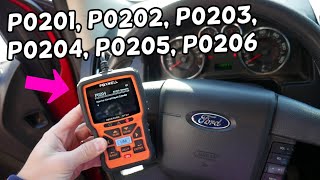
Typical fix: Repair the broken wire or replace the injector connector pigtail. 🎬 See how to fix Ford fuel injector circuit codes and wiring issues
Est. part cost: $10-$25 - Faulty Powertrain Control Module (PCM) ⚪ Low Probability
How to confirm: This should only be considered after the injector and wiring have been definitively ruled out. A professional shop can perform advanced diagnostics, such as checking for a 12V pulse at the injector terminal while cranking, to confirm if the injector driver circuit within the PCM has failed.
Typical fix: Replace and reprogram the PCM.
Est. part cost: $400-$800
Diagnosis Steps
- Verify the code with an OBD-II scanner. Check for any other codes like P0305 or P0200.
- Identify Cylinder 5. On the 3.5L V6 in the Explorer, the cylinders are numbered 1-2-3 on the rear bank (firewall side) and 4-5-6 on the front bank (radiator side). Cylinder 5 is the middle cylinder on the front bank.
- Visually inspect the wiring harness and electrical connector for the cylinder 5 fuel injector. Look for any obvious signs of damage, melting, corrosion, or loose pins.
- Perform a 'wiggle test' by gently moving the connector and nearby wires while the engine is idling to see if the misfire changes.
- Use a 'noid light' to test the signal at the injector connector. Unplug the injector, plug in the noid light, and crank or start the engine. The light should flash rhythmically, indicating the PCM is sending a pulse signal. If it doesn't flash, or stays on constantly, the problem is in the wiring or the PCM.
- If the noid light flashes correctly, the issue is likely the injector itself. To confirm, swap the cylinder 5 injector with the cylinder 6 injector (or cylinder 4). This is the definitive DIY test.
- Clear the codes and drive the vehicle until the check engine light returns. If the code changes to P0206 (or P0204), the fuel injector you moved is faulty and needs to be replaced.
- If the P0205 code returns after the swap, the problem is in the wiring harness or connector specific to the cylinder 5 position.
- If all else fails and the wiring is confirmed to be good with a multimeter (checking for continuity and shorts), the issue may be a rare failure of the injector driver inside the PCM.
Parts You'll Likely Need
- Fuel Injector
(OEM #BB5Z-9F593-B)— This is the most common point of failure for a P0205 code after ruling out simple wiring damage. The OEM part number BB5Z-9F593-B replaces the previous number BB5Z-9F593-A. The Motorcraft service part number is often listed as CM5212.
Trusted brands: Motorcraft, Bosch, Standard Motor Products (SMP)
OEM price range: $120-$180
Aftermarket price range: $70-$110 - Fuel Injector Connector Pigtail
(OEM #Motorcraft WPT-1051 (check for specific vehicle fitment))— The plastic connector and its locking tab can become brittle and fail, causing a poor connection. It is inexpensive and wise to replace it if it shows any signs of damage or if the locking tab breaks during removal.
Trusted brands: Motorcraft, Dorman
OEM price range: $20-$30
Aftermarket price range: $10-$20
Related Codes That Often Appear With This One
- P0305 — P0305 means 'Cylinder 5 Misfire Detected.' Since the P0205 code indicates the injector circuit isn't working, cylinder 5 isn't getting the right amount of fuel, which directly causes a misfire.
- P0200 — P0200 is 'Injector Circuit Malfunction.' This is a more general code that may appear alongside a specific cylinder code like P0205 if there is a wider issue affecting the injector system.
- P0300 — P0300 indicates 'Random/Multiple Cylinder Misfire.' This might appear if the injector issue is intermittent or if the resulting imbalance is causing instability in other cylinders.
Technical Service Bulletins (TSBs) & Recalls
- SSM 49759: While for the Ford Expedition, this TSB mentions that P0205 (along with other P020x codes) can occur and instructs technicians to follow standard diagnostic pinpoint tests in the service manual.
Platform-Specific Known Issues
- Easy Access to Cylinder 5: Unlike many V6 engines where some cylinders are buried against the firewall, the Ford 3.5L transverse engine places cylinder 5 on the front bank. This makes accessing the injector and its wiring for testing or replacement much easier, without requiring removal of the intake manifold.
Mechanic-Grade Diagnostic Values
- Fuel Injector Coil Resistance — expected: 12Ω - 16Ω. Failure: A reading of 0Ω (short circuit) or infinite/O.L. (open circuit), or a value significantly different from the other injectors.
- Relative Injector Flow Test Result — expected: Approx. 140 ms ± 15 ms. Failure: A time value significantly higher or lower than the other injectors, or outside the expected range.
Scan Tool Commands That Help
- FORScan: Key On Engine Off (KOEO) Injector Electrical Self Test ('Buzz Test') — This is a preliminary electrical test. The tool commands the PCM to individually activate each injector solenoid, creating an audible 'buzz'. A weak or silent injector indicates an electrical failure in the injector coil or its wiring.
- Ford IDS, Snap-on, Autel (Professional Scanners): Power Balance Test — This is a dynamic test performed with the engine running. The scanner displays the RPM contribution of each cylinder. The technician can then disable individual injectors (like cylinder 5) and observe the corresponding drop in RPM. If disabling cylinder 5 causes little or no change in engine speed, it confirms that cylinder is not contributing, pointing to a fault in the injector, wiring, or fuel delivery.
- Ford IDS, High-End Scanners: Relative Injector Flow Test — This advanced test cranks the engine and pulses each injector individually while monitoring fuel rail pressure drop. It calculates a 'flow time' in milliseconds for each injector. It's used to identify an injector that is electrically okay but mechanically restricted or flowing poorly.
Wiring & Ground Locations
- G104 — Right side of the engine compartment.. This is a primary engine compartment ground. A poor connection here can cause intermittent electrical issues for various sensors and modules, including the Powertrain Control Module (PCM).
- G105 — Top right side of the engine.. Another critical engine ground. Given its location, it is susceptible to corrosion. A faulty ground can introduce electrical noise and voltage drops, potentially triggering a circuit code like P0205.
- G106 — Right side of the engine compartment bulkhead (firewall).. This ground serves components on the bulkhead. Verifying all major engine and PCM grounds are clean and tight is a crucial step before condemning an expensive component like the PCM.
OEM Part Supersession History
BB5Z-9F593-A→BB5Z-9F593-B— Not officially stated, but typically indicates a minor revision for improved reliability, manufacturing process, or internal component sourcing.
Model Year Variations Within This Range
- 2011-2019: While the core engine remained the same, Ford sometimes changes component suppliers during a production run. For example, on the related EcoBoost engines, a switch from Hitachi to Bosch fuel systems occurred around 2013. While not confirmed for the 3.5L Cyclone, be aware that minor differences in connectors or internal specs could exist between early (2011-2012) and later (2013-2019) models. Always verify part fitment with the vehicle's VIN.
- 2016-2019: The Explorer received a mid-cycle facelift for the 2016 model year. While this primarily involved cosmetic changes and the introduction of the 2.3L engine option, it's possible some wiring harness routing or connector types were updated. The fundamental diagnosis for P0205 on the 3.5L V6 remains the same.
Diagnostic Flowchart
Other Known Issues on This Vehicle
Issues unrelated to this code that are worth knowing about as an owner of this generation:
- Internal Water Pump Failure 🔴 High — Common after 80,000-100,000 miles. A major design flaw of the 3.5L/3.7L Cyclone engine family.
- Electronic Throttle Body Failure 🟠 Medium — Common on 2011-2016 models, leading to customer satisfaction programs. (Ref: Customer Satisfaction Program 13N03, 16B32)
- Power Transfer Unit (PTU) Failure 🔴 High — Common on AWD models, often due to overheating and lack of serviceability.
- Carbon Monoxide / Exhaust Smell in Cabin 🔴 High — A well-documented issue, particularly in earlier 5th gen models, that prompted NHTSA investigations. (Ref: Ford offered complimentary service to address this.)
Used vs. New Parts: Buying Guide for This Vehicle
When a used part is the smart pick: A used wiring harness pigtail from a junkyard is a viable option if the connector is in good condition (not brittle, locking tab intact) and there is enough wire length for splicing. It is not recommended to purchase used electronic components like the PCM or fuel injectors.
Donor-vehicle mileage cap: roughly under 80000 miles for the part to have meaningful remaining life.
What to inspect on the donor part:
- For a wiring pigtail, inspect for flexibility; avoid hard, brittle plastic.
- Check that the connector's locking tab is present and functional.
- Look for clean, corrosion-free electrical pins inside the connector.
- Ensure there are at least 4-6 inches of wire attached for easier splicing.
OEM-only on this vehicle (don't cheap out):
- Powertrain Control Module (PCM): While used PCMs are available, they require vehicle-specific programming (flashing) to match the VIN and immobilizer system. This often makes a pre-programmed unit from a specialty supplier or a new OEM unit a more reliable choice.
Aftermarket brands forum-validated for this vehicle:
- Motorcraft (OEM)
- Bosch
Real Owner Stories
Aggregated from forums and TSBs cited above. Mileages and costs reflect what owners reported in those sources.
2015 Ford Explorer 3.5L V6
Symptoms: The vehicle experienced a cylinder 5 injector circuit open fault.
What fixed it: The technician diagnosed the issue as either a faulty injector or wiring, following a standard diagnostic approach for the P0205 code.
Source hint: YouTube - P0205 cylinder 5 injector A circuit open / ford explorer 2015/ ford taurus
2008-2019 Ford Taurus 3.5L V6
Symptoms: The owner experienced both P0205 and P0305 codes, indicating an injector circuit malfunction and a corresponding misfire.
What fixed it: Replaced the fuel injectors to resolve the circuit fault and the misfire.
Source hint: FordForums.com - P0205 and P0305 - Injector circuit malfunction
Related OBD-II Codes
Frequently Asked Questions
Where is cylinder 5 located on my 2011-2019 Ford Explorer 3.5L V6?
Do I need to remove the intake manifold to replace the cylinder 5 fuel injector?
Is there a TSB for P0205 on my Ford vehicle?
What is the typical resistance for a fuel injector on this engine?
Could a P0205 code be related to the common water pump failure on the 3.5L Cyclone engine?
How can I tell if the problem is the injector or the PCM?
Helpful Videos


Used OEM Parts in Stock


New Aftermarket Parts Available


The information in this article is provided for general reference and educational purposes only. Vehicle specifications, procedures, and part compatibility can vary by production date, trim level, and region. Always consult your vehicle's factory service manual and verify part numbers before purchasing or performing repairs. Safety-critical components such as airbags, seat belts, and braking systems should be installed by a qualified professional.
- Ford Explorer:
- 🎬 Helpful Videos
- 🛍️ Shop This Part
- What's Unique About the 2011-2019 Ford Explorer
- Symptoms You May Notice
- Most Likely Causes
- Diagnosis Steps
- Parts You'll Likely Need
- Related Codes That Often Appear With This One
- Technical Service Bulletins (TSBs) & Recalls
- Platform-Specific Known Issues
- Mechanic-Grade Diagnostic Values
- Scan Tool Commands That Help
- Wiring & Ground Locations
- OEM Part Supersession History
- Model Year Variations Within This Range
- Diagnostic Flowchart
- Other Known Issues on This Vehicle
- Used vs. New Parts: Buying Guide for This Vehicle
- Real Owner Stories
- 2015 Ford Explorer 3.5L V6
- 2008-2019 Ford Taurus 3.5L V6
- Related OBD-II Codes
- Frequently Asked Questions
- 🎟️ Get 5% Off