

P0204 on 2001-2010 Chrysler PT Cruiser 2.4L: Injector Circuit Fault Causes and Fixes
For a P0204 code on a PT Cruiser, the most common causes are a failed fuel injector for cylinder 4 or a wiring issue near the injector connector. Expect to pay around $40-$90 for a new injector. Diagnosis involves testing the injector's resistance (spec is ~12 Ohms) and checking the wiring for a pulse signal with a noid light.
- P0204 on a PT Cruiser is an electrical fault for the cylinder 4 fuel injector.
- The most likely causes are a bad fuel injector or a damaged wiring connector.
- A simple way to confirm a bad injector is to swap it with another cylinder and see if the trouble code follows the injector.
- Always check the wiring and use a noid light before buying parts.
- Driving with this code can damage your catalytic converter, so it's best to address it promptly.
What's Unique About the 2001-2010 Chrysler PT Cruiser
On the PT Cruiser's 2.4L engine, the P0204 code is a straightforward electrical fault. Unlike some other Chrysler engines that have TSBs for software-related false codes, the issue on the PT Cruiser is almost always a physical component failure. The primary culprits are either the fuel injector itself failing internally or a break in the wiring harness. The harness is known to become brittle from heat and vibration, often failing right at the #4 injector connector or where it might rub against other components.
Symptoms You May Notice
- Check Engine Light is on
- Rough or shaking idle
- Engine misfire (feels like a stumble or shudder)
- Hesitation or lack of power during acceleration
- Reduced fuel economy
- Engine may stall, especially at idle
- Smell of unburnt fuel from the exhaust
- Replacing the spark plug or ignition coil for cylinder 4. While these parts can cause a misfire (P0304), they will not cause an injector circuit code like P0204, which is specifically an electrical fault in the fuel injector's control circuit.
Most Likely Causes
- Failed Fuel Injector (Cylinder 4) 🔴 High Probability Injectors are a wear item. The internal electronic coil can fail over time, creating an 'open' or short circuit that the PCM detects. This is the most frequent point of failure for this code.
How to confirm: Measure the resistance of the injector with a multimeter. A good injector for this engine should read approximately 12 ohms. An 'OL' (infinite) reading indicates an open circuit, while a near-zero reading indicates a short. The most definitive test is to swap the #4 injector with another cylinder (e.g., #3). Clear the codes and run the engine. If the code changes to P0203, the injector is confirmed to be bad.
Typical fix: Replace the faulty fuel injector. It's highly recommended to replace the O-rings for any injectors that are removed to prevent fuel leaks. The upper and lower O-rings are crucial for a proper seal.
Est. part cost: $40-$90 - Damaged Wiring or Connector 🟡 Medium Probability The wiring harness and plastic connectors in the engine bay become brittle from constant heat cycles and vibration. Wires can break or corrode inside the insulation, especially right at the injector connector where it is handled during service.
How to confirm: Visually inspect the wiring going to the #4 injector for any signs of cracking, melting, or chafing. Wiggle the connector and harness with the engine running to see if it affects the idle. Use a 'noid light' plugged into the injector connector to confirm the PCM is sending a pulse signal. A flashing light is good; no light or a steady light points to a wiring or PCM problem.
Typical fix: If the connector is damaged, replace it with a new pigtail connector which can be spliced into the harness. If a wire is broken further down the harness, it will need to be carefully repaired and sealed.
Est. part cost: $10-$25 for a connector pigtail
Rare But Worth Checking
- Failed Powertrain Control Module (PCM): This is the least likely cause. The internal driver circuit for the #4 injector can fail inside the PCM. Always exhaust all other possibilities (injector and wiring tests) before condemning the PCM. If a noid light test shows no signal at the connector and the wiring has been proven to have good continuity from the PCM connector to the injector connector, the PCM is the likely culprit.
Technical Service Bulletins (TSBs) & Recalls
- While the PT Cruiser typically suffers from hardware failures, other Chrysler platforms have documented software-related issues for this code. For example, TSB Bulletin #18-014-14 notes that a P0204 code may require selectively erasing and reprogramming the Powertrain Control Module (PCM) with new software.
- Additionally, manufacturer records such as TSB Bulletin #1810216 describe instances where P0204 appears alongside other codes like P0108 and P0606, sometimes accompanied by transmission shift quality issues like a "1 - 2 upshift clunk or bump."
Diagnosis Steps
- Scan for Codes: Confirm P0204 is present and check for any other codes, like P0304.
- Inspect the Wiring: Carefully inspect the wiring harness and connector for cylinder 4's fuel injector. Look for obvious signs of damage, melting, corrosion, or chafing against other engine parts.
- Listen to the Injector: With the engine running, use a mechanic's stethoscope or a long screwdriver placed on the injector body to listen for a steady clicking sound. Compare the sound to an adjacent injector. No sound suggests it's not activating.
- Perform a Noid Light Test: Disconnect the injector and plug a 'noid light' into the electrical connector. Crank or start the engine. A rhythmic flashing light means the PCM and wiring are sending the signal to fire the injector. No light or a steady light points to a wiring or PCM problem.
- Test Injector Resistance: Unplug the injector and use a multimeter set to Ohms to measure the resistance between its two electrical pins. The specification for the OEM Siemens injector is around 12 Ohms. A reading of infinity (OL) or near zero confirms a failed injector.
- Swap the Injector: If the resistance test is inconclusive, swap the fuel injector from cylinder 4 with one from another cylinder (e.g., cylinder 3). Clear the codes, start the engine, and let it run for a few minutes. Re-scan for codes. If the code returns as P0203 ('Injector Circuit/Open - Cylinder 3'), the injector is faulty. If P0204 returns, the problem is in the wiring or PCM.
- Check Wiring Continuity: If the noid light test failed, disconnect the battery and the PCM connector. Use a multimeter to check for continuity on the control wire (usually a dark blue/pink wire on many PT Cruisers) from the PCM connector pin to the injector connector pin. Also check for a short to ground on that same wire.
Parts You'll Likely Need
- Fuel Injector (Cylinder 4)
(OEM #04891573AB (also seen as 4891573AB). This part may be discontinued by Mopar but is widely available as a direct replacement from brands like Siemens/VDO.)— This is the most common component to fail, causing an open or shorted circuit.
Trusted brands: Mopar, Siemens VDO, Bosch, Standard Motor Products (SMP), Delphi
OEM price range: $70-$110
Aftermarket price range: $40-$90 - Fuel Injector Connector Pigtail — The plastic connector and its locking tab can become brittle and break, or the wires can fail right at the connector, requiring replacement.
Trusted brands: Mopar, Dorman, Standard Motor Products (SMP)
OEM price range: $20-$35
Aftermarket price range: $10-$25 - Fuel Injector O-Ring Kit
(OEM #4897125AA)— Crucial for preventing fuel leaks whenever an injector is removed and reinstalled. It is mandatory to replace them.
Trusted brands: Mopar, Fel-Pro, Mahle
OEM price range: $5-$10
Aftermarket price range: $2-$5
Related Codes That Often Appear With This One
- P0304 — This code means 'Cylinder 4 Misfire Detected'. Since P0204 indicates a problem with the fuel supply to cylinder 4, the cylinder can't fire correctly, directly causing a misfire. It is very common to see both codes together.
Platform-Specific Known Issues
- On some PT Cruisers, the main engine wiring harness that runs over the top of the engine can become brittle from heat. The section of the harness that breaks out to the fuel injectors is a common trouble spot. Wiggling this harness while the engine is idling can sometimes reveal an intermittent open or short.
Mechanic-Grade Diagnostic Values
- Fuel Pressure (Key On, Engine Off) — expected: 59 ± 5 psi (407 ± 34 kPa) for non-turbo models.. Failure: Significantly lower pressure could indicate a weak fuel pump, but is not a direct cause of a P0204 circuit code.
- Fuel Injector Resistance — expected: Approximately 11.4 - 14.0 Ohms. Some sources cite up to 16.5 Ohms. The most important factor is that all injectors should have readings within 1 Ohm of each other.. Failure: A reading of 'OL' (infinite resistance) indicates an open coil. A reading near 0 Ohms indicates a shorted coil. Either confirms a failed injector.
- Injector Connector Voltage (Power Feed) — expected: Battery voltage (~12V) on one pin with the key in the 'On' position. This power is typically supplied via the ASD (Auto Shutdown) relay.. Failure: No voltage indicates a problem with the ASD relay or the power supply wiring, not the injector control circuit itself.
- Injector Connector Voltage (Control Wire, Engine Running) — expected: A pulsing signal that, when measured with a multimeter on DC volts, will show a fluctuating voltage. A lab scope would show a square wave pattern.. Failure: A steady low voltage on the control wire of the suspect injector (#4) while other injectors show battery voltage points to a short-to-ground in the wiring or a stuck-open PCM driver. No pulse with a noid light indicates a wiring break or failed PCM driver.
Scan Tool Commands That Help
- Chrysler DRB III / wiTECH or equivalent professional scanner: Injector Kill / Actuator Test — This function allows the technician to disable the cylinder 4 fuel injector with a software command while the engine is idling. If the engine's idle quality does not change when the injector is 'killed,' it confirms that cylinder 4 was not contributing to engine operation, validating the fault is isolated to that cylinder's fuel or ignition system.
Wiring & Ground Locations
- G100 — Located on the left side of the engine compartment, typically on the inner fender or frame rail.. This is a primary chassis and engine ground point. Corrosion or a loose connection here can cause a wide range of unpredictable electrical issues, including erratic sensor readings and phantom faults in the PCM.
- Cylinder Head Ground Strap — A braided strap that connects the cylinder head to the chassis or firewall. On the PT Cruiser, it often attaches near the upper motor mount.. Ensures the engine's top end is properly grounded. A poor connection can force electrical circuits to find other paths, potentially through sensor grounds, which can interfere with PCM operation and injector signals.
- PCM Connector C1 — The Powertrain Control Module (PCM) is located in the engine bay. It has four main connectors (C1, C2, C3, C4). C1 is one of the primary connectors for engine functions.. The control wire for the #4 fuel injector (often Dark Blue/Pink) terminates at a specific pin in this connector. When diagnosing a wiring fault, checking for continuity between the injector connector and this specific PCM pin is the definitive test to rule out a broken wire.
Real Owner Repair Stories
- Chrysler Forum user 'FIREM' (2003 PT Cruiser GT (Turbo, but principle applies)) — Car dies at idle, multiple injector codes logged simultaneously (P0201, P0202, P0203, P0204).
❌ Tried (didn't work) The owner replaced the coil, wires, plugs, thermostat, and O2 sensors before realizing the codes were for the injectors.
✅ What actually fixed it The advice given by a senior forum member was that it is extremely unlikely for all four injectors to fail at once. The root cause is almost certainly a shared power or ground issue. The recommended first step was to disconnect, clean, and secure all main power and ground connections, including battery terminals, jump posts, and engine/body ground straps, before further diagnosis.
OEM Part Supersession History
04891573AB (Non-Turbo)→N/A - This part number is often cross-referenced by aftermarket suppliers. No direct Mopar supersession is clearly documented.
Heads up: Be aware that injectors for the 2.4L non-turbo (EDZ) and 2.4L turbo (EDV/EDT) engines are different and have different part numbers (e.g., 04891574AB for turbo). They are not interchangeable due to different flow rates.
Model Year Variations Within This Range
- 2006-2010: The 2006 model year facelift introduced changes to the Body Control Module (BCM) and associated wiring. While the core engine and fuel injector circuits remained fundamentally the same for P0204 diagnosis, it is crucial to use a wiring diagram specific to the vehicle's year (pre- or post-2006) to ensure correct pinouts and wire colors when tracing faults back to the PCM or other modules.
Diagnostic Flowchart
Other Known Issues on This Vehicle
Issues unrelated to this code that are worth knowing about as an owner of this generation:
- Premature Timing Belt Failure 🔴 High — The official interval is around 102,000 miles, but many owners and mechanics recommend replacement based on age (7-8 years) or earlier mileage (90,000 miles) to be safe. The 2.4L is an interference engine, meaning a snapped belt will cause catastrophic engine damage.
- Failing Front Control Arm Bushings 🟠 Medium — Bushings tend to wear out prematurely, often before 100,000 miles, causing a knocking or squeaking sound from the front suspension, uneven tire wear, and wandering steering.
- Cooling Fan Relay/Motor Failure 🟠 Medium — The radiator cooling fan relay or the fan motor itself are common failure points, leading to engine overheating, especially in stop-and-go traffic or at idle. Sometimes the fan stays on after the car is shut off, draining the battery.
- Crankshaft Thrust Washer Failure ('Crank Walk') 🔴 High — A serious but less common issue where the crankshaft thrust washers fail, allowing for excessive side-to-side movement ('end play') of the crankshaft. This can push the front crank seal out, causing a massive oil leak and leading to engine failure if not caught immediately.
Used vs. New Parts: Buying Guide for This Vehicle
When a used part is the smart pick: A used wiring harness or an injector connector pigtail from a salvage yard can be a cost-effective repair, provided it is from a low-mileage vehicle and shows no signs of brittleness, cracking, or heat damage. Inspect the locking tabs and pins carefully.
Donor-vehicle mileage cap: roughly under 80000 miles for the part to have meaningful remaining life.
What to inspect on the donor part:
- For wiring, check for flexibility; avoid anything stiff or brittle.
- Inspect connectors for intact locking tabs and clean, uncorroded pins.
- Ask for the donor vehicle's mileage if possible.
- Avoid parts from vehicles with signs of a front-end fire or major engine damage.
OEM-only on this vehicle (don't cheap out):
- Powertrain Control Module (PCM) — While a used PCM can be obtained, it is VIN-locked and requires specialized programming to work in a different vehicle. It is safer to use a reputable remanufacturing service that provides a pre-programmed unit.
Aftermarket brands forum-validated for this vehicle:
- Siemens VDO (often the original OEM supplier)
- Bosch
- Standard Motor Products (SMP)
- Delphi
Brands owners have reported issues with on this vehicle:
- Unbranded, low-cost injectors from online marketplaces. Forum discussions and seller warnings indicate these often have inconsistent flow rates and high failure rates, posing a risk to engine health.
Real Owner Stories
Aggregated from forums and TSBs cited above. Mileages and costs reflect what owners reported in those sources.
2001-2010 Chrysler PT Cruiser 2.4L
Symptoms: The owner experienced a rough idle and a check engine light. Upon testing, the injector resistance was found to be out of spec.
What fixed it: Replaced the single faulty fuel injector.
Source hint: ptcruizer.com - The PT Cruiser Forum
2001-2010 Chrysler PT Cruiser 2.4L
Symptoms: The vehicle triggered a P0204 code, which was traced back to a wiring issue rather than the injector itself.
What fixed it: Repaired a broken wire found inside the insulation near the injector connector.
Source hint: ptcruizer.com - The PT Cruiser Forum
Related OBD-II Codes
Frequently Asked Questions
What is the specific resistance specification for a fuel injector on the PT Cruiser 2.4L engine?
Is there a specific part of the PT Cruiser wiring harness prone to causing the P0204 code?
Can I confirm if the P0204 code is the injector or the PCM without buying new parts?
What color is the control wire for the cylinder 4 injector on the PT Cruiser?
Should I replace the O-rings when fixing a P0204 code on my 2.4L I4?
Does the P0204 code on a PT Cruiser usually cause a noticeable misfire?
Helpful Videos
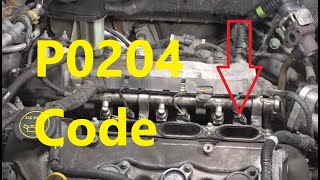
Used OEM Parts in Stock

New Aftermarket Parts Available

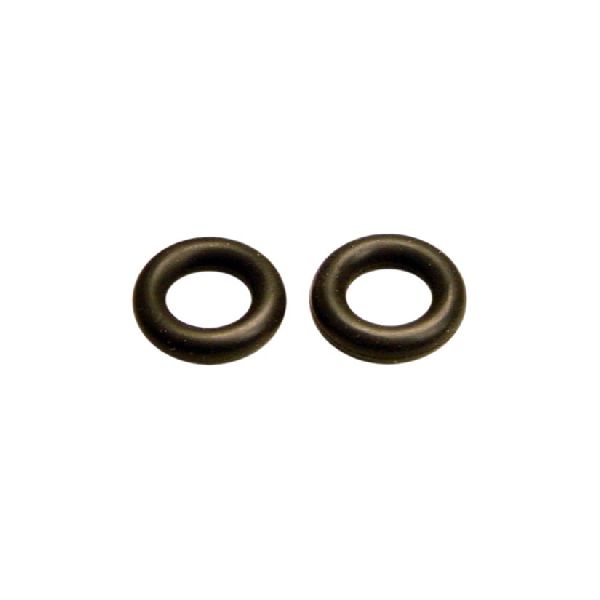
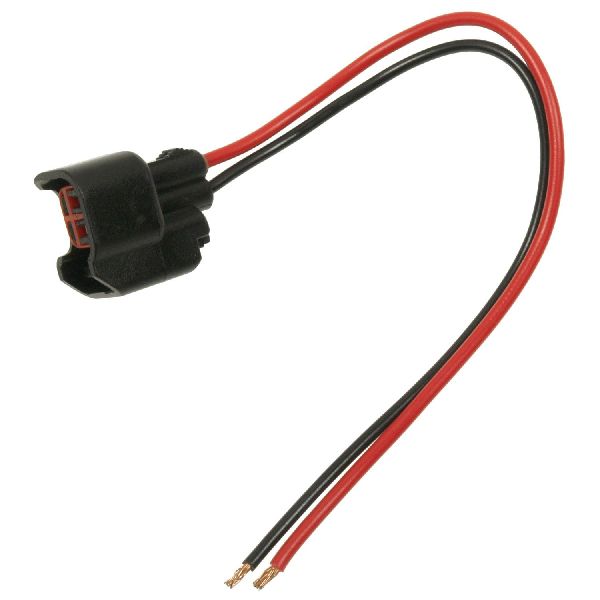

The information in this article is provided for general reference and educational purposes only. Vehicle specifications, procedures, and part compatibility can vary by production date, trim level, and region. Always consult your vehicle's factory service manual and verify part numbers before purchasing or performing repairs. Safety-critical components such as airbags, seat belts, and braking systems should be installed by a qualified professional.
- Chrysler PT Cruiser:
- 🎬 Helpful Videos
- 🛍️ Shop This Part
- What's Unique About the 2001-2010 Chrysler PT Cruiser
- Symptoms You May Notice
- Most Likely Causes
- Rare But Worth Checking
- Technical Service Bulletins (TSBs) & Recalls
- Diagnosis Steps
- Parts You'll Likely Need
- Related Codes That Often Appear With This One
- Platform-Specific Known Issues
- Mechanic-Grade Diagnostic Values
- Scan Tool Commands That Help
- Wiring & Ground Locations
- Real Owner Repair Stories
- OEM Part Supersession History
- Model Year Variations Within This Range
- Diagnostic Flowchart
- Other Known Issues on This Vehicle
- Used vs. New Parts: Buying Guide for This Vehicle
- Real Owner Stories
- 2001-2010 Chrysler PT Cruiser 2.4L
- 2001-2010 Chrysler PT Cruiser 2.4L
- Related OBD-II Codes
- Frequently Asked Questions
- 🎟️ Get 5% Off