

P0204 on 2011-2014 Chrysler 200: Cylinder 4 Injector Circuit Fixes
For a P0204 code on a 2011-2014 Chrysler 200 2.4L, first check if TSB #18-014-14 applies, as a PCM software update may fix the issue without replacing parts. If the software is up to date, the most likely cause is a faulty fuel injector for cylinder 4. Other possibilities include a wiring/connector issue or, rarely, a failed Powertrain Control Module (PCM). A definitive test is swapping the injector to another cylinder to see if the code follows.
- For P0204 on a 2011-2014 Chrysler 200 2.4L, first check if TSB #18-014-14 (PCM reflash) applies to your vehicle before replacing parts.
- If software is not the issue, the most likely cause is a failed fuel injector. A simple diagnostic is to swap the injector with another cylinder and see if the code follows.
- Always check the wiring and connector to the injector for damage or a loose connection, as this is a common and inexpensive fix.
- This code is almost always accompanied by a P0304 misfire code, causing a rough idle and poor performance.
- Driving for an extended period with this fault can damage the catalytic converter, a much more expensive repair.
What's Unique About the 2011-2014 Chrysler 200
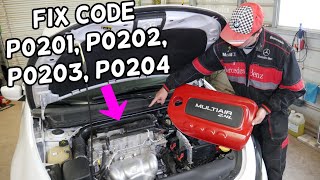
For the 2.4L engine in the Chrysler 200 and its platform mates (Dodge Avenger, etc.), the P0204 code has a significant known software-related cause. Chrysler issued Technical Service Bulletin (TSB) #18-014-14 specifically because the PCM could falsely set a P0204 code. A software reflash is the designated fix and should be investigated 🎬 Watch: Diagnosing P0204 codes on Chrysler 2.4L engines before replacing any hardware. If the software fix does not apply or has been performed, the issue is then typically a standard hardware failure of the injector or its wiring, common to many vehicles.
Symptoms You May Notice
- Check Engine Light is on (may be flashing if misfire is severe)
- Rough or vibrating idle
- Engine misfire, which may feel like a shake or stumble
- Poor acceleration and loss of power
- Reduced fuel economy
- Engine may hesitate or stall
- Engine runs on three cylinders
- A manufacturer service bulletin (TSB Bulletin #1810216) also notes that the customer may notice a 1-2 upshift clunk or bump, or a 4-5 upshift clunk or bump in conjunction with the MIL illumination.
- Replacing spark plugs or ignition coils. While these can cause a misfire (P0304), they will not cause an injector circuit code (P0204). The P0204 code is specifically an electrical circuit fault, not a combustion or ignition fault.
- Replacing the fuel injector before checking for the PCM software update TSB #18-014-14. This can lead to unnecessary expense as the software glitch is a known primary cause.
Most Likely Causes
- PCM Software Glitch (Requires Update) 🔴 High Probability Chrysler released TSB #18-014-14 specifically to address this code being falsely triggered by the PCM on 2.4L models. This indicates it's a known software anomaly.
How to confirm: Contact a Chrysler dealership or a qualified repair shop with access to OEM tools (like wiTECH). They can check your vehicle's VIN to see if TSB #18-014-14 is applicable and if the update has already been performed.
Typical fix: Reprogram (reflash) the Powertrain Control Module (PCM) with the updated software provided in the TSB. This must be done by a dealer or properly equipped independent shop.
Est. part cost: $0-$200 (Labor for the reflash) - Faulty Fuel Injector #4 🟡 Medium Probability Fuel injectors are electro-mechanical parts that can fail electrically or mechanically over time. A common failure mode is the internal coil developing an open circuit, especially when the engine warms up to operating temperature.
How to confirm: Check the injector's resistance with a multimeter when cold (typically 11-18 ohms). A more definitive test is to swap the #4 injector with one from another cylinder (e.g., #2). Clear the codes and drive. If the code changes to P0202, the injector is confirmed to be faulty. In some cases, the injector may test fine when cold but fail when hot; heating the injector with a heat gun while testing resistance can reveal this failure.
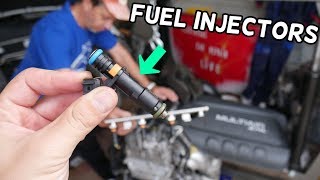
Typical fix: Replace the failed fuel injector. It is often recommended to replace all four injectors at the same time 🎬 See this step-by-step fuel injector replacement walkthrough on higher mileage vehicles to ensure balanced fuel delivery.
Est. part cost: $50-$150 - Wiring or Connector Issue 🟡 Medium Probability The wiring harness and connectors in the engine bay are subjected to heat and vibration. The plastic locking tab on the injector connector can become brittle and break, leading to a loose connection that triggers the code. Wires can also chafe or break near the connector.
How to confirm: Visually inspect the wiring and connector for cylinder #4's fuel injector. Look for broken wires, corrosion, or a loose connection. Wiggle the connector while the engine is idling to see if it affects the misfire. Use a noid light to confirm if the PCM is sending a pulse signal to the connector; if the light flashes, the PCM and wiring to the connector are likely good.
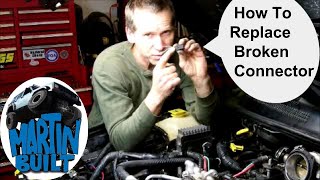
Typical fix: Repair the broken wire or replace the injector connector pigtail if it is damaged or corroded. Ensure the new connector 'clicks' into place.
Est. part cost: $10-$30 - Faulty Powertrain Control Module (PCM) ⚪ Low Probability While rare, the internal driver circuit within the PCM that controls the fuel injector can fail. This should be considered only after a software update has been performed and the injector and wiring have been proven to be good.
How to confirm: This is a diagnosis of exclusion. If a noid light shows no pulse at the connector, and the wiring has been tested for continuity back to the PCM with no breaks found, the PCM's internal driver is the likely culprit.
Typical fix: Replace and reprogram the Powertrain Control Module. This typically requires a professional with programming capabilities.
Est. part cost: $300-$800
Rare But Worth Checking
- Intermittent Open in Injector Coil:
Diagnosis Steps
- Scan the vehicle for all stored trouble codes. Note if P0304 (Cylinder 4 Misfire) is also present.
- Check for TSBs. Contact a dealer or equipped shop to verify if TSB #18-014-14 is applicable to your VIN and has not been performed. If it is applicable, have the PCM reprogrammed. This may resolve the issue immediately.
- Visually inspect the wiring harness and connector for fuel injector #4. Look for any signs of damage, corrosion, or a loose connection. Ensure the connector is fully seated and the locking tab is engaged.
- Test the circuit with a noid light. Unplug the injector and plug in the noid light. Start the engine. The light should flash steadily. If it flashes, the PCM and wiring are likely good, pointing towards the injector itself. If it does not flash or stays on solid, there is a problem with the wiring or the PCM driver.
- If the noid light flashes, perform an injector swap. Swap the fuel injector from cylinder #4 with the injector from another cylinder (e.g., cylinder #3). Clear the codes and drive the vehicle.
- Rescan for codes. If the code has changed to P0203 (Injector Circuit/Open - Cylinder 3), the fuel injector is faulty and needs to be replaced.
- If the P0204 code returns after the swap, the problem lies in the wiring between the connector and the PCM.
- If the noid light did not flash, use a multimeter to check for continuity on the control wire between the PCM connector and the injector connector. If there is no continuity (high resistance), repair the broken wire.
- If all wiring tests good and there is no signal from the PCM (noid light test failed), and the TSB reflash is not applicable or did not work, the PCM itself is the likely cause of the problem.
Parts You'll Likely Need
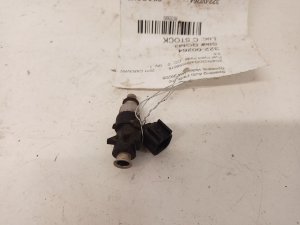
- Fuel Injector
(OEM #04593986AA, superseded by 04593986AB)— This is the most common hardware failure for a P0204 code, failing electrically after years of use, sometimes only when hot.
Trusted brands: Mopar, Bosch, Standard Motor Products (SMP), Motor Man (Remanufactured)
OEM price range: $100-$197
Aftermarket price range: $30-$120 - Fuel Injector Connector Pigtail — The locking tab on the original connector can become brittle and break, or the terminals can corrode, leading to a poor connection that triggers the code.
Trusted brands: Dorman (e.g., 85137 - verify fitment), Standard Motor Products (e.g., HP3945), Mopar
OEM price range: $25-$40
Aftermarket price range: $10-$25
Related Codes That Often Appear With This One
- P0304 — P0304 means 'Cylinder 4 Misfire Detected'. Since P0204 indicates a problem with the fuel supply for that same cylinder, the cylinder isn't getting the right amount of fuel, causing it to misfire. This is a very common and expected pairing.
Technical Service Bulletins (TSBs) & Recalls
- TSB Bulletin #18-014-14: Recommends selectively erasing and reprogramming the Powertrain Control Module (PCM) with new software to resolve a false P0204 code on models with the 2.4L engine.
- TSB Bulletin #1810216: Notes that P0204 may occur alongside other codes like P0108 or P0606, and involves reprogramming the PCM to address these circuit faults and transmission shift quality issues.
Platform-Specific Known Issues
- TSB for False P0204 Code: Chrysler issued Technical Service Bulletin #18-014-14 for some 2011-2014 models with the 2.4L engine. The bulletin addresses a condition where the PCM may incorrectly set the P0204 fault code. The official repair is to reprogram the PCM with updated software. This should be a primary diagnostic step before replacing any parts.
Mechanic-Grade Diagnostic Values
- Fuel Injector Coil Resistance — expected: 11 - 18 Ohms. Failure: A reading of 0 Ohms (short circuit) or infinite/OL (open circuit) indicates a failed injector. A reading significantly outside the normal range also points to a problem.
- Fuel Injector Connector Voltage (Key On, Engine Off) — expected: Approximately 12 Volts (Battery Voltage) on one of the two pins.. Failure: No voltage indicates an open in the power supply wire from the ASD (Auto Shutdown) relay or a blown fuse.
- Injector Pulse Width (at idle) — expected: Typically 2.0 - 4.0 milliseconds (ms), viewable on a scan tool with live data.. Failure: A value of 0 ms for cylinder 4 while others are normal confirms the PCM is not commanding the injector to fire. Unusually high or low values compared to other cylinders can indicate a fueling problem or compensation for other issues.
- PCM Injector #4 Control Wire — expected: Pin 15, Dark Green/Tan wire, on connector C2 of the Powertrain Control Module.. Failure: Testing for continuity between this pin and the corresponding pin at the injector connector will show high resistance or an open circuit if the wire is broken.
Scan Tool Commands That Help
- wiTECH (Chrysler OEM Tool) or equivalent professional scanner: Fuel Injector Actuator Test / Injector Kill — This bidirectional command allows a technician to individually disable fuel injectors while the engine is running. When injector #4 is disabled, if there is no change in engine RPM or sound, it confirms that cylinder was not contributing, pointing to a fault in that circuit. If disabling another injector (e.g., #3) causes a noticeable drop in RPM, it proves that injector was working correctly. This helps isolate the fault to cylinder 4 without swapping parts.
Wiring & Ground Locations
- Cylinder #4 Location — On the 2.4L inline 4-cylinder engine, the cylinders are numbered 1-2-3-4 from left (timing belt side) to right (transmission side). Cylinder #4 is on the far right, closest to the transmission.. Correctly identifying cylinder #4 is the first step to diagnosing the correct injector and circuit.
- PCM Connector C2, Pin 15 — This is the specific pin on the Powertrain Control Module (PCM) that sends the ground pulse to fire the #4 fuel injector. The wire color is typically Dark Green with a Tan stripe.. When a noid light test fails, checking for continuity between this pin and the injector connector is the definitive test to rule out a broken wire. If the wire is good, the fault is likely in the PCM itself.
- Main Engine Ground Strap — A primary ground strap connects the engine block or transmission case directly to the vehicle's chassis or negative battery terminal. A common location is from the transmission housing to the frame rail.. While not a direct cause of a single injector code, a poor engine ground can cause a host of intermittent electrical issues, including erratic sensor readings and module behavior. Ensuring this connection is clean and tight is a crucial step in any electrical diagnosis.
Real Owner Repair Stories
- YouTube channel 'mechanic life style' (Vehicle with P0204 (specific model was a Land Rover, but the principle is identical)) — Check Engine Light with code P0204.
❌ Tried (didn't work) Initial diagnosis suspected a bad fuel injector.
✅ What actually fixed it The wiring connector for the #4 fuel injector had come loose. The retaining clip was not properly seated, causing an intermittent open circuit. After taking the intake manifold off to access the injector, the technician simply pushed the connector on until it clicked. This resolved the code without replacing any parts.
OEM Part Supersession History
04593986AA→04593986AB, RL593986AB (Remanufactured designation)— Standard part revision by the manufacturer, likely for minor improvements in materials or manufacturing process. Functionally identical.
Heads up: There are no known incompatibilities between these part numbers for the specified vehicle. They are interchangeable.
Diagnostic Flowchart
Used vs. New Parts: Buying Guide for This Vehicle
When a used part is the smart pick: A used OEM fuel injector from a low-mileage donor vehicle can be a cost-effective option, as Chrysler injectors are generally reliable. However, it's only recommended if you can verify the donor vehicle's mileage and condition. A used wiring harness pigtail is also a viable option if the connector is in good shape with an intact locking tab.
Donor-vehicle mileage cap: roughly under 80000 miles for the part to have meaningful remaining life.
What to inspect on the donor part:
- Check for corrosion on the electrical pins.
- Ensure the plastic connector body and locking tab are not cracked or brittle.
- Inspect the O-rings for cracks or hardening; however, it is always recommended to install new O-rings regardless.
- Ask the seller if the injectors were tested or came from a running vehicle.
OEM-only on this vehicle (don't cheap out):
- Powertrain Control Module (PCM) - Due to the need for VIN-specific programming, a used PCM is difficult to implement and often not worth the hassle compared to a properly programmed remanufactured unit.
Aftermarket brands forum-validated for this vehicle:
- Bosch
- Standard Motor Products (SMP)
- Continental
Brands owners have reported issues with on this vehicle:
- Unbranded 'no-name' injectors from online marketplaces. Forum and seller feedback often warns that these parts can be poorly manufactured, fail to meet OEM flow rates, and may cause performance issues or fail prematurely.
Real Owner Stories
Aggregated from forums and TSBs cited above. Mileages and costs reflect what owners reported in those sources.
2011-2014 Chrysler 200 2.4L World GE
Symptoms: The vehicle had a P0204 trouble code stored.
What fixed it: The cause was a loose connector clip on the #4 fuel injector. Pushing the connector on until it clicked and securing the lock resolved the issue without replacing any parts.
Source hint: YouTube - 'P0204 Chrysler 200'
Related OBD-II Codes
Frequently Asked Questions
I have a P0204 code on my 2012 Chrysler 200. Is there a recall or TSB for this specific issue?
My 2013 Chrysler 200 has a P0204 and is running rough. What's the very first thing I should check?
How can I be sure the #4 fuel injector is bad on my 2.4L Chrysler 200 before buying a new one?
Could a loose wire really cause the P0204 code and a misfire on my Chrysler 200?
If I find that the #4 injector is bad on my high-mileage Chrysler 200, should I replace just that one?
I've checked the wiring and swapped the injector, but P0204 keeps coming back. Could it be the computer (PCM)?
My friend has a Dodge Dart with the same engine and a similar code. Is this a common problem on other cars?
Helpful Videos
Used OEM Parts in Stock

New Aftermarket Parts Available


The information in this article is provided for general reference and educational purposes only. Vehicle specifications, procedures, and part compatibility can vary by production date, trim level, and region. Always consult your vehicle's factory service manual and verify part numbers before purchasing or performing repairs. Safety-critical components such as airbags, seat belts, and braking systems should be installed by a qualified professional.
- Chrysler 200:
- 🎬 Helpful Videos
- 🛍️ Shop This Part
- What's Unique About the 2011-2014 Chrysler 200
- Symptoms You May Notice
- Most Likely Causes
- Rare But Worth Checking
- Diagnosis Steps
- Parts You'll Likely Need
- Related Codes That Often Appear With This One
- Technical Service Bulletins (TSBs) & Recalls
- Platform-Specific Known Issues
- Mechanic-Grade Diagnostic Values
- Scan Tool Commands That Help
- Wiring & Ground Locations
- Real Owner Repair Stories
- OEM Part Supersession History
- Diagnostic Flowchart
- Used vs. New Parts: Buying Guide for This Vehicle
- Real Owner Stories
- 2011-2014 Chrysler 200 2.4L World GE
- Related OBD-II Codes
- Frequently Asked Questions
- 🎟️ Get 5% Off