

P0201 on 2006-2011 Saab 9-3 2.8T V6: Injector Circuit Causes and Fixes
P0201 indicates a fault in the cylinder 1 fuel injector circuit. On the Saab 9-3 2.8T, this is most commonly caused by a failed Engine Control Module (ECM), a known platform issue due to heat and vibration causing internal solder joint failure. Damaged wiring or a faulty injector are also possible. Diagnosis involves checking wiring, swapping the injector, and using a noid light. An ECM repair service is the typical fix for a confirmed module failure and costs around $450-$600.
- P0201 on a Saab 9-3 2.8T points to an electrical issue with the cylinder 1 injector, not a spark or compression problem.
- Cylinder 1 is on the rear bank by the firewall, making access more difficult and labor-intensive.
- Unlike most cars, a failed Engine Control Module (ECM) is a high-probability cause for this code on this specific vehicle and should be considered a primary suspect.
- A definitive diagnosis involves swapping the cylinder 1 injector with another cylinder. If the code doesn't move with the injector, and the wiring is good, the ECM is almost certainly the fault.
- Sending the original ECM for repair is the most common and cost-effective solution for a confirmed ECM failure.
What's Unique About the 2006-2011 Saab 9-3
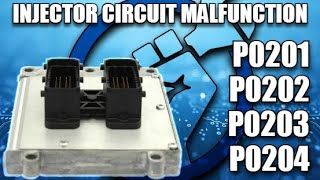
While any car can suffer from a bad injector or wiring, the 2006-2011 Saab 9-3 with the 2.8T V6 has a well-documented weakness in its Trionic 8 (T8) Engine Control Module. The ECM is mounted directly on the engine, exposing it to significant heat and vibration. This environment causes the solder balls on the BGA (Ball Grid Array) processor chip inside the ECM to develop micro-fractures over time. This failure specifically affects the injector driver circuits, making ECM failure a very common cause for P0201 and other related injector codes (P0202, P0203, etc.) on this platform. This possibility should be considered much earlier in the diagnostic process than on most other vehicles.
🎬 Watch: Why the ECM is usually the culprit for these codes.Symptoms You May Notice
- Check Engine Light is on
- Rough, unstable idle
- Engine misfiring, which may feel like a shudder or hesitation
- Reduced engine power and poor acceleration, possibly entering 'limp home mode'
- Increased fuel consumption
- Strong smell of gasoline from the exhaust, sometimes accompanied by white or black smoke on startup.
- Replacing the spark plug and ignition coil for cylinder 1. While these can cause a misfire (P0301), they will not cause an injector circuit code like P0201, which is specifically an electrical fault.
Most Likely Causes
- Failed Engine Control Module (ECM) 🔴 High Probability The Trionic 8 ECM used in this V6 model is known to suffer from internal failures of the injector driver circuits due to heat and vibration cracking the BGA solder joints for the main processor. This is a widely reported issue in owner forums and by specialist repair shops who offer rebuild services specifically for this fault.
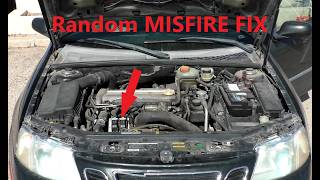
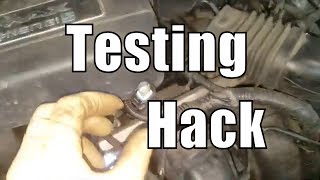
How to confirm: If the wiring and the injector itself are confirmed to be good (e.g., by swapping the injector to another cylinder and the P0201 code remains), the ECM is the most likely culprit. A noid light test showing no pulse at the connector also points strongly to the ECM. 🎬 See this quick hack for testing your fuel injectors. The definitive test is sending the ECM to a specialist for bench testing.
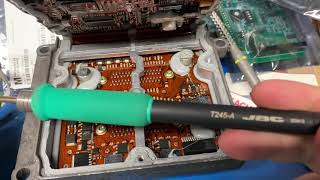
Typical fix: The ECM must be sent to a specialist for repair. They will typically 'reball' the processor chip, which involves removing it, replacing the tiny solder balls underneath with a more durable leaded solder, and reattaching it. This is more cost-effective than buying 🎬 Watch: A look inside the ECM and how it's repaired. and programming a new unit.
Est. part cost: $450-$600 for a repair service - Damaged Wiring or Connector to Injector 1 🟡 Medium Probability The engine bay is tightly packed, and wiring harnesses, especially for the rear bank of cylinders near the firewall, are exposed to high heat, which can make them brittle over time. The plastic injector connectors can also become brittle and crack.
How to confirm: Visually inspect the wiring harness and connector for cylinder 1 for any signs of melting, chafing, or corrosion. Use a multimeter to check for ~12V power at the connector with the key on and check for continuity on the ground (control) wire back to the ECM.
Typical fix: Repair the damaged section of wire or replace the injector connector pigtail. Apply dielectric grease to the new connector to prevent future corrosion.
Est. part cost: $15-$40 - Faulty Cylinder 1 Fuel Injector 🟡 Medium Probability While Bosch injectors are generally reliable, they can fail electrically (open or shorted coil) or become clogged over time. An injector with high resistance can also stress the ECM driver circuit, potentially leading to its failure.
How to confirm: Swap the cylinder 1 injector with an injector from another cylinder (e.g., cylinder 3, also on the rear bank). Clear the codes and run the engine. If the code changes to P0203, the injector is faulty. You can also measure the injector's resistance with a multimeter; it should be within a specific range, typically 13.5-16 ohms.
Typical fix: Replace the faulty fuel injector. It is often recommended to replace all injectors on a high-mileage engine at the same time, especially if one has failed.
Est. part cost: $60-$120
Diagnosis Steps
- Read the fault codes with an OBD-II scanner to confirm P0201 and note any other codes present, such as P0301 or other P020x codes.
- Locate cylinder 1. On the transverse 2.8T V6, the rear bank (closest to the firewall) contains cylinders 1, 3, and 5, from passenger side to driver's side. Cylinder 1 is on the passenger side, closest to the firewall.
- Inspect the wiring harness and electrical connector for the cylinder 1 fuel injector. Look for any visible signs of damage, melting, corrosion, or loose pins. The rear bank is difficult to access.
- Check Injector Resistance. Disconnect the injector and measure the resistance across its two terminals with a multimeter. A reading between 13.5-16 ohms is expected. An open circuit (infinite resistance) or short (near zero ohms) indicates a bad injector.
- Perform a noid light test. Disconnect the injector harness and plug in a noid light. Crank the engine. The light should flash rapidly, indicating the ECM is sending a signal. If it does not flash, the problem is likely in the wiring or the ECM itself.
- Swap the injector. To definitively test the injector, swap the cylinder 1 injector with another one (cylinder 3 is also on the rear bank, making it a comparable swap). Clear the codes and drive the vehicle. If the code returns as P0201, the injector is not the problem. If the code moves to P0203, the injector is faulty and must be replaced.
- If the injector swap proves the injector is good, and the noid light test failed, re-check the wiring for continuity between the injector connector and the ECM connector. If the wiring is intact, the ECM is the confirmed point of failure and requires a specialist repair.
Parts You'll Likely Need
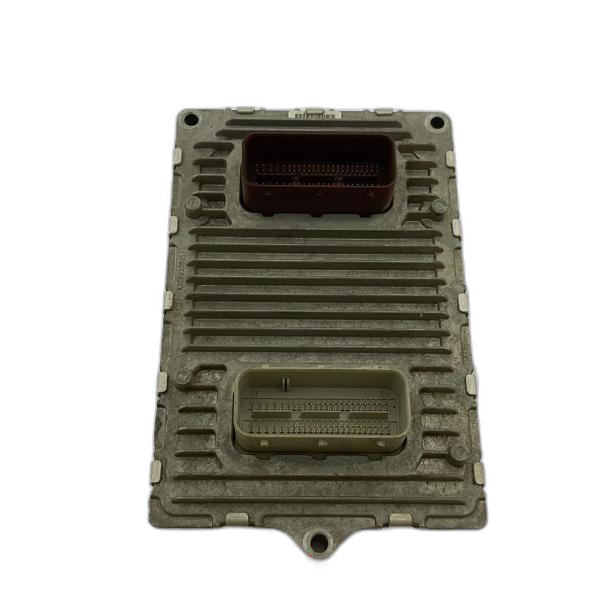
- Engine Control Module (ECM) Repair Service
(OEM #Various (e.g., 55352571, 55565020, 55574377))— This is a very common failure point on the 2.8T V6 engine, causing injector circuit codes. Repairing the original unit is plug-and-play and avoids costly dealership programming for a new ECM.
Trusted brands: Nick's Electronic Repair, Your Parts Source (YPS-USA), Hirschmann & Koxha GbR (Germany)
OEM price range: $1500+ for new unit
Aftermarket price range: $450-$600 for repair service - Fuel Injector
(OEM #12581682)— If the injector itself has failed its internal coil, it must be replaced. This is confirmed by swapping the injector to another cylinder and seeing if the fault code follows.
Trusted brands: Bosch (OEM supplier), ACDelco
OEM price range: $90-$150
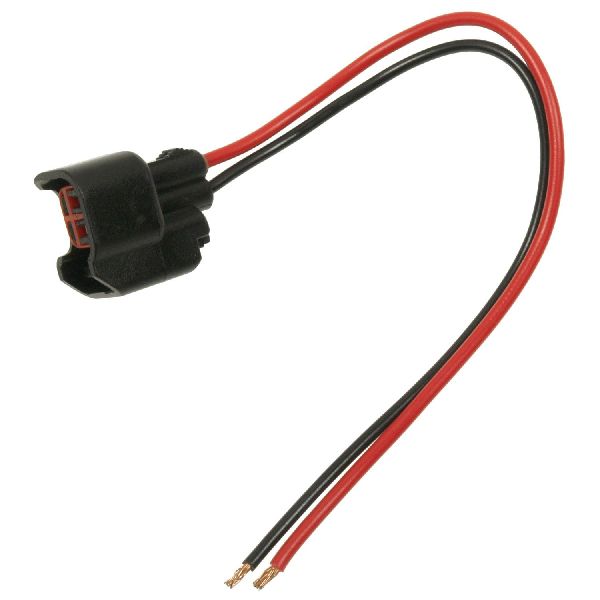
Aftermarket price range: $60-$100 - Fuel Injector Connector Pigtail — The plastic connector and wires can become brittle and fail from heat, causing an open or short in the circuit. Splicing in a new pigtail is the standard repair.
Trusted brands: ACDelco, Dorman
OEM price range: $25-$40
Aftermarket price range: $15-$30
Related Codes That Often Appear With This One
- P0301 — P0301 is 'Cylinder 1 Misfire Detected'. Since the P0201 code indicates a problem delivering fuel to cylinder 1, a misfire in that same cylinder is a direct and expected consequence.
- P0202, P0203, P0204, P0205, P0206 — When multiple injector circuit codes appear simultaneously, it is a very strong indicator of a failing ECM, as it's highly unlikely that multiple injectors or their wiring would fail at the exact same time.
- P0089 — P0089 is 'Fuel Pressure Regulator Performance'. While less direct, some owners have reported seeing this code alongside injector circuit faults, potentially indicating a broader fuel system issue or a complex ECM fault.
Platform-Specific Known Issues
- The Trionic 8 (T8) Engine Control Module (ECM) on the 2.8T V6 is highly susceptible to failure of the internal injector driver circuits. This is caused by repeated heat cycles and engine vibration cracking the solder joints on the main BGA processor chip. This failure commonly presents with one or more P020x codes.
- Accessing the rear bank of cylinders (1, 3, 5) where cylinder 1 is located is difficult. It often requires removing the ECM and carefully navigating around various harnesses and hoses to reach the injectors and coils.
Mechanic-Grade Diagnostic Values
- Fuel Injector Coil Resistance — expected: 13.5 - 16.0 ohms. Failure: A reading significantly outside this range, or showing an open circuit (infinite resistance), points to a failed injector.
- Injector Control Circuit Voltage (Key On) — expected: 5.8 - 7.8 Volts. Failure: With the injector disconnected and key on, voltage on the control circuit (wire to ECM) should be in this range. Lower voltage suggests an open/high resistance or a short to ground. Higher voltage suggests a short to voltage.
- Injector Power Supply Voltage (Key On) — expected: Battery Voltage (~12V). Failure: With the injector disconnected and key on, one of the two pins in the connector should have battery voltage. If not, there is an open/short in the power supply circuit from the main relay.
Scan Tool Commands That Help
- Saab Tech2: Fuel Injector Balance Test — This function, found in the Special Functions or Output Controls menu, allows a technician to individually pulse each injector for a set duration while monitoring the fuel pressure drop. It is used to identify a mechanically clogged or weakly performing injector without having to physically swap it between cylinders. An injector with a significantly different pressure drop compared to the others is faulty.
- Saab Tech2: FUEL/AIR Deviation Monitoring — While not a direct injector test, this data parameter helps diagnose overall drivability issues. It compares actual MAF sensor readings against factory-stored values under various conditions. A significant deviation can help confirm if the misfire from P0201 is causing a rich/lean condition that the rest of the system is trying to compensate for.
Wiring & Ground Locations
- Injector Connector Pin 1 — On the fuel injector electrical connector.. This pin supplies B+ (battery voltage) to the injector from the main relay. A test lamp connected between this pin and ground should illuminate with the key on.
- Injector Connector Pin 2 — On the fuel injector electrical connector.. This is the control circuit pin. The ECM grounds this pin to fire the injector. A noid light connected across Pin 1 and Pin 2 will flash while cranking if the ECM driver is working.
- ECM Grounds — Two 7mm screws secure the ECM grounds. One is easily accessible on a bracket. The second, more hidden ground, is located on the driver's side; a wire comes off one of the main ECM connectors and attaches to the chassis.. These grounds are critical for the ECM's operation. They are often forgotten or improperly tightened during reassembly after accessing the rear bank of cylinders, which can cause a host of electrical issues, including injector circuit faults.
Real Owner Repair Stories
- YouTube channel 'B.A.D. Car Club' (2005 Saab 9-3 (2.0T, but same Trionic 8 ECM family and issue)) — Check engine light with codes P0201, P0202, P0203, P0204 (all injector circuits open).
❌ Tried (didn't work) Initial diagnosis pointed to the ECM.
✅ What actually fixed it The ECM was sent to a repair service (Your Parts Source / YPS-USA) who confirmed a bad fuel injector driver and a bad turbo driver. The repaired, plug-and-play ECM resolved all fault codes. The repair service noted that a failing injector can often cause the ECM driver to fail. - YouTube channel 'Nick's Electronic Repair' (2003-2011 Saab 9-3) — P0201 through P0204 codes, misfires, and limp mode.
❌ Tried (didn't work) Owners typically replace spark plugs, coils, and injectors with no success.
✅ What actually fixed it The video demonstrates the professional repair process. The processor chips on the ECM are removed, the old cracked solder balls are stripped, and new leaded solder balls are installed ('reballed'). This permanently fixes the broken connections caused by heat and vibration, resolving the injector circuit codes. - Reddit user on r/saab (Saab 9-3 (engine not specified but symptoms are relevant)) — Hesitation issues above 12psi of boost, confirmed misfire on cylinders 2 and 3.
❌ Tried (didn't work) Replacing all spark plugs helped but did not fully resolve the hesitation under load.
✅ What actually fixed it The owner removed the fuel injectors and cleaned them in an ultrasonic cleaner. This completely fixed the performance issues, indicating the injectors were mechanically clogged or dirty, not electrically failed.
OEM Part Supersession History
Various (see list)→Various (see list)— These are not supersessions in a typical sense, but a list of compatible part numbers for the Trionic 8 ECM used in the 9-3. The specific number may vary by model year and original configuration.
Heads up: While many Trionic 8 units are physically interchangeable for cloning, you must use a unit from a V6 to clone for a V6 car. A used ECM must be 'added' to the car via Tech2 security access or have the immobilizer and VIN data from the original unit cloned onto it. It is not a plug-and-play swap without one of these steps. Compatible part numbers include 55352571, 55352688, 55353231, 55565020, 55567225, and 55569738.
Model Year Variations Within This Range
- 2006-2008: The horsepower rating of the 2.8T V6 engine changed, but the core hardware remained the same. The engine was released with 250hp (2006), updated to 255hp (2007), and finally 280hp (2008). These changes were accomplished via different factory software calibrations in the ECM, not through different injectors, turbos, or internal engine parts. This indicates good parts interchangeability across these years for P0201-related components.
Diagnostic Flowchart
Used vs. New Parts: Buying Guide for This Vehicle
When a used part is the smart pick: For the Engine Control Module (ECM), a used part is the primary choice, but NOT for direct installation. A used ECM from a donor vehicle should be sent along with your original failed unit to a specialist for 'cloning'. They will transfer the immobilizer data, VIN, and engine configuration from your old ECM to the used one, making it plug-and-play. This is far more cost-effective than a new, unprogrammed dealer part. A used fuel injector can also be a good value if its resistance is tested and confirmed to be in spec (13.5-16 ohms) before installation.
Donor-vehicle mileage cap: roughly under 100000 miles for the part to have meaningful remaining life.
What to inspect on the donor part:
- For an ECM: Ensure the donor car is the same engine type (2.8T V6). Check that the case and connectors are free of physical damage or corrosion.
- For an Injector: Ask for the donor vehicle's mileage. Visually inspect the injector for cracks, and check the electrical pins for corrosion. If possible, test resistance with a multimeter before purchase.
OEM-only on this vehicle (don't cheap out):
- Engine Control Module (ECM): While a used OEM unit is the basis for repair/cloning, avoid generic aftermarket 'remanufactured' ECMs that are not from a reputable Saab specialist. The cloning/repair of the original Bosch Trionic 8 unit is critical.
Aftermarket brands forum-validated for this vehicle:
- ECM Repair Service: Nick's Electronic Repair, Your Parts Source (YPS-USA)
- Fuel Injector: Bosch (OEM), ACDelco
Brands owners have reported issues with on this vehicle:
- Unbranded, no-name fuel injectors from online marketplaces. Sticking to the OEM (Bosch) or a reputable equivalent like ACDelco is highly recommended to avoid performance issues or premature failure.
Real Owner Stories
Aggregated from forums and TSBs cited above. Mileages and costs reflect what owners reported in those sources.
2007 Saab 9-3 Aero V6
Symptoms: The user reported the code P0201 for an open circuit on cylinder 1, a persistent 'misfiring issue', and poor gas mileage of 14 mpg.
What fixed it: The owner had not found a final solution at the time of the post. The discussion noted that while ECU failure is common on 4-cylinder models, the V6 ECU can also fail with age. A diagnostic dead-end involved replacing two leaking injectors, which improved fuel economy but did not fix the misfire.
Source hint: Reddit r/saab
2006-2011 Saab 9-3 2.8T V6
Symptoms: Check Engine Light with P0201, rough and unstable idle, and a noticeable engine misfire.
What fixed it: Following a common narrative, the owner first replaced the cylinder 1 fuel injector and checked the wiring harness, but the code persisted. The ultimate fix was sending the Engine Control Module (ECM) to a specialist for repair.
Cost: $450-$600
Source hint: SaabCentral.com: Numerous threads discuss P020x codes on the 2.8T V6.
Related OBD-II Codes
Frequently Asked Questions
Is the ECM really the most common cause for a P0201 code on my Saab 9-3 2.8T?
Where is cylinder 1 located on the 2.8T V6 engine?
I swapped the injector from cylinder 1 to cylinder 3, and now I have a P0203 code. What does that mean?
My noid light doesn't flash on the cylinder 1 connector. Is the ECM definitely bad?
What is the correct resistance for a fuel injector on this engine?
Is it better to repair my failed ECM or buy a new one?
Do other GM vehicles with this engine have the same ECM failure issue?
Helpful Videos
Used OEM Parts in Stock

New Aftermarket Parts Available


The information in this article is provided for general reference and educational purposes only. Vehicle specifications, procedures, and part compatibility can vary by production date, trim level, and region. Always consult your vehicle's factory service manual and verify part numbers before purchasing or performing repairs. Safety-critical components such as airbags, seat belts, and braking systems should be installed by a qualified professional.
- Saab 9-3:
- 🎬 Helpful Videos
- 🛍️ Shop This Part
- What's Unique About the 2006-2011 Saab 9-3
- Symptoms You May Notice
- Most Likely Causes
- Diagnosis Steps
- Parts You'll Likely Need
- Related Codes That Often Appear With This One
- Platform-Specific Known Issues
- Mechanic-Grade Diagnostic Values
- Scan Tool Commands That Help
- Wiring & Ground Locations
- Real Owner Repair Stories
- OEM Part Supersession History
- Model Year Variations Within This Range
- Diagnostic Flowchart
- Used vs. New Parts: Buying Guide for This Vehicle
- Real Owner Stories
- 2007 Saab 9-3 Aero V6
- 2006-2011 Saab 9-3 2.8T V6
- Related OBD-II Codes
- Frequently Asked Questions
- 🎟️ Get 5% Off