

P0201 on 2011-2014 Hyundai Sonata 2.4L: Injector Circuit Malfunction Causes and Fixes
On a 2011-2014 Sonata with the 2.4L GDI engine, code P0201 almost always means the cylinder 1 fuel injector has failed. A simple swap with the cylinder 2 injector can confirm the diagnosis. Expect to pay around $50-$100 for an aftermarket injector or $150+ for OEM. The issue is also common on the Kia Optima, Santa Fe Sport, and Sorento with the same engine.
- P0201 is an electrical circuit code for the cylinder 1 fuel injector.
- The most likely cause on the 2011-2014 Sonata 2.4L is a failed fuel injector due to an internal open circuit.
- A simple and definitive DIY test is to swap the cylinder 1 and 2 injectors and see if the code follows (changes to P0202).
- Do not ignore this code, as continued driving can lead to expensive catalytic converter damage.
- While this engine has a history of major recalls for bearing failure, P0201 is a separate, more straightforward electrical issue.
What's Unique About the 2011-2014 Hyundai Sonata
The 2011-2014 Sonata's Theta II 2.4L GDI engine is infamous for major internal issues, including connecting rod bearing failures that led to massive recalls (Recall 132) and a class-action lawsuit resulting in engine replacements. While P0201 is a separate electrical fault, the context of engine unreliability is critical. The Gasoline Direct Injection (GDI) system uses high-pressure injectors that sit directly in the combustion chamber, operating in a harsher environment than older port injection systems, which contributes to a higher failure rate of their internal electrical coils. Furthermore, these engines are known for significant carbon buildup on intake valves, which can cause misfires but will not trigger a P0201 circuit code.
Symptoms You May Notice
- Check Engine Light is on
- Rough idle and engine shaking
- Noticeable engine misfire (often felt as a constant shudder)
- Reduced engine power and poor acceleration
- Hesitation during acceleration
- Worse than normal fuel economy
- Engine may stall in some cases
- Flashing Check Engine Light under load
- Replacing the spark plug or ignition coil. While these can cause a misfire (P0301), they will not cause an injector circuit code (P0201). The P0201 code specifically points to an electrical issue with the injector or its circuit, not a combustion or spark problem.
Most Likely Causes
- Failed Cylinder 1 Fuel Injector 🔴 High Probability The GDI injectors operate under very high pressure and are exposed to intense combustion chamber temperatures, leading to the eventual failure of the internal electrical coil. This is the most common point of failure for this code across the Theta II GDI engine family.
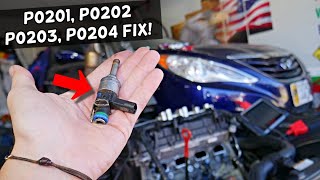
How to confirm: Swap the cylinder 1 fuel injector with the injector from cylinder 2. Clear the codes and run the engine. If the code changes to P0202 (Injector Circuit/Open - Cylinder 2), the injector is definitively bad. Alternatively, check the resistance of the injector with a multimeter. 🎬 Watch: How to test your fuel injector circuit and resistance. A good GDI injector should have a low resistance, typically around 1-5 Ohms, though some sources suggest a higher range of 12-16 Ohms for similar GDI engines. The key is consistency; if the cylinder 1 injector's resistance is OL (Open/infinite) or significantly different from the other three, it has failed.
Typical fix: Replace the faulty fuel injector. It is mandatory to replace the injector's Teflon combustion seal and O-rings whenever it is removed.
Est. part cost: $50-$150 - Wiring Harness or Connector Issue 🟡 Medium Probability Engine heat and vibration can make wires brittle and cause them to break inside the insulation. A known weak point on some Theta II engines is the harness section near the throttle body, which can rub through its protective loom and short out. The injector connector's plastic locking tab can also break easily, leading to a poor connection.
How to confirm: Visually inspect the wiring harness leading to the cylinder 1 injector for any signs of damage, melting, or breaks. Check that the connector is securely clipped onto the injector and that the pins inside are clean and not corroded. Use a 'noid light' to confirm the computer is sending a pulse to the connector; the light should flash while cranking. Wiggle the harness with the engine running to see if it induces a misfire.
Typical fix: Repair the broken wire(s) or replace the damaged connector pigtail. Pigtail connectors are available from Dorman, Standard Motor Products, or as OEM parts.
Est. part cost: $15-$40
Rare But Worth Checking
- Faulty Powertrain Control Module (PCM/ECM): This is very rare. The internal injector driver circuit within the PCM can fail, but this should only be considered after the injector and wiring have been definitively ruled out. PCM replacement is expensive and requires programming by a dealer or specialized shop.
Diagnosis Steps
- Scan the vehicle for OBD-II codes. Confirm P0201 is present, and note any other codes like P0301.
- Visually inspect the wiring and connector for the cylinder 1 fuel injector. Cylinder 1 is the cylinder closest to the belts on the left side of the engine. Look for obvious damage, corrosion, rodent chew marks, or loose connections.
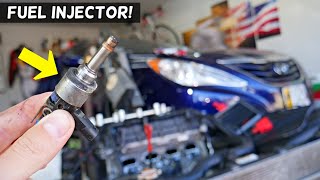
- If no visual issues are found, perform an 'injector swap'. Disconnect the battery. Relieve fuel pressure from the high-pressure fuel system. Carefully swap the cylinder 1 and cylinder 2 fuel injectors. This will require removing the intake manifold. 🎬 See this walkthrough for removing and replacing the fuel injectors.
- Clear the OBD-II codes and start the engine. Let it run for a minute.
- Re-scan for codes. If the code has moved to P0202, the fuel injector is confirmed to be the problem.
- If the P0201 code returns, the issue is likely in the wiring or the ECM. The next step is to use a 'noid light' to test for an electrical signal at the injector connector. The light should flash steadily while cranking the engine.
- If the noid light does not flash, check for ~12V power on one pin of the connector with the key on. If power is present, the issue is on the ground control wire back to the ECM. If no power is present, check the main injector fuse/relay.
- If the noid light flashes correctly, but the injector swap didn't move the code, you may have an intermittent wiring issue that only occurs when the connector is plugged in and under load. Perform a continuity and wiggle test on the harness between the injector and ECM.
Parts You'll Likely Need
- Fuel Injector (Cylinder 1)
(OEM #35310-2GGA0)— This is the most common cause of a P0201 code on this vehicle due to failure of the internal electrical coil.
Trusted brands: Hyundai (OEM), Bosch, Standard Motor Products, GB Remanufacturing
OEM price range: $150-$200
Aftermarket price range: $50-$100 - Fuel Injector Seal Kit
(OEM #35310-2G700 (This is often a kit including the injector))— Whenever a GDI injector is removed, its Teflon tip seal and other O-rings must be replaced to prevent high-pressure fuel and compression leaks. These are single-use parts.
Trusted brands: Hyundai (OEM), Fel-Pro
OEM price range: $15-$30
Aftermarket price range: $10-$20 - Fuel Injector Connector Pigtail
(OEM #PU465-02127 (aftermarket) or 35341-2GHA0 (OEM harness component))— The connector's locking clip often becomes brittle and breaks, or the wiring itself fails near the connector, requiring a new pigtail to be spliced in.
Trusted brands: Dorman, ACDelco, Standard Motor Products (SMP)
OEM price range: $25-$40
Aftermarket price range: $15-$30
Related Codes That Often Appear With This One
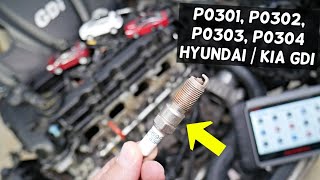
- P0301 — P0301 means 'Cylinder 1 Misfire Detected'. Since P0201 indicates the injector circuit is not working, no fuel is being delivered to cylinder 1, which directly causes a misfire. These two codes almost always appear together. 🎬 Watch: Diagnosing misfire codes on Hyundai GDI engines.
- P0300 — P0300 means 'Random/Multiple Cylinder Misfire Detected'. This can occur if the P0201 fault is intermittent or if the resulting imbalance from the dead cylinder causes the crankshaft position sensor to detect misfires on other cylinders.
Technical Service Bulletins (TSBs) & Recalls
- TSB 17-ST-002: Details the warranty extension and replacement procedure for the common steering column flexible coupler failure, which causes a clicking noise.
- TSB 17-01-046-1: A technical service bulletin related to the main engine recall (132), providing dealers with the updated inspection and replacement procedure for the engine short block.
Platform-Specific Known Issues
- Engine Recall Context: This vehicle's Theta II 2.4L GDI engine was subject to major recalls (NHTSA 15V-568, Campaign 132) for engine bearing failure due to metallic debris from manufacturing. Symptoms included a knocking noise, stalling, and potential for engine seizure. While P0201 is not a direct symptom of this failure, any work on these engines should be done with awareness of this widespread and serious issue.
- Soy-Based Wiring: Like many modern cars, the wire insulation may be soy-based, which has been known to attract rodents. If you see signs of rodent activity in the engine bay, pay close attention to the injector wiring harness for chew marks.
Mechanic-Grade Diagnostic Values
- Fuel Injector Coil Resistance — expected: 1-5 Ohms (for GDI type) or 12-16 Ohms. The critical test is comparing the reading from cylinder 1 to the other three cylinders.. Failure: A reading of 'OL' (Open Loop/infinite resistance) or a value significantly different from the other injectors indicates a failed internal coil.
- High-Pressure Fuel System Pressure — expected: 2,175 PSI (150 bar) maximum operating pressure.. Failure: While low pressure won't cause a P0201 circuit code, it's a key health indicator for the GDI system. This code points to an electrical, not a pressure, fault.
- Injector Pulse Width (Live Scan Data) — expected: A positive value in milliseconds (ms) that varies with engine RPM and load.. Failure: A value of 0 ms for cylinder 1 while other cylinders show normal pulsing can indicate the ECM has shut down the driver for that circuit due to the detected fault.
Scan Tool Commands That Help
- Hyundai GDS (Global Diagnostic System): Actuation Test / Active Test for Fuel Injectors — This function allows a technician to command a specific injector to fire while the engine is off. It's used to verify if the ECM driver and wiring are capable of activating the injector, helping to isolate the fault between the injector itself and the control circuit.
Wiring & Ground Locations
- Injector #1 Control Wire — Runs from the cylinder 1 fuel injector connector back to a specific pin on the Engine Control Module (ECM).. This is the ground-side wire that the ECM pulses to fire the injector. An open or short-to-ground on this specific wire is a primary cause of P0201 if the injector itself is good. A wiring diagram is needed to identify the correct ECM pin for a continuity test.
- ECM HIGHSIDE Control Circuit (HS_14) — Internal to the ECM, this circuit provides the power supply to the injector driver.. On this engine, the ECM's HIGHSIDE control circuit (HS_14) is shared between injectors #1 and #4. A fault in this shared circuit could potentially cause issues with both cylinders, though a single P0201 code points away from this.
- Ground Point Gf03 — A wiring diagram indicates a ground point labeled 'Gf03' on the left side of the engine compartment.. While not exclusive to the injector circuit, a poor or corroded main engine ground can cause a multitude of electrical issues, including erratic voltage and incorrect sensor readings that could indirectly contribute to control module problems.
Real Owner Repair Stories
- YouTube Channel 'Auto Repair Guys' (Hyundai Sonata (year not specified, but GDI engine)) — Check Engine Light with code P0204 (same issue, different cylinder).
❌ Tried (didn't work) Initial diagnosis assumed a bad injector.
✅ What actually fixed it The injector connector wire had come loose. The retaining spring clip on the connector was missing or not installed correctly, allowing the connector to back off from vibration. Securing the connector and installing a new clip resolved the open circuit and cleared the code.
OEM Part Supersession History
35310-2GGA0→35310-2GGA1— Part has been updated by the manufacturer. The new part number is often sold as a complete assembly with seals pre-installed.
Heads up: The parts are generally interchangeable, but it is always recommended to use the latest revision. Some vendors list 35310-2GGA0 for 2015-2017 Sonatas, indicating potential overlap or continued use of the original number.
Model Year Variations Within This Range
- 2014: For the 2014 model year refresh, the 2.4L GDI engine's horsepower was slightly rerated to 190 hp (from 198-200 hp) due to revisions needed to meet EPA standards. This change does not affect the diagnosis or repair of a P0201 code.
Diagnostic Flowchart
Other Known Issues on This Vehicle
Issues unrelated to this code that are worth knowing about as an owner of this generation:
- Catastrophic Engine Bearing Failure (Theta II) 🔴 High — Extremely common, affecting a large percentage of 2011-2014 models. Can occur at any mileage, but often seen between 60k-100k miles. (Ref: Recall 132 (NHTSA 15V-568) and subsequent campaigns (e.g., TSB 17-01-046-1) were issued to inspect and replace affected engines.)
- Worn Steering Column Flexible Coupler 🟠 Medium — Very common. Owners typically notice a distinct clicking or ticking sound from the steering column when turning the wheel at low speeds or when stopped. (Ref: TSB 17-ST-002 extended the warranty for this part to 10 years/100,000 miles. The part number for the improved coupler is 56315-2K000-FFF.)
- Intake Valve Carbon Buildup 🟠 Medium — Inevitable on all GDI engines. Symptoms like rough idle, hesitation, and misfires typically appear between 60,000 and 100,000 miles.
- High Oil Consumption 🟠 Medium — Frequently reported, often starting after 80,000 miles. Can be caused by clogged oil control rings. Some owners report consumption as high as a quart every 1,000 miles. (Ref: Related to the broader Theta II engine issues, but not addressed by a specific recall unless it leads to bearing failure.)
Used vs. New Parts: Buying Guide for This Vehicle
When a used part is the smart pick: A used wiring harness pigtail from a junkyard is a perfectly acceptable and cost-effective repair for a broken connector clip or damaged wire, provided the donor part is in good condition.
Donor-vehicle mileage cap: roughly under 80000 miles for the part to have meaningful remaining life.
What to inspect on the donor part:
- For a pigtail, ensure the plastic is not brittle and the locking tab clicks securely.
- Check for any signs of corrosion on the pins or frayed wires.
- Avoid parts from vehicles with obvious signs of engine fire or rodent infestation.
OEM-only on this vehicle (don't cheap out):
- Fuel Injector: Due to the high-stress GDI environment and the critical nature of the internal electrical coil, a new OEM or high-quality OEM-spec aftermarket part is strongly recommended over a used injector. The failure is electronic wear, not just clogging, so a used part has unknown remaining life.
Aftermarket brands forum-validated for this vehicle:
- Bosch (often the original OEM supplier)
- Standard Motor Products (SMP)
Brands owners have reported issues with on this vehicle:
- Unnamed, no-brand injectors from online marketplaces should be avoided. Remanufactured GDI injectors can be a gamble, as the internal sealed electronics cannot be truly 'rebuilt' in the same way mechanical parts can; they are often just cleaned and tested.
Real Owner Stories
Aggregated from forums and TSBs cited above. Mileages and costs reflect what owners reported in those sources.
2011-2014 Hyundai Sonata 2.4L GDI
Symptoms: The car developed a rough idle and a noticeable engine misfire.
What fixed it: The owner confirmed a bad injector using the swap method (moving the injector to another cylinder to see if the code followed) and replaced the faulty injector.
Source hint: hyundai-forums.com threads discussing P0201 and injector codes on the YF Sonata
2011-2015 Kia Optima 2.4L GDI
Symptoms: Severe hesitation and stalling even after the electrical code was resolved.
What fixed it: Proper installation of the injector seals; the owner noted that an improper seal after a cleaning attempt caused the drivability issues.
Source hint: Reddit (r/MechanicAdvice, r/kia) threads for the sister vehicle, the Kia Optima
Related OBD-II Codes
Frequently Asked Questions
Is the P0201 code related to the major engine recall (Campaign 132) on my 2011-2014 Sonata?
Could the clicking noise in my steering column be related to the P0201 injector code?
Why is my Sonata's wiring potentially attracting rodents and causing injector circuit codes?
Can I just clean the injectors to fix the P0201 code on my Theta II GDI engine?
What is the 'injector swap' method mentioned for diagnosing my Sonata?
Is there a specific wiring weak point I should check for P0201?
Helpful Videos
Used OEM Parts in Stock


New Aftermarket Parts Available


The information in this article is provided for general reference and educational purposes only. Vehicle specifications, procedures, and part compatibility can vary by production date, trim level, and region. Always consult your vehicle's factory service manual and verify part numbers before purchasing or performing repairs. Safety-critical components such as airbags, seat belts, and braking systems should be installed by a qualified professional.
- Hyundai Sonata:
- 🎬 Helpful Videos
- 🛍️ Shop This Part
- What's Unique About the 2011-2014 Hyundai Sonata
- Symptoms You May Notice
- Most Likely Causes
- Rare But Worth Checking
- Diagnosis Steps
- Parts You'll Likely Need
- Related Codes That Often Appear With This One
- Technical Service Bulletins (TSBs) & Recalls
- Platform-Specific Known Issues
- Mechanic-Grade Diagnostic Values
- Scan Tool Commands That Help
- Wiring & Ground Locations
- Real Owner Repair Stories
- OEM Part Supersession History
- Model Year Variations Within This Range
- Diagnostic Flowchart
- Other Known Issues on This Vehicle
- Used vs. New Parts: Buying Guide for This Vehicle
- Real Owner Stories
- 2011-2014 Hyundai Sonata 2.4L GDI
- 2011-2015 Kia Optima 2.4L GDI
- Related OBD-II Codes
- Frequently Asked Questions
- 🎟️ Get 5% Off