

P0201 on 2001-2012 Ford Ranger 4.0L: Injector Circuit Malfunction Causes and Fixes
On a Ford Ranger with the 4.0L V6, code P0201 is most often caused by a failed fuel injector for cylinder #1. A replacement injector costs between $50-$120. The second most likely cause is a damaged wire or connector, sometimes due to chafing near the heat shield. A PCM failure is rare but possible.
- P0201 on your Ranger points to an electrical problem with the fuel injector on cylinder 1, which is the front cylinder on the passenger side.
- The most common cause is a failed fuel injector itself. A definitive test is to swap it with an adjacent injector and see if the code follows.
- The second most common cause is a wiring or connector issue. Check for chafing near the injector heat shield.
- Driving with this code can damage your catalytic converter over time, leading to a much more expensive repair.
- Verify the correct fuel injector part number for your specific model year, as they differ within the 2001-2012 range.
What's Unique About the 2001-2012 Ford Ranger
For the 4.0L SOHC V6 in the Ranger, the key to diagnosing P0201 is knowing the cylinder layout. Cylinder #1 is the front-most cylinder on the passenger side of the engine (Bank 1). While the code itself is generic, owners report that the injectors themselves are the most common failure point, more so than the wiring harness. However, a known issue on 4.0L engines is wiring chafing near the fuel injector heat shield, which can cause an intermittent open or short. The issue is typically a straightforward electrical fault rather than a unique design flaw of the platform.
Symptoms You May Notice
- Check Engine Light is on
- Noticeable engine misfire, especially at idle
- Rough or unstable idle
- Hesitation or stumbling during acceleration
- Reduced engine power
- Worse than usual fuel economy
- A raw fuel smell from the exhaust is possible
- Engine may shake or vibrate more than usual.
- Replacing the spark plug or ignition coil for cylinder 1. While a misfire code (P0301) can be caused by spark issues, a P0201 code is specifically an electrical circuit fault for the fuel injector. A P0201 will almost always cause a P0301, but the root cause is in the fuel injector circuit, not the ignition system.
Most Likely Causes
- Failed Cylinder 1 Fuel Injector 🔴 High Probability The internal coil windings of the injector can fail over time due to heat cycles and age, causing an open or short circuit. This is the most common failure, with some repair databases estimating it accounts for 60% of P0201 cases.
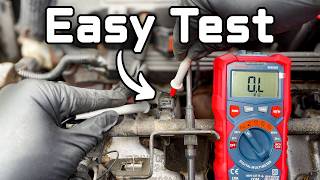
How to confirm: Unplug the injector and measure its resistance with a multimeter set to Ohms. 🎬 Watch: How to test fuel injectors with a multimeter A good injector for this engine should have a resistance of approximately 11-18 Ohms. Compare the reading from cylinder 1 to an adjacent injector; if it's significantly different (e.g., infinite for an open circuit or zero for a short), the injector is bad. The most definitive test is to swap the cylinder 1 injector with another cylinder (e.g., cylinder 2). If the code changes to P0202, the injector is confirmed to be faulty.
Typical fix: Replace the faulty fuel injector. It is highly recommended to replace the O-rings for the fuel rail at the same time. Lubricate the new O-rings with clean engine oil before installation.
Est. part cost: $50-$120 - Wiring Harness or Connector Issue 🟡 Medium Probability Engine vibration and heat can cause wires to become brittle and break. A specific area to check is where the harness runs near the fuel injector heat shield, as chafing can occur. The plastic locking tab on the connector can also fail, leading to a poor connection.
How to confirm: Visually inspect the wiring going to the cylinder 1 injector for any signs of chafing, melting, or breaks. Check the connector for corrosion, bent pins, or a loose fit. With the engine running, carefully perform a 'wiggle test' by gently moving the connector and wire to see if it affects the idle, which would indicate an intermittent connection. You should also check for 12V+ power at the connector with the key on. The other wire is the ground pulse from the PCM.
Typical fix: Repair the damaged section of wire or replace the injector pigtail connector. Pigtail kits are readily available from brands like Dorman and Standard Motor Products.
Est. part cost: $10-$30
Rare But Worth Checking
- Faulty Powertrain Control Module (PCM): This is the least likely cause. The internal transistor (driver circuit) in the PCM that fires the injector can fail. This should only be considered after definitively ruling out the injector and wiring. If an injector swap does not move the code (e.g., P0201 remains), and the wiring shows good continuity and power, the PCM driver is the likely culprit.
Diagnosis Steps
- Verify the code with an OBD-II scanner. Confirm P0201 is present, and note any other codes like P0301.
- Identify Cylinder 1. On the 4.0L V6, this is the front-most cylinder on the passenger side.
- Visually inspect the wiring harness and connector for the cylinder 1 injector. Look for obvious damage, corrosion, loose connections, or chafing, especially near hot engine components or the injector heat shield.
- Listen to the injector. Using a mechanic's stethoscope or a long screwdriver held to your ear, listen to the cylinder 1 injector while the engine is idling. You should hear a distinct, rhythmic clicking. Compare the sound to an adjacent injector. No clicking means the injector is not firing.
- Check for Power and Signal with a 'Noid' Light. Disconnect the injector and plug a noid light into the connector. Start the engine. The noid light should flash rhythmically, indicating the PCM is sending a proper signal. If it flashes, the wiring and PCM are likely okay, and the injector itself is the problem. If it does not flash or stays on constantly, the problem is in the wiring or the PCM.
- Test the Injector Resistance. Disconnect the injector and use a multimeter to measure the resistance across its two pins. A good injector should read between 11 and 18 ohms. A reading near zero indicates a short circuit, and an infinite reading (OL) indicates an open circuit. In either case, the injector has failed.
- Check for Voltage at the Connector. With the injector unplugged and the key in the 'ON' position, use a multimeter to check for battery voltage (approx. 12V) at one of the pins on the harness-side connector. If there is no voltage, there is an open circuit in the power supply wire.
- Swap the Injector. If you are still unsure, swap the cylinder 1 injector with the cylinder 2 injector (the one behind it). Clear the codes and drive the vehicle. If the code changes to P0202, you have confirmed the injector is the problem. If the P0201 code returns, the problem is in the wiring or PCM. This is a very reliable diagnostic step.
Parts You'll Likely Need
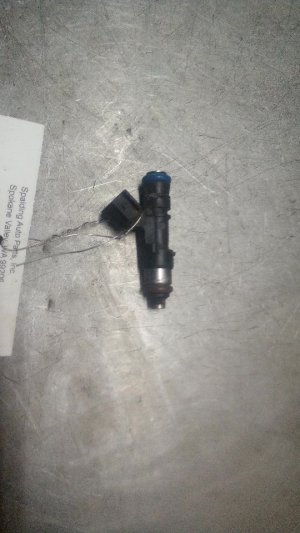
- Fuel Injector
(OEM #2001-2002: (Check with VIN), 2003-2004: Motorcraft CM-5109 (Ford P/N: 4L5Z-9F593-CA), 2005-2011: Motorcraft CM-5147 or W0133-1938542)— This is the most common cause of a P0201 code, resulting from an internal electrical failure of the injector's solenoid coil. Part numbers vary by model year.
Trusted brands: Motorcraft, Bosch, Denso, Standard Motor Products
OEM price range: $90-$140
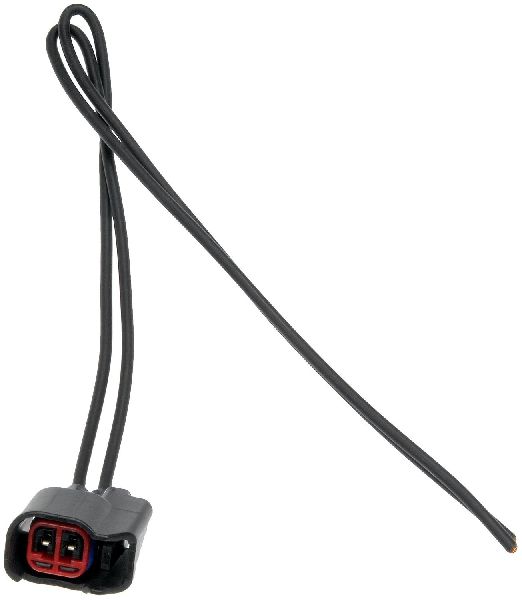
Aftermarket price range: $50-$90 - Fuel Injector Connector Pigtail
(OEM #Motorcraft WPT-179 (check application))— If the wiring or connector at the injector is damaged, corroded, or has a broken locking tab, replacing the pigtail is the standard repair.
Trusted brands: Motorcraft, Dorman, Standard Motor Products (S-824)
OEM price range: $20-$35
Aftermarket price range: $10-$20
Related Codes That Often Appear With This One
- P0301 — P0301 means 'Cylinder 1 Misfire Detected'. Since the P0201 code indicates the injector for cylinder 1 isn't working correctly, that cylinder won't be getting the proper amount of fuel, causing it to misfire.
- P0316 — P0316 means 'Misfire Detected on Startup (First 1000 Revolutions)'. If the injector circuit fails from the moment the engine is started, the PCM will detect the immediate misfire and log this code along with the specific cylinder misfire code (P0301).
Technical Service Bulletins (TSBs) & Recalls
- TSB 98-6-8: While not for a P0201 code, this TSB addresses a redesigned fuel supply manifold gasket for 1997 4.0L engines that could get drawn into the intake runners. This is relevant information for anyone removing the fuel rail to replace injectors on early models, as replacing this gasket is advisable.
Platform-Specific Known Issues
- Wiring Harness Chafing: On some 4.0L engines, the injector wiring harness is routed close to a fiber-plastic heat shield. Over time, engine vibration can cause the harness to rub against the edge of this shield, chafing the insulation and causing a short or open circuit. One owner on a forum found a chafed wire at the back of the fuel injector heat shield to be the cause of their P0201 issue. When diagnosing, pay close attention to the harness in this area.
Mechanic-Grade Diagnostic Values
- Fuel Injector Coil Resistance — expected: 11 - 18 Ohms. Failure: A reading of 0 Ohms indicates a shorted injector. A reading of infinity (OL) indicates an open injector. Both require injector replacement.
- Injector Connector Power (Key On, Engine Off) — expected: ~12 Volts (Battery Voltage). Failure: Voltage significantly below battery voltage (e.g., <10V) or 0V indicates a problem in the power supply wire to the injector.
- Injector Circuit Voltage Drop (Cranking/Running) — expected: Less than 0.5V drop. Failure: A voltage drop greater than 0.5V suggests high resistance in the wiring or a problem with the PCM driver circuit.
- Fuel Pressure (Key On, Engine Off) — expected: 50 to 65 PSI. Failure: While not a direct cause of P0201, low fuel pressure can cause similar symptoms. This check helps rule out a fuel delivery problem vs. an electrical circuit fault.
Scan Tool Commands That Help
- Ford IDS (Integrated Diagnostic System) / FORScan: Key On Engine Off (KOEO) Injector Electrical Self Test ('Buzz Test') — This is a bidirectional command that instructs the PCM to cycle each injector solenoid. The technician listens for an audible 'buzz' from each injector. A weak or absent buzz from cylinder #1, when others sound normal, points towards a fault in the injector or its wiring. It's a quick way to electrically test the circuit without disassembly.
- Ford IDS (Integrated Diagnostic System): Relative Injector Flow Test / Power Balance — After confirming the electrical circuit is intact, this test can identify a mechanically faulty or clogged injector. The test measures the RPM drop when each cylinder is deactivated. If deactivating cylinder #1 causes little or no change in RPM compared to other cylinders, it confirms cylinder #1 was not contributing, often due to a clogged or mechanically failed injector.
Wiring & Ground Locations
- PCM (Powertrain Control Module) — For the 2001-2003 models, the PCM is typically located in the engine bay on the passenger side firewall. For 2004 and newer models, it is often found in the same area, sometimes behind a protective cover.. The PCM contains the driver circuit that sends the ground pulse to fire the injector. All diagnostic paths eventually lead here if the injector and wiring test good.
- Injector #1 PCM Control Pin — On the 104-pin PCM connector used in this era, the control wire for injector #1 is typically located at Pin 75 (Tan wire).. This is the specific pin on the PCM that provides the ground signal for the cylinder 1 injector. A continuity test from this pin to the injector connector can definitively confirm if the control wire is intact or has a break.
- PCM Power Ground Pins — On the 104-pin PCM connector, there are multiple power ground pins, including Pin 76 and Pin 77 (both typically Black/White wires).. A poor ground connection at the PCM can cause a wide range of erratic issues, including injector driver faults. While not a common cause for a single injector code, it should be verified if multiple strange electrical codes are present.
- G108 / Engine Block Ground — Main ground connection on the lower driver's side of the engine block.. The engine block itself is part of the main grounding path. A loose or corroded main engine ground can cause unpredictable electrical issues, including problems that could manifest as injector circuit faults.
Real Owner Repair Stories
- Ranger-Forums.com user (2003 Ford Ranger 4.0L SOHC 4x4) — Check Engine Light with code P0203 (Injector circuit for cylinder 3, but the diagnostic process is identical for P0201).
❌ Tried (didn't work) Swapping the fuel injector with a known good one.
✅ What actually fixed it The user confirmed 12V power at the injector connector but the noid light would not flash. This indicated a break in the ground-side control wire between the PCM and the injector. The user planned to bypass the faulty section by running a new wire from the appropriate PCM pin (Pin 74 for cylinder 3) directly to the injector connector pigtail.
Model Year Variations Within This Range
- 2001-2003 vs 2004-2012: While the engine is fundamentally the same, there can be differences in the PCM connector type and pinout locations between the earlier and later models of this generation. The 2001-2003 models often use a 104-pin connector, while later models may have variations. Always verify the specific pinout diagram for the vehicle's exact year before performing continuity checks to the PCM.
Diagnostic Flowchart
Real Owner Stories
Aggregated from forums and TSBs cited above. Mileages and costs reflect what owners reported in those sources.
Ford Ranger 4.0L V6
Symptoms: Experienced a P0201 code due to a short/open circuit in the injector wiring.
What fixed it: Found and repaired a chafed wire at the back of the fiber-plastic fuel injector heat shield.
Source hint: Forum owner report cited in 'Vehicle Specific Issues'
2010 Ford Explorer 4.0L SOHC V6
Symptoms: Received a P0201 code immediately after having the PCM and wiring harness replaced due to a corrosion issue.
What fixed it: Addressed PCM and wiring harness corrosion.
Source hint: Ford Truck Enthusiasts forum
Related OBD-II Codes
Frequently Asked Questions
Where is cylinder 1 located on my 4.0L V6 Ranger?
How can I test if the cylinder 1 injector is bad on my Ranger?
I heard the wiring harness can cause P0201 on the 4.0L. Where should I check?
Does TSB 98-6-8 apply to my P0201 code?
Are there other vehicles that share this exact P0201 issue with the Ranger?
Helpful Videos
Used OEM Parts in Stock


New Aftermarket Parts Available

The information in this article is provided for general reference and educational purposes only. Vehicle specifications, procedures, and part compatibility can vary by production date, trim level, and region. Always consult your vehicle's factory service manual and verify part numbers before purchasing or performing repairs. Safety-critical components such as airbags, seat belts, and braking systems should be installed by a qualified professional.
- Ford Ranger:
- 🎬 Helpful Videos
- 🛍️ Shop This Part
- What's Unique About the 2001-2012 Ford Ranger
- Symptoms You May Notice
- Most Likely Causes
- Rare But Worth Checking
- Diagnosis Steps
- Parts You'll Likely Need
- Related Codes That Often Appear With This One
- Technical Service Bulletins (TSBs) & Recalls
- Platform-Specific Known Issues
- Mechanic-Grade Diagnostic Values
- Scan Tool Commands That Help
- Wiring & Ground Locations
- Real Owner Repair Stories
- Model Year Variations Within This Range
- Diagnostic Flowchart
- Real Owner Stories
- Ford Ranger 4.0L V6
- 2010 Ford Explorer 4.0L SOHC V6
- Related OBD-II Codes
- Frequently Asked Questions
- 🎟️ Get 5% Off