

P0197 on 2018-2019 Volkswagen Jetta: Engine Oil Temperature Sensor Circuit Low Causes and Fixes
On a 2018-2019 VW Jetta, P0197 is almost always caused by a faulty oil level/temperature sensor in the oil pan or damaged wiring to it. The most common fix is replacing the sensor, which requires an oil change. Before replacing the sensor, inspect the wiring for rodent damage or chafing, a known vulnerability. Expect to pay $50-$150 for the part.
- P0197 on a 2018-2019 Jetta means there's a problem with the oil temperature sensor circuit, not necessarily the oil itself.
- The most likely cause is a failed oil level/temperature sensor located in the bottom of the oil pan.
- Before replacing the sensor, always inspect the wiring harness leading to it for damage, as this is a known issue, especially on the 2019 1.4T model. Rodent damage is a surprisingly common cause.
- Fixing this code requires an oil change to replace the sensor.
- This is a DIY-friendly repair for those comfortable with performing an oil change.
What's Unique About the 2018-2019 Volkswagen JETTA

For the 2018-2019 Jetta, this code has a well-documented history. The 2019 model, which marked the beginning of the A7 generation on the MQB platform, is specifically called out in Volkswagen technical documents for issues with damaged wiring at the oil level sensor, leading to this code. Unlike some vehicles where this is a rare code, on this platform it's a known issue with a straightforward diagnosis pointing to either the sensor itself or its vulnerable, low-hanging wiring. Several owners have reported that the lack of a full belly pan or undertray on some trims makes the wiring susceptible to rodent damage.
Diagnostic Flowchart

Tap your situation to follow the diagnostic path that matches what you're seeing on this vehicle.
Generation note: This range covers two Jetta generations. The 2018 model is the final year of the A6 generation, which offered 1.4T, 1.8T, and 2.0T engines. The 2019 model is the first year of the A7 generation (based on the MQB platform), which primarily used a 1.4T EA211 engine (engine code DGXA) and a 2.0T EA888 in the GLI model. While the cause is similar for both (sensor/wiring), NHTSA documents specifically highlight the 2019 1.4T model for wiring damage issues related to P0197. The underlying sensor and circuit design are shared across many VW/Audi models.
Symptoms You May Notice
- Check Engine Light is on
- Oil temperature gauge (if equipped) reads incorrectly, often staying at the lowest value or not moving
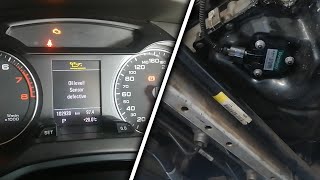
- In-dash warning message like "Oil Sensor - Service Vehicle" may appear.
- Slight decrease in fuel economy
- Possible rough idle for a few seconds on a cold start
- Replacing the oil pressure switch. The oil temperature/level sensor is a different part, located in the oil pan, whereas oil pressure switches are typically located elsewhere on the engine block or cylinder head.
Most Likely Causes

- Faulty Oil Level / Temperature Sensor 🔴 High Probability On modern VW engines, the oil temperature and level sensors are integrated into a single unit (VW designation G266) mounted on the bottom of the oil pan. This sensor is a common failure point across the VW lineup due to its exposure to heat and potential oil contamination.
How to confirm: Using an OBD-II scanner, check the live data for the oil temperature. If it shows a static, unusually low value (like -40°F/C) even when the engine is warm, the sensor has failed. A multimeter can be used to check resistance, which should typically be between 200 and 2,500 ohms depending on temperature; a reading far outside this range indicates a faulty sensor. 🎬 See how to test and replace the oil temperature sensor.
Typical fix: Replace the oil level/temperature sensor. This requires draining the engine oil to access and remove the sensor from the oil pan, which is held by three 10mm bolts.
Est. part cost: $50-$150 - Damaged Wiring or Connector 🟡 Medium Probability The sensor's wiring is located at the bottom of the engine, making it susceptible to damage from road debris, corrosion, or rodents chewing the wires. Multiple owners on forums specifically report rodent damage as the cause. The lack of a protective undertray on some models exacerbates this vulnerability.
How to confirm: Visually inspect the wiring harness and 3-pin connector leading to the sensor on the oil pan. Look for frayed wires, breaks, corrosion in the connector pins, or signs of rodent damage. A broken locking tab on the connector can also cause an intermittent connection.
Typical fix: Repair the damaged section of the wiring harness by splicing in new wire or replace the connector pigtail. Ensure the repair is sealed against moisture.
Est. part cost: $10-$40
Rare But Worth Checking
- Faulty Engine Control Module (ECM): This is extremely rare. The ECM should only be considered after the sensor and wiring have been thoroughly tested and confirmed to be good. One owner on a forum reported needing an ECU replacement after extensive diagnostics failed to find a sensor or wiring issue.
Diagnosis Steps
- Connect an OBD-II scanner and confirm P0197 is the active code. Note any other codes like P0198 or 00562.
- View live data on the scanner. Check the 'Engine Oil Temperature' reading. A reading that is stuck at a very low number (e.g., -40 degrees) points to a circuit low fault.
- Safely raise the vehicle and secure it on jack stands. Remove the plastic undertray if equipped.
- Locate the oil level/temperature sensor on the bottom of the oil pan. It is typically a black plastic sensor held by three 10mm bolts with one 3-pin electrical connector.
- Thoroughly inspect the wiring harness and connector for any signs of physical damage, chafing against the oil pan, corrosion, or rodent damage (chewed wires). Wiggle the connector and wires to see if the live data reading on the scanner changes, which would indicate a poor connection.
- If wiring is damaged, repair it. If the wiring looks good, disconnect the sensor and test the sensor's resistance with a multimeter. Compare the reading to the manufacturer's specification (typically 200-2,500 ohms). An open circuit or very high resistance indicates a failed sensor.
- If the wiring and connector are intact and the sensor is deemed faulty, it must be replaced. This requires first draining the engine oil.
- Unbolt the three 10mm fasteners, remove the old sensor, and be prepared for some residual oil to spill out.
- Install the new sensor with a new O-ring/gasket, and tighten the bolts to the specified torque (typically low, around 8 ft-lbs, as it's plastic).
- Reinstall the oil drain plug, refill the engine with the correct specification oil, and clear the trouble code with the scanner. Start the engine and verify that the Check Engine Light does not return and that the oil temperature reading is now plausible.
Parts You'll Likely Need

- Engine Oil Level and Temperature Sensor
(OEM #06L907660C (verify by VIN, 04E907660C for some 1.4T models))— This is the most common part to fail, causing the P0197 code. It is an integrated unit that reads both oil level and temperature.
Trusted brands: Hella, Bosch, NTK, Continental, Genuine Volkswagen
OEM price range: $120-$180
Aftermarket price range: $50-$100 - Sensor O-Ring / Gasket
(OEM #038103196)— This seal should always be replaced with the sensor to prevent oil leaks from the oil pan.
Trusted brands: Elring, Victor Reinz, Genuine Volkswagen
OEM price range: $5-$10
Aftermarket price range: $2-$5
Related Codes That Often Appear With This One
- P0198 — This code is for 'Engine Oil Temperature Sensor Circuit High'. Seeing P0197 and P0198 intermittently can point to a loose connection or a wire that is intermittently shorting to ground and then having an open circuit.
- 00562 — This is a VW-specific fault code for the 'Sensor for Oil Level/Temperature'. It often appears with P0197 and directly confirms the issue 🎬 Watch: How to fix a defective oil level sensor DTC. is with the sensor or its circuit.
- P0196 — This code for 'Engine Oil Temperature Sensor Circuit Range/Performance' can appear alongside P0197 or P0198, indicating the sensor's reading is irrational compared to other engine sensors, further pointing to a fault in the sensor circuit.
Technical Service Bulletins (TSBs) & Recalls
- VIN4APIN20190906: A VW technical document from Sept 2019 lists P0197 as a known issue on the 2019 Jetta 1.4T, noting it can be caused by damaged wiring at the oil level sensor.
- VIN4APIN20190617: An earlier VW technical document from June 2019 also lists P0197 as a potential MIL-on fault for the 2019 Jetta. [Bulletin #VIN4APIN20190617]
Platform-Specific Known Issues
- Volkswagen has acknowledged a specific issue on the 2019 Jetta 1.4T where this code can be triggered by 'wiring damaged at oil level sensor'.
- Multiple owner reports on forums for Jettas and platform-mates cite rodent damage to the exposed sensor wiring as the root cause, suggesting a vulnerability in the wiring's location and lack of protection on some models.
Mechanic-Grade Diagnostic Values
- G266 Sensor Connector Voltage Test (Key On, Engine Off) — expected: Pin 1: +12V (battery voltage), Pin 2: Ground (continuity to chassis), Pin 3: Signal wire (approx. 5V reference or PWM signal).. Failure: No voltage on Pin 1 suggests a fuse or power supply issue. No ground on Pin 2 indicates a broken ground wire. Incorrect voltage on Pin 3 points to a wiring short or open.
- G266 Sensor Resistance — expected: VW oil temperature sensors are NTC thermistors. While a specific chart for the G266 is not readily available, typical VW sensors show high resistance when cold (e.g., ~2500-6000 Ohms at 20°C/68°F) and low resistance when hot (e.g., ~200-300 Ohms at 100°C/212°F).. Failure: An infinite resistance (open circuit) or zero resistance (short circuit) reading across the temperature sensing pins indicates a failed sensor.
Hidden / Shadow Codes Worth Checking
- 00562: Sensor for Oil Level/Temperature (G266): Open or Short to Plus. This is a VW-specific code that is more descriptive than the generic P0197 and directly points to an electrical fault in the G266 sensor circuit. (see via VW-specific scan tools like VCDS (VAG-COM) or ODIS will show this code, often in the Instrument Cluster (Address 17) module, not just the Engine (Address 01) module.)
Scan Tool Commands That Help
- VCDS (VAG-COM): Coding out the oil level sensor — As a temporary measure if a repair cannot be performed immediately, some users have successfully coded out the sensor to extinguish the dashboard warning. In the 'Instruments' (17) module, under 'Adaptation', changing the channel for 'Service Interval Extension (SIE)' related to the 'Oil level thermal sensor' from 'connected' to 'not connected' can disable the warning. This is not a repair and means the system is no longer monitored.
Wiring & Ground Locations
- G266 Connector — On the bottom of the engine oil pan, connecting to the oil level/temperature sensor.. This 3-pin connector and its pigtail are the most common points of wiring failure due to rodent damage or road debris. Pin 1 is power (+12V), Pin 2 is ground, and Pin 3 is the signal wire to the instrument cluster/ECU.
- Engine Bay Main Ground Point — On the MQB platform (2019+ Jetta), a primary ground point with multiple brown wires is located on the chassis frame rail, often near or under the battery tray.. While a failure here is unlikely to cause only P0197, a poor ground at this location can cause a variety of erratic sensor readings. Pin 2 of the G266 connector should have solid continuity to this point.
Real Owner Repair Stories
- Reddit user BronzeRippa on r/jetta (2020 VW Jetta (MK7)) — Check Engine Light with code P0197, 'engine oil temp sensor - low input' message.
❌ Tried (didn't work) Initially planned to replace the sensor and purchased the part.
✅ What actually fixed it Upon inspection, the user discovered that rodents had chewed the wire leading to the sensor. The fix was to solder the wire back together. The new sensor was not needed and was returned. - Reddit user Ashamed-Pomegranate on r/jetta (2019+ VW Jetta (MK7)) — P0197 code due to 'the classic rodent chew through the oil temp sensor problem'.
✅ What actually fixed it The user posted a picture of wires chewed right at the connector and inquired about splicing them, which is the standard repair for this specific issue. This case confirms the pattern of rodent damage on this platform.
OEM Part Supersession History
04E907660, 04E907660A, 04E907660B→04E907660C— Part revisions to improve reliability or manufacturing process.
Heads up: Part number 04E907660C is specific to the 1.4T EA211 engine used in the 2019+ Jetta.06L907660, 06L907660A, 06L907660B→06L907660C— Part revisions for the EA888 engine family.
Heads up: Part number 06L907660C is used on the 1.8T and 2.0T EA888 engines, found in the 2018 Jetta and 2019 Jetta GLI. It is not interchangeable with the 1.4T sensor.
Model Year Variations Within This Range
- 2018 vs 2019: The 2018 Jetta (A6) used a mix of 1.4T, 1.8T, and 2.0T engines. The 2019 Jetta (A7/MQB) primarily uses the 1.4T EA211 engine (DGXA), with the GLI model using the 2.0T EA888 engine. This means the correct oil level/temp sensor part number is different. The 1.4T uses P/N 04E907660C, while the 1.8T/2.0T models use P/N 06L907660C. The TSBs specifically mentioning wiring damage are focused on the 2019 1.4T model. [Bulletin #VIN4APIN20190906]
Helpful Videos

We Have This Part in Stock



The information in this article is provided for general reference and educational purposes only. Vehicle specifications, procedures, and part compatibility can vary by production date, trim level, and region. Always consult your vehicle's factory service manual and verify part numbers before purchasing or performing repairs. Safety-critical components such as airbags, seat belts, and braking systems should be installed by a qualified professional.
- Volkswagen JETTA:
- 🎬 Helpful Videos
- 🛍️ Shop This Part
- What's Unique About the 2018-2019 Volkswagen JETTA
- Diagnostic Flowchart
- Symptoms You May Notice
- Most Likely Causes
- Rare But Worth Checking
- Diagnosis Steps
- Parts You'll Likely Need
- Related Codes That Often Appear With This One
- Technical Service Bulletins (TSBs) & Recalls
- Platform-Specific Known Issues
- Mechanic-Grade Diagnostic Values
- Hidden / Shadow Codes Worth Checking
- Scan Tool Commands That Help
- Wiring & Ground Locations
- Real Owner Repair Stories
- OEM Part Supersession History
- Model Year Variations Within This Range
- 🎟️ Get 5% Off