

P0196 on 2012-2024 Mazda CX-5 2.2L Skyactiv-D: Engine Oil Temperature Sensor Issues and Fixes
On the Mazda CX-5 2.2L Skyactiv-D, code P0196 is usually caused by a faulty Engine Oil Temperature (EOT) sensor or Engine Coolant Temperature (ECT) sensor, or their wiring. The computer compares both sensors on a cold start, and if they don't match, it sets the code. Replacing the failed sensor is the most common fix.
- P0196 on this Mazda is a comparison code between the oil and coolant temperature sensors on a cold start.
- The most likely cause is a faulty Engine Oil Temperature (EOT) sensor or Engine Coolant Temperature (ECT) sensor.
- Diagnose by checking the live data from both sensors with a scan tool when the engine is cold; they should read nearly the same.
- The EOT sensor is combined with the oil pressure sensor into a single unit.
- Always check the wiring and connectors for both sensors before replacing parts.
What's Unique About the 2012-2024 Mazda CX-5
Unlike a generic P0196 code which just points to an oil temperature sensor fault, Mazda's system specifically triggers this code based on a comparison between the oil temperature and coolant temperature sensors at startup. This means the Engine Coolant Temperature (ECT) sensor can be the actual cause of this oil-related code. Additionally, on the Skyactiv-D engine, the Engine Oil Temperature (EOT) sensor is integrated into a single unit with the oil pressure sensor, which is important to know when sourcing the correct replacement part.
Generation note: This guide covers the first generation (KE, 2012-2017) and second generation (KF, 2017-2024) of the Mazda CX-5 equipped with the 2.2L Skyactiv-D engine. The diagnostic logic for P0196 appears consistent across these model years based on available service information. The same engine and fault logic are also found in the Mazda 6 (GJ/GL) and Mazda 3 (BM/BN) of the same era.
Symptoms You May Notice
- Check Engine Light is illuminated.
- No other drivability symptoms are common, as Mazda does not specify a fail-safe action for this specific code.
- In some cases, the cooling fans may run unnecessarily or at incorrect times if the PCM receives faulty temperature data.
- Replacing the Engine Oil Temperature sensor without checking the Engine Coolant Temperature sensor's reading. Since the code is based on a comparison, either sensor can be at fault.
- Ignoring a potential wiring issue and immediately replacing a sensor that tests good.
Most Likely Causes
- Faulty Engine Oil Temperature (EOT) Sensor 🔴 High Probability Sensors are electronic components that can fail over time due to heat cycles and vibration. On this engine, the EOT sensor is part of a combined unit with the oil pressure sensor, and these are known to fail, sometimes causing multiple oil-related codes.
How to confirm: Using a scan tool, compare the live data readings of the EOT and ECT sensors after the vehicle has been parked overnight. They should be within a few degrees of each other and the ambient air temperature. If the EOT reading is illogical (e.g., -40°C or extremely high), the sensor is likely faulty. You can also test the sensor's resistance against a temperature chart from the service manual.
Typical fix: Replace the engine oil temperature/pressure sensor assembly. 🎬 Watch this step-by-step oil pressure and fuel temp sensor replacement video
Est. part cost: $80-$150 - Faulty Engine Coolant Temperature (ECT) Sensor 🟡 Medium Probability Because the code is set by comparing the EOT and ECT sensor readings, a faulty ECT sensor can be the root cause. These sensors can degrade over time, leading to incorrect readings, especially when cold.
How to confirm: Using a scan tool, compare the live data readings of the EOT and ECT sensors after a cold soak. If the ECT reading is illogical while the EOT reading appears correct (close to ambient temperature), the ECT sensor is the likely culprit.
Typical fix: Replace the Engine Coolant Temperature (ECT) sensor.
Est. part cost: $30-$70 - Wiring or Connector Issue 🟡 Medium Probability Engine bay wiring is exposed to heat, vibration, and potential oil contamination, which can lead to corrosion, pushed-out pins, or damaged wires over time.
How to confirm: Visually inspect the connectors and wiring harnesses for both the EOT and ECT sensors. Look for corrosion, pushed-out pins, or frayed wires. Check for the 5-volt reference signal and a good ground at the sensor connectors with the ignition on.
Typical fix: Repair the damaged wiring or clean/replace the affected connector. Pigtail repair kits are available for common connectors.
Est. part cost: $10-$50
Rare But Worth Checking
- Powertrain Control Module (PCM) Fault: This is very rare. The PCM is the last item to suspect after all sensors and wiring have been thoroughly tested and confirmed to be working correctly.
Diagnosis Steps
- Connect an OBD-II scanner and check for any other stored codes. Record the freeze-frame data to see the conditions under which P0196 was set.
- Access Live Data on the scanner. With the engine cold (off for 6+ hours), compare the readings for 'Engine Oil Temperature' and 'Engine Coolant Temperature'. They should be very close to each other and the ambient air temperature.
- If one of the readings is clearly incorrect (e.g., stuck at -40 degrees, or a very high value), that sensor is the primary suspect.
- If the readings are plausible but still different enough to trigger the code, proceed to inspect the wiring.
- Switch the ignition off. Locate and disconnect the connectors for both the EOT and ECT sensors. The EOT/pressure sensor is a 4-pin triangular connector on the engine block. The ECT sensor is typically on the cylinder head near the thermostat housing.
- Inspect the connectors and pins for damage, corrosion, or oil contamination. Clean with electrical contact cleaner if necessary.
- Inspect the wiring harnesses leading to both sensors for any signs of chafing, melting, or breaks. Check for continuity and for shorts to ground or power.
- If wiring and sensors appear okay, test the sensors individually using a multimeter to measure resistance at a known temperature and compare it to the manufacturer's specifications. An NTC thermistor's resistance should decrease as temperature increases.
- For a deeper check, monitor live data for oil pressure. At operating temperature (70-80°C coolant), oil pressure should be around 180 kPa at 2,000 RPM and 400 kPa at 3,500 RPM. While not directly for P0196, abnormal pressure could indicate wider oil system issues affecting the sensor.
- If a sensor fails the test, replace it. If both sensors and wiring test good, the issue may be an intermittent connection or a rare PCM fault.
Parts You'll Likely Need
- Engine Oil Temperature / Pressure Sensor
(OEM #SH01-18-541)— This is one of the two sensors the PCM compares to set the code. It is a common failure point for this fault. Note that it is a combined unit with the pressure sensor. It has a 4-pin triangular connector and an M10x1 mm thread.
Trusted brands: Mazda (OEM), Bosch, Metzger, Sidat, NTY, Fispa
OEM price range: $120-$180
Aftermarket price range: $50-$150 - Engine Coolant Temperature (ECT) Sensor
(OEM #SH01-18-840)— A faulty ECT sensor providing an incorrect reading on a cold start will cause the PCM to log P0196, as it relies on this sensor for comparison.
Trusted brands: Mazda (OEM), Denso
OEM price range: $40-$70
Aftermarket price range: $25-$50
Technical Service Bulletins (TSBs) & Recalls
- While no TSB is directly for P0196, several relate to the overall health of the Skyactiv-D engine. TSB SA-026/19 provides service cautions for the engine, highlighting its unique features like the DPF and SCR systems. Other TSBs like 01-008/17 address low oil pressure codes (P0524) on related Skyactiv engines, which can sometimes be seen in conjunction with sensor faults.
Platform-Specific Known Issues
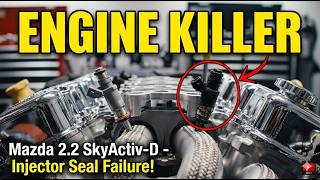
- The 2.2L Skyactiv-D engine is known to be sensitive to oil quality and maintenance intervals. Carbon buildup and oil contamination can lead to various oil system problems. While P0196 is an electrical fault, maintaining clean oil and proper service intervals is crucial for the overall health of this engine's lubrication system. Specifically, oil dilution from incomplete DPF regenerations (common with short-trip driving) degrades the oil's lubricating properties and can lead to a host of severe mechanical failures, including turbo and bearing damage. 🎬 Learn how injector seal failure causes severe SkyActiv-D engine damage
Mechanic-Grade Diagnostic Values
- Engine Coolant Temperature (ECT) Sensor Resistance — expected: Approximately 2,200 - 3,000 Ω at 20°C (68°F) and 250 - 350 Ω at 80°C (176°F).. Failure: Readings significantly outside this range, or resistance that does not decrease smoothly as the sensor is heated, indicates a faulty sensor.
- Engine Oil Temperature (EOT) Sensor Resistance — expected: As an NTC thermistor, it should show similar characteristics to the ECT sensor: high resistance when cold (e.g., ~2.5 kΩ at 20°C) and low resistance when hot.. Failure: An open circuit (infinite resistance) or short circuit (zero resistance) reading on a multimeter, or a value that doesn't change with temperature, indicates a failed sensor.
- Sensor Connector Voltage (EOT and ECT) — expected: With the ignition on and sensor disconnected, one pin in the connector should show a 5V reference signal from the PCM. The other pin should be a good ground (low resistance to chassis ground).. Failure: Absence of the 5V reference or a poor ground points to a wiring or PCM issue, not a sensor fault.
Scan Tool Commands That Help
- FORScan: Live Data (PIDs: EOT_T, ECT_T) — FORScan is a powerful aftermarket tool for Ford and Mazda vehicles that provides dealer-level access. Use it to monitor the Engine Oil Temperature (EOT_T) and Engine Coolant Temperature (ECT_T) PIDs side-by-side during a cold start to verify the fault condition. The readings should be nearly identical after an overnight soak.
- Mazda M-MDS (or equivalent): Oil Data Reset — After performing an oil and filter change on the Skyactiv-D, the oil data must be reset. While not directly related to P0196, failing to do so can lead to other oil-related warnings. A manual procedure exists by grounding a specific pin in a service connector and pressing the accelerator pedal 5 times, confirmed by the coil light flashing.
Wiring & Ground Locations
- Engine Bay Ground Points — Main grounding points are located in the engine compartment, bolted to the chassis and engine block. For jump-starting, Mazda specifies a dedicated ground point on the engine block away from the battery.. A poor engine or chassis ground can introduce voltage offsets and instability into sensor circuits, potentially causing incorrect readings that could trigger a comparison fault like P0196. Ensuring these main grounds are clean and tight is a crucial, often overlooked, basic step.
- EOT/Oil Pressure Sensor Connector — On the 2.2L Skyactiv-D engine block. It is a 4-pin, black, triangular-shaped connector.. This is the primary connection point for the EOT sensor. It should be inspected for oil contamination, corrosion, or pushed-out pins, which are common failure points in the engine bay environment.
- ECT Sensor Connector — Typically located on the cylinder head, often near the thermostat housing. On some CX-5 models, there may be two ECT sensors; for this code, the primary one feeding the PCM is the one to test.. This is the connection for the second sensor used in the PCM's comparison test. Its integrity is just as important as the EOT sensor connector for diagnosing P0196.
OEM Part Supersession History
SH01-18-541→PX9R-18-541— Standard part evolution and consolidation by the manufacturer.
Heads up: PX9R-18-541 is listed as a direct replacement for SH01-18-541, so no incompatibility is expected.
Diagnostic Flowchart
Other Known Issues on This Vehicle
Issues unrelated to this code that are worth knowing about as an owner of this generation:
- Excessive Intake Carbon Buildup 🔴 High — Very common, especially on vehicles used for frequent short trips. Can become significant by 60,000-80,000 miles (100,000-130,000 km).
- Oil Dilution and Rising Oil Level 🔴 High — A well-documented issue where unburnt diesel fuel enters the crankcase during interrupted DPF regeneration cycles, thinning the oil and raising the level on the dipstick past the 'X' mark. This is more common with city driving. (Ref: Mazda addressed this in some markets with a software update and a revised dipstick.)
- Premature Turbocharger Failure 🔴 High — Failures of either the small or large turbo have been reported, sometimes as early as 70,000-80,000 miles (110,000-130,000 km). This can be a consequence of other issues like oil contamination or carbon restriction.
- Injector Seal Failure 🔴 High — Leaking copper injector seals can allow combustion gases to contaminate the engine oil, creating sludge that blocks the oil pickup strainer, leading to low oil pressure and catastrophic engine failure. This is a known design flaw, particularly on earlier models. (Ref: Updated seals were reportedly introduced, but it remains a critical inspection point.)
- Stretched Timing Chain / Oil Pump Chain Failure 🟠 Medium — While less common than other issues, timing chain stretch and, more critically, oil pump chain failure have been reported, often linked to poor lubrication from diluted oil. Failures can cluster around 85,000 miles.
Used vs. New Parts: Buying Guide for This Vehicle
When a used part is the smart pick: For this specific repair, buying used sensors is generally not recommended. The cost savings are minimal compared to the labor involved in a potential repeat repair. The failure is electronic and age-related, so a used part has an unknown remaining lifespan. A used wiring harness pigtail from a junkyard can be a good option if only the connector is damaged and a new pigtail isn't available.
Donor-vehicle mileage cap: roughly under 40000 miles for the part to have meaningful remaining life.
What to inspect on the donor part:
- For a connector pigtail, ensure the plastic isn't brittle and the locking tab is intact.
- Check that the wires have sufficient length for splicing.
- Inspect the pins inside the connector for any signs of corrosion (green or white powder) or deformation.
OEM-only on this vehicle (don't cheap out):
- While not strictly 'OEM-only', using OEM or a reputable OEM supplier like Denso or Bosch for electronic sensors is highly recommended for reliability and to avoid immediate failure or incorrect readings from low-quality aftermarket parts.
Aftermarket brands forum-validated for this vehicle:
- Bosch
- Denso
- NTY
- Metzger
- Fispa
Brands owners have reported issues with on this vehicle:
- Unnamed, no-brand sensors from online marketplaces should be avoided as their quality control, internal thermistor accuracy, and material durability are often questionable, leading to repeat failures.
Real Owner Stories
Aggregated from forums and TSBs cited above. Mileages and costs reflect what owners reported in those sources.
2012 Mazda CX-5 2.2L Diesel
Symptoms: Experienced escalating oil-related issues while towing, including codes for Engine Oil Over Temperature.
What fixed it: Replacement of a damaged oil pressure sensor (which is part of the combined EOT/pressure sensor assembly).
Source hint: https://www.mazdaforum.com/forum/mazda-cx-5-54/cx-5-oil-problem-advice-urgently-needed-41223/
2016 Mazda 6 2.2D Skyactiv
Symptoms: Low oil pressure warnings appeared immediately after a service; discussion noted risks of oil sludge blocking the pickup strainer.
What fixed it: The source identifies leaking injector washers (seals) as a root cause that contaminates oil and leads to sensor-related warnings.
Source hint: https://www.reddit.com/r/mazda6/comments/1209l9x/2016_mazda_6_22d_skyactiv_150_check_engine_and_low/
2019 Mazda CX-5 Diesel
Symptoms: Owner reported 'Engine Oil Level to High' warning on the dashboard.
What fixed it: Identified as diesel fuel mixing with oil during DPF regeneration (oil dilution).
Source hint: https://www.mazdaforum.com/forum/mazda-cx-5-54/cx5-diesel-engine-level-high-44023/
Related OBD-II Codes
Frequently Asked Questions
Is there a specific TSB for the P0196 code on my 2.2L Skyactiv-D?
Why is my CX-5 showing an 'Engine Oil Level too High' warning along with oil codes?
Can a faulty coolant sensor cause the P0196 oil temperature code?
Where is the Engine Oil Temperature sensor located on the 2.2L Skyactiv-D?
Does Mazda specify a fail-safe or 'limp mode' for the P0196 code?
How can I tell if the sensor itself is bad versus a wiring problem?
Helpful Videos
We Have This Part in Stock


The information in this article is provided for general reference and educational purposes only. Vehicle specifications, procedures, and part compatibility can vary by production date, trim level, and region. Always consult your vehicle's factory service manual and verify part numbers before purchasing or performing repairs. Safety-critical components such as airbags, seat belts, and braking systems should be installed by a qualified professional.
- Mazda CX-5:
- 🎬 Helpful Videos
- 🛍️ Shop This Part
- What's Unique About the 2012-2024 Mazda CX-5
- Symptoms You May Notice
- Most Likely Causes
- Rare But Worth Checking
- Diagnosis Steps
- Parts You'll Likely Need
- Technical Service Bulletins (TSBs) & Recalls
- Platform-Specific Known Issues
- Mechanic-Grade Diagnostic Values
- Scan Tool Commands That Help
- Wiring & Ground Locations
- OEM Part Supersession History
- Diagnostic Flowchart
- Other Known Issues on This Vehicle
- Used vs. New Parts: Buying Guide for This Vehicle
- Real Owner Stories
- 2012 Mazda CX-5 2.2L Diesel
- 2016 Mazda 6 2.2D Skyactiv
- 2019 Mazda CX-5 Diesel
- Related OBD-II Codes
- Frequently Asked Questions
- 🎟️ Get 5% Off