

P0193 on 2015-2020 Ford F-150 3.5L EcoBoost: Fuel Rail Pressure Sensor Circuit High Causes and Fixes
On a 2015-2020 F-150 with the 3.5L EcoBoost, P0193 almost always means the high-pressure Fuel Rail Pressure (FRP) sensor has failed. It's an electrical fault, not an actual pressure issue. The sensor itself costs $80-$150, but its location at the back of the engine makes replacement labor-intensive (3-5 hours), so professional repair can cost $500-$800.
- P0193 is an electrical code for the Fuel Rail Pressure (FRP) sensor, not a mechanical pressure problem.
- The most likely fix is replacing the FRP sensor, but diagnosis is key to avoid replacing expensive parts like the fuel pump unnecessarily.
- The sensor is located at the back of the engine and is difficult to access, making labor a significant portion of the repair cost.
- Verify you are buying the correct sensor part number, as it differs between 2015-2016 and 2017-2020 models.
- If any engine work was recently done on a 2017+ model, check for the backward fuel jumper line mentioned in TSB SSM 50089 before replacing any parts.
What's Unique About the 2015-2020 Ford F-150
The 3.5L EcoBoost uses a Gasoline Direct Injection (GTDI) system with extremely high fuel pressures, operating with both a low-pressure in-tank pump and a high-pressure, engine-driven pump (HPFP). The P0193 code specifically relates to the sensor on this high-pressure rail. The 2015-2020 year range spans two generations of this engine: the 1st Gen (2015-2016) and the 2nd Gen (2017-2020), which added a secondary port injection system to help clean intake valves. While the cause of P0193 is typically the same for both (a failed sensor), the part numbers for the sensor and its location differ between these generations.
Generation note: This range covers the 13th generation F-150. However, it also spans two versions of the 3.5L EcoBoost engine. The 2015-2016 models use the 1st generation engine, while the 2017-2020 models use the updated 2nd generation engine with a dual (port and direct) injection system. The Fuel Rail Pressure (FRP) sensors have different part numbers and are in slightly different locations between these two engine versions.
Symptoms You May Notice
- Check Engine Light is on
- Engine is hard to start or will not start (cranks but won't fire)
- Engine stalls, especially after warming up or at idle
- Rough or unstable idle
- Poor acceleration and significant lack of power (limp mode)
- Reduced fuel economy
- Strong smell of fuel in some rare cases
- Replacing the High-Pressure Fuel Pump (HPFP). The HPFP is very expensive and is a mechanical part. P0193 is an electrical circuit code, which almost always points to the sensor or wiring, not the pump itself.
- Replacing the in-tank low-pressure fuel pump or Fuel Pump Driver Module (FPDM). These components are part of the low-pressure system and are highly unlikely to cause a 'Circuit High' fault on the high-pressure sensor.
- For 2017+ models, failing to check for a backward fuel jumper line (per TSB SSM 50089) after recent engine work. While this TSB primarily addresses low-pressure codes (P0087), it's a platform-specific issue that can cause general fuel system faults and should be checked.
Most Likely Causes
- Failed Fuel Rail Pressure (FRP) Sensor 🔴 High Probability The FRP sensor is exposed to extreme heat cycles at the back of the engine against the firewall, leading to internal electronic failure. It often shorts internally, causing the signal wire to constantly read the 5-volt reference voltage, sending a fixed, high signal to the PCM.
How to confirm: With the Key On, Engine Off (KOEO), use a scan tool to monitor the fuel rail pressure PID. If the reading is abnormally high and static (e.g., 2,000+ PSI or a maxed-out value), the sensor has failed or the wiring is shorted. Actual pressure in the rail is zero.
Typical fix: Replace the Fuel Rail Pressure sensor. This is labor-intensive due to its location. Depressurizing the fuel system is a critical first step.
Est. part cost: $80-$150 - Wiring Harness or Connector Issue ⚪ Low Probability The wiring harness near the sensor is also exposed to high heat, which can cause insulation to become brittle and crack over time. This can lead to a short circuit between the signal wire and the 5V reference wire, mimicking a failed sensor. Manufacturer bulletin TSB Bulletin #SSM 47337 notes that some vehicles may exhibit an illuminated MIL and/or runs rough condition with DTC P0193 due to engine harness chafing at the right cylinder head near connector C1056.
How to confirm: Visually inspect the wiring harness and connector for any signs of melting, chafing, or damage. Perform a continuity test on the wiring between the sensor connector and the PCM. A user on F150forum.com reported this exact issue: 'P0193... ended up being a bad wire between the PCM and sensor. It was shorting out on the block somewhere.'
Typical fix: Repair the damaged section of the wiring harness or replace the sensor connector pigtail.
Est. part cost: $20-$50
Rare But Worth Checking
- Powertrain Control Module (PCM) Fault: This is extremely rare. The PCM should only be considered after the sensor and wiring have been definitively ruled out by thorough testing. A failed internal driver in the PCM could theoretically cause this fault.
- Crankshaft Position Sensor Reference Voltage: While documented on other Ford platforms like the F-250, TSB Bulletin #SSM 46456 and TSB Bulletin #SSM 46351 indicate that P0193 can sometimes be triggered by a concern with the reference voltage or signal return circuit of the crankshaft position sensor.
Diagnosis Steps
- Connect a diagnostic scan tool and confirm P0193 is the primary active code.
- Access the live data stream on the scan tool.
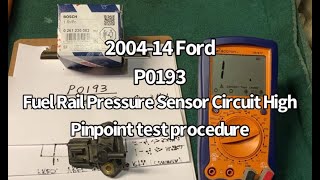
- With the Key On, Engine Off (KOEO), observe the Fuel Rail Pressure (FRP) PID. If it shows a very high, fixed value (e.g., thousands of PSI or a voltage reading near 5.0V), this confirms the electrical fault. The actual pressure is zero. 🎬 Watch: Step-by-step Ford P0193 diagnostic testing procedure
- Turn the ignition off. Carefully depressurize the high-pressure fuel system following the manufacturer's service procedure.
- Disconnect the FRP sensor electrical connector at the back of the engine (passenger side).
- Turn the Key On, Engine Off again. Re-check the FRP reading on the scan tool. The reading should now be very low or zero (voltage near 0V), and a P0192 (Circuit Low) code may appear. If this happens, it confirms the wiring to the PCM is intact and the sensor itself has failed internally.
- If the high reading (near 5V) persists with the sensor disconnected, there is a short to voltage in the wiring harness between the sensor and the PCM. You will need to trace the signal wire back to the PCM to find the short.
- Thoroughly inspect the wiring harness for any signs of melting, chafing, or damage, especially near the back of the cylinder head and any contact points with the engine block.
- If the sensor is confirmed bad, replace the Fuel Rail Pressure sensor and clear the codes.
Parts You'll Likely Need
- Fuel Rail Pressure Sensor (2017-2020 Models)
(OEM #BU5Z-9F972-B)— This is the direct injection high-pressure sensor for the 2nd generation 3.5L EcoBoost. It is the most common cause of P0193 on these model years. This part supersedes BU5Z-9F972-A.
Trusted brands: Motorcraft (CM-5250)
OEM price range: $90-$150
Aftermarket price range: $50-$100 - Fuel Rail Pressure Sensor (2015-2016 Models)
(OEM #BL3Z-9F972-A)— This is the direct injection high-pressure sensor for the 1st generation 3.5L EcoBoost. It is the most common cause of P0193 on these model years.
Trusted brands: Motorcraft (CM-5229)
OEM price range: $80-$130
Aftermarket price range: $60-$90
Related Codes That Often Appear With This One
- P0088 — P0088 means 'Fuel Rail Pressure Too High'. If the failed sensor sends a false high reading, the PCM may log both the electrical fault (P0193) and the perceived performance fault (P0088).
- P0192 — This code means 'Fuel Rail Pressure Sensor Circuit Low'. Seeing P0192 and P0193 together or intermittently could indicate an erratic sensor or a wiring problem causing shorts to both ground and voltage.
Technical Service Bulletins (TSBs) & Recalls
- SSM 47337 - Describes how vehicles may exhibit an illuminated MIL and/or runs rough condition with DTC P0193 due to engine harness chafing at the right cylinder head near connector C1056.
- SSM 50089 - Notes that on 2017-2021 models, a fuel jumper line can be installed backward after service, leading to fuel pressure DTCs.
Platform-Specific Known Issues
- Harness Chafing: A TSB for some F-150s notes that the engine harness can chafe near the right cylinder head, potentially causing shorts that could trigger codes like P0193.
- Incorrect Jumper Line Installation (2017+): Ford TSB SSM 50089 applies to 2017-2020 models. If fuel system work was recently performed, a fuel jumper line between the HPFP and port injection rail can be installed backward, causing various fuel pressure codes. While it typically causes low pressure codes, it's a critical check after any service.
Mechanic-Grade Diagnostic Values
- FRP Sensor Signal Voltage (KOEO) — expected: ~0.5V. Failure: A reading of 4.5V or higher indicates a hard fault (shorted sensor or wiring).
- FRP Sensor Connector VREF (5V Reference) to SIG RTN (Ground) — expected: 4.0V to 6.0V. Failure: Voltage outside this range indicates a problem with the PCM or the wiring for power/ground to the sensor.
- FRP Signal Circuit Resistance (PCM and Sensor disconnected) — expected: Less than 5.0 ohms. Failure: Resistance greater than 5.0 ohms indicates an open or high resistance in the signal wire between the PCM and sensor.
- FRP Signal Circuit Short to Ground/Return Test (PCM and Sensor disconnected) — expected: Greater than 10,000 ohms. Failure: Resistance less than 10,000 ohms between the FRP signal pin and the SIG RTN pin (or chassis ground) indicates a short circuit.
Scan Tool Commands That Help
- Ford IDS / FORScan: FRP PID (Fuel Rail Pressure) — This is the primary live data PID to monitor. With KOEO, it should read near zero PSI. A maxed-out reading (e.g., 2175+ PSI) or a voltage stuck near 5V confirms the 'Circuit High' electrical fault.
- Ford IDS / FORScan: FRP_DSD (Desired Fuel Rail Pressure) vs. FRP (Actual) — While more useful for performance codes like P0087/P0088, comparing desired vs. actual pressure can help confirm the reading is irrational. For P0193, you will typically see 'Actual' pegged high while 'Desired' is low.
Wiring & Ground Locations
- C167 — The electrical connector for the Fuel Rail Pressure (FRP) sensor itself, located on the high-pressure fuel rail at the back of the engine.. This is the primary connection to test. The 3 pins are typically: 5V Reference (VREF), Signal Return/Ground (SIG RTN), and the FRP Signal wire. Testing voltages and continuity at this connector is the first step after checking scan data.
- C1551A / C175E — These are designations for the large PCM connectors located on the passenger side firewall.. The three wires from the C167 connector terminate here. For example, on some models, the FRP signal wire is a Brown/White wire going to Pin 57 of the PCM connector. Checking for a short-to-voltage at these pins with the sensor disconnected can confirm a harness problem.
- G102 / G103 — Main engine grounds, typically located on the engine block or cylinder head near the front of the engine compartment.. The FRP sensor's Signal Return (ground) wire ultimately connects to a shared sensor ground that is tied to these main engine grounds. A poor main ground can cause floating voltages and erratic sensor readings, though it would likely cause multiple sensor codes, not just P0193.
Real Owner Repair Stories
- F150forum.com user 'muckernator' (2019 Ford F-150 5.0L (Note: different engine, but identical code and electrical principle)) — P0193 code appeared after installing a GT intake manifold. Engine would stall when touching certain pins on the FRP connector with a multimeter.
❌ Tried (didn't work) Swapped all fuel injectors, Replaced the entire fuel rail, Replaced the FRP sensor
✅ What actually fixed it The user suspected a pulled pin in the FRP sensor connector from stretching the harness during the manifold swap. The final diagnosis pointed to a missing or faulty ground connection at the 3-pin sensor connector, causing the 5V reference to be uncontrolled and creating the 'Circuit High' condition.
OEM Part Supersession History
BU5Z-9F972-A→BU5Z-9F972-B (Motorcraft CM-5250)— Standard part revision, likely for improved durability or internal electronics.3F2Z-9G756-AC→BL3Z-9F972-A (Motorcraft CM-5229)— Part number consolidation and revision for the 1st generation EcoBoost and other Ford applications.
Heads up: CM-5229 is for the Gen 1 EcoBoost (2015-16) and is not interchangeable with CM-5250 for the Gen 2 (2017-20).
Model Year Variations Within This Range
- 2015-2016: Uses the 1st generation 3.5L EcoBoost engine. The correct FRP sensor is Motorcraft CM-5229 (OEM P/N BL3Z-9F972-A).
- 2017-2020: Uses the 2nd generation 3.5L EcoBoost with dual injection. The correct FRP sensor is Motorcraft CM-5250 (OEM P/N BU5Z-9F972-B). This engine also has the potential for the backward fuel jumper line issue (TSB SSM 50089) if recently serviced.
Diagnostic Flowchart
Other Known Issues on This Vehicle
Issues unrelated to this code that are worth knowing about as an owner of this generation:
- Cam Phaser Rattle on Cold Start 🔴 High — Very common on 2nd Gen (2017+) 3.5L EcoBoost engines, typically appearing after 30,000-60,000 miles. Causes a 2-5 second metallic rattle from the front of the engine after a cold soak. (Ref: TSB 21-2119, TSB 22-2200, TSB 23-2143, Customer Satisfaction Program 21N03.)
- 10R80 Transmission Harsh/Erratic Shifting 🟠 Medium — Widespread on 2017+ models equipped with the 10-speed automatic transmission. Symptoms include harsh shifts (especially 1-2 and 2-3), delayed engagement, and shuddering. Onset can be as early as 45,000 miles. (Ref: Multiple software-related TSBs have been issued. Internal component failures like the CDF drum sleeve are also common.)
- Leaking Plastic Oil Pan 🟠 Medium — Common on 2017-2018 models due to poor RTV sealant adhesion from the factory. The repair requires a meticulous cleaning and preparation procedure to be successful. (Ref: TSB 20-2051 (supersedes TSB 20-2015).)
- Carbon Buildup on Intake Valves 🟡 Low — A known characteristic of all direct-injection engines. The 2nd Gen (2017+) engine added port injection to mitigate this, but the 1st Gen (2015-2016) is more susceptible. Can cause a gradual loss of power and efficiency over 80,000-100,000 miles.
- IWE System Failure (4WD Models) 🟠 Medium — The vacuum-operated Integrated Wheel End (IWE) hubs are prone to failure, causing a grinding or clicking noise from the front wheels. This is often due to vacuum leaks in the lines or a faulty solenoid.
Used vs. New Parts: Buying Guide for This Vehicle
When a used part is the smart pick: For this specific repair, buying a used Fuel Rail Pressure (FRP) sensor is NOT recommended. The failure is electronic and heat-cycle related, meaning a used part from a junkyard has unknown remaining life and is very likely to fail soon, if it doesn't arrive already faulty. A used wiring harness pigtail is a viable option if the connector is damaged, provided it is in good physical condition with no brittle plastic or corroded pins.
Donor-vehicle mileage cap: roughly under 30000 miles for the part to have meaningful remaining life.
What to inspect on the donor part:
- For a pigtail: check that the locking tab is intact and clicks firmly.
- Inspect the wires for flexibility; avoid any that are stiff or have cracked insulation.
- Look at the pins inside the connector; they should be clean and straight, with no signs of green or white corrosion.
OEM-only on this vehicle (don't cheap out):
- Fuel Rail Pressure Sensor
Aftermarket brands forum-validated for this vehicle:
- Motorcraft (OEM)
- Bosch (Often the original manufacturer for Ford)
Brands owners have reported issues with on this vehicle:
- No-name, unbranded sensors from online marketplaces. Forum discussions frequently show these parts failing quickly or being dead-on-arrival. The labor to access this sensor is too high to risk using a low-quality part.
Real Owner Stories
Aggregated from forums and TSBs cited above. Mileages and costs reflect what owners reported in those sources.
2017 Ford F-150 3.5L EcoBoost
Symptoms: The vehicle experienced P0193, hard starting, and stalling.
What fixed it: The dealer diagnosed and repaired a short in the wiring harness between the sensor and the PCM that was shorting out on the block.
Source hint: f150forum.com thread titled 'P0193 Help'
2018 Ford F-150 3.5L EcoBoost
Symptoms: Classic symptoms of hard starting and engine stalling.
What fixed it: Replacement of the Fuel Rail Pressure (FRP) sensor.
Source hint: f150ecoboost.net thread titled 'P0193 code - fuel rail pressure sensor'
Ford Escape (Cross-Platform Reference)
Symptoms: An owner reported the engine light had been on for several months with the only code being P0193.
What fixed it: NHTSA ODI #10593745 describes a repair involving the fuel rail pressure sensor high input fault.
Ford Five Hundred (Cross-Platform Reference)
Symptoms: An owner reported a P0193 code while also experiencing issues with driver controls and door sensors.
What fixed it: NHTSA ODI #11234304 notes the only engine code present was P0193 for the fuel rail pressure sensor.
Related OBD-II Codes
Frequently Asked Questions
I have a 2017 F-150 and just had fuel system work done; now I have fuel pressure codes. Could it be a parts installation error?
Why does the Fuel Rail Pressure (FRP) sensor fail so often on the 3.5L EcoBoost?
My 2018 F-150 is stalling and hard to start. Is there a specific part number for the replacement sensor?
Can a wiring problem cause a P0193 code even if the sensor is good?
Does the Ford Expedition share this P0193 sensor issue?
How can I tell if the sensor is actually bad or if it's a wiring short?
Helpful Videos
Used OEM Parts in Stock

New Aftermarket Parts Available


The information in this article is provided for general reference and educational purposes only. Vehicle specifications, procedures, and part compatibility can vary by production date, trim level, and region. Always consult your vehicle's factory service manual and verify part numbers before purchasing or performing repairs. Safety-critical components such as airbags, seat belts, and braking systems should be installed by a qualified professional.
- Ford F-150:
- 🎬 Helpful Videos
- 🛍️ Shop This Part
- What's Unique About the 2015-2020 Ford F-150
- Symptoms You May Notice
- Most Likely Causes
- Rare But Worth Checking
- Diagnosis Steps
- Parts You'll Likely Need
- Related Codes That Often Appear With This One
- Technical Service Bulletins (TSBs) & Recalls
- Platform-Specific Known Issues
- Mechanic-Grade Diagnostic Values
- Scan Tool Commands That Help
- Wiring & Ground Locations
- Real Owner Repair Stories
- OEM Part Supersession History
- Model Year Variations Within This Range
- Diagnostic Flowchart
- Other Known Issues on This Vehicle
- Used vs. New Parts: Buying Guide for This Vehicle
- Real Owner Stories
- 2017 Ford F-150 3.5L EcoBoost
- 2018 Ford F-150 3.5L EcoBoost
- Ford Escape (Cross-Platform Reference)
- Ford Five Hundred (Cross-Platform Reference)
- Related OBD-II Codes
- Frequently Asked Questions
- 🎟️ Get 5% Off