

P0192 on 2014-2021 Mazda 6: Fuel Rail Pressure Sensor Causes and Fixes
On a 2014-2021 Mazda 6 with the SKYACTIV-G 2.5L engine, the trouble code P0192 almost always indicates a failing high-pressure fuel pump (HPFP), not the fuel rail pressure sensor itself. This is confirmed by Mazda Technical Service Bulletin (TSB) 01-010/14 for early 2014 models and is widely reported by owners in forums for later years as well. Symptoms include a long crank, stalling, and limp mode.
- P0192 on a SKYACTIV-G Mazda 6 is a 'Fuel Rail Pressure Sensor Circuit Low' code, but the most common cause is a mechanical failure of the high-pressure fuel pump, not the sensor itself.
- Symptoms are serious and include stalling, hard starting, and a significant loss of power (limp mode). You should not drive the vehicle.
- A Mazda TSB exists for early 2014 models, explicitly calling for the replacement of the high-pressure fuel pump to fix this code.
- Before buying parts, check if your vehicle falls under the PZEV emissions warranty, as the costly high-pressure fuel pump replacement may be covered.
- Diagnosis should involve checking live fuel pressure data with a scan tool to see if pressure is actually low, which would point towards the pump.
What's Unique About the 2014-2021 Mazda 6
Mazda's SKYACTIV-G direct-injection engines use a high-pressure fuel system where the HPFP is a known failure point. While P0192 is an electrical circuit code, Mazda issued TSB #01-010/14 for early 2014 models (and other platform mates like the CX-5 and Mazda3) acknowledging that a failing HPFP is the root cause. Numerous owner experiences on forums like Reddit and Mazda6Club confirm that replacing the HPFP is the definitive fix for P0192, even when the code's definition misleadingly points to the sensor or its circuit. This makes it critical to diagnose beyond the code's literal definition.
Symptoms You May Notice
- Check Engine Light is on
- Engine is hard to start or requires multiple cranks ('long crank').
- Engine stalls, sometimes after sputtering on a cold start or when coming to a stop.
- Noticeable loss of power as the car enters 'limp mode', with limited acceleration.
- Engine hesitates or jerks during acceleration.
- Car starts and then dies immediately.
- Replacing the fuel rail pressure sensor when the actual cause is the high-pressure fuel pump. Because the code definition points to the sensor circuit, it's a common first step, but often doesn't solve the problem on this platform.
- Replacing the in-tank low-pressure fuel pump when the high-pressure pump is at fault.
Most Likely Causes
- Failing High-Pressure Fuel Pump (HPFP) 🔴 High Probability A Mazda TSB for 2014 models specifically identifies a manufacturing defect in the HPFP as the cause for P0192. Extensive owner reports for the entire 2014-2021 year range corroborate that the HPFP is the most common failure point that presents with this code, often failing between 30,000 and 100,000 miles.
How to confirm: Use a diagnostic scan tool to monitor live fuel rail pressure. With the key on, engine off, pressure should be around 60-70 PSI (from the in-tank pump). At idle, it should be 500-600 PSI. If the actual pressure fails to meet the desired pressure, especially during startup or acceleration, the pump is likely weak. A technician on a Reddit forum noted that seeing the pressure drop to the low-pressure value (around 60 PSI or 420 kPa) while running indicates a stuck open spill valve in the HPFP.
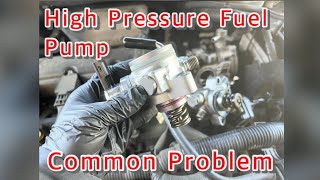
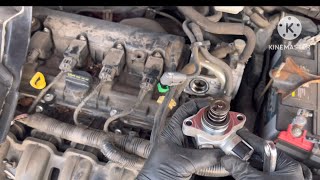
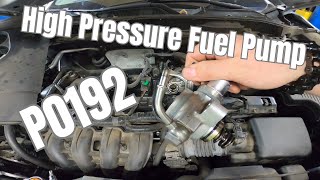
Typical fix: Replace the high-pressure fuel pump. This pump is mechanically driven by the camshaft and located on top of the engine. 🎬 Watch this step-by-step Mazda high-pressure fuel pump replacement guide
Est. part cost: $200-$700 - Faulty Fuel Rail Pressure Sensor ⚪ Low Probability While the sensor can fail, it is an uncommon cause for P0192 on this platform. An internal failure can cause the signal to drop, but symptoms and owner reports overwhelmingly point to the HPFP. This is often misdiagnosed as the primary issue.
How to confirm: With the key on and engine off, check the sensor's signal voltage with a scan tool or multimeter. A reading near zero volts points to a bad sensor or a wiring short. Unplugging the sensor may cause the PCM to use a default value; if the car's running condition changes, it points towards the sensor. However, this is an unlikely fix. According to a Mazda workshop manual, the PCM will trigger P0192 if the sensor input voltage is less than 0.4 V.
Typical fix: Replace the fuel rail pressure sensor. On the SKYACTIV-G 2.5L, the sensor is typically integrated into the fuel rail and not sold as a separate part, requiring replacement of the entire fuel rail assembly.
Est. part cost: $50-$200 - Wiring or Connector Issue ⚪ Low Probability
How to confirm: Visually inspect the wiring harness and connector going to the fuel rail pressure sensor for any signs of damage, corrosion, or loose pins. Use a multimeter to check for a 5-volt reference, a good ground, and continuity on the signal wire back to the PCM. Pay close attention to the harness near the HPFP itself. A workshop manual specifies checking for a short to ground in the wiring harness between fuel pressure sensor terminal C and PCM terminal 90.
Typical fix: Repair the damaged section of the wiring harness or clean/replace the connector.
Est. part cost: $5-$50
Rare But Worth Checking
- Failing In-Tank Low-Pressure Fuel Pump: Some owners have reported that issues with the low-pressure pump, especially when the fuel tank is below 1/4 full, can starve the high-pressure pump and trigger pressure-related codes. This is less common than an HPFP failure but worth considering if the issue only occurs on a low tank of gas.
- Faulty Powertrain Control Module (PCM): This is extremely rare, but a fault within the PCM's internal circuits can cause it to misinterpret the sensor's signal. This should only be considered after all other possibilities, especially the HPFP, have been exhaustively ruled out.
Diagnosis Steps
- Connect an OBD-II scanner to confirm P0192 and check for other codes like P0087, P0191, or P0171.
- Use the scanner's live data function to monitor 'Fuel Rail Pressure (Commanded)' and 'Fuel Rail Pressure (Actual)'.
- With Key On, Engine Off (KOEO), verify the actual pressure is reading from the low-pressure pump (approx. 60-70 PSI).
- Start the engine. At idle, the actual pressure should closely match the commanded pressure, typically around 400-600 PSI.
- If the engine cranks but won't start, or if it starts and stalls, and the actual pressure is very low (e.g., under 100 PSI), the High-Pressure Fuel Pump (HPFP) is the primary suspect.
- If the engine runs, briefly rev the engine while monitoring the live data. The actual pressure should track the commanded pressure. If it lags significantly or drops, this strongly indicates a weak HPFP.
- If the pressure reading is stuck at or near zero, or the voltage is below 0.4V, perform an electrical check. Inspect the fuel rail pressure sensor connector for damage. Use a multimeter to verify the 5V reference, ground, and signal wire integrity.
- Given the high failure rate, if fuel pressure is confirmed to be low, the next step is to replace the High-Pressure Fuel Pump.
- If a new HPFP does not resolve the issue, investigate the low-pressure in-tank pump, especially if symptoms are related to the fuel level.
- Only after confirming both fuel pumps and all wiring are functional should the fuel rail pressure sensor or PCM be considered.
Parts You'll Likely Need
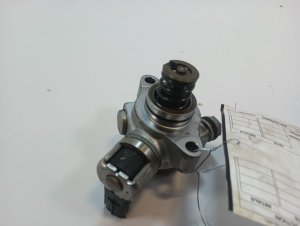
- High-Pressure Fuel Pump
(OEM #PE19-20-3F0)— This is the most frequently cited cause of P0192 on SKYACTIV-G engines, confirmed by a TSB and extensive owner reports. The original part number PE01-20-3F0D was superseded by PE01-20-3F0E, and later by PE19-20-3F0.
Trusted brands: Mazda (OEM), Bosch
OEM price range: $500-$880
Aftermarket price range: $160-$450 - Fuel Rail Assembly — Rarely needed for this code. The pressure sensor is integrated into the rail and not sold separately. It would only be replaced if a direct electrical fault with the sensor was confirmed after the HPFP was ruled out.
Trusted brands: Mazda (OEM)
OEM price range: $250-$400
Aftermarket price range: $150-$250
Related Codes That Often Appear With This One
- P0191 — This code for 'Fuel Pressure Sensor Circuit Range/Performance' is mentioned in the same Mazda TSB (01-010/14) and relates to similar fuel pressure plausibility issues caused by a failing HPFP.
- P0087 — This code for 'Fuel Rail/System Pressure - Too Low' indicates a direct mechanical pressure problem and can appear alongside P0192 if the high-pressure fuel pump is failing. TSB 01-003-18-3421 notes that this code may be stored when fuel delivery is insufficient.
- P0171 — This code for 'System Too Lean' can be triggered when low fuel pressure prevents the injectors from delivering the correct amount of fuel, causing a lean air-fuel mixture. Multiple NHTSA complaints cite this code appearing with P0192.
Technical Service Bulletins (TSBs) & Recalls
- 01-010/14 - Addresses the Check Engine Light on with DTC P0191:00 or P0192:00. Identifies a manufacturing error in the high-pressure fuel pump as the cause
Platform-Specific Known Issues
- A Technical Service Bulletin (TSB #01-010/14) was issued for some 2014 Mazda 6 vehicles with VINs lower than JM1GJ**162756. It states that P0192 or P0191 can be caused by the high-pressure fuel pump not generating target pressure due to a manufacturing error. The fix is replacing the HPFP with a modified part.
- Owners on Reddit and other forums confirm the fuel rail pressure sensor is integrated into the fuel rail and cannot be purchased separately, requiring replacement of the entire rail if the sensor is proven faulty.
- For vehicles sold in PZEV (Partial Zero Emission Vehicle) states like California, the high-pressure fuel pump is often covered under an extended emissions warranty (typically 15 years/150,000 miles). An owner of a 2016 Mazda 6 in California confirmed their HPFP replacement for P0192 was covered under this warranty at 91,000 miles. It is critical to contact a dealer to verify VIN-specific coverage. A class action settlement also extended warranty coverage to 15 years for fuel pumps on many Mazda vehicles, so owners should check their VIN for eligibility.
Mechanic-Grade Diagnostic Values
- Fuel Rail Pressure Sensor Signal Voltage (DTC Trigger) — expected: > 0.4 V. Failure: Less than 0.4 V. This will trigger DTC P0192.
- Fuel Rail Pressure (High-Side) at Idle — expected: Approx. 400-600 PSI. Failure: Pressure significantly below commanded value, or dropping to low-side pressure (approx. 60 PSI).
- Fuel Rail Pressure (Low-Side) - KOEO — expected: Approx. 60-70 PSI (around 420-480 kPa). Failure: Significantly lower pressure may indicate a failing in-tank pump.
- Fuel Rail Pressure Sensor 'A' Voltage (KOEO) — expected: Approx. 1.43 V (as seen in one diagnostic video). Failure: Voltage near 0V or below the 0.4V threshold.
Wiring & Ground Locations
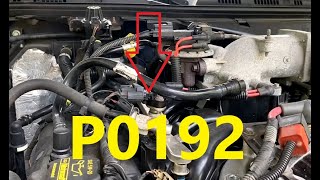
- Fuel Pressure Sensor Connector — On the end of the high-pressure fuel rail, located on the top of the engine, somewhat tucked under the intake manifold area.. This is the primary connection point to check for corrosion, damage, or a loose connection that could cause a 'Circuit Low' fault.
- PCM Terminal 90 — At the Powertrain Control Module (PCM) connector.. This is the termination point for the fuel pressure sensor signal wire (Terminal C at the sensor). A short to ground on this wire is a specific diagnostic step listed in the workshop manual for P0192.
- PCM Terminal 61 — At the Powertrain Control Module (PCM) connector.. This is the termination point for another wire in the sensor harness (Terminal B). The manual also lists checking for a short to ground on this wire.
Real Owner Repair Stories
- Reddit user in /r/mazda (2015 Mazda 3 (same engine/fuel system)) — Check engine light came on, car went into limp mode with any moderate throttle application.
✅ What actually fixed it Replaced the High-Pressure Fuel Pump (HPFP), camshaft follower, and the sensor. Live data showed desired pressure was well above actual pressure before the fix. After replacement, codes were cleared and data returned to normal. - Reddit user in /r/mazda (2017 Mazda CX-5 (same engine/fuel system), 63,000 miles) — Vehicle shut off completely while driving on the highway. Would not restart for 30 minutes. P0192 code was stored.
❌ Tried (didn't work) The car had a similar issue at 15,000 miles where the dealer replaced the HPFP under warranty.
✅ What actually fixed it The dealer replaced the high-pressure fuel pump again (at owner's expense this time). The car started and ran fine for the dealer upon arrival, but the code pointed to the pump. The owner noted the intermittent nature of the failure, where the pump seemingly works again after cooling down.
OEM Part Supersession History
PE01-20-3F0D→PE01-20-3F0E, then PE19-20-3F0— Part revision and improvement to address failure issues noted in TSB 01-010/14.
Diagnostic Flowchart
Other Known Issues on This Vehicle
Issues unrelated to this code that are worth knowing about as an owner of this generation:
- Infotainment Screen Delamination / Ghost Touch 🟠 Medium — Very common on 2016+ models. Screen may develop spider cracks, peel, or register phantom touches, making it unusable. (Ref: Manufacturer Communication SA-027-24 (NHTSA ID 10254187) acknowledges the issue and provides a repair kit.)
- Intake Valve Carbon Buildup 🟠 Medium — An inherent issue for all SKYACTIV-G direct injection engines. Typically requires cleaning via walnut blasting between 80,000-120,000 miles to prevent rough idle, misfires, and performance loss.
- Prematurely Warped Brake Rotors 🟡 Low — A common complaint where the OEM front brake rotors warp easily, causing vibration during braking. Often requires replacement with aftermarket rotors for a permanent fix.
- Manual Transmission Hard Shifting / Jumping Out of Gear 🟠 Medium — Affects 6-speed manual transmission models from 2014-2016. Can be hard to shift into 3rd-6th gear or jump out of 3rd. (Ref: TSB 05-005/15)
- Failing Cooling Fan Control Module 🟠 Medium — A known issue where the cooling fan module fails, causing fans to run constantly or not at all, leading to potential overheating.
Used vs. New Parts: Buying Guide for This Vehicle
When a used part is the smart pick: Given the high failure rate and the existence of updated part numbers, buying a used High-Pressure Fuel Pump (HPFP) is generally not recommended. The risk of acquiring a part that is already near the end of its service life is high. A used part should only be considered as a last resort or for temporary diagnostic purposes.
Donor-vehicle mileage cap: roughly under 40000 miles for the part to have meaningful remaining life.
What to inspect on the donor part:
- Verify the part number on the used pump; prioritize the latest superseded number (PE19-20-3F0).
- Ask for the VIN of the donor vehicle to check its service history, if possible.
- Inspect the electrical connector for any signs of corrosion or damage.
- Avoid pumps from vehicles that show signs of poor maintenance or high mileage.
OEM-only on this vehicle (don't cheap out):
- High-Pressure Fuel Pump (HPFP)
Aftermarket brands forum-validated for this vehicle:
- Bosch (often the OEM supplier)
Brands owners have reported issues with on this vehicle:
- Unknown, no-name brands from online marketplaces should be avoided due to the critical nature of this part and the high pressures involved.
Real Owner Stories
Aggregated from forums and TSBs cited above. Mileages and costs reflect what owners reported in those sources.
2016 Mazda 6 SKYACTIV-G 2.5L — 91000 miles
Symptoms: Check engine light with P0192, cold start stalling, and the car entering limp mode.
What fixed it: The dealer replaced the high-pressure fuel pump (HPFP) under the PZEV warranty.
Source hint: Reddit r/mazda thread titled 'check engine light p0192'
2014 Mazda 6 SKYACTIV-G 2.5L — ~155342 miles
Symptoms: Lack of power and code P0192.
What fixed it: Replacement of the high-pressure fuel pump.
Source hint: Reddit r/mazda6 thread titled 'this is not my year'
2015 Mazda 6 SKYACTIV-G 2.5L — 37000 miles
Symptoms: Code P0192 triggered.
What fixed it: Failed high-pressure fuel pump (HPFP) replacement.
Source hint: Reddit r/mazda6 thread titled 'this is not my year' (comment section)
Related OBD-II Codes
Frequently Asked Questions
Does TSB 01-010/14 apply to my 2014 Mazda 6?
Can I just replace the fuel rail pressure sensor on my SKYACTIV-G 2.5L?
Is the high-pressure fuel pump covered under warranty for a 2016 Mazda 6?
What should the fuel pressure readings be on a healthy Mazda 6 2.5L?
My car stalls on cold starts and has a 'long crank'—is this P0192?
How can I tell if the HPFP spill valve is stuck open?
Helpful Videos
Used OEM Parts in Stock


New Aftermarket Parts Available


The information in this article is provided for general reference and educational purposes only. Vehicle specifications, procedures, and part compatibility can vary by production date, trim level, and region. Always consult your vehicle's factory service manual and verify part numbers before purchasing or performing repairs. Safety-critical components such as airbags, seat belts, and braking systems should be installed by a qualified professional.
- Mazda 6:
- 🎬 Helpful Videos
- 🛍️ Shop This Part
- What's Unique About the 2014-2021 Mazda 6
- Symptoms You May Notice
- Most Likely Causes
- Rare But Worth Checking
- Diagnosis Steps
- Parts You'll Likely Need
- Related Codes That Often Appear With This One
- Technical Service Bulletins (TSBs) & Recalls
- Platform-Specific Known Issues
- Mechanic-Grade Diagnostic Values
- Wiring & Ground Locations
- Real Owner Repair Stories
- OEM Part Supersession History
- Diagnostic Flowchart
- Other Known Issues on This Vehicle
- Used vs. New Parts: Buying Guide for This Vehicle
- Real Owner Stories
- 2016 Mazda 6 SKYACTIV-G 2.5L — 91000 miles
- 2014 Mazda 6 SKYACTIV-G 2.5L — ~155342 miles
- 2015 Mazda 6 SKYACTIV-G 2.5L — 37000 miles
- Related OBD-II Codes
- Frequently Asked Questions
- 🎟️ Get 5% Off