

P0192 on 2001-2007 Ford Escape 3.0L V6: Causes and Fixes for Fuel Pressure Sensor Low Input
On a 2001-2007 Escape 3.0L, P0192 is most often caused by a failed Fuel Rail Pressure (FRP) sensor. It's an easy DIY replacement located on the engine's fuel rail. Expect to pay $45-$80 for an aftermarket sensor or around $100 for an OEM Motorcraft part. Before replacing, check for fuel in the sensor's vacuum line, a sure sign of failure.
- P0192 on a 2001-2007 Escape 3.0L almost always points to an electrical issue with the Fuel Rail Pressure (FRP) sensor or its wiring.
- The most likely fix is replacing the FRP sensor itself, which is an inexpensive part and very easy to access on top of the engine.
- Do not replace the fuel pump unless you have confirmed low fuel pressure with a mechanical gauge.
- Because this code can cause the engine to stall at any time, it is a serious safety issue that should be addressed immediately.
What's Unique About the 2001-2007 Ford Escape
For the first-generation Ford Escape with the 3.0L Duratec V6, this code is a straightforward and common issue. Unlike newer direct-injection engines, the fuel system is a relatively simple port-injection design. The Fuel Rail Pressure (FRP) sensor is a well-known failure point, and its location on top of the engine makes it one of the easier sensors to access and replace, often taking less than 15 minutes with basic tools. The platform mates, Mazda Tribute and Mercury Mariner, experience the exact same failure pattern.
Symptoms You May Notice
- Check Engine Light is on
- Engine is hard to start or requires long cranking
- Engine stalls, especially when coming to a stop or at idle
- Hesitation or severe lack of power during acceleration
- Rough or erratic idle
- Vehicle may not start at all
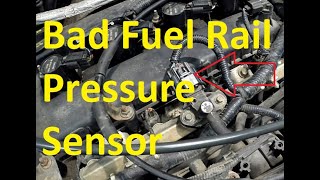
- Sputtering or stumbling as if running out of fuel 🎬 Watch: Common symptoms of a failing fuel rail pressure sensor
- Replacing the fuel pump before verifying that the actual fuel pressure is low with a mechanical gauge.
- Replacing the PCM when the fault is in the wiring or the sensor itself.
- Replacing the FRP sensor multiple times without thoroughly checking the wiring harness for intermittent shorts or opens, which can mimic sensor failure.
Most Likely Causes
- Faulty Fuel Rail Pressure (FRP) Sensor 🔴 High Probability The sensor is a common failure item on this engine due to age and heat cycles. The internal diaphragm can rupture, allowing raw fuel into the vacuum line, or the internal electronics can fail, causing the signal voltage to drop to ground.
How to confirm: With a scan tool, observe the FRP sensor voltage (FRP V) with the key on, engine off. If the voltage is stuck below 0.5V, the sensor is likely bad. A definitive check is to disconnect the vacuum line from the sensor; if raw fuel is present, the sensor's internal diaphragm has failed and it must be replaced. You can also test resistance between the sensor's pins with it unplugged; a reading under 10k Ohms may indicate an internal short, as noted by a user on Reddit.
Typical fix: Replace the Fuel Rail Pressure sensor. This is a simple job involving two 8mm bolts, an electrical 🎬 See this step-by-step sensor replacement for the 3.0L engine connector, and a vacuum line.
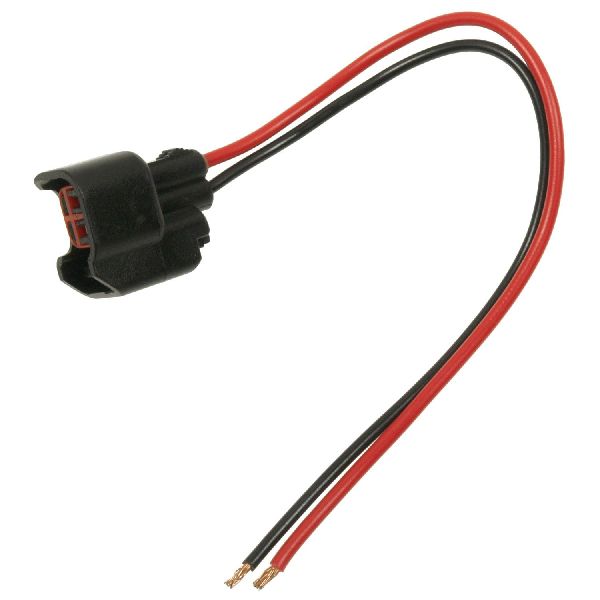
Est. part cost: $45-$105 - Wiring or Connector Issue 🟡 Medium Probability After many years, the wiring harness and connector pigtail for the sensor can become brittle, corroded, or chafe against other components, causing a short to ground or an open circuit.
How to confirm: Visually inspect the wiring going to the FRP sensor for any signs of damage. Unplug the connector and check for corrosion or pushed-out pins. With the sensor unplugged and key on, use a multimeter to check for 5V reference power and a good ground at the connector. Wiggle the harness while watching live data on a scan tool to see if the voltage reading glitches, which indicates an intermittent connection.
Typical fix: Repair the damaged section of wire or replace the connector pigtail.
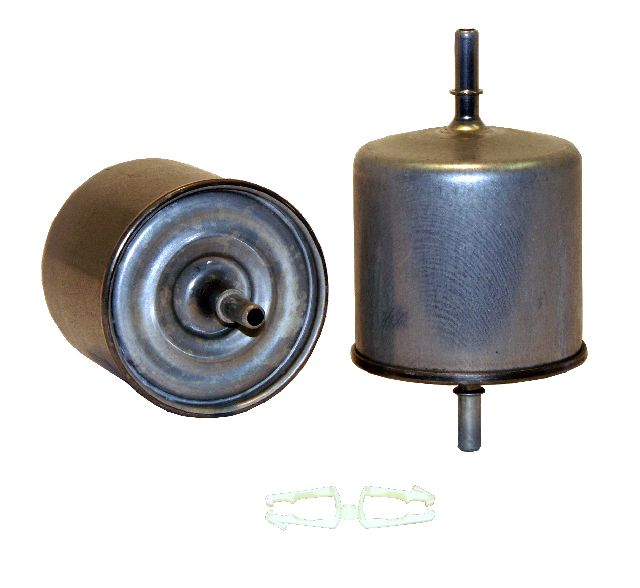
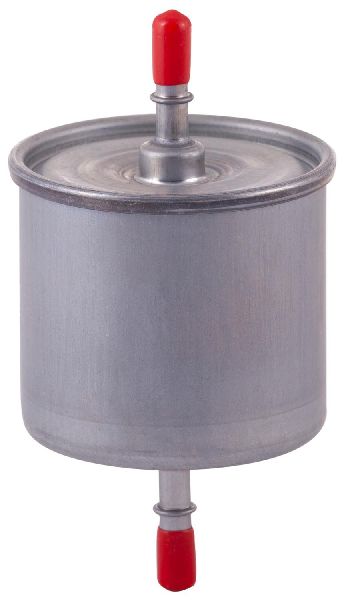
Est. part cost: $10-$30 - Clogged Fuel Filter or Weak Fuel Pump ⚪ Low Probability The fuel filter is a maintenance item that is often neglected. A clogged filter restricts flow, forcing the pump to work harder and eventually wear out, leading to low actual fuel pressure.
How to confirm: If the FRP sensor and wiring test good, connect a mechanical fuel pressure gauge. For 2001-2004 models, use the Schrader valve on the fuel rail; spec is 55-65 PSI (KOEO). For 2005-2008 models, a special adapter is needed as there is no test port; spec is 39 PSI (KOEO/KOER). If pressure is low, the issue is with fuel delivery.
Typical fix: Replace the fuel filter first, as it is inexpensive. If pressure is still low, the in-tank fuel pump likely needs replacement.
Est. part cost: $10-$25 (filter), $100-$250 (pump)
Rare But Worth Checking
- Failed Fuel Pump Driver Module (FPDM): On many Fords, this module controls voltage to the fuel pump. On the Escape, it is located behind the rear passenger-side tire, mounted to the frame. While less common on this specific model than on F-150s, a failing FPDM can cause low fuel pressure symptoms. It's worth considering if a new pump and filter don't solve a confirmed low-pressure issue, as documented in a complex case on Reddit where it was replaced as part of a larger diagnostic effort.
- Faulty Powertrain Control Module (PCM): This is extremely rare. The PCM is the last thing to suspect. Only consider this after exhaustively ruling out the sensor, wiring, and the entire fuel delivery system. A Reddit user reported their vehicle had the PCM replaced by a dealership for this issue, but the problem persisted, ultimately pointing back towards an intermittent wiring fault.
Diagnosis Steps
- Scan for Codes: Read all stored DTCs. Note if P0191 or P0193 are also present, as this often points to a sensor or wiring issue.
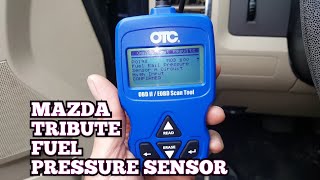
- Check Live Data: Using a scan tool, monitor the 'FRP' or 'Fuel Rail Pressure' PID. With the key on and engine off, it should show a plausible pressure. If it reads 0 psi or the corresponding voltage is below 0.5V, a circuit fault is highly likely. 🎬 Watch: How to diagnose and fix the P0192 circuit code
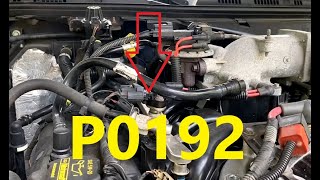
- Visual Inspection: Inspect the FRP sensor on the fuel rail. Check its electrical connector for corrosion and ensure the wiring harness is not damaged, melted, or chafed. Crucially, disconnect the vacuum line and check for any trace of liquid fuel, which confirms sensor failure.
- Electrical Test: Disconnect the sensor. With the key on, use a multimeter to test the connector terminals. You should find a 5-volt reference wire, a ground wire (check for continuity to the battery negative), and a signal wire.
- Confirm with Mechanical Gauge: If the electrical circuit seems okay, connect a mechanical fuel pressure gauge. For 2001-2004 models, use the Schrader valve; spec is 55-65 PSI. For 2005-2008 models, a 'hair-pin T-fitting' adapter is required; spec is 39 PSI.
- Interpret Results: If the mechanical gauge shows good pressure but the scan tool shows low pressure/voltage, the FRP sensor is bad. If the mechanical gauge also shows low pressure, the problem is in the fuel delivery system (filter, pump, FPDM).
Parts You'll Likely Need
- Fuel Rail Pressure Sensor
(OEM #3F2Z-9G756-AC)— This is the most common failure point for code P0192 on this vehicle.
Trusted brands: Motorcraft (CM-5229), Bosch (0261230093)
OEM price range: $80-$105
Aftermarket price range: $45-$75 - Fuel Filter — A clogged fuel filter is a common cause of low fuel pressure and is an inexpensive maintenance item to rule out.
Trusted brands: Motorcraft, Fram
OEM price range: $20-$30
Aftermarket price range: $10-$20
Related Codes That Often Appear With This One
- P0193 — Fuel Rail Pressure Sensor Circuit High Input. Seeing both P0192 and P0193 intermittently suggests a loose connection or a failing sensor causing erratic voltage swings from ground (0V) to reference (5V).
- P0191 — Fuel Rail Pressure Sensor Circuit Range/Performance. This indicates the sensor's reading is illogical. It often appears with P0192/P0193 as the sensor begins to fail completely or if there is a wiring issue.
Technical Service Bulletins (TSBs) & Recalls
- No specific TSBs were found for the 2001-2007 Escape regarding P0192. Searches for this code on later model Escapes (2020-2021) show TSBs SSM 50245 and 50116 related to wiring harness chafing, but this is a different platform and issue.
Platform-Specific Known Issues
- The fuel pressure test procedure differs by year. 2001-2004 models have a convenient Schrader valve on the fuel rail for easy testing. 2005-2008 models with the returnless fuel system do not have this test port, requiring a special T-fitting adapter to be installed in the fuel line for a mechanical pressure reading.
Mechanic-Grade Diagnostic Values
- FRP Sensor Reference Voltage (VREF) — expected: 4.8V - 5.2V. Failure: Voltage below 4.8V or above 5.2V indicates a PCM or wiring issue.
- FRP Sensor Signal Voltage (KOEO) — expected: 0.5V - 1.8V. Failure: Voltage stuck below 0.5V triggers P0192. Voltage above this range may indicate high pressure or a different fault.
- FRP Sensor Internal Resistance — expected: Infinite resistance (Open Line). Failure: A resistance reading under 10k Ohms between certain pins can indicate an internal short. One technician reported a bad sensor reading 5,400 Ohms while a new one showed infinite resistance.
- Mechanical Fuel Pressure (2001-2004) — expected: 55-65 PSI. Failure: Pressure below 55 PSI indicates a fuel delivery problem (pump, filter).
- Mechanical Fuel Pressure (2005-2008) — expected: 39 PSI. Failure: Pressure below 35 PSI, especially under load, indicates a fuel delivery problem (pump, filter, FPDM).
Scan Tool Commands That Help
- Ford IDS or equivalent bidirectional scan tool: Fuel Pump Activation / Component Test — With a mechanical pressure gauge connected, this command forces the fuel pump to run with the engine off. It allows you to safely check for maximum fuel pump pressure (deadhead pressure) and verify if the pump and FPDM are responding to commands from the PCM, isolating the pump from the sensor circuit.
Wiring & Ground Locations
- G108 — On the 3.0L V6, this ground is located at the rear of the engine compartment, on the firewall.. This is a primary engine ground. A poor connection here can cause erratic behavior in multiple sensors, including the FRP sensor, by creating an unstable ground reference for the PCM.
- G105 / G106 / G107 — Located at the front of the engine compartment, near the battery and radiator support. G105 is on the left (driver's) side, while G106/G107 are on the right.. These are major chassis and engine component ground points. Corrosion or looseness can lead to intermittent electrical issues throughout the powertrain system.
- FRP Sensor Connector — A 3-pin connector on the fuel rail pressure sensor, located on the fuel rail on top of the engine.. This is the direct connection point. Pinpoint tests for 5V reference, ground, and signal voltage are performed here. The pins are typically: Pin 1 (Signal), Pin 2 (Reference Voltage), Pin 3 (Ground).
Real Owner Repair Stories
- Reddit user on r/MechanicAdvice (2007 Ford Escape 3.0L V6) — Intermittent hard starting, rough idle, and stalling when coming to a stop. Codes P0191, P0192, and P0193 would appear.
❌ Tried (didn't work) Replaced FRP sensor (3 times), Replaced fuel pump and filter (twice), Replaced Fuel Pump Driver Module (FPDM), Replaced Powertrain Control Module (PCM), Repaired vacuum leaks
✅ What actually fixed it The issue was never definitively posted as 'fixed' but the user's extensive diagnosis, after replacing nearly every component in the system, strongly pointed to an intermittent short-to-ground or short-to-voltage in the wiring harness between the PCM and the FRP sensor. This highlights that even with new parts, a persistent wiring fault can mimic component failure.
OEM Part Supersession History
3F2E-9G756-AD, 3F2E-9G756-AA→3F2Z-9G756-AC— Standard part revision and consolidation by Ford.
Heads up: The Motorcraft part number is CM-5229. While aftermarket versions from brands like Bosch (0261230093) are available and generally compatible, some forum users report preferring the OEM Motorcraft part to avoid any potential calibration or longevity issues.
Model Year Variations Within This Range
- 2001-2004: These models use a mechanical return-style fuel system with a vacuum-referenced regulator. Fuel pressure is higher, typically 55-65 PSI, and can be easily tested at a Schrader valve on the fuel rail.
- 2005-2007: These models use an electronic returnless fuel system (ERFS). Fuel pressure is controlled by the PCM via a Fuel Pump Driver Module (FPDM). The target pressure is lower, around 39 PSI. There is no Schrader test port on the fuel rail, requiring a special adapter for mechanical testing.
Diagnostic Flowchart
Used vs. New Parts: Buying Guide for This Vehicle
When a used part is the smart pick: For this specific repair, using a used part is generally not recommended. The primary cause is an electronic sensor (FRP) that is a known failure item due to age and heat cycles. A used sensor from a junkyard carries a high risk of having the same internal wear or being close to failure.
Donor-vehicle mileage cap: roughly under 50000 miles for the part to have meaningful remaining life.
What to inspect on the donor part:
- If considering a used sensor, visually inspect for any cracks in the plastic housing.
- Ensure the electrical pins are clean, straight, and free of corrosion.
- Check that the vacuum port is clear and has no smell of raw fuel.
OEM-only on this vehicle (don't cheap out):
- Fuel Rail Pressure (FRP) Sensor: While good aftermarket options exist, the OEM Motorcraft sensor (CM-5229) is the safest bet to avoid calibration issues that can sometimes occur with cheaper aftermarket parts on sensitive electronic systems.
Aftermarket brands forum-validated for this vehicle:
- Bosch (for the FRP sensor)
- Delphi (for the fuel pump assembly)
Brands owners have reported issues with on this vehicle:
- Unnamed, 'white-box' or no-brand electronic sensors from online marketplaces should be avoided, as their internal electronics may not be calibrated to OEM specifications, leading to persistent codes or poor performance.
Real Owner Stories
Aggregated from forums and TSBs cited above. Mileages and costs reflect what owners reported in those sources.
2007 Ford Escape 3.0L V6
Symptoms: The vehicle had intermittent hard starting requiring multiple crank attempts, a rough idle, and would sometimes stall when coming to a stop shortly after starting.
What fixed it: The owner did not report a final solution. The issue persisted despite replacing the FRP sensor (multiple times), the fuel pump and filter (twice), the fuel pump driver module, and even the PCM. The owner's diagnostics pointed towards a likely intermittent short in the wiring harness.
Source hint: Reddit (r/MechanicAdvice) - '2007 V6 Ford Escape P0191, P0192, P0193 Codes, Stalling, Rough Idle' (Feb 2023)
Related OBD-II Codes
Frequently Asked Questions
How do I check the actual fuel pressure on my 2001-2007 Escape, and does the procedure change by year?
What should the fuel pressure be on my 3.0L V6 Escape?
I disconnected the vacuum line from the Fuel Rail Pressure (FRP) sensor and found liquid fuel. What does this mean?
My scan tool shows the FRP sensor voltage is stuck at 0.4V with the key on. Is the sensor bad?
Are there any official Ford TSBs for the P0192 code on my 2006 Escape?
Does this P0192 problem also affect the Mazda Tribute or Mercury Mariner?
Helpful Videos
We Have This Part in Stock


The information in this article is provided for general reference and educational purposes only. Vehicle specifications, procedures, and part compatibility can vary by production date, trim level, and region. Always consult your vehicle's factory service manual and verify part numbers before purchasing or performing repairs. Safety-critical components such as airbags, seat belts, and braking systems should be installed by a qualified professional.
- Ford Escape:
- 🎬 Helpful Videos
- 🛍️ Shop This Part
- What's Unique About the 2001-2007 Ford Escape
- Symptoms You May Notice
- Most Likely Causes
- Rare But Worth Checking
- Diagnosis Steps
- Parts You'll Likely Need
- Related Codes That Often Appear With This One
- Technical Service Bulletins (TSBs) & Recalls
- Platform-Specific Known Issues
- Mechanic-Grade Diagnostic Values
- Scan Tool Commands That Help
- Wiring & Ground Locations
- Real Owner Repair Stories
- OEM Part Supersession History
- Model Year Variations Within This Range
- Diagnostic Flowchart
- Used vs. New Parts: Buying Guide for This Vehicle
- Real Owner Stories
- 2007 Ford Escape 3.0L V6
- Related OBD-II Codes
- Frequently Asked Questions
- 🎟️ Get 5% Off