

P0191 on 2011-2020 Kia Sorento: Fuel Rail Pressure Sensor Causes and Fixes
For a 2011-2020 Kia Sorento with a GDI engine, code P0191 is most often caused by a failing high-pressure fuel pump (HPFP) or a faulty fuel rail pressure sensor (FRPS). A strong fuel smell in the engine oil is a key sign of a bad HPFP. On 2012-2014 models, an ECU software update (SC114) should be checked before replacing parts. Expect repair costs of $450-$600 for the sensor and $1,300-$1,800+ for the pump.
- P0191 on a GDI Sorento points to a serious problem with the high-pressure fuel system that requires prompt attention.
- The two most likely causes are a failed high-pressure fuel pump (HPFP) or a bad fuel rail pressure sensor (FRPS).
- A strong gasoline smell in the engine oil is a tell-tale sign of HPFP failure; stop driving and check immediately.
- Before replacing an expensive HPFP on a 2012-2014 model, verify with a Kia dealer if Service Campaign SC114 (ECU update) is applicable and has been performed.
- Due to extreme fuel pressures and component locations, this repair is complex and professional service is strongly recommended.
What's Unique About the 2011-2020 Kia Sorento

The 2011-2020 Sorento's GDI (Gasoline Direct Injection) engines operate with a very high-pressure fuel system, making them susceptible to this code. The two primary components, the high-pressure fuel pump (HPFP) and the fuel rail pressure sensor (FRPS), are both well-documented failure points on this platform. For earlier models (2011-2015), an ECU software issue could also incorrectly trigger fuel pressure codes, leading Kia to issue a service campaign (SC114) to update the logic for DTC P0087, which is closely related to P0191. Therefore, diagnosis isn't just about the parts; it must also consider the vehicle's service history.
Generation note: This range covers the second generation (XM, 2011-2015) and third generation (UM, 2016-2020) Sorento. Key causes and parts can differ. For example, Service Campaign SC114 for an ECU update applies to 2012-2014 models. High-pressure fuel pump part numbers also differ between generations.
Symptoms You May Notice
- Check Engine Light is on
- Engine hesitation, sputtering, or bucking, especially under acceleration
- Significant loss of engine power or entering 'limp mode'
- Engine stalling, sometimes unexpectedly
- Rough or unstable idle
- Hard starting or extended cranking time
- Reduced fuel economy
- Rattling or ticking noise from the engine-mounted high-pressure fuel pump
- Strong smell of gasoline in the engine oil
- Replacing the fuel rail pressure sensor when the actual fault is a damaged wire in the harness.
- Replacing the high-pressure fuel pump without checking for applicable ECU software updates (like SC114) first on 2012-2014 models.
- Replacing the in-tank (low-pressure) fuel pump before verifying that the high-pressure pump is functioning correctly.
- Assuming the FRPS is bad when an aftermarket sensor was faulty out of the box.
Most Likely Causes

- Failing High-Pressure Fuel Pump (HPFP) 🔴 High Probability The HPFP is a widely documented failure point on Kia/Hyundai Theta II GDI engines of this era. Internal seals can fail, causing both pressure issues and fuel to leak into the crankcase, diluting the engine oil.
How to confirm: Check the engine oil for a strong gasoline smell. Use a scan tool to monitor 'Desired' vs. 'Actual' fuel rail pressure; if 'Actual' is consistently low, especially under load, the pump is a likely culprit. This often appears with code P0087. 🎬 Watch: How to easily repair P0087 on Kia GDI engines.
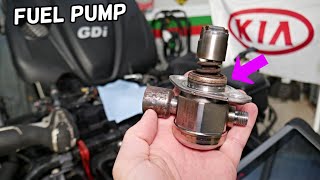
Typical fix: Replace the high-pressure fuel pump, the cam follower (tappet), and the single-use high-pressure fuel pipe. 🎬 See this walkthrough for replacing the high-pressure fuel pump. An oil change is required if fuel has contaminated the oil.
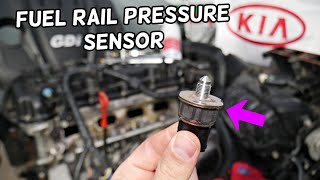
Est. part cost: $400-$1350 - Faulty Fuel Rail Pressure Sensor (FRPS) 🔴 High Probability The sensor operates in a high-heat, high-vibration environment under the intake manifold and can fail internally, sending erratic or incorrect voltage signals to the PCM.
How to confirm: With a scan tool, observe the 'Actual' fuel pressure reading. If it is erratic, stuck at a default value, or clearly incorrect (e.g., reading high pressure with the engine off), the sensor is likely bad. This diagnosis assumes wiring is intact. The sensor should show a 5V reference signal with the key on.
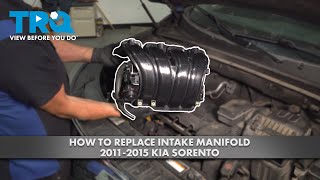
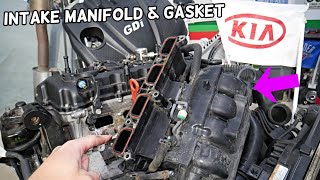
Typical fix: Replace the fuel rail pressure sensor. This requires removing the intake manifold for access. 🎬 Watch: Step-by-step guide to removing the intake manifold and gaskets.
Est. part cost: $70-$250 - Wiring or Connector Issue 🟡 Medium Probability The FRPS wiring harness is routed under the intake manifold in a high-heat area, making it prone to becoming brittle, chafed, or corroded over time. Mice chewing on wires is also a reported cause.
How to confirm: Visually inspect the FRPS connector and surrounding wires for damage. Perform a continuity test on the power (5V reference), ground, and signal wires between the sensor and the PCM. Wiggle the harness while monitoring the sensor's voltage on a scan tool to check for intermittent faults.
Typical fix: Repair the damaged section of the wiring harness or replace the sensor's pigtail connector.
Est. part cost: $15-$50 - Outdated Engine Control Module (ECM) Software ⚪ Low Probability Specifically for 2012-2014 Sorento models (and related Kia/Hyundai vehicles), Kia issued Service Campaign SC114 because the original ECM logic could misinterpret fuel pressure data and set DTC P0087 ('Fuel Rail Pressure Too Low'). This logic issue can also contribute to P0191.
How to confirm: A Kia dealership can check the vehicle's VIN to see if campaign SC114 is open or was completed. This should be done before replacing expensive hardware on applicable model years.
Typical fix: The dealership reprograms the ECM with the updated software, which improves the durability and operation of the fuel pump's Flow Control Valve (FCV) needle.
Est. part cost: $0 (if campaign is active)
Rare But Worth Checking
- Worn or Missing HPFP Cam Follower (Tappet): While often replaced with the HPFP, a failed tappet on its own can cause a no-pressure condition, leading to this code. One technician found this was the ultimate cause after all other major parts were replaced.
- Failing In-Tank (Low-Pressure) Fuel Pump: If the HPFP is starved of fuel from the tank, it cannot generate the required high pressure. This is less common than HPFP failure but should be ruled out by testing low-side pressure (should be ~70-75 PSI). A failure here is more likely to set a P0087 code first.
Diagnosis Steps

- Connect an OBD-II scanner and confirm P0191 is the primary code. Note any other codes like P0087.
- Using the scanner's live data, monitor 'Desired Fuel Rail Pressure' and 'Actual Fuel Rail Pressure'. At idle, the pressure should be steady. With key-on-engine-off, pressure should be low. During a test drive, 'Actual' should closely follow 'Desired'.
- If the 'Actual' pressure is erratic, stuck, or reads high with the engine off, suspect the FRPS or its wiring.
- If the 'Actual' pressure is consistently far below 'Desired' pressure, especially under acceleration, suspect a mechanical issue like the HPFP.
- Carefully open the oil cap and check for a strong smell of raw gasoline. If present, this strongly indicates a failed internal seal on the HPFP, which is leaking fuel into the crankcase.
- Visually inspect the FRPS connector and wiring harness for any signs of corrosion, melting, or physical damage. Wiggle the harness to see if it affects the live data reading.
- If wiring looks good and the sensor reading is suspect, backprobe the sensor connector to test for a 5V reference signal, a good ground, and a fluctuating signal voltage to rule out an electrical issue.
- If a mechanical pressure issue is suspected, test the low-pressure fuel pump's output to ensure it's supplying adequate fuel to the HPFP (approx. 70-75 PSI).
- For 2012-2014 models, contact a Kia dealer with the VIN to check the status of Service Campaign SC114 before replacing the HPFP.
Parts You'll Likely Need

- High-Pressure Fuel Pump (HPFP)
(OEM #35320-2G740 (or -2G720/-2G730 for 2011-2015); 35320-2GGA0 (for 2016-2020 2.4L))— This is the most common major mechanical failure for code P0191 on these GDI engines.
Related Codes That Often Appear With This One
- P0087 — This code means 'Fuel Rail Pressure Too Low'. It often appears with P0191 when the high-pressure fuel pump is failing and cannot build enough pressure.
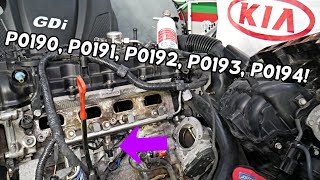
- P0192 / P0193 — These are more specific electrical codes for the FRPS circuit being low (short) or high (open). They point more directly to a wiring or sensor electrical fault than the general 'performance' nature of P0191.
- P0300-P0304 — Misfire codes can be triggered when incorrect fuel pressure leads to a lean or rich air/fuel mixture, causing poor combustion.
Technical Service Bulletins (TSBs) & Recalls
- SC114: Voluntary Service Campaign - ECM Upgrade for MIL On with DTC P0087.
- TSB-026: Addresses MIL illumination requiring HPFP and fuel pipe replacement.
- PS356: Notes compatibility issues between the HPFP and fuel line on some 2014 Sorento models.
Platform-Specific Known Issues
- Service Campaign SC114: Affects 2012-2014 Sorento models with 2.4L & 2.0T GDI engines. Involves an ECM update to improve the control logic for the fuel pump's flow control valve to prevent setting false trouble codes like P0087.
- TSB FUE 026 / TSB-026: For 2014 models, this bulletin addresses MIL illumination by replacing the high-pressure fuel pump and related fuel pipe if necessary.
Mechanic-Grade Diagnostic Values
- Low-Pressure Fuel System (In-tank pump) — expected: 69.7 - 71.8 PSI. Failure: Pressure significantly below this range indicates a weak in-tank pump or a restriction in the low-pressure fuel line, starving the HPFP.
- High-Pressure Fuel System (Scan tool, warm idle) — expected: Approx. 40 bar (~580 PSI). Acceptable range is 3.5-5.5 MPa (508-798 PSI).. Failure: Actual pressure is significantly lower than desired, or is stuck at the low-pressure system's value (~70 PSI).
- High-Pressure Fuel System (Scan tool, under load) — expected: Should rise quickly to 140-150 bar (~2030-2175 PSI).. Failure: Actual pressure fails to follow the desired pressure, showing a large gap, indicating a failing HPFP or a worn tappet.
- Fuel Rail Pressure Sensor (FRPS) Connector Pin Voltage — expected: Pin 1 (Red): 5V reference; Pin 2 (Pink/Orange): Signal voltage (varies with pressure); Pin 3 (Brown/Green): Sensor ground.. Failure: Missing 5V reference or ground indicates a wiring or PCM issue. Signal voltage that is stuck, erratic, or doesn't change with engine RPM points to a bad sensor.
Scan Tool Commands That Help
- Kia GDS / Advanced Aftermarket (Autel, etc.): Fuel Pump Activation / Fuel System Test — This bidirectional command allows a technician to run the low-pressure in-tank fuel pump with the engine off. It is used to verify the low-pressure pump's ability to build pressure and to check for leaks in the low-pressure lines before diagnosing the high-pressure system.
Wiring & Ground Locations
- Fuel Rail Pressure Sensor (FRPS) Connector — On the high-pressure fuel rail, located underneath the intake manifold.. This is the primary connection to test for power, ground, and signal. It is in a high-heat area and is a common point of failure due to corrosion or damaged pins.
- ECM Connector — Varies by model year, but typically in the engine bay near the battery or firewall.. If voltage tests at the sensor connector fail, a continuity test must be performed between the FRPS connector pins and their corresponding pins at the ECM connector to identify a break in the wiring harness.
Real Owner Repair Stories
- SorentoForums.com user (2012 Kia Sorento 2.4L GDI) — Car would die while driving, codes P0191 and P0087 present. Strong smell of fuel in the oil.
❌ Tried (didn't work) Replaced the fuel rail pressure sensor (FRPS).
✅ What actually fixed it Replacing the high-pressure fuel pump (HPFP). The original pump had failed internally, causing low pressure and leaking fuel into the crankcase. - Kia-Forums.com user (2012 Kia Sorento 2.4L GDI) — Stalling, hesitation, and codes P0087 and P0191.
❌ Tried (didn't work) Initial diagnosis suggested replacing the fuel rail pressure sensor.
✅ What actually fixed it The final repair was replacing the high-pressure fuel pump (HPFP) and the associated tappet (cam follower). The user noted that after replacing the pump, the car ran perfectly. - NHTSA ODI #11682506 — An owner reported that their vehicle displayed a Check Engine Light with DTC P0191 for Fuel Rail Pressure Sensor Range/Performance, but noted that the dealer performed minimal diagnosis with no resolution.
- NHTSA ODI #11597574 — A Kia owner reported that their car had codes P0171 and P0191 pop into the system for the third time, noting the vehicle did not feel right immediately after leaving a service facility.
OEM Part Supersession History
35320-2G720, 35320-2G730→35320-2G740— Standard part evolution for improved reliability and performance.
Heads up: These parts are for the second generation (XM) Sorento (approx. 2011-2015) and are not compatible with the third generation.N/A→35320-2GGA0— New part for the updated engine in the third generation (UM) Sorento.
Heads up: This part is for the third generation (UM) Sorento (approx. 2016-2020) 2.4L and is not backward compatible with the earlier 35320-2G7xx series pumps.
Model Year Variations Within This Range
- 2011-2015 (XM Generation): Uses the HPFP series 35320-2G7xx. Models from 2012-2014 are subject to Service Campaign SC114 for an ECM update to prevent false low-pressure codes.
- 2016-2020 (UM Generation): The Sorento was fully redesigned for 2016. The 2.4L GDI engine now uses HPFP part number 35320-2GGA0. The 2.0T GDI engine was also available. The ECU logic is different and not subject to the earlier SC114 campaign.
Other Known Issues on This Vehicle
Issues unrelated to this code that are worth knowing about as an owner of this generation:
- Catastrophic Engine Failure (Theta II GDI) 🔴 High — Widespread across 2011-2019 models. Caused by manufacturing debris leading to premature connecting rod bearing wear. (Ref: Multiple recalls (e.g., SC147) and a major class-action lawsuit settlement offering lifetime warranties for the engine short block.)
- Excessive Oil Consumption 🟠 Medium — Commonly reported, often starting around 60,000-100,000 miles. Can be a symptom of failing piston rings or other internal engine wear related to the primary engine defect. (Ref: Kia has TSBs outlining an oil consumption test procedure dealers must follow before authorizing repairs.)
- Carbon Buildup on Intake Valves 🟠 Medium — An inherent issue with all GDI engines, including the Theta II. Becomes noticeable after 50,000-80,000 miles, causing rough idle and misfires. NHTSA ODI #11716465 describes concerns regarding carbon buildup and warning lights including P0171, P0174, and P0191.
- Timing Chain Tensioner Failure 🟠 Medium — Can occur between 30,000-60,000 miles, causing a rattling noise on cold starts. If ignored, can lead to timing chain failure. (Ref: Kia released an updated tensioner design to address the issue.)
Used vs. New Parts: Buying Guide for This Vehicle
When a used part is the smart pick: Used parts for this repair are generally not recommended. However, if budget constraints are severe, a used Fuel Rail Pressure Sensor (FRPS) from a low-mileage donor could be considered. A used wiring harness pigtail is also a viable option if only the connector is damaged.
Donor-vehicle mileage cap: roughly under 60000 miles for the part to have meaningful remaining life.
What to inspect on the donor part:
- For a used HPFP: Ask for the VIN of the donor vehicle to check for accident history and verify mileage. Inspect the electrical connector for corrosion and the pump body for any signs of physical damage. This is extremely high risk.
- For a used FRPS: Ensure the connector pins are straight and clean. Avoid parts from vehicles with visible engine bay damage or fire.
- For any used part: Purchase from a reputable salvage yard with a return policy or warranty, even if it's only 30 days.
OEM-only on this vehicle (don't cheap out):
- High-Pressure Fuel Pump (HPFP): Due to the high failure rate and precision nature of this component, using a new OEM or top-tier OE-supplier part is critical. Cheap aftermarket HPFPs have a very poor reputation for reliability on GDI engines.
- High-Pressure Fuel Pipe: This is a single-use, torque-to-yield part. It must be replaced with a new OEM part any time it is loosened to prevent catastrophic fuel leaks and fire risk.
Aftermarket brands forum-validated for this vehicle:
- Delphi: As a major OE supplier for GDI systems, Delphi is a trusted aftermarket brand for high-pressure fuel pumps.
Brands owners have reported issues with on this vehicle:
- Unnamed, no-brand 'white box' parts from online marketplaces. The internal tolerances of GDI pumps are too fine to trust to unknown manufacturers; failure is common and can lead to engine damage from fuel dilution.
Real Owner Stories
Aggregated from forums and TSBs cited above. Mileages and costs reflect what owners reported in those sources.
2012 Kia Sorento 2.4L GDI
Symptoms: The vehicle experienced stalling and hesitation, throwing codes P0087 and P0191.
What fixed it: Replacing the high-pressure fuel pump (HPFP) resolved the issue after a new fuel rail pressure sensor failed to fix it. The original pump had failed internally and was leaking fuel into the engine oil.
Source hint: Kia-Forums thread titled '2012 Sorento 2.4 GDI P0087 P0191'
2015 Hyundai Sonata 2.4L GDI
Symptoms: The owner dealt with a P0193 code (circuit high), which is closely related to the P0191 range/performance issue.
What fixed it: The fuel rail pressure sensor (FRPS) was replaced, which required the removal of the intake manifold to access the fuel rail.
Source hint: YouTube video by 'Draft Gear' regarding FRPS replacement on Theta II GDI
Related OBD-II Codes
Frequently Asked Questions
My 2013 Kia Sorento 2.4L GDI is stalling and has code P0191; is there a software update for this?
I have a 2014 Sorento with a Check Engine Light and P0191. Is there a specific TSB for the high-pressure fuel pump?
Why does my engine oil smell like gasoline along with the P0191 code?
Can I replace the Fuel Rail Pressure Sensor (FRPS) myself on my 2.4L Sorento?
Are there any other major engine issues I should be aware of while fixing this fuel code?
What parts should be replaced if the High-Pressure Fuel Pump is found to be the cause of P0191?
Helpful Videos
Used OEM Parts in Stock



New Aftermarket Parts Available



The information in this article is provided for general reference and educational purposes only. Vehicle specifications, procedures, and part compatibility can vary by production date, trim level, and region. Always consult your vehicle's factory service manual and verify part numbers before purchasing or performing repairs. Safety-critical components such as airbags, seat belts, and braking systems should be installed by a qualified professional.
- Kia Sorento:
- 🎬 Helpful Videos
- 🛍️ Shop This Part
- What's Unique About the 2011-2020 Kia Sorento
- Symptoms You May Notice
- Most Likely Causes
- Rare But Worth Checking
- Diagnosis Steps
- Parts You'll Likely Need
- Related Codes That Often Appear With This One
- Technical Service Bulletins (TSBs) & Recalls
- Platform-Specific Known Issues
- Mechanic-Grade Diagnostic Values
- Scan Tool Commands That Help
- Wiring & Ground Locations
- Real Owner Repair Stories
- OEM Part Supersession History
- Model Year Variations Within This Range
- Other Known Issues on This Vehicle
- Used vs. New Parts: Buying Guide for This Vehicle
- Real Owner Stories
- 2012 Kia Sorento 2.4L GDI
- 2015 Hyundai Sonata 2.4L GDI
- Related OBD-II Codes
- Frequently Asked Questions
- 🎟️ Get 5% Off