

P0175 on 2005-2010 Scion tC: Causes and Fixes for Rich Fuel Mixture (P0172)
This code is impossible on your 4-cylinder Scion tC; the actual code is P0172 (System Too Rich). The most common causes are a dirty Mass Airflow (MAF) sensor or a failing upstream Air/Fuel Ratio sensor, which can be fouled by engine oil due to a known consumption issue. Cleaning the MAF sensor is a good first step, followed by inspecting the A/F sensor.
- The code on your Scion tC is P0172, not P0175. P0175 is for V-type engines.
- Start your diagnosis by cleaning the Mass Airflow (MAF) sensor with dedicated cleaner; this is a cheap and very common fix.
- If cleaning the MAF doesn't work, the next most likely cause is a failing upstream Air/Fuel Ratio sensor (in the exhaust manifold).
- Be aware that your engine may have an oil consumption issue, which can foul sensors and complicate diagnosis. Check your oil level regularly.
What's Unique About the 2005-2010 Scion tC
The first-generation Scion tC is generally reliable, but its 2AZ-FE engine is widely known for a specific issue that can complicate diagnoses like this. Many of these engines suffer from excessive oil consumption due to a piston and piston ring design flaw. This was addressed in Toyota/Scion Technical Service Bulletins (TSBs) S-SB-0031-14 and T-SB-0094-11. While this oil burning doesn't directly cause a rich code, the burnt oil vapor can travel through the exhaust and foul the sensitive tip of the upstream Air/Fuel ratio sensor, causing it to send incorrect (often biased lean) readings to the ECU. The ECU then overcompensates by adding excess fuel, triggering the P0172 rich code.
Symptoms You May Notice
- Check Engine Light is on
- Poor fuel economy
- Strong smell of gasoline from the exhaust
- Black smoke from the tailpipe
- Rough or unstable idle, sometimes stalling
- Engine hesitation or lack of power
- Failing an emissions test
- Replacing the downstream (post-catalytic converter) oxygen sensor. This sensor's primary role is to monitor catalyst efficiency and it has minimal impact on fuel trim.
- Replacing spark plugs. While a rich condition can foul spark plugs, the plugs themselves are not the cause of the rich mixture. A sooty plug is a symptom, not the cause.
Most Likely Causes
- Dirty or Faulty Mass Airflow (MAF) Sensor 🔴 High Probability The MAF sensor is a sensitive component that can become contaminated over time, especially if an aftermarket oiled air filter is used. It's a frequent culprit for fuel trim issues on many Toyota/Scion models and a common first step in diagnosis.
How to confirm: Unplug the MAF sensor and see if the idle quality changes or improves. A more definitive test is to use a scan tool to monitor the MAF reading (g/s) at idle and while driving to see if it's within the expected range. Often, a visual inspection will show a dirty sensor wire. Cleaning is a cheap and effective first step.
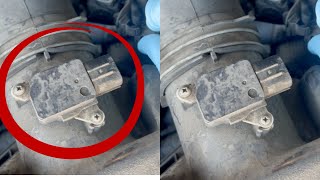
Typical fix: First, attempt to clean the sensor using a dedicated MAF sensor cleaner spray. 🎬 Watch: How to clean your Scion tC MAF sensor properly. Do not touch the delicate sensor wires. If cleaning doesn't resolve the issue, the sensor must be replaced.
Est. part cost: $10 (cleaner) - $150 (new sensor) - Failing Upstream Air/Fuel (A/F) Ratio Sensor 🔴 High Probability This sensor (also called Bank 1, Sensor 1) works constantly to measure the air-fuel mixture. As mentioned, the 2AZ-FE's oil consumption issue can foul the sensor with burnt oil deposits, causing it to read inaccurately and leading the ECU to inject too much fuel. It is a very common failure point on this engine.
How to confirm: Use a scan tool with live data capabilities to graph the A/F sensor's voltage. A healthy sensor will fluctuate rapidly. A lazy or dead sensor will have slow or no response. A sensor biased lean will cause the computer to add fuel, resulting in a rich condition and negative long-term fuel trims of -10% or more.
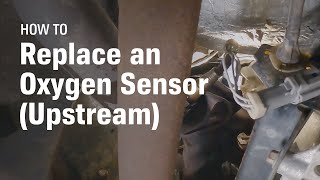
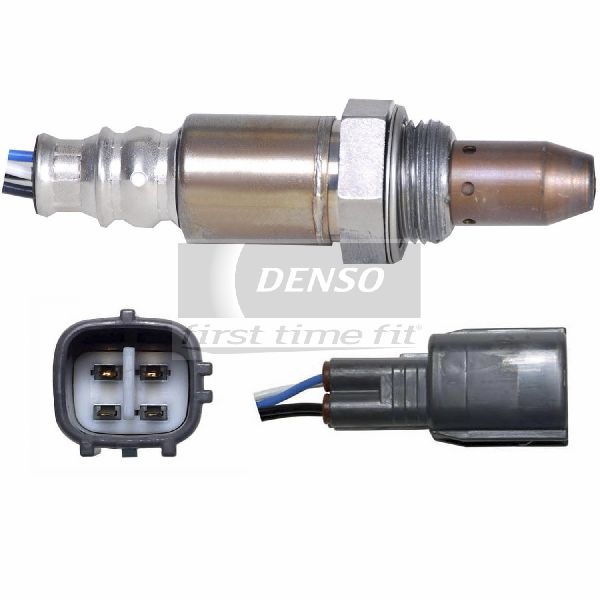
Typical fix: Replacement of the upstream A/F ratio sensor located in the exhaust manifold. Using a special O2 sensor socket is required. 🎬 See this walkthrough on replacing the upstream air/fuel ratio sensor. Denso is the OEM supplier and highly recommended.
Est. part cost: $120-$200 - Leaking Fuel Injector(s) 🟡 Medium Probability Injectors can fail over time, either by getting stuck open or developing a poor seal at the O-ring, causing raw fuel to leak into a cylinder.
How to confirm: A strong fuel smell in the engine bay or on the dipstick is a major clue. You can perform a fuel pressure leak-down test. Another method is to remove the fuel rail with injectors attached, pressurize the system, and watch for drips from the injector nozzles. Pulling spark plugs can also reveal if one cylinder is running richer (black and sooty) than others.
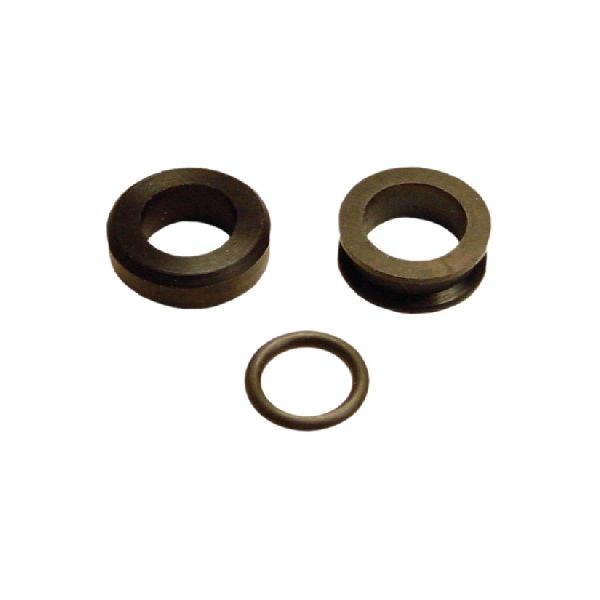
Typical fix: Replace the faulty fuel injector and its O-rings. It is often recommended to replace all four injectors as a set to ensure balanced fuel delivery.
Est. part cost: $50-$150 per injector
Rare But Worth Checking
- High Fuel Pressure: A faulty fuel pressure regulator can cause excessive pressure in the fuel rail, forcing too much fuel through the injectors. This is less common than sensor issues but should be checked if the main causes are ruled out. On some vehicles, a torn diaphragm in the regulator can leak fuel directly into the intake manifold through its vacuum line.
- Faulty Engine Coolant Temperature (ECT) Sensor: If the ECT sensor incorrectly tells the computer the engine is always cold, the computer will continuously run a rich fuel mixture intended for cold starts. This would typically be accompanied by other symptoms like a non-functional temperature gauge or cooling fan issues.
- Saturated EVAP Purge Canister: If the charcoal canister becomes saturated with fuel (often from overfilling the gas tank), the purge valve can draw raw fuel vapors into the intake manifold, creating a rich condition. This is less common but has been reported.
Diagnosis Steps
- Verify the code with an OBD-II scanner. Note the freeze frame data, paying close attention to the Long-Term Fuel Trim (LTFT), which will be highly negative (e.g., -10% to -25% or more). 🎬 Watch: A complete diagnosis and repair guide for the P0172 code.
- Inspect the engine bay for any obvious signs of a strong fuel smell, which could indicate a leaking injector or fuel line.
- Inspect the air intake system between the MAF sensor and the throttle body for any cracks or loose connections.
- Remove and inspect the Mass Airflow (MAF) sensor. If it appears dirty, clean it with dedicated MAF sensor cleaner. Reinstall and reset the ECU by disconnecting the battery for 15 minutes.
- If the code returns, use a scan tool to monitor the live data for the upstream A/F ratio sensor (Bank 1, Sensor 1). A healthy sensor should show rapidly fluctuating voltage. A slow or flat-lined sensor is likely faulty and needs replacement.
- Check fuel pressure using a fuel pressure gauge connected to the fuel rail. Compare the reading to the manufacturer's specification. Check the vacuum line to the fuel pressure regulator for the presence of raw fuel, which indicates a failed regulator diaphragm.
- If a specific cylinder is suspected (e.g., if you also have a P030x code), inspect the spark plug for that cylinder. A plug black with soot indicates a rich condition in that cylinder, pointing towards a leaking injector.
- Perform a fuel injector balance test or a leak-down test to confirm if one or more injectors are leaking.
Parts You'll Likely Need
- Upstream Air/Fuel Ratio Sensor
(OEM #89467-06030)— This is the primary sensor the ECU uses to determine fuel mixture. It is a common failure point and can be fouled by the engine's tendency to consume oil. Denso is the OEM supplier.
Trusted brands: Denso (P/N: 234-9049 or 234-9041 depending on specific model year/transmission)
OEM price range: $190-$220
Aftermarket price range: $120-$180 - Mass Airflow (MAF) Sensor
(OEM #22204-22010 (supersedes 22204-0C020, 22204-0D030))— A dirty or failed MAF sensor provides incorrect airflow data to the ECU, directly causing an incorrect fuel mixture and is a very common cause for this code.
Trusted brands: Denso
OEM price range: $120-$160
Aftermarket price range: $60-$110 - Fuel Injector
(OEM #23250-28070)— An injector that is mechanically stuck open or has a failed O-ring seal will continuously leak fuel, causing a rich condition.
Trusted brands: Denso, Standard Motor Products
OEM price range: $150-$200
Aftermarket price range: $50-$120
Related Codes That Often Appear With This One
- P0101 — This code indicates a fault with the Mass Airflow (MAF) sensor circuit, which is a primary cause of P0172.
- P0300, P0301, P0302, P0303, P0304 — A severely leaking fuel injector can flood a cylinder, causing a misfire code for that specific cylinder. Additionally, the oil consumption issue noted in TSB S-SB-0031-14 can also cause misfire codes from fouled plugs.
Technical Service Bulletins (TSBs) & Recalls
- S-SB-0031-14: '2AZ-FE Engine Oil Consumption Inspection Procedure' - Applies to 2007-2009 tC. Outlines the procedure to confirm excessive oil consumption, which is a known precursor to fouled sensors.
- T-SB-0094-11: '2AZ-FE Engine Oil Consumption Repair Procedure' - The broader Toyota TSB covering multiple vehicles with the 2AZ-FE engine, including Camry and RAV4, detailing the piston assembly replacement to fix oil consumption.
Platform-Specific Known Issues
- The 2AZ-FE engine in 2007-2010 Scion tC models is subject to a Technical Service Bulletin (S-SB-0031-14) for excessive oil consumption. Defective piston rings can cause the engine to burn more than 1 quart of oil in 1,200 miles. This can foul spark plugs and, more critically, the upstream A/F sensor, which may directly cause a P0172 code or be misdiagnosed as a primary fuel system problem.
Mechanic-Grade Diagnostic Values
- Fuel Pressure (at idle) — expected: 304 to 343 kPa (44.1 to 49.7 psi). Failure: Pressure significantly above this range indicates a faulty regulator; pressure below indicates a potential pump or filter issue.
- Fuel Pressure Leak-Down — expected: Pressure should remain above 147 kPa (21 psi) for 5 minutes after turning the engine off.. Failure: A rapid drop in pressure points to a leaking fuel injector, fuel pump check valve, or pressure regulator.
- Mass Airflow (MAF) Sensor Reading at Idle — expected: 0.58 to 4.67 g/s (A/T) or 0.54 to 4.33 g/s (M/T) with a warm engine, in neutral, A/C off. A general rule of thumb is engine displacement in liters should roughly equal g/s (e.g., 2.4L ≈ 2.4 g/s).. Failure: A reading that is significantly higher than expected can cause a rich condition. A lower reading would cause a lean condition.
- Upstream Air/Fuel (A/F) Ratio Sensor Voltage at Idle — expected: 2.8 to 3.8 V. Failure: A voltage that is stuck, slow to respond, or biased outside this range indicates a faulty sensor. A sensor reading consistently low (e.g., <2.8V) may be incorrectly telling the ECU the mixture is lean, causing it to add fuel and trigger a rich code.
- Fuel Injector Pulse Width at Idle — expected: 1.92 to 3.37 ms. Failure: A significantly shorter pulse width indicates the ECU is trying to correct a rich condition by injecting less fuel. This confirms the rich condition but doesn't pinpoint the cause.
- Fuel Injector Coil Resistance — expected: 11.6 to 12.4 Ω at 20°C (68°F). Failure: Resistance outside this range indicates a faulty injector coil.
Hidden / Shadow Codes Worth Checking
- Mode $06 Test Results: This is not a specific code, but a diagnostic mode that shows results from the ECU's self-tests before a DTC is set. A technician can view the test results for the A/F sensor (e.g., Test ID $01, Component ID $01) and fuel system monitors. A failing value in Mode $06 can point to a component that is on the verge of failure, even if the P0172 code is not yet present or is intermittent. (see via Professional scan tools like Toyota Techstream or others with Mode $06 capability.)
Scan Tool Commands That Help
- Toyota Techstream: Active Test: Fuel Cut — To isolate a leaking fuel injector. By sequentially cutting fuel to each cylinder, you can watch for changes in fuel trim or engine smoothness. If you cut fuel to a cylinder and the rich condition improves (fuel trims move toward zero), that cylinder's injector is the likely culprit.
- Toyota Techstream: Active Test: Control the Fuel Pump / Speed — To test the fuel pump and check for correct fuel pressure without the engine running. This helps separate a fuel delivery problem from an engine operational issue.
- Toyota Techstream: Utility: Reset Memory — This is a critical final step after replacing a component like an A/F sensor, MAF sensor, or fuel injectors. It clears the long-term fuel trim values that the ECU has learned, forcing it to re-learn based on the new, correctly functioning parts. Failing to do this can cause the code to return even after a successful repair.
Wiring & Ground Locations
- EA, EB, EC, ED — These are common Toyota ground point designators. On a similar chassis, EA and EB are located on the right-side fender and engine compartment, while EC and ED are on the left-side fender area.. The MAF and A/F sensors rely on a clean ground reference to send accurate signals to the ECU. A corroded or loose engine or chassis ground can cause erratic sensor readings, leading to incorrect fuel calculations and codes like P0172.
- ECM Connector Pins — At the Engine Control Module (ECM), typically located behind the glove box.. A technician can back-probe the pins for the A/F sensor and MAF sensor at the ECM to verify the signal the computer is actually receiving. This helps determine if a sensor is bad or if there is a wiring issue (short, open, or high resistance) between the sensor and the ECM.
"I Checked Everything" — The Actual Cause
- A smoke test is for vacuum leaks, which cause lean codes (P0171). For a rich code (P0172), a more relevant scenario is when all sensors test good. A documented cause for the 2AZ-FE is fuel dilution of the engine oil, often from repeated short-trip driving where the engine doesn't reach full operating temperature. This fuel-laden oil is then pulled through the PCV system into the intake, creating a rich mixture that the sensors correctly detect but cannot compensate for. The fix is an oil change and advising the owner to ensure the vehicle is driven long enough to fully warm up regularly.
OEM Part Supersession History
Denso 234-9041→Denso 234-9049— Part update/consolidation by the manufacturer.
Heads up: While 234-9041 is listed for the 2005-2010 tC, multiple parts suppliers note to sell out the old stock and reorder 234-9049 as the current replacement for the upstream A/F sensor. Using the most current part number is recommended to ensure compatibility and the latest design.
Model Year Variations Within This Range
- 2005-2006 vs. 2007-2010: The 2AZ-FE engine was updated for the 2007 model year. The later engines (07-10) feature higher compression, piston oil squirters, and a different intake camshaft. While a long block can be swapped between the year groups, the ECU and some external components like the thermostat housing may differ. The excessive oil consumption TSB also primarily targets the updated 2007-2009 engines.
Diagnostic Flowchart
Real Owner Stories
Aggregated from forums and TSBs cited above. Mileages and costs reflect what owners reported in those sources.
Scion tC
Symptoms: Check Engine Light illuminated with a P0172 rich code after installing an aftermarket Injen intake.
What fixed it: Diagnosing the aftermarket intake and its effect on the MAF sensor.
Source hint: ScionLife.com: 'CEL Code P0172: Help Needed'
2007-2009 Scion tC 2AZ-FE
Symptoms: Engine burning more than 1 quart of oil every 1,200 miles, resulting in fouled spark plugs and a fouled upstream A/F sensor that triggered a rich code.
What fixed it: Inspection and confirmation of defective piston rings per the manufacturer service bulletin.
Source hint: TSB S-SB-0031-14: '2AZ-FE Engine Oil Consumption Inspection Procedure'
Toyota Camry / RAV4 (2.4L 2AZ-FE)
Symptoms: Excessive oil consumption leading to fouled sensors and fuel trim issues.
What fixed it: Piston assembly replacement to resolve the underlying oil consumption defect.
Source hint: TSB T-SB-0094-11: '2AZ-FE Engine Oil Consumption Repair Procedure'
Related OBD-II Codes
Frequently Asked Questions
Does the excessive oil consumption TSB apply to my Scion tC and cause a rich condition?
Can an aftermarket air filter cause fuel trim codes on my 2.4L tC?
Which brand of A/F ratio sensor should I use for replacement on my 2AZ-FE?
How can I tell if my fuel injectors are leaking on my Scion tC?
What should the Long-Term Fuel Trim (LTFT) look like on a scan tool if my tC is running rich?
Helpful Videos




Used OEM Parts in Stock


New Aftermarket Parts Available


The information in this article is provided for general reference and educational purposes only. Vehicle specifications, procedures, and part compatibility can vary by production date, trim level, and region. Always consult your vehicle's factory service manual and verify part numbers before purchasing or performing repairs. Safety-critical components such as airbags, seat belts, and braking systems should be installed by a qualified professional.
- Scion tC:
- 🎬 Helpful Videos
- 🛍️ Shop This Part
- What's Unique About the 2005-2010 Scion tC
- Symptoms You May Notice
- Most Likely Causes
- Rare But Worth Checking
- Diagnosis Steps
- Parts You'll Likely Need
- Related Codes That Often Appear With This One
- Technical Service Bulletins (TSBs) & Recalls
- Platform-Specific Known Issues
- Mechanic-Grade Diagnostic Values
- Hidden / Shadow Codes Worth Checking
- Scan Tool Commands That Help
- Wiring & Ground Locations
- "I Checked Everything" — The Actual Cause
- OEM Part Supersession History
- Model Year Variations Within This Range
- Diagnostic Flowchart
- Real Owner Stories
- Scion tC
- 2007-2009 Scion tC 2AZ-FE
- Toyota Camry / RAV4 (2.4L 2AZ-FE)
- Related OBD-II Codes
- Frequently Asked Questions
- 🎟️ Get 5% Off