

P0141 on 1997-2006 BMW 3-Series: O2 Sensor Heater Fixes & Causes
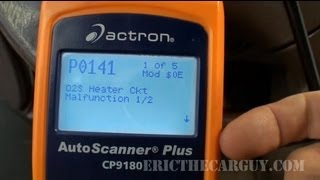
On a 1997-2006 BMW 3-Series (E36/E46), code P0141 is almost always caused by a failed downstream (post-cat) oxygen sensor for Bank 1. Before replacing the sensor, it is critical to check the 30-amp fuse in the under-hood electronics box (E-box), as this is a very common failure point, especially if other O2 heater codes are present. A new OEM-quality Bosch sensor costs around $60-$90.
- P0141 points to a bad heater in the O2 sensor after the catalytic converter (Bank 1).
- Before buying any parts, check for other O2 heater codes. If you have more than one, the problem is likely a single 30A fuse hidden in the E-box under the hood.
- If P0141 is the only code, the downstream O2 sensor for cylinders 1-3 has most likely failed and needs to be replaced.
- Bosch is the original equipment manufacturer for these sensors; using an OEM-quality part is recommended.
- This fault will not leave you stranded but should be fixed to ensure proper emissions and to pass inspections.
What's Unique About the 1997-2006 BMW 3-Series
For the E36 and E46 3-Series, a very common point of failure for this code is not the sensor itself, but a shared fuse that powers the heaters for multiple O2 sensors. This 30-amp fuse is located in a small, separate black fuse holder inside the main electronics box (E-box) under the hood. Accessing it requires removing the passenger-side cabin air filter housing. Owners frequently replace an O2 sensor only to find the code returns because the underlying issue was this hidden fuse. If you have multiple O2 heater codes (e.g., P0135, P0155, P0161) along with P0141, a blown fuse is the most likely culprit.
Generation note: This range covers the end of the E36 generation (1997-1999) and the full E46 generation (1998-2006), which used the M52, M52TU, and M54 inline-6 engines. The meaning of the code and the diagnostic approach are identical for both generations. The primary difference may be the exact OEM part number for the O2 sensor, but the common causes and fixes apply across these platforms.
Symptoms You May Notice
- Check Engine Light is on
- Failure to pass an emissions test
- Slightly decreased fuel economy over a long period (often not noticeable by the driver)
- Rough idle on cold starts (rare)
- Replacing the O2 sensor when the hidden 30A fuse in the E-box was the actual problem. This is especially common if multiple O2 heater codes are present.
- Replacing the wrong O2 sensor (e.g., replacing the pre-cat sensor instead of the post-cat, or replacing Bank 2 instead of Bank 1).
Most Likely Causes
- Failed Oxygen Sensor 🔴 High Probability The internal heater element is a resistor that simply burns out over time from thousands of heat cycles. It's a common wear-and-tear item, especially on vehicles over 100,000 miles.
How to confirm: After confirming the fuse and wiring are intact, test the resistance across the two heater wires on the sensor's connector (usually the two same-colored wires, often white on Bosch sensors). A healthy sensor will have a low resistance, typically between 2 and 6 ohms when cold at 68°F (20°C). An open circuit (infinite resistance) confirms the internal heater has failed. 🎬 See how to test O2 sensor heater resistance with a multimeter.
Typical fix: Replace the Bank 1, Sensor 2 (downstream, cylinders 1-3) oxygen sensor. An O2 sensor socket is highly recommended for removal. 🎬 Watch: Step-by-step guide to replacing the downstream sensor.
Est. part cost: $60-$120 - Blown O2 Sensor Heater Fuse 🟡 Medium Probability This fuse can blow due to a short in any of the O2 sensor wiring harnesses, often from contact with hot exhaust components or age-related wire degradation. It's a frequent issue on the E46 platform that protects all four O2 sensor heaters.
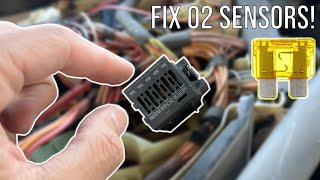
How to confirm: Access the electronics box (E-box) under the hood (passenger side, beneath the cabin air filter housing). Inside, find a small black fuse carrier with five fuses. Check the 30-amp fuse (often position F1-F5, specifically fuse #4 on many models) that powers the O2 sensor heaters. If multiple O2 heater codes (P0135, P0155, P0161) are present, this is the first thing to check. 🎬 Watch: How to find and fix the hidden O2 sensor fuse.
Typical fix: Replace the blown 30-amp fuse and inspect all four O2 sensor wiring harnesses for shorts to ground to prevent a repeat failure.
Est. part cost: $1-$5 - Damaged Wiring or Connector ⚪ Low Probability The sensor wiring is routed near the hot exhaust and underbody of the car, making it susceptible to melting, chafing, or damage from road debris. The plastic connectors can also become brittle and break.
How to confirm: Visually inspect the wiring harness from the O2 sensor to its connection point. Look for any signs of melting, frayed wires, or physical damage. Check the connector pins for corrosion, moisture, or damage. A continuity test from the DME connector to the sensor connector can confirm a wiring break.
Typical fix: Repair the damaged section of the wire or replace the connector pigtail.
Est. part cost: $10-$30
Rare But Worth Checking
- Faulty Engine Control Module (DME): This is extremely rare. The internal driver circuit in the DME that provides the pulsed ground signal to the heater can fail. This should only be considered after all other possibilities (sensor, fuse, wiring) have been definitively ruled out and confirmed with advanced diagnostics.
Diagnosis Steps
- Read all fault codes with an OBD-II scanner. Note if other O2 sensor heater codes (P0135, P0155, P0161) are present.
- If multiple heater codes are stored, immediately suspect the shared 30A fuse. Proceed to Step 3.
- Locate the electronics box (E-box) under the hood on the passenger side, beneath the cabin air filter housing. Remove the housing for access.
- Open the E-box cover (typically 4-5 screws). Find the small, separate black fuse holder containing 5 fuses. Inspect the 30-amp fuse for the O2 sensor heaters. Replace if blown.
- If the fuse is good or only P0141 is present, locate the Bank 1 Sensor 2 O2 sensor. It is downstream of the catalytic converter for cylinders 1-3 (the front half of the engine).
- Inspect the sensor's wiring harness and connector for any visible damage, melting, or corrosion.
- If wiring appears okay, disconnect the sensor. Use a multimeter to check for resistance between the two heater pins on the sensor side (typically two white wires on a Bosch sensor). A reading between 2-6 Ohms is good. An open loop (OL) or infinite resistance means the heater is broken and the sensor must be replaced.
- If resistance is within spec, check for 12V power at the corresponding pins on the harness side with the ignition on. If no power is present, re-check the fuse and trace the power wire.
- If power is present and the sensor's heater has good resistance, the issue could be in the ground signal wire leading back to the DME. This is a rare wiring fault that requires more advanced tracing.
Parts You'll Likely Need
- Downstream Oxygen Sensor (Bank 1, Sensor 2)
(OEM #11781433940)— This is the most common cause of a solitary P0141 code, as the internal heater fails with age.
Trusted brands: Bosch (OEM), NTK, Denso
OEM price range: $90-$140
Aftermarket price range: $60-$90 - 30 Amp Blade Fuse
(OEM #61131387683)— This fuse protects the heater circuits for all O2 sensors and is a common failure point on the E46 platform, causing multiple heater codes.
Trusted brands: Littelfuse, Bussmann
OEM price range: $1-$5
Aftermarket price range: $1-$5
Related Codes That Often Appear With This One
- P0135 — Heater circuit fault for Bank 1, Sensor 1. If seen with P0141, it strongly suggests a common power supply issue, like the 30A E-box fuse.
- P0161 — Heater circuit fault for Bank 2, Sensor 2. If seen with P0141, it also points to a common power supply issue like the fuse.
- P0155 — Heater circuit fault for Bank 2, Sensor 1. If seen with P0141, it strongly suggests a common power supply issue.
Platform-Specific Known Issues
- The O2 sensor heater fuse is not in the main glove box fuse panel, but is hidden within the DME/ECU electronics box under the hood, leading to frequent misdiagnosis.
- Owner Experience: A user on bimmerforums.com with a 2001 330ci reported getting P0141 and P0161 simultaneously. Instead of replacing both O2 sensors, they checked the E-box and found the 30A fuse was blown. Replacing the fuse and clearing the codes resolved the issue, saving hundreds of dollars.
Mechanic-Grade Diagnostic Values
- O2 Sensor Heater Element Resistance — expected: 2.0 - 6.0 Ohms at 68°F (20°C). Failure: Open circuit (infinite resistance) or resistance far outside the expected range.
- Voltage at O2 Sensor Harness (Heater Power Pin) — expected: ~12V (Battery Voltage) with ignition on. Failure: 0V or significantly low voltage, indicating a blown fuse or wiring issue.
- Post-Catalyst O2 Sensor Live Data (at steady idle/cruise) — expected: A steady voltage between 0.7V and 0.8V.. Failure: Voltage fluctuating rapidly similar to the pre-cat sensor, or a flatline at a very low voltage.
Scan Tool Commands That Help
- ISTA/D or DIS: DME -> Diagnostics Scan -> Oxygen Sensor Control -> Test Schedule — To have the DME run a guided test of the oxygen sensor circuits, including the heater, and display live voltage data to confirm sensor operation after a repair or during diagnosis.
- INPA: Engine -> MS43 -> Analog Values -> O2 Sensors — For viewing raw, real-time voltage data from all four oxygen sensors simultaneously to quickly compare Bank 1 vs Bank 2 and pre-cat vs post-cat sensor behavior.
Wiring & Ground Locations
- DME Connector (MS43) — Inside the electronics box (E-box) on the passenger side of the engine bay, under the cabin air filter housing.. This is the termination point for the sensor wiring. Testing for continuity between the sensor connector and the correct DME pin can definitively rule out a wiring break. Pinouts vary, but for MS43, the post-cat heater signal can be on Pin 7 or Pin 15 of specific connectors.
- O2 Sensor Connector (Heater Ground) — On the sensor-side of the electrical connector for the O2 sensor.. The DME provides a pulsed ground to Pin 2 (often a black/blue wire) of the sensor connector to control the heater. Checking for this ground signal with a test light can diagnose a failed DME driver.
- O2 Sensor Connector (Heater Power) — On the harness-side of the electrical connector for the O2 sensor.. Pin 3 of the connector should have ~12V with the ignition on, supplied via the 30A fuse in the E-box. No voltage here points directly to a power supply issue, not a sensor or DME ground issue.
Real Owner Repair Stories
- Reddit user on r/e46 (BMW E46 (year not specified)) — Codes P0135, P0141, P0155, P0161 (all four O2 heater circuits) plus multiple random misfire codes (P0300, P0302-P0306).
❌ Tried (didn't work) The user was considering replacing all O2 sensors and investigating the crankshaft position sensor for the misfires.
✅ What actually fixed it Forum advice correctly identified that all four heater circuits failing simultaneously is extremely unlikely. The root cause was pointed out to be a common power supply issue, almost certainly the 30A fuse in the E-box that powers all four heaters. The misfires were likely a secondary result of the faulty sensor readings. - BMW Owner (NHTSA ODI #11495474) — An owner reported using a computerized diagnostics tool that identified error HO2S 12 Heater Control Circuit, specifically code P0141 for the Bank 1 Sensor 2 downstream oxygen sensor heater circuit malfunction.
OEM Part Supersession History
11781433940→11781433940 (current)— N/A, part number has remained stable.
Heads up: For E46 325i/330i models, this part number is only correct for vehicles produced up to February 2003. Later models use a different sensor. For the E85 Z4, this part is for Bank 1 only; Bank 2 uses a different part number.
Model Year Variations Within This Range
- 1998-2000 (M52TU) vs 2001-2006 (M54): The M52TU engine uses the Siemens MS42 DME, while the M54 engine uses the MS43. While functionally similar, this results in different DME pinouts for electrical testing. The M52TU also uses a mechanical throttle cable as a backup to its electronic throttle, whereas the M54 is fully drive-by-wire.
- 2003-2006 (325i/330i models): Models produced after February 2003 use a different downstream oxygen sensor part number than earlier models. Using part number 11781433940 on these later cars will not work correctly.
Diagnostic Flowchart
Other Known Issues on This Vehicle
Issues unrelated to this code that are worth knowing about as an owner of this generation:
- Cooling System Failure 🔴 High — Very common. Plastic components like the expansion tank, radiator necks, and water pump impeller become brittle and fail, typically between 60,000-100,000 miles. Overheating can cause catastrophic engine damage.
- Rear Subframe Mount Cracks (E46) 🔴 High — A widespread issue affecting all E46 models where the sheet metal of the rear axle carrier panel cracks around the subframe mounting points. Not a matter of if, but when. BMW initiated a recall/repair campaign in some markets. (Ref: BMW offered a goodwill repair procedure involving injecting structural foam and, in severe cases, welding reinforcement plates.)
- VANOS System Failure 🟠 Medium — The seals in the VANOS (variable valve timing) unit degrade over time, causing a rattling noise from the engine, rough idle, and loss of low-end torque. Typically occurs after 70,000 miles.
- Oil Leaks (Valve Cover Gasket, Oil Filter Housing Gasket) 🟠 Medium — Extremely common. The rubber gaskets harden and shrink with age and heat cycles, leading to significant oil leaks. Typically requires attention every 80,000-100,000 miles.
- DISA Valve Failure (M54 Engine) 🟠 Medium — The plastic flap or pin on the DISA (differentiated air intake) valve can break, causing a rattling sound and potentially sending debris into the engine. Failure is common around 100,000 miles.
- Window Regulator Failure 🟡 Low — Very common on E46 models. The plastic clips that hold the window glass to the regulator break, causing the window to fall into the door.
- Rust (E36) 🟠 Medium — Common on E36 models, especially in areas with road salt. Key areas to check are wheel arches, jack pads, and sills.
Used vs. New Parts: Buying Guide for This Vehicle
When a used part is the smart pick: For this repair, a used part is almost never a smart choice for the oxygen sensor itself. However, obtaining a used wiring connector pigtail from a junkyard is a viable option if only the connector is broken.
Donor-vehicle mileage cap: roughly under 120000 miles for the part to have meaningful remaining life.
What to inspect on the donor part:
- For a wiring pigtail, ensure the plastic is not brittle or cracked.
- Check for any signs of melting on the connector or wires.
- Verify the locking tab on the connector is intact.
- Ensure there is at least 6-8 inches of wire attached for easier splicing.
OEM-only on this vehicle (don't cheap out):
- While not strictly 'OEM-only', it is highly recommended to use the OEM supplier (Bosch) or a reputable OE-equivalent brand for the oxygen sensor. Cheap, unbranded sensors are known for premature failure and inaccurate readings.
Aftermarket brands forum-validated for this vehicle:
- Bosch (OEM supplier)
- NTK
- Denso
Brands owners have reported issues with on this vehicle:
- Unbranded 'eBay' or 'Amazon' special sensors.
- Universal sensors that require cutting and splicing wires are generally not recommended over direct-fit options due to the risk of poor connections causing resistance issues.
Real Owner Stories
Aggregated from forums and TSBs cited above. Mileages and costs reflect what owners reported in those sources.
2001 330ci
Symptoms: Check Engine Light on with codes P0141 and P0161 appearing simultaneously.
What fixed it: Instead of replacing the O2 sensors, the owner checked the E-box under the hood and found the 30A fuse for the O2 sensor heaters was blown. Replacing the fuse and clearing the codes resolved the issue.
Source hint: bimmerforums.com user experience cited in Vehicle Specific Issues
BMW Owner Experience
Symptoms: Diagnostics tool identified error HO2S 12 Heater Control Circuit specifics: Engine code P0141 – O2 Sensor Heater Circuit Malfunction (Bank 1- Sensor 2) Downstream.
What fixed it: This report (NHTSA ODI #11495474) confirms the diagnostic identification of the downstream heater circuit failure on this manufacturer's platform.
Source hint: NHTSA ODI #11495474
Related OBD-II Codes
Frequently Asked Questions
Where is the fuse for the O2 sensor heater on my E46? I can't find it in the glove box.
I have P0141 along with other O2 sensor heater codes like P0135 and P0161. Should I replace all the sensors?
Which specific oxygen sensor is 'Bank 1, Sensor 2' on my 1997-2006 3-Series?
How can I test the O2 sensor heater to confirm it has failed?
Will the P0141 code cause any serious driving issues or damage my engine?
Helpful Videos
We Have This Part in Stock



The information in this article is provided for general reference and educational purposes only. Vehicle specifications, procedures, and part compatibility can vary by production date, trim level, and region. Always consult your vehicle's factory service manual and verify part numbers before purchasing or performing repairs. Safety-critical components such as airbags, seat belts, and braking systems should be installed by a qualified professional.
- BMW 3-Series:
- 🎬 Helpful Videos
- 🛍️ Shop This Part
- What's Unique About the 1997-2006 BMW 3-Series
- Symptoms You May Notice
- Most Likely Causes
- Rare But Worth Checking
- Diagnosis Steps
- Parts You'll Likely Need
- Related Codes That Often Appear With This One
- Platform-Specific Known Issues
- Mechanic-Grade Diagnostic Values
- Scan Tool Commands That Help
- Wiring & Ground Locations
- Real Owner Repair Stories
- OEM Part Supersession History
- Model Year Variations Within This Range
- Diagnostic Flowchart
- Other Known Issues on This Vehicle
- Used vs. New Parts: Buying Guide for This Vehicle
- Real Owner Stories
- 2001 330ci
- BMW Owner Experience
- Related OBD-II Codes
- Frequently Asked Questions
- 🎟️ Get 5% Off