

P0139 on 2003-2009 Mercedes-Benz E-Class: Slow O2 Sensor Response Causes and Fixes
On a 2003-2009 Mercedes E-Class, code P0139 almost always means the downstream oxygen sensor (Bank 1, Sensor 2) is old and needs replacement. This is the sensor on the passenger side, after the catalytic converter. Expect to pay $70-$150 for a quality aftermarket sensor (like Bosch) and about one hour of labor. Before replacing, quickly check for exhaust leaks and wiring damage.
- P0139 points to the downstream (post-catalytic converter) O2 sensor on the passenger side.
- The most likely cause is simply an old, worn-out sensor that needs to be replaced.
- Before replacing the sensor, always check for exhaust leaks (listen for ticking when cold) and inspect the sensor's wiring for damage.
- This fault will cause an automatic failure on an emissions test, so it must be repaired to keep the car legally on the road in most states.
- Replacing an O2 sensor is a manageable DIY job, but requires an O2 sensor socket and can be difficult if the old sensor is rusted in place.
- Be sure to purchase the correct sensor for your specific engine (M113 V8 or M272 V6) as the parts are different.
What's Unique About the 2003-2009 Mercedes-Benz E-Class
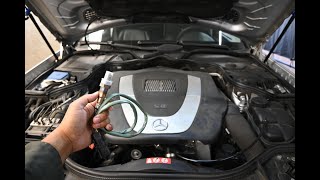
For the W211 E-Class, this code is straightforward and typically doesn't point to a unique platform-specific flaw. The causes are standard for this fault code across many vehicles. The main variation within this year range is the engine: earlier models often feature the M113 V8, while the 2006+ facelift brought the M272 V6. 🎬 See how to replace O2 sensors on the M272 engine. While the root cause of P0139 is the same, the exact part number and physical location of the Bank 1, Sensor 2 will differ between these engine types.
Symptoms You May Notice
- Check Engine Light is on.
- Failing a state emissions/smog test.
- Slightly reduced fuel economy (though may not be noticeable).
- Occasional rough idle or hesitation on deceleration (rare).
- Replacing the O2 sensor without first checking for exhaust leaks. An exhaust leak will cause the new sensor to report slow readings as well, leading to the code returning.
- Replacing the wrong sensor. This code is for Bank 1 (passenger side) and Sensor 2 (downstream/post-cat). It is easy to confuse it with Sensor 1 (upstream/pre-cat) or the sensors on Bank 2 (driver's side).
Most Likely Causes
- Failing or Aged Downstream Oxygen Sensor 🔴 High Probability Oxygen sensors are wear items. After 100,000+ miles, the internal sensing element becomes contaminated with carbon and exhaust deposits, slowing its ability to react.
How to confirm: Use a scan tool to graph the voltage for 'Bank 1 Sensor 2'. A healthy downstream sensor should show a relatively steady voltage between 0.6V and 0.8V when the engine is warm and at a steady RPM. A slow sensor will have lazy, choppy, or flat-lined voltage readings that do not respond quickly when the engine is revved and then allowed to return to idle. 🎬 Watch: How to diagnose a slow response O2 sensor code. The code may set if the sensor voltage fails to drop below 0.2V for more than 7 seconds during deceleration fuel cut-off.
Typical fix: Replace the Bank 1, Sensor 2 oxygen sensor. It is located on the passenger side exhaust pipe, after the catalytic converter.
Est. part cost: $70-$150 - Exhaust System Leak 🟡 Medium Probability Exhaust components, particularly flex pipes and flange gaskets, can develop small cracks or leaks over time due to heat cycles and corrosion. These leaks allow outside air to enter the exhaust stream, skewing the O2 sensor's readings.
How to confirm: Listen for a 'ticking' or 'puffing' sound from the exhaust, especially when the engine is cold, that may quiet down as it warms up. Visually inspect the exhaust manifold and pipes leading to the sensor for black soot marks, which indicate a leak. A smoke test is the most definitive way to find small leaks.
Typical fix: Repair the leak. This may involve replacing a gasket, welding a crack, or replacing a section of pipe. The leak must be fixed before replacing the O2 sensor, as it is the root cause.
Est. part cost: $10-$200 - Damaged Wiring or Connector ⚪ Low Probability The sensor wiring runs under the car and is exposed to heat, road debris, and moisture, which can cause corrosion or physical damage over time. The harness can sometimes rub against the transmission bellhousing or driveshaft if not properly secured. On M272 engines, leaking camshaft adjuster solenoids can also cause oil to wick through the engine harness and contaminate sensor connectors.
How to confirm: Visually inspect the wiring harness leading to the Bank 1 Sensor 2. Look for any signs of melting, chafing against the chassis or exhaust, or corrosion in the connector pins. Unplug the connector and check for the presence of engine oil. Use a multimeter to check for continuity and voltage between the ECM and the sensor connector. Resistance over 5 ohms indicates a problem.
Typical fix: Repair the damaged section of the harness or clean the connector terminals. If damage is severe, a new connector pigtail may need to be spliced in. If oil contamination is present from cam solenoids, the source of the leak must be fixed and the harness cleaned or replaced.
Est. part cost: $20-$50
Rare But Worth Checking
- Engine Control Module (ECM/PCM) Software Issue: In some cases, the logic within the engine computer for monitoring the sensor can be overly sensitive. A software update from a Mercedes-Benz dealer can sometimes resolve the issue if a new sensor and verified wiring do not fix the code.
Diagnosis Steps
- Use an OBD-II scanner to confirm P0139 is the only code present. If other codes like misfires (P030x) or lean/rich conditions (P0171/P0172) are active, diagnose and fix them first.
- Perform a thorough visual inspection of the exhaust system from the engine to the rear of the car. Look for soot, listen for leaks (especially on a cold start), and check for physical damage.
- Inspect the wiring and connector for the Bank 1, Sensor 2 (passenger side, post-catalytic converter). Check for any signs of melting, chafing, or corrosion. On M272 engines, specifically check for oil inside the connector.
- With a scan tool capable of graphing live data, monitor the voltage of 'B1S2' (Bank 1, Sensor 2). At a steady 2500 RPM, the voltage should be relatively stable, typically between 0.6V and 0.8V. When you snap the throttle, the voltage should react. If it's slow to change, fluctuating wildly, or stuck (e.g., at 0.45V), the sensor is likely bad.
- If the wiring and exhaust are good, and the live data points to a slow sensor, replace the Bank 1, Sensor 2 oxygen sensor.
- Clear the code and perform a drive cycle to ensure the code does not return.
Parts You'll Likely Need
- Oxygen Sensor (Bank 1, Sensor 2)
(OEM #M113 V8: A0015400517; M272 V6: A0035427218)— This is the component that has aged and is no longer responding quickly enough, which is the direct cause of the code in most cases.
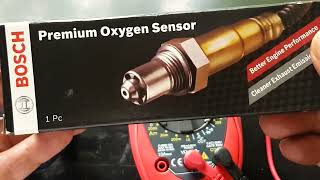
Trusted brands: Bosch (OEM), Denso
OEM price range: $120-$200
Aftermarket price range: $70-$150
Related Codes That Often Appear With This One
- P0420 — P0420 means 'Catalyst System Efficiency Below Threshold'. Since P0139 indicates the sensor that monitors the catalyst is slow, the computer may not be able to trust its reading and could flag the catalyst as well, or a failing catalyst could contribute to erratic sensor readings.
Platform-Specific Known Issues
- Sensor Location Varies by Engine: On the M113 V8 (E500), the Bank 1 Sensor 2 is relatively easy to access on the passenger side exhaust pipe. 🎬 Watch: Step-by-step O2 sensor replacement for M113 V8 engines. On the M272 V6 (E350), the exhaust routing is tighter, and while still accessible, may require more extensions and swivels to reach the sensor.
- Real Owner Repair Story: A user on MBWorld.org with a W211 E350 reported getting P0139 along with P2A00 and P2414. Their live data showed the Bank 1 Sensor 2 voltage stuck high at 0.890V while the other bank's sensor was reading normally. This pointed directly to a failed sensor rather than a systemic issue like an exhaust leak. Replacing the sensor resolved all codes.
Mechanic-Grade Diagnostic Values
- Downstream O2 Sensor (B1S2) Voltage at Idle/Steady RPM — expected: Relatively stable voltage between 0.6V and 0.8V.. Failure: Voltage is stuck (e.g., at 0.3V or 0.45V), flat-lined, or responds very slowly to throttle changes.
- Downstream O2 Sensor (B1S2) Voltage during Deceleration Fuel Cut-Off — expected: Voltage should drop below 0.2V quickly.. Failure: Voltage fails to drop below 0.2V for 7 seconds or more, triggering the P0139 code.
- O2 Sensor Heater Element Resistance — expected: Between 2 and 10 Ohms when measured across the two heater circuit pins (often the same color wires).. Failure: Infinite resistance (open circuit) or near-zero resistance (short circuit).
- O2 Sensor Signal Wire Resistance (from sensor connector to ECM) — expected: Less than 5 Ohms.. Failure: Resistance values above 5 Ohms suggest corrosion or a damaged wire in the harness.
Scan Tool Commands That Help
- Mercedes STAR/XENTRY: Guided Tests — To follow a manufacturer-specific diagnostic tree that prompts the technician to check specific values and components in the correct order for a given fault code.
- Mercedes STAR/XENTRY: Reset adaptations / Teach-in processes — After replacing a component like an O2 sensor or fixing a root cause like a vacuum leak, resetting the engine's learned fuel trim adaptations can help the system relearn faster with the new, correct sensor inputs. While specific O2 sensor calibration isn't required, resetting the overall engine adaptations is good practice.
Wiring & Ground Locations
- G3/6 — This is the Mercedes component identifier for the Right O2 sensor located after the TWC (catalytic converter). For a LHD vehicle, this corresponds to Bank 1 Sensor 2.. Knowing the official component name helps locate it in official wiring diagrams.
- W15/7 or W15/8 — These are ground points located in the right front footwell area of the W211 chassis.. The engine control unit and its associated sensor circuits often use grounds in the passenger footwell. A corroded or loose ground at this location could cause erratic sensor readings or faults.
Real Owner Repair Stories
- Reddit user in r/MechanicAdvice (Vehicle with P0139, specific model not mentioned but general principle applies.) — Check Engine Light with P0139, scan tool showed sensor voltage stuck at 0.3V.
❌ Tried (didn't work) Initial diagnosis
✅ What actually fixed it The user tested the old sensor by heating it with a propane torch and confirmed it was very slow to react. They spliced in a new universal Bosch O2 sensor, which resolved the code. After replacement, live data showed correct voltage fluctuation between 0.2V and 0.7V.
"I Checked Everything" — The Actual Cause
- In one documented case for a P0139 code, all standard checks (exhaust leaks, sensor, wiring) were fine. The actual root cause was a faulty fuel pressure regulator that was causing a rich condition. The downstream O2 sensor was correctly reporting the rich mixture, but its slow reaction to the abnormal state triggered the P0139 code. Replacing the fuel pressure regulator, not the O2 sensor, fixed the problem.
OEM Part Supersession History
Varies by engine (M113/M272)→Varies— Standard part evolution.
Heads up: The most critical issue is not supersession but brand compatibility and counterfeits. While Bosch is the OEM supplier, some vehicles can be sensitive to minor differences in aftermarket sensor calibration. Always use a reputable OE-quality brand like Bosch, NTK, or Denso. Be aware of counterfeit parts, especially for popular brands like Bosch, which may look identical but perform poorly or fail quickly.
Diagnostic Flowchart
Other Known Issues on This Vehicle
Issues unrelated to this code that are worth knowing about as an owner of this generation:
- M272 Engine: Balance Shaft Gear Wear 🔴 High — Common on M272 engines manufactured before engine number 2729..30 468993 (approx. pre-2008). Failure can occur between 60,000 and 100,000 miles. (Ref: A class-action lawsuit addressed this, but no formal recall was issued. A Mercedes-Benz service bulletin exists for the repair.)
- Sensotronic Brake Control (SBC) Pump Failure 🔴 High — The SBC pump has a pre-programmed service life based on brake pedal actuations. It will eventually time out, typically between 80,000-150,000 miles, triggering a red 'Visit Workshop' warning. (Ref: Mercedes extended the warranty on the SBC unit to 25 years with unlimited mileage, meaning dealers will often replace it for free.)
- Airmatic Suspension Failure 🟠 Medium — Common on models equipped with Airmatic. Rear air springs are the most common failure point, often leaking around 100,000-150,000 miles. The compressor can also fail from being overworked by leaks.
- M113 Engine: Harmonic Balancer Separation 🔴 High — Affects earlier M113 engines (approx. 1998-2002). The rubber dampener delaminates, causing the outer pulley ring to separate, which can damage the timing cover and other components. (Ref: A service campaign was issued in the US, but it's not a formal recall. Part numbers 112 035 00 00 and 112 035 06 00 are the primary ones of concern.)
- M272 Engine: Intake Manifold Tumble Flap Lever Failure 🟠 Medium — A plastic lever on the intake manifold that controls tumble flaps is prone to breaking, causing performance issues and sometimes a check engine light. Failure is common after 70,000 miles.
- M113 Engine: Valve Cover Gasket and Breather Hose Oil Leaks 🟡 Low — Very common as the engine ages (100,000+ miles). The valve cover gaskets and PCV breather hoses become brittle and leak oil.
Used vs. New Parts: Buying Guide for This Vehicle
When a used part is the smart pick: For this specific repair, a used part is almost never a smart choice. Oxygen sensors are wear items with a limited lifespan of around 100,000 miles. Installing a used sensor is likely to result in the same code returning shortly. A used exhaust pipe or manifold from a donor car could be a cost-effective fix for an exhaust leak, provided it is thoroughly inspected.
Donor-vehicle mileage cap: roughly under 100000 miles for the part to have meaningful remaining life.
What to inspect on the donor part:
- For exhaust components: check for rust perforation, especially at welds and flanges.
- Tap the component lightly with a hammer to listen for internal rattling that could indicate a failing catalytic converter.
- Ensure all mounting studs and flanges are intact and not severely corroded.
OEM-only on this vehicle (don't cheap out):
- While not strictly 'OEM-only', using a proven OE-quality brand for the oxygen sensor is critical. Cheap, no-name sensors are a common cause of repeat failures.
Aftermarket brands forum-validated for this vehicle:
- Bosch (OEM supplier for this vehicle)
- NTK
- Denso
Brands owners have reported issues with on this vehicle:
- Avoid unbranded, generic 'universal' sensors from online marketplaces that require splicing without a brand name attached. While some universal sensors from reputable brands are fine, the risk of poor quality from no-name sellers is very high.
Real Owner Stories
Aggregated from forums and TSBs cited above. Mileages and costs reflect what owners reported in those sources.
2006-2009 Mercedes-Benz E350 (W211) M272 V6
Symptoms: The user reported getting P0139 along with P2A00 and P2414. Live data showed the Bank 1 Sensor 2 voltage stuck high at 0.890V while the other bank's sensor was reading normally.
What fixed it: Replacing the Bank 1 Sensor 2 oxygen sensor resolved all codes.
Source hint: MBWorld.org - Thread 'O2 sensor problem': A user details their diagnostic process for P0139 and related codes on a W211, confirming with live data that the B1S2 sensor was faulty before replacing it. URL: https://mbworld.org/forums/e-class-w211/813351-o2-sensor-problem.html
Related OBD-II Codes
Frequently Asked Questions
Where is the Bank 1 Sensor 2 located on my E350 with the M272 engine?
Can leaking camshaft adjuster solenoids on my M272 engine cause the P0139 code?
Is there a specific voltage I should look for when testing the downstream sensor on my W211?
I have an E500 with the M113 engine; is the P0139 fix different for me?
Should I be worried about the balance shaft gear issue if I'm diagnosing O2 sensor codes on my 2006 E350?
Helpful Videos
We Have This Part in Stock


The information in this article is provided for general reference and educational purposes only. Vehicle specifications, procedures, and part compatibility can vary by production date, trim level, and region. Always consult your vehicle's factory service manual and verify part numbers before purchasing or performing repairs. Safety-critical components such as airbags, seat belts, and braking systems should be installed by a qualified professional.
- Mercedes-Benz E-Class:
- 🎬 Helpful Videos
- 🛍️ Shop This Part
- What's Unique About the 2003-2009 Mercedes-Benz E-Class
- Symptoms You May Notice
- Most Likely Causes
- Rare But Worth Checking
- Diagnosis Steps
- Parts You'll Likely Need
- Related Codes That Often Appear With This One
- Platform-Specific Known Issues
- Mechanic-Grade Diagnostic Values
- Scan Tool Commands That Help
- Wiring & Ground Locations
- Real Owner Repair Stories
- "I Checked Everything" — The Actual Cause
- OEM Part Supersession History
- Diagnostic Flowchart
- Other Known Issues on This Vehicle
- Used vs. New Parts: Buying Guide for This Vehicle
- Real Owner Stories
- 2006-2009 Mercedes-Benz E350 (W211) M272 V6
- Related OBD-II Codes
- Frequently Asked Questions
- 🎟️ Get 5% Off