

P0136 on 2016-2018 Toyota RAV4 Hybrid: Causes and Fixes for O2 Sensor Circuit
For the 2016-2018 RAV4 Hybrid, code P0136 almost always means the downstream oxygen sensor (Bank 1, Sensor 2) has failed due to normal wear. Replacing this sensor is the most common fix, with parts costing around $70-$100 for an aftermarket Denso (Part No. 234-4509) and $130-$180 for a genuine Toyota OEM part (Part No. 89465-0R040). Before replacement, a quick visual check of the under-vehicle wiring for damage is recommended.
- P0136 on a 2016-2018 RAV4 Hybrid points directly to the downstream oxygen sensor (Bank 1, Sensor 2).
- The most probable cause is a failed sensor, which is a common wear item. The OEM part is 89465-0R040, and the equivalent Denso part is 234-4509.
- Before replacing the sensor, always perform a quick visual inspection of the wiring and connector for any obvious damage like melting or fraying.
- This is a DIY-friendly repair for those with basic tools. A 22mm (or 7/8") O2 sensor socket and penetrating oil are highly recommended for easier removal.
- Using a genuine Toyota or Denso-branded replacement sensor is highly recommended for reliability and to avoid potential compatibility issues.
What's Unique About the 2016-2018 Toyota RAV4 Hybrid
On the 2016-2018 (XA40 generation) RAV4 Hybrid, the P0136 code is a very common and straightforward issue. The platform is not known for complex wiring or ECU problems related to this code; the failure is almost always the oxygen sensor itself, which is a standard wear-and-tear component. Denso is the original equipment manufacturer for these sensors, making high-quality replacements widely available and recommended to avoid compatibility issues seen on other Toyota models.
Symptoms You May Notice
- Check Engine Light is on
- Vehicle will not pass an emissions test
- Potentially decreased fuel economy (may not be noticeable by the driver)
- Rough idling or engine hesitation (rare for this specific code)
- Replacing the upstream Air/Fuel Ratio Sensor (Bank 1, Sensor 1) instead of the downstream Oxygen Sensor (Bank 1, Sensor 2). The code is specific to Sensor 2.
- Replacing the catalytic converter. P0136 points to a fault in the sensor's circuit or its reading, not necessarily the converter's performance. A catalyst efficiency code (like P0420) is the primary indicator of a bad converter. It is often recommended to resolve any O2 sensor codes first before addressing a P0420, as a faulty sensor can sometimes cause a false P0420.
Most Likely Causes
- Failed Downstream Oxygen Sensor (Bank 1, Sensor 2) 🔴 High Probability Oxygen sensors are wear items that degrade over time due to constant exposure to high-temperature exhaust gases. Their internal heating element or sensing capabilities simply wear out. This is the most common failure point for P0136 on virtually all modern vehicles, including the RAV4 Hybrid.
How to confirm: Use a scan tool to monitor the live data voltage 🎬 Watch: How to diagnose low voltage codes with a scanner of Bank 1, Sensor 2. A healthy downstream sensor should show a relatively stable voltage, typically between 0.5V and 0.8V when the catalytic converter is hot and working. If the voltage is stuck low (near 0V), stuck high (near 1V), or fluctuating rapidly like the upstream sensor, the sensor has likely failed. You can also test the sensor's internal heater circuit for correct resistance with a multimeter; a reading of infinite resistance (OL) indicates a failed heater.
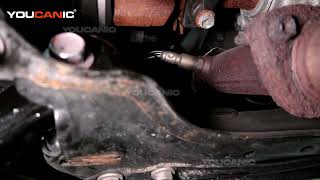
Typical fix: Replace the downstream oxygen sensor. This sensor is located underneath the vehicle, screwed into the exhaust pipe after the catalytic converter. Soaking the threads with penetrating oil before removal is highly recommended. Use a specialized 22mm (7/8") O2 sensor socket to avoid rounding off the hex fitting. 🎬 See this step-by-step downstream sensor replacement walkthrough
Est. part cost: $70-$180 - Damaged Wiring or Connector 🟡 Medium Probability The sensor and its wiring are located under the vehicle, making them susceptible to damage from road debris, moisture, and corrosion. Wires can become brittle from heat cycles, get snagged and pulled, or the connector pins can corrode.
How to confirm: Visually inspect the wiring harness from the O2 sensor to where it connects to the main loom. Look for any signs of melting, chafing, breaks, or corrosion. Check the connector for corrosion, bent pins, or a loose connection. Use a multimeter to perform a voltage and ground check at the sensor connector to ensure the circuit is intact.
Typical fix: Repair the damaged section of the wiring harness. Clean the connector pins with an electrical contact cleaner or replace the connector pigtail if it's heavily damaged.
Est. part cost: $10-$50 - Exhaust Leak ⚪ Low Probability Rust can cause small leaks at exhaust flanges or in the pipe itself, especially in areas with heavy road salt use. An exhaust leak located before the sensor can allow outside oxygen to enter the exhaust stream, which skews the sensor's readings and can trigger the P0136 code.
How to confirm: Visually inspect the exhaust system for cracks or rust holes, paying close attention to gaskets and welds. Listen for hissing or ticking sounds from the exhaust when the engine is running, which may be more noticeable when the engine is cold. A professional repair shop can perform a smoke test to definitively pinpoint the location of small leaks.
Typical fix: Repair the leak. This may involve replacing a failed gasket, applying exhaust sealant for a pinhole leak, or welding a patch or replacing a section of the exhaust pipe for larger failures.
Est. part cost: $20-$200
Rare But Worth Checking
- Faulty Engine Control Module (ECM): This is extremely rare. The ECM should only be considered after all other possibilities (sensor, wiring, exhaust leaks) have been thoroughly ruled out by testing.
Diagnosis Steps
- Read the trouble codes with an OBD-II scanner and confirm P0136 is present. Note any other codes, especially P0137 or P0138.
- Visually inspect the Bank 1, Sensor 2 (downstream) oxygen sensor and its wiring harness. Follow the wire from the sensor to its connector, looking for obvious damage, melting, or corrosion.
- Use a scan tool with live data capabilities to observe the voltage from Bank 1, Sensor 2. With the engine fully warmed up and at a steady 2,500 RPM, the voltage should be relatively stable (typically above 0.5V). If it's stuck low (near 0V), high (near 1V), or fluctuating wildly, the sensor is likely faulty.
- If the sensor signal appears abnormal, test the sensor's heater circuit. With the ignition off, unplug the sensor and measure the resistance between the two heater pins on the sensor side. Check a repair manual for the exact specification, but a reading outside the expected range (e.g., not between 0.8-1.4 ohms for a similar A/F sensor) indicates a failed heater.
- If the sensor and heater circuit test good, check the vehicle-side connector for proper voltage and ground with the ignition on. This confirms the ECM is sending power to the sensor circuit.
- If the wiring and power supply are confirmed to be good, and the sensor readings are still incorrect, check for exhaust leaks between the catalytic converter and the downstream O2 sensor.
- If no exhaust leaks are found and the wiring is good, the oxygen sensor itself is the definitive culprit and should be replaced.
Parts You'll Likely Need
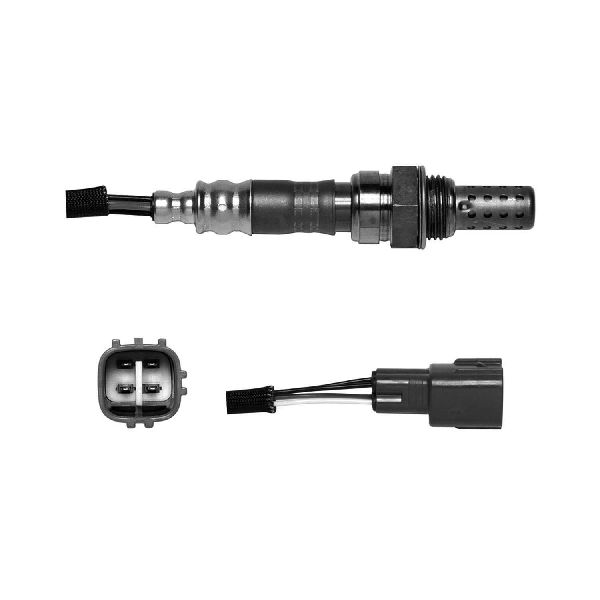
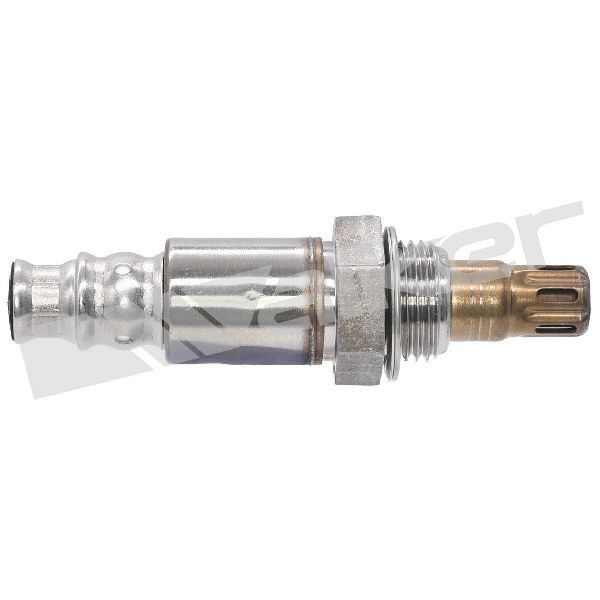
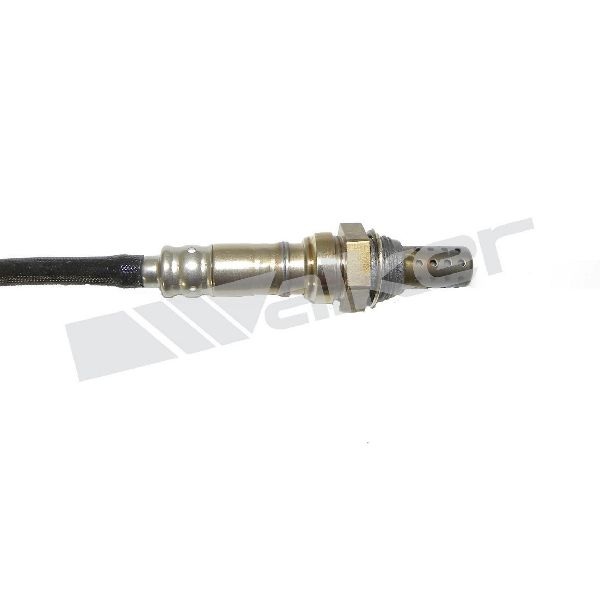
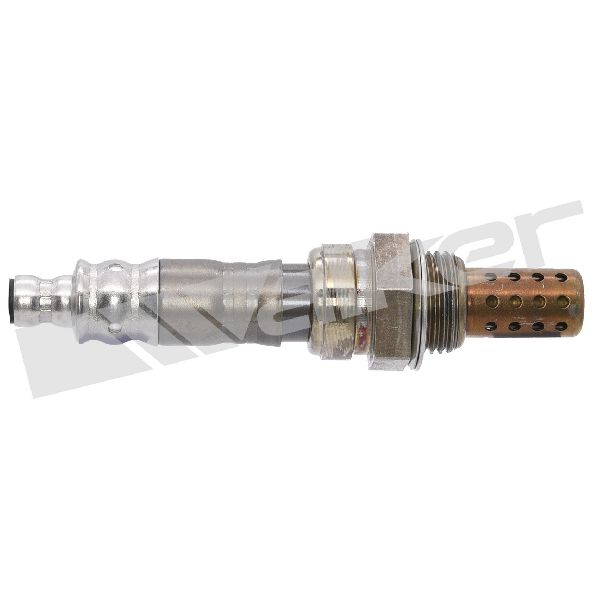
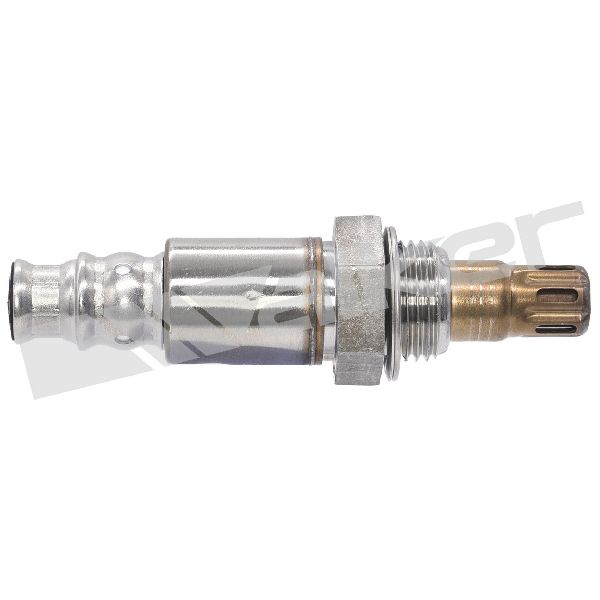
- Downstream Oxygen Sensor (Bank 1, Sensor 2)
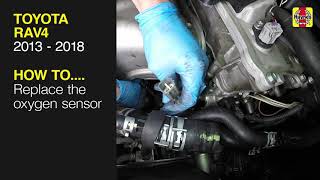
(OEM #89465-0R040)— This is the component that has failed in the vast majority of P0136 cases on this vehicle. It is a standard wear item. 🎬 Watch: A quick guide to replacing the Bank 1 Sensor 2 This part number supersedes the older 89465-42230.
Trusted brands: Toyota (Genuine OEM), Denso (OEM Supplier, Part # 234-4509), Bosch, Walker
OEM price range: $130-$180
Aftermarket price range: $70-$100
Related Codes That Often Appear With This One
- P0137 — This code indicates 'O2 Sensor Circuit Low Voltage' from the same sensor (Bank 1, Sensor 2). It frequently appears alongside P0136 as the sensor begins to fail and its signal drops out.
- P0138 — This code indicates 'O2 Sensor Circuit High Voltage' from the same sensor. It points to a similar failure mode of the Bank 1, Sensor 2, often due to an internal short.
- P0420 — A failing downstream O2 sensor can provide incorrect data that leads the ECM to incorrectly flag a P0420 (Catalyst System Efficiency Below Threshold) code. It's often wise to resolve O2 sensor codes first before addressing a P0420.
Technical Service Bulletins (TSBs) & Recalls
- T-SB-0072-12: While not for the RAV4 Hybrid directly, this TSB for the contemporary Camry Hybrid with a similar engine (2AZ-FXE) addresses P0136 by updating the ECU logic and replacing the sensor. This highlights the platform's sensitivity to sensor calibration and reinforces the recommendation to use OEM/Denso parts.
Mechanic-Grade Diagnostic Values
- Heated Oxygen Sensor (Bank 1, Sensor 2) Heater Circuit Resistance — expected: While a specific value for the downstream sensor isn't listed, a similar upstream A/F sensor has a specification of 0.8 to 1.4 Ω at room temperature. A healthy heater should have a similarly low resistance.. Failure: An infinite resistance reading (OL) indicates an open circuit and a failed heater element. The ECM may also set a P0137 if the sensor impedance exceeds 15 kΩ.
- Heated Oxygen Sensor (Bank 1, Sensor 2) Voltage during Active Test — expected: When using a scan tool's 'A/F CONTROL' active test to force the fuel mixture rich or lean, a healthy sensor's voltage should react accordingly, alternating between less than 0.4V and more than 0.5V.. Failure: If the voltage does not decrease to less than 0.21 V and does not increase to more than 0.59 V during the active test, the ECM determines the sensor output is abnormal and sets DTC P0136.
- Heated Oxygen Sensor (Bank 1, Sensor 2) Voltage at ECM — expected: A healthy, warm downstream sensor should produce a relatively stable voltage, typically above 0.5V.. Failure: A voltage signal that is stuck low (near 0V), stuck high (near 1.2V), or shows no activity.
Scan Tool Commands That Help
- Toyota Techstream: ACTIVE TEST -> A/F CONTROL — This function allows a technician to manually force the engine's air-fuel ratio rich or lean, and then observe the reaction of the downstream O2 sensor (O2S B1 S2) on the live data graph. A healthy sensor will show a clear voltage change in response to the command, while a failed sensor will remain flat or react slowly. This is a definitive way to confirm sensor failure after wiring has been checked.
Wiring & Ground Locations
- A/F HTR Fuse — In the engine compartment fuse box.. This 15A fuse provides power to the oxygen sensor's internal heater. Although a blown fuse is more commonly associated with heater circuit codes (like P0135), a loss of heater function can lead to slow sensor response and trigger a P0136. It should be checked early in the diagnosis.
- ECM Connector (OX1B pin) — At the Engine Control Module (ECM). The specific pin for the B1S2 signal is labeled OX1B in wiring diagrams.. This is the terminal where the O2 sensor's voltage signal wire terminates at the ECM. Checking for continuity between this pin and the sensor connector pin is the final step to rule out a wiring break after visual inspection.
OEM Part Supersession History
89465-42230→89465-0R040— Standard part number update by Toyota.
Heads up: The new part number (89465-0R040) is the correct and direct replacement for the old one. No incompatibility issues are known.
Diagnostic Flowchart
Other Known Issues on This Vehicle
Issues unrelated to this code that are worth knowing about as an owner of this generation:
- Brake Actuator Failure 🔴 High — Uncommon, but can occur. More prevalent on other Toyota hybrid models but has been reported by RAV4 owners. Failure can lead to a loss of braking assist and multiple warning lights. (Ref: No specific recall for this generation, but Toyota has had recalls and warranty extensions for this part on other models like the Prius.)
- High Voltage Cable Corrosion ('Cablegate') 🔴 High — Primarily documented as a major issue on the next-generation (2019+) RAV4 Hybrid, especially in salt-belt regions. While the 2016-2018 models are not the main focus of the 'Cablegate' issue and associated warranty extensions, owners in harsh climates should be aware of potential corrosion on underbody high-voltage components. (Ref: Customer Support Program 22TE09 covers 2019-2022 models, not the 2016-2018 generation.)
- 12-Volt Battery Short Circuit Risk 🔴 High — A recall was issued because certain replacement 12V batteries could shift in the tray, contact the hold-down bracket, and cause a short circuit, increasing fire risk. (Ref: NHTSA Recall 23V-722 (Affects 2013-2018 RAV4 models))
- Soy-Based Wiring Insulation Attracting Rodents 🟠 Medium — A general issue across many modern Toyota models, not specific to the RAV4 Hybrid. The environmentally friendly wiring insulation can attract rodents, leading to chewed wires and various electrical faults. (Ref: No recall; this is considered an external environmental factor.)
Used vs. New Parts: Buying Guide for This Vehicle
When a used part is the smart pick: For this repair, buying a used oxygen sensor is NOT recommended. O2 sensors are wear-and-tear items with a finite lifespan. The cost savings of a used part are minimal and not worth the risk of premature failure and having to repeat the labor.
What to inspect on the donor part:
- Not applicable as used purchase is not advised.
OEM-only on this vehicle (don't cheap out):
- While not strictly 'OEM-only', using either a genuine Toyota sensor or one from the original equipment manufacturer (Denso) is highly recommended. Cheaper, unbranded sensors are known to have incorrect heater resistances or poor calibration, leading to persistent codes or rapid failure.
Aftermarket brands forum-validated for this vehicle:
- Denso (Part No. 234-4509) is the OEM supplier and the most recommended aftermarket choice.
- Bosch is also a reputable alternative.
Brands owners have reported issues with on this vehicle:
- Generic, no-name sensors from online marketplaces should be avoided, as they are a common source of repeat failures on Toyota vehicles.
Real Owner Stories
Aggregated from forums and TSBs cited above. Mileages and costs reflect what owners reported in those sources.
2015 Lexus NX 300h (2AR-FXE 2.5L)
Symptoms: Check Engine Light on with code P0136.
What fixed it: Replacement of the downstream O2 sensor (Bank 1, Sensor 2).
Source hint: ClubLexus Forum - 'P0136 code - O2 sensor- bank 1 sensor 2 location'
2016-2018 Toyota RAV4 Hybrid
Symptoms: Check Engine Light is on; owner discussions confirm this is the standard fix for the platform.
What fixed it: Replacing the downstream O2 sensor (Bank 1, Sensor 2).
Source hint: rav4world.com / Reddit (r/rav4club)
Toyota Prius (Cross-Model Reference)
Symptoms: An owner reported persistent P0136 Bank 1 Sensor 2 error codes.
What fixed it: Mechanics replaced the downstream O2 sensor to resolve the circuit fault (NHTSA ODI #11377970).
Toyota Camry (Cross-Model Reference)
Symptoms: A dealer diagnostic report confirmed a P0136 oxygen sensor malfunction.
What fixed it: The dealer advised replacing the sensor at a cost of approximately $230.00 to clear the check engine light (NHTSA ODI #10194123).
Related OBD-II Codes
Frequently Asked Questions
Does TSB-0072-12 apply directly to my 2016-2018 RAV4 Hybrid?
Is there a recall for the high-voltage cable corrosion ('Cablegate') on my 2016-2018 model?
What specific brand of oxygen sensor should I use for my RAV4 Hybrid?
Is there a fire risk associated with the 12V battery in my 2017 RAV4 Hybrid?
Could a rodent problem cause my P0136 code?
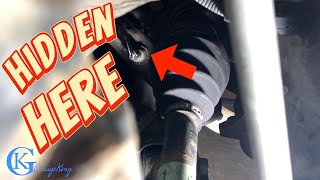
Where is the Bank 1, Sensor 2 located on my 2.5L 2AR-FXE engine?
Helpful Videos
We Have This Part in Stock


The information in this article is provided for general reference and educational purposes only. Vehicle specifications, procedures, and part compatibility can vary by production date, trim level, and region. Always consult your vehicle's factory service manual and verify part numbers before purchasing or performing repairs. Safety-critical components such as airbags, seat belts, and braking systems should be installed by a qualified professional.
- Toyota RAV4 Hybrid:
- 🎬 Helpful Videos
- 🛍️ Shop This Part
- What's Unique About the 2016-2018 Toyota RAV4 Hybrid
- Symptoms You May Notice
- Most Likely Causes
- Rare But Worth Checking
- Diagnosis Steps
- Parts You'll Likely Need
- Related Codes That Often Appear With This One
- Technical Service Bulletins (TSBs) & Recalls
- Mechanic-Grade Diagnostic Values
- Scan Tool Commands That Help
- Wiring & Ground Locations
- OEM Part Supersession History
- Diagnostic Flowchart
- Other Known Issues on This Vehicle
- Used vs. New Parts: Buying Guide for This Vehicle
- Real Owner Stories
- 2015 Lexus NX 300h (2AR-FXE 2.5L)
- 2016-2018 Toyota RAV4 Hybrid
- Toyota Prius (Cross-Model Reference)
- Toyota Camry (Cross-Model Reference)
- Related OBD-II Codes
- Frequently Asked Questions
- 🎟️ Get 5% Off