

P0133 on 2002-2006 Honda CR-V: Slow O2 Sensor Response Causes & Fixes
On a 2002-2006 Honda CR-V, code P0133 almost always points to a failing primary (upstream) Air/Fuel ratio sensor. It's reacting too slowly to changes in the exhaust, hurting fuel economy. Replacing this sensor with a Denso-branded part (specifically Denso 234-9005 for 02-04 models and 234-9064 for 05-06 models) is the most common and reliable fix.
- P0133 on your CR-V means the primary, upstream A/F (O2) sensor is dying.
- The most common symptoms are a Check Engine Light and a noticeable decrease in gas mileage.
- Do not replace the downstream (rear) sensor; this code is specific to the upstream (front) sensor.
- The most reliable fix is to replace the sensor with a new part from Denso (234-9005 for '02-'04, 234-9064 for '05-'06) or Honda.
- While you can drive with this code, fixing it will restore fuel economy and prevent future, more expensive problems like catalytic converter damage.
What's Unique About the 2002-2006 Honda CR-V
The second-generation CR-V with its K24A1 engine is known for its reliability, but the primary A/F sensor is a maintenance item that ages over time. Honda uses a high-quality wideband A/F sensor in this position (made by Denso), which is more precise than a traditional oxygen sensor. While durable, they are not immune to failure after many years and miles. Owners consistently report that using the OEM or Denso-branded replacement is crucial for a lasting repair, as the vehicle's computer is sensitive to the specific sensor's performance and may not work correctly with other brands like Bosch.
Symptoms You May Notice
- Check Engine Light is on
- Decreased fuel economy
- Rough or unstable idle
- Hesitation during acceleration
- Strong smell of gasoline from the exhaust
- Loud roaring exhaust sound (if an exhaust leak is the cause)
- Replacing the downstream (post-catalyst) O2 sensor. P0133 is specific to the upstream sensor (Sensor 1).
- Replacing the catalytic converter. A bad converter typically sets codes like P0420, not P0133.
- Using a non-Denso or 'universal' oxygen sensor. Many owners report that the Honda ECM is very sensitive and will not operate correctly with sensors that are not OEM or Denso, leading to the code returning.
- Replacing fuel injectors or the mass airflow sensor without proper diagnosis. While fuel system issues can cause performance problems, they are not the direct cause of a 'slow response' code for the O2 sensor.
Most Likely Causes
- Failing Primary Air/Fuel (O2) Sensor 🔴 High Probability The sensor is a wear-and-tear item. After 100,000+ miles, the internal heating element or sensing element degrades from heat and contaminants, slowing its reaction time.
How to confirm: Use a scan tool with live data to graph the voltage of 'Bank 1 Sensor 1'. A healthy sensor's voltage will fluctuate rapidly between approximately 0.1V and 0.9V. A slow, lazy waveform that takes a long time to switch or gets stuck confirms the sensor is failing. A 'throttle snap' test (quickly revving the engine) should produce a sharp, immediate change in voltage; a slow sensor will lag.
Typical fix: Replace the upstream (pre-catalyst) Air/Fuel ratio sensor. It is highly recommended to use an OEM Honda or a direct-fit Denso replacement part. Using other brands, even reputable ones, has been reported by owners to not solve the issue.
Est. part cost: $100 - $180 - Exhaust Leak 🟡 Medium Probability The exhaust manifold gasket or the manifold itself can develop cracks or leaks from age and heat cycles. This allows outside air to enter the exhaust stream, skewing the sensor's readings and making it appear 'slow'.
How to confirm: Visually inspect the exhaust manifold and the pipe leading to the sensor for black soot marks, which indicate a leak. Listen for a 'ticking' or 'puffing' sound from the engine bay, especially when the engine is cold. A large leak can sound like a loud roar, sometimes mistaken for a stolen catalytic converter. A mechanic can perform a smoke test to pinpoint the leak's location.
Typical fix: Replace the leaking gasket or repair/replace the cracked exhaust component.
Est. part cost: $10 - $300 - Damaged Wiring or Connector ⚪ Low Probability
How to confirm: Visually inspect the wiring harness and connector for the upstream O2 sensor. Look for any signs of melting (from contact with the exhaust), corrosion on the pins, chafing, or broken wires. Use a multimeter to check for continuity and proper voltage at the connector.
Typical fix: Repair the damaged section of the harness or clean/replace the connector.
Est. part cost: $5 - $50
Rare But Worth Checking
- Engine Control Module (ECM) Fault: This is extremely rare. Before considering the ECM, all other possibilities, especially the sensor itself and any exhaust leaks, must be thoroughly ruled out. One owner on Honda-Tech reported a dealer incorrectly diagnosed a bad ECM when the O2 sensor was the actual culprit.
- Low Fuel Pressure or Leaking Injectors: An improper air-fuel mixture caused by a weak fuel pump or a leaking fuel injector can sometimes cause the O2 sensor to behave erratically, though it's less likely to cause a 'slow response' code specifically.
Diagnosis Steps
- Read the code with an OBD-II scanner to confirm P0133 is present. Note any other codes.
- Visually inspect the exhaust system from the engine to the catalytic converter for any signs of leaks, such as black soot, cracks, or audible ticking/roaring sounds.
- Inspect the wiring and connector for the upstream A/F sensor (Bank 1, Sensor 1) for any visible damage, corrosion, or loose connections. Ensure it is not melted or chafed.
- Use a scan tool with live data capabilities to monitor the voltage of the upstream A/F sensor (often labeled A/F S1). Start the engine and let it warm up to operating temperature.
- Observe the sensor's waveform or voltage reading. A healthy sensor will show rapid fluctuations between ~0.1V and 0.9V. If the voltage changes slowly, is lazy to respond to throttle changes, or stays fixed, the sensor is bad.
- If the sensor, wiring, and exhaust system appear to be in good condition, check for any relevant Technical Service Bulletins (TSBs) for your vehicle, although none are widely reported for this specific issue.
- Based on overwhelming evidence for this vehicle, if steps 2 and 3 show no issues, the most effective step is to replace the upstream A/F sensor with a Denso or OEM part. Use a proper 22mm (7/8") O2 sensor socket for removal to avoid damaging the sensor or wiring. 🎬 See this simple trick for removing a stuck sensor.
Parts You'll Likely Need
- Upstream Air/Fuel Ratio Sensor
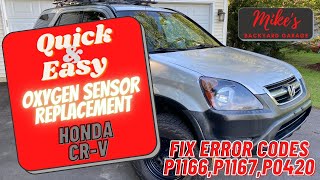
(OEM #36531-PPA-003 (superseded by 36531-PPA-A01 for some models))🎬 Watch: A complete walkthrough for replacing the upstream sensor. — This is the primary component responsible for measuring the air-fuel ratio, and its degradation is the direct cause of the 'slow response' error.
Trusted brands: Denso (OEM Manufacturer), NGK/NTK
OEM price range: $160-$220
Aftermarket price range: $100-$180 - O2 Sensor Socket — A special slotted socket (22mm or 7/8") is often required to remove and install the sensor without damaging its wires. It can be rented from most auto parts stores.
Trusted brands: Lisle, OEMTools
Aftermarket price range: $10-$20
Technical Service Bulletins (TSBs) & Recalls
- Honda Service Bulletin 01-093: While this TSB applies to a Honda Prelude, it addresses the same P0133 code and recommends replacing the primary heated oxygen sensor, showing a consistent repair strategy from Honda for this code.
Platform-Specific Known Issues
- ECU Sensitivity: The Engine Control Unit in this generation of Honda is notoriously picky about the A/F sensor. Forum users repeatedly warn against using Bosch or other non-Denso/OEM brands, as they often fail to fix the P0133 code.
- Exhaust Manifold Cracks: While not as common as sensor failure, the K24A1 can develop cracks in the integrated exhaust manifold/header, creating a leak that triggers this code.
Mechanic-Grade Diagnostic Values
- A/F Sensor (Sensor 1) Voltage — expected: For Honda wideband A/F sensors, the voltage should hover around 3.3 Volts at stoichiometric (ideal) air-fuel ratio. Unlike traditional O2 sensors, it does not rapidly switch between 0.1V and 0.9V.. Failure: A voltage that is slow to change when the throttle is snapped, or a signal that is stuck or biased significantly away from the 3.3V target during steady operation, indicates a lazy sensor.
- A/F Sensor Heater Circuit Resistance — expected: While specific OEM values are not published for DIY testing, a typical 4-wire sensor heater circuit will have a resistance between 2 and 30 ohms when measured at the sensor's pins. An open circuit (infinite resistance) or a direct short (zero resistance) indicates a failed heater element.. Failure: An out-of-spec or open heater circuit will dramatically increase the time it takes for the sensor to reach operating temperature, directly causing a P0133 slow response code, especially on short trips.
Scan Tool Commands That Help
- Honda Diagnostic System (HDS): DTCs MENU - OBD STATUS for P0133 — After a repair, a specific drive cycle must be completed to get the P0133 monitor to run. The HDS can show the status as PASSED, FAILED, or NOT COMPLETED. This confirms if the fix was successful without waiting for the check engine light to return.
- Honda Diagnostic System (HDS): PCM IDLE LEARN PROCEDURE — This procedure should be performed after replacing the A/F sensor or clearing the DTC. It resets the idle adaptations in the engine computer, ensuring it learns the characteristics of the new sensor correctly.
Wiring & Ground Locations
- G101 — Located on the left side of the engine, typically on or near the thermostat housing.. This is a primary power and logic ground for the ECU. A corroded or loose G101 ground can cause a wide range of bizarre sensor reading issues, including incorrect or slow A/F sensor data, as it can introduce voltage offsets and noise into the sensor circuits. Technicians report that a frayed wire within the loom near this ground point can cause intermittent no-start or stalling issues that mimic sensor failures.
- A/F Sensor Connector — Under the middle of the vehicle, requiring the vehicle to be raised for access.. This connector is exposed to road debris and moisture. Corrosion on the pins or damage to the connector can cause a poor signal, mimicking a failed sensor. A visual inspection of the connector pins for green or white corrosion is a critical diagnostic step.
Real Owner Repair Stories
- Honda-Tech.com user 'HCivicEx2001' (2001 Honda Civic (Similar Honda platform with P0133)) — Intermittent Check Engine Light for P0133. The light would come on after several short trips but would go off after a few days of single, longer trips.
❌ Tried (didn't work) A Honda dealer misdiagnosed the issue as a faulty computer and quoted over $2000 for the repair.
✅ What actually fixed it Replacing the primary O2 sensor with a new Denso part resolved the issue, and the code did not return.
Documented NHTSA Reports
- NHTSA ODI #10058999: An owner of a similar Honda model reported that the malfunction indicator lamp illuminated specifically with diagnostic trouble code P0133.
OEM Part Supersession History
36531-PPA-003→36531-PPA-A01 (for some models)— Part revision or manufacturer change. The exact reason is not publicly documented by Honda but is common practice for minor improvements or supplier changes.
Heads up: The primary difference is between the 2002-2004 and 2005-2006 model years. While 36531-PPA-003 may be listed for 2005-2006 models by some vendors, the correct Denso aftermarket part changes from 234-9005 (for 02-04) to 234-9064 (for 05-06), indicating a change in the sensor's connector or internal calibration that makes them non-interchangeable.
Model Year Variations Within This Range
- 2005-2006: The upstream A/F ratio sensor part number is different for the 2005-2006 models compared to the 2002-2004 models. The 2005-2006 CR-V requires Denso part #234-9064, whereas the earlier models use Denso #234-9005. This is likely due to a change in the electrical connector or a minor ECU software update during the mid-generation refresh. Using the wrong year's sensor will result in the code not being resolved.
Diagnostic Flowchart
Real Owner Stories
Aggregated from forums and TSBs cited above. Mileages and costs reflect what owners reported in those sources.
2005 Honda CR-V
Symptoms: Check engine light with P0133 code for an upstream O2 sensor slow response.
What fixed it: The owner did not find a fix. They replaced the upstream O2 sensor twice, cleared the code, and drove over 200 miles, but the code returned. They also tried running Sea Foam through the gas tank to clean the injectors to no avail.
Source hint: reddit.com - Honda 2005 CRV upstream O2 sensor
2005 Honda CR-V 2.0 (110kW)
Symptoms: Check engine light on since purchase. Code returns about 10 km after clearing. Car drives normally.
What fixed it: Unresolved in the provided text. The owner replaced a rusted catalytic converter and both O2 sensors (using Denso parts), and sealed the exhaust. A Honda dealer claimed the issue persisted because a genuine Honda-branded sensor was required instead of Denso.
Source hint: Honda-klub.com (Czech)
2001-2005 Honda Civic / CR-V Era
Symptoms: The P0133 code appeared intermittently. A dealer had previously misdiagnosed the issue as a bad computer, quoting over $2000 for the repair.
What fixed it: Replacing the primary O2 sensor with a Denso part permanently resolved the code.
Source hint: Honda-Tech.com - Thread: 'Error code P0133' (2019)
Honda Element (Platform-mate)
Symptoms: Experienced a persistent P0133 code after installing an aftermarket catalytic converter and factory O2 sensors.
What fixed it: The thread highlights that exhaust system changes and potential leaks from aftermarket catalytic converters are a significant cause to investigate when factory sensors do not resolve the code.
Source hint: Reddit r/HondaElement - Thread: 'code p0133, aftermarket cat' (2021)
Related OBD-II Codes
Frequently Asked Questions
Can I use a Bosch or aftermarket O2 sensor to fix P0133 on my 2002-2006 CR-V?
Does Honda Service Bulletin 01-093 apply to my 2002-2006 CR-V?
My CR-V has a loud roaring sound and code P0133. What does this mean?
I replaced the upstream O2 sensor on my CR-V but P0133 came back. What else could it be?
At what mileage does the primary A/F sensor typically fail on the 02-06 CR-V?
What is the exact part number for the upstream A/F sensor on this platform?
Helpful Videos
We Have This Part in Stock


The information in this article is provided for general reference and educational purposes only. Vehicle specifications, procedures, and part compatibility can vary by production date, trim level, and region. Always consult your vehicle's factory service manual and verify part numbers before purchasing or performing repairs. Safety-critical components such as airbags, seat belts, and braking systems should be installed by a qualified professional.
- Honda CR-V:
- 🎬 Helpful Videos
- 🛍️ Shop This Part
- What's Unique About the 2002-2006 Honda CR-V
- Symptoms You May Notice
- Most Likely Causes
- Rare But Worth Checking
- Diagnosis Steps
- Parts You'll Likely Need
- Technical Service Bulletins (TSBs) & Recalls
- Platform-Specific Known Issues
- Mechanic-Grade Diagnostic Values
- Scan Tool Commands That Help
- Wiring & Ground Locations
- Real Owner Repair Stories
- Documented NHTSA Reports
- OEM Part Supersession History
- Model Year Variations Within This Range
- Diagnostic Flowchart
- Real Owner Stories
- 2005 Honda CR-V
- 2005 Honda CR-V 2.0 (110kW)
- 2001-2005 Honda Civic / CR-V Era
- Honda Element (Platform-mate)
- Related OBD-II Codes
- Frequently Asked Questions
- 🎟️ Get 5% Off