

P0133 on 2005-2014 Ford Mustang: Slow O2 Sensor Response Causes and Fixes
This code means the passenger-side upstream O2 sensor is responding slowly. The most common fix is replacing the Bank 1, Sensor 1 oxygen sensor with a new Motorcraft part. If you have aftermarket long-tube headers, a custom tune is likely required to fix this code by adjusting the sensor's warm-up delay parameters.
- P0133 on a 2005-2014 Mustang almost always points to the passenger-side upstream O2 sensor.
- The most likely fix is replacing the sensor. Use an OEM Motorcraft part to avoid issues.
- If the car has aftermarket long-tube headers, the code is likely caused by the new sensor location and will require a custom PCM tune to fix.
- Before replacing the sensor, always perform a quick inspection for exhaust leaks between the engine and the sensor, as this is another common cause.
What's Unique About the 2005-2014 Ford Mustang

For the S197 Mustang, P0133 is a straightforward code that often points to a failing sensor. However, it's frequently triggered on modified cars, specifically those with aftermarket long-tube headers. These headers move the O2 sensor's location further down the exhaust pipe, causing it to heat up more slowly and trigger a 'slow response' code. A custom tune is the correct fix for this modification, as it adjusts the PCM's expected warm-up time for the sensor. Owners on forums also strongly advise against using aftermarket Bosch O2 sensors, as they are known to cause this code on Mustangs, recommending OEM Motorcraft parts instead.
Generation note: The 2005-2014 year range covers the entire 5th generation (S197) of the Ford Mustang. This generation had a significant update in 2010 and major engine changes in 2011. - 2005-2010 models used a 4.0L V6 or a 4.6L V8. - 2011-2014 models received the more powerful 3.7L V6 and 5.0L 'Coyote' V8. While the code's meaning is the same, the exact part numbers for the O2 sensor will differ between these engine types.
Symptoms You May Notice
- Check Engine Light is on
- Reduced fuel economy
- Rough or uneven idle
- Slight decrease in engine performance or acceleration
- Engine hesitation, especially when cold or stopping
- Failing an emissions test
- Replacing the O2 sensor with a non-Motorcraft brand, especially Bosch, which is reported by many Mustang owners to cause this code right out of the box.
- Replacing other components like the MAF sensor or fuel injectors before thoroughly diagnosing the O2 sensor circuit and checking for exhaust leaks.
- Replacing the O2 sensor when the actual cause is a required tune adjustment for long-tube headers.
Most Likely Causes

- Failing or Contaminated Bank 1, Sensor 1 Oxygen Sensor 🔴 High Probability Oxygen sensors are consumable parts that degrade over time from heat and exhaust contaminants (like oil or soot), causing them to become 'lazy' or slow to respond.
How to confirm: Use a scan tool (like FORScan) to monitor the live voltage of the Bank 1 Sensor 1 (O2S11). It should fluctuate rapidly between approximately 0.1V and 0.9V. If the switching is visibly slower than the Bank 2 sensor (O2S21), it needs replacement. A common diagnostic trick is to swap the upstream sensors from Bank 1 and Bank 2. If the code changes to P0153 (Bank 2 Slow Response), the sensor is confirmed bad.
Typical fix: Replace the Bank 1, Sensor 1 (passenger side, upstream) oxygen sensor. It is highly recommended to use an OEM Motorcraft sensor to avoid compatibility issues.
Est. part cost: $50-$120 - Exhaust Leak Before the O2 Sensor 🟡 Medium Probability Leaks can develop at the exhaust manifold gasket or the flange where the manifold connects to the downpipe, especially on older or high-mileage vehicles. This allows unmetered air to enter the exhaust, skewing sensor readings.
How to confirm: Listen for a ticking or hissing sound from the engine bay, especially on a cold start, which may go away as the metal expands. Visually inspect the exhaust manifold and connections for black soot marks, which indicate a leak. A shop can use a smoke machine to pinpoint the leak. 🎬 Watch: Pro tips for finding hidden exhaust leaks
Typical fix: Replace the leaking gasket or tighten the loose connection. In some cases, a cracked manifold may need to be replaced or repaired.
Est. part cost: $10-$200 - Damaged Wiring or Connectors ⚪ Low Probability The O2 sensor harness is close to hot exhaust components and can become brittle, melted, or frayed. A known failure point on some S197 Mustangs is where the harness runs over the top of the transmission bellhousing; the wire is short and can break from engine/transmission flex over time.
How to confirm: Visually inspect the wiring harness and connector for the passenger-side upstream O2 sensor. Look for any signs of melting, chafing, corrosion, or loose pins. Pay close attention to the harness section behind the engine, on top of the transmission.
Typical fix: Repair the damaged section of the harness or replace the connector pigtail. It may be necessary to add a little slack to the wire to prevent future breakage.
Est. part cost: $15-$40
Rare But Worth Checking
- Aftermarket Long-Tube Headers Installed Without a Tune: This is a very common cause on modified Mustangs. The headers relocate the O2 sensor further from the engine, so it doesn't heat up fast enough. The PCM's default parameters see this as a slow sensor. The only proper fix is a custom tune to adjust the warm-up delay for the sensors.
- Vacuum Leak: A significant vacuum leak from a cracked hose or bad intake manifold gasket can lean out the air-fuel mixture, which can sometimes manifest as a slow O2 sensor response code.
- Low Fuel Pressure: A weak fuel pump or failing fuel pressure regulator can cause a lean condition that may contribute to this code.
- A/C Condensation Dripping on Sensor: On some S197 models, the A/C drain can drip water directly onto the Bank 1 Sensor 1 O2 sensor or its connector, causing thermal shock and premature failure.
Diagnosis Steps

- Read the code with an OBD-II scanner to confirm P0133 is present. Note if it is a pending or permanent code.
- Visually inspect the exhaust manifold on the passenger side for cracks or black soot indicating an exhaust leak.
- Inspect the O2 sensor wiring harness for any signs of melting, fraying, or corrosion, paying special attention to the area on top of the transmission bellhousing.
- Using a scan tool with live data (like FORScan), observe the voltage of 'O2S11' (Bank 1, Sensor 1). It should fluctuate rapidly. Compare its activity to 'O2S21' (Bank 2, Sensor 1). If O2S11 is significantly slower, the sensor is likely the cause.
- If you have aftermarket long-tube headers, confirm if the vehicle has a custom tune that accounts for them. If not, this is the most likely cause.
- If the sensor and wiring appear good and there are no leaks, consider swapping the Bank 1 and Bank 2 upstream sensors. Clear the codes and drive the car. If the code returns as P0153, the sensor you moved is faulty.
- If the original P0133 code returns, the problem is not the sensor itself but something in the wiring, an exhaust leak on Bank 1, or a PCM issue.
- Check for A/C condensation dripping onto the sensor or its connector.
Parts You'll Likely Need

- Oxygen Sensor (Bank 1, Sensor 1)
(OEM #Motorcraft DY-1252 (for 3.7L V6 / 5.0L V8, 2011-14), check specific application for 4.0L/4.6L)🎬 Watch: How to replace O2 sensors on 05-14 Mustangs — This is the upstream sensor on the passenger side. It is the most common point of failure for code P0133. It is highly recommended to use an OEM Motorcraft part to avoid compatibility issues.
Trusted brands: Motorcraft, Denso, NTK
OEM price range: $70-$120
Aftermarket price range: $50-$90
Related Codes That Often Appear With This One
- P0153 — This is the same 'slow response' code but for Bank 2 (driver's side). If both appear together, it points towards a systemic issue like exhaust leaks on both sides, problems caused by long-tube headers without a tune, or a bad battery/grounding issue.
- P0171 — This code for 'System Too Lean (Bank 1)' can be caused by an exhaust leak or a failing O2 sensor that is incorrectly reading the exhaust gases, both of which are also root causes for P0133.
- P1131 — This is a Ford-specific code for 'Lack of HO2S11 Switches, Sensor Indicates Lean'. It often appears alongside P0133, especially on cars with long-tube headers, pointing to the sensor not providing the expected feedback.
Platform-Specific Known Issues
- Installation of aftermarket long-tube headers is a primary cause of P0133 on this platform, as it moves the O2 sensor bung further from the engine block, slowing its heat-up time. A custom PCM tune is required to adjust the sensor delay parameters to prevent the code.
- There is a strong community consensus to avoid using Bosch-branded oxygen sensors on these Mustangs, as they are frequently reported to have slow response times out of the box, leading to a P0133 code even with a new part.
- The wiring harness for the upstream O2 sensors can be stressed and break where it passes over the transmission bellhousing due to a lack of slack, causing intermittent connection issues that can trigger P0133.
Mechanic-Grade Diagnostic Values
- O2 Sensor Heater Resistance — expected: 3 to 25 Ohms (cold). Failure: An infinite reading (open circuit) or a reading outside of the 3-25 Ohm range indicates a failed heater element.
- Upstream O2 Sensor Voltage (Live Data) — expected: Rapidly fluctuating between ~0.1V and ~0.9V at idle in closed loop.. Failure: A slow, lazy, or flat-lined voltage that does not switch rapidly indicates a failing sensor.
- O2 Sensor Signal Circuit Integrity Test — expected: When applying voltage (e.g., via a test light connected to battery positive) to the signal wire at the disconnected harness connector, the scan tool PID for O2 sensor voltage should jump to its maximum readable value (e.g., 1.6V).. Failure: If the voltage on the scan tool does not change, it indicates an open or short-to-ground in the signal wire between the connector and the PCM.
Scan Tool Commands That Help
- Ford IDS (Integrated Diagnostic System): Self Test > Continuous Memory — This is the standard function on the Ford dealer tool to read and clear stored Diagnostic Trouble Codes (DTCs), including history codes that may not be currently active. It also provides access to freeze-frame data, which shows engine conditions at the moment the P0133 code was set.
- Ford IDS (Integrated Diagnostic System): Datalogger > O2 Sensor Monitor Test — The IDS can run a specific on-board diagnostic test for the oxygen sensors, which forces the system to evaluate sensor response time and heater circuits, providing a more definitive pass/fail result than just observing live data during idle.
- FORScan: Live Data PID Monitoring (O2S11, O2S21) — FORScan is a powerful aftermarket tool for Ford vehicles. Use it to graph the voltage of the Bank 1 (O2S11) and Bank 2 (O2S21) upstream sensors simultaneously. Comparing the two graphs makes a slow sensor on Bank 1 immediately obvious. You can also view freeze frame data associated with the code.
Wiring & Ground Locations

- G104 — On the left (driver's side) front fender apron, located behind the battery.. G104 is a critical ground for the Data Link Connector (DLC) and other systems. While not a direct O2 sensor ground, a poor connection here can cause communication issues with scan tools, hindering diagnosis.
- G201 — On the passenger side kick panel, near the Powertrain Control Module (PCM).. This is a primary ground for the PCM. A faulty G201 can cause a wide range of erratic sensor readings and codes, including P0133, because the PCM relies on this stable ground reference.
- G103 — On the passenger side top of the radiator support, near the hood prop rod.. This ground is reported to be part of the O2 sensor's ground path on some SN95/S197 platform discussions. A corroded or loose connection here could directly impact sensor performance and heater circuit operation.
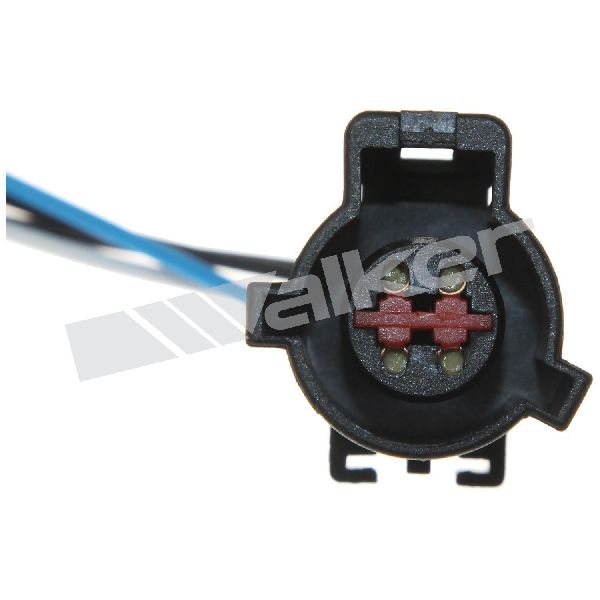
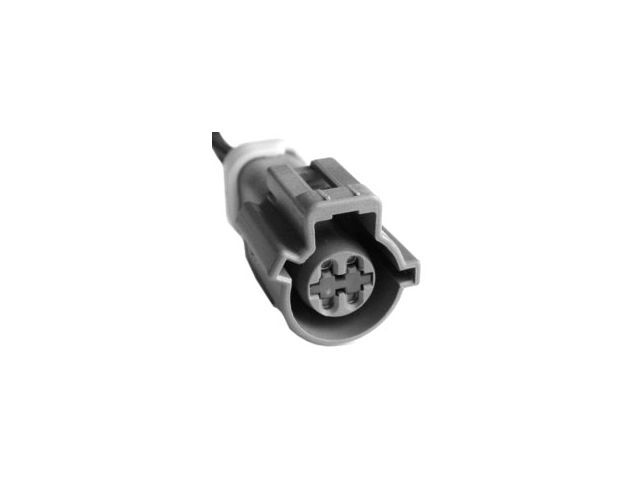
- Bank 1 Sensor 1 Connector — On the passenger side exhaust, before the catalytic converter.. For the 2011-2014 models, the relevant wires at the harness connector are Red/Yellow (Heater Power), Grey/Red (Heater Ground), Red/White (Signal), and Grey/Light Blue (Signal Ground/Return). Verifying voltage and continuity at these specific wires is key to diagnosing a wiring fault.
Real Owner Repair Stories
- Reddit user in r/ft86 (Subaru BRZ/Scion FR-S (similar issue dynamics to Mustang)) — Check Engine Light with code P0133 immediately after installing aftermarket headers and an OpenFlash Tablet (OFT) Stage 2 tune.
❌ Tried (didn't work) The user initially installed an O2 sensor spacer along with the headers, assuming it was necessary.
✅ What actually fixed it Removing the O2 sensor spacer completely. The spacer was too restrictive, slowing down the exhaust gas flow to the sensor and triggering the 'slow response' code, even with a tune. - CorvetteForum user (Chevrolet Corvette with long tube headers) — Constantly getting P0133 & P0153 after long tube header installation.
❌ Tried (didn't work) Replacing one of the O2 sensors., Using O2 simulators (these are for rear sensors, not front)., A dyno tune temporarily fixed it, but the codes returned after 1000 miles.
✅ What actually fixed it Having the tuner specifically edit the PCM calibration to disable the P0133 and P0153 diagnostic tests. This is a common practice for modified cars where the sensor relocation makes it impossible to meet the stock response time parameters.
OEM Part Supersession History
Varies by year→Motorcraft DY-1252— Part consolidation and design updates.
Heads up: The OEM part number for the upstream sensor on 2011-2014 5.0L/3.7L Mustangs is BR3Z-9F472-A, which corresponds to the Motorcraft service part DY-1252. The sensor for the 2005-2010 4.6L GT is a different part, Motorcraft DY-1401. The physical sensor and connector may be similar, but the internal calibration and heater characteristics are different. Using the wrong part number can cause P0133.
Model Year Variations Within This Range
- 2005-2010: These models with the 4.6L V8 use a different upstream oxygen sensor (Motorcraft DY-1401) than the later 5.0L models. The wiring and PCM logic are specific to this earlier powertrain generation.
- 2011-2014: These models with the 5.0L Coyote and 3.7L V6 use upstream oxygen sensor Motorcraft DY-1252 (Ford P/N BR3Z-9F472-A). The PCM strategy for monitoring sensor response is more refined on these models, which can make them more sensitive to modifications like long-tube headers.
Diagnostic Flowchart
Real Owner Stories
Aggregated from forums and TSBs cited above. Mileages and costs reflect what owners reported in those sources.
2006 Mustang 4.0L V6 — 89000 miles
Symptoms: DTC P0133 popped up during a scan while checking for a P1000 code, but there was no dash warning light.
What fixed it: The DTC disappeared on its own before the repair, but the user planned to replace both upstream sensors to be safe.
Source hint: S197Forum.com
2005-2014 Mustang GT
Symptoms: Check engine light with P0133 code popped up yesterday evening, just a few weeks after replacing all 4 O2 sensors.
What fixed it: The community identified that aftermarket sensors (like Bosch) cause slow response issues on this platform, and replacing them with OEM Motorcraft sensors resolves the code.
Source hint: MustangForums.com
2005-2009 Mustang (S197)
Symptoms: Intermittent O2 sensor codes including P0130, P0131, and P0133.
What fixed it: Discovered the O2 sensor wiring harness was too short and broke over the transmission bellhousing. Repaired the wiring harness to restore the connection.
Source hint: S197Forum.com
2005-2014 Ford Mustang
Symptoms: P0133 and P0153 codes appeared after installing aftermarket long tube headers.
What fixed it: Applied a custom PCM tune to disable the rear O2 sensors and adjust the front O2 sensor timing/warm-up timer to account for the sensors being moved further from the engine block.
Source hint: allfordmustangs.com
Related OBD-II Codes
Frequently Asked Questions
I just installed long-tube headers on my Mustang GT and got a P0133 code. Is the new O2 sensor bad?
Can I use a Bosch oxygen sensor to fix the P0133 code on my 2005-2014 Mustang?
I've replaced the Bank 1 Sensor 1 O2 sensor on my S197 Mustang but the P0133 code keeps returning. What else should I check?
How can I confirm if the Bank 1 Sensor 1 oxygen sensor is actually the problem before buying a new one?
Could an exhaust leak cause a P0133 code on my 4.6L or 5.0L Mustang?
What should the live data look like for a healthy O2 sensor on this car?
Helpful Videos
We Have This Part in Stock


The information in this article is provided for general reference and educational purposes only. Vehicle specifications, procedures, and part compatibility can vary by production date, trim level, and region. Always consult your vehicle's factory service manual and verify part numbers before purchasing or performing repairs. Safety-critical components such as airbags, seat belts, and braking systems should be installed by a qualified professional.
- Ford Mustang:
- 🎬 Helpful Videos
- 🛍️ Shop This Part
- What's Unique About the 2005-2014 Ford Mustang
- Symptoms You May Notice
- Most Likely Causes
- Rare But Worth Checking
- Diagnosis Steps
- Parts You'll Likely Need
- Related Codes That Often Appear With This One
- Platform-Specific Known Issues
- Mechanic-Grade Diagnostic Values
- Scan Tool Commands That Help
- Wiring & Ground Locations
- Real Owner Repair Stories
- OEM Part Supersession History
- Model Year Variations Within This Range
- Diagnostic Flowchart
- Real Owner Stories
- 2006 Mustang 4.0L V6 — 89000 miles
- 2005-2014 Mustang GT
- 2005-2009 Mustang (S197)
- 2005-2014 Ford Mustang
- Related OBD-II Codes
- Frequently Asked Questions
- 🎟️ Get 5% Off