

OBD-II Code P1000: On-Board Diagnostic (OBD) Systems Readiness Test Not Complete
What P1000 means, why it triggers, and how to fix it
- P1000 is an informational status code indicating the vehicle's emissions self-tests are incomplete, not a mechanical failure.
- The code clears itself automatically after 50 to 100 miles of mixed city and highway driving.
- A vehicle with an active P1000 code automatically fails state emissions and smog inspections.
- If P1000 persists beyond 200 miles, an underlying fault like a loose gas cap or failing oxygen sensor is preventing a specific test from finishing.
What Does P1000 Mean?

The P1000 code is an informational status, not a traditional error code. It signifies your vehicle's Engine Control Module (ECM) or Powertrain Control Module (PCM) has not completed all required emissions system self-tests. These 'readiness monitors' run automatically during normal driving to verify components like oxygen sensors, the catalytic converter, and the EVAP system function correctly. The code prevents vehicles from passing emissions tests if diagnostic systems were recently reset (e.g., by disconnecting the battery or clearing codes) to hide an underlying problem. A persistent P1000 masks real issues, as the fault preventing the monitor from completing stops the P1000 from clearing.
Technical definition: On-Board Diagnostic (OBD) Systems Readiness Test Not Complete. This manufacturer-specific code indicates the diagnostic self-tests required for emissions compliance have not all completed since the last time the powertrain control module (PCM) memory was cleared.
Can I Drive With P1000?
Yes, But With Caution. Yes, it is safe to drive with a P1000 code. This code indicates the car's computer hasn't finished its self-tests, not an immediate mechanical failure. However, a persistent P1000 that doesn't clear after 100-200 miles of mixed driving means an underlying fault is preventing a monitor from completing. For example, a faulty oxygen sensor preventing the monitor from running causes poor fuel economy and eventual catalytic converter damage costing $800-$2500. Do not ignore the code indefinitely.
Common Causes

- Recent Battery Disconnection or Code Clearing (Very Common) — Disconnecting the battery or using a scan tool to clear trouble codes erases the computer's memory, including completed readiness monitors. The P1000 code appears until the self-tests run again.
- Incomplete Drive Cycle (Common) — The vehicle has not been driven long enough or under the specific conditions (a mix of city/highway speeds, idling, cold starts) required by the manufacturer to complete all self-tests.
- Specific Monitor Conditions Not Met (Common) — Certain readiness monitors have strict enabling criteria. For example, the EVAP monitor only runs when the fuel tank is between 15% and 85% full and the ambient air temperature is 40-95°F (4-35°C). Driving with a full or near-empty tank prevents this monitor from running.
- Underlying Component Fault (Common) — An unresolved issue with an emissions component (like a failing oxygen sensor, a loose gas cap, or a small EVAP leak) prevents its corresponding readiness monitor from completing. The P1000 persists until the root-cause fault is repaired.
- Intermittent System Faults or Unstable Voltage (Less Common) — An unstable voltage supply from a failing battery or alternator interrupts or resets the drive cycle monitors as they try to run. An intermittent sensor fault also prevents specific monitors from completing.
- PCM Software Issue or Fault (Rare) — A software glitch, corrupted flash memory, or internal fault in the PCM prevents readiness monitors from completing. This failure is often covered under the Federal Emissions Warranty for 8 years/80,000 miles. 🎬 Jaguar owner? Watch this explanation of P1000 and P1111 codes.
Symptoms
- Check Engine Light Remains Off — P1000 is an informational status, not a system fault. The Check Engine Light remains off unless a separate, active trouble code is also present.
- Normal Engine Performance — The vehicle drives, accelerates, and handles normally. The P1000 code itself does not affect engine performance or drivability.
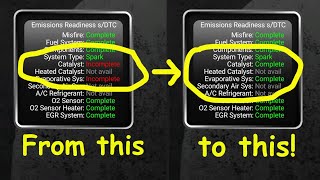
- Automatic Emissions Test Failure (scan-tool only — no driver-felt sign) — Most states require all or most readiness monitors to be 'Complete' to pass an emissions inspection. A P1000 code indicates they are 'Incomplete' and results in an automatic failure. 🎬 Watch: How to set readiness monitors to pass your smog test.
- Masking of Underlying Issues (scan-tool only — no driver-felt sign) — A P1000 code that will not clear after 200 miles indicates an underlying problem with a specific component is preventing a readiness monitor from running, hiding the root cause.
Diagnostic Flowchart
Tap your situation to follow the diagnostic path that matches what you're seeing on this code.
Common Fixes & Costs
- Complete a Full Drive Cycle — Parts: $0, Labor: $0 (DIY)
- Repair Underlying Component Fault
— Parts: $15 - $800+, Labor: $130 - $500+, ~1.5 hr book time
(Professional)
: OEM
: OEM
: OEM - Professional Diagnostic Scan and Analysis — Parts: $0, Labor: $130 - $200, ~1.5 hr book time (Professional)
- Control Module Software Reflash — Parts: $0, Labor: $150 - $300, ~1.5 hr book time (Professional)
Used vs. New Parts: Buying Guide
When a used part is worth it: For expensive components like catalytic converters, a used OEM part from a low-mileage vehicle wrecked for non-engine reasons is a cost-effective alternative to a new aftermarket part. For cheaper parts like O2 sensors or EVAP valves, buy new.
Donor-vehicle mileage cap: roughly under 80000 miles for the part to have meaningful remaining life.
Donor quality checklist:
- Verify donor vehicle was not scrapped for emissions failure or high mileage.
- Match part numbers exactly, as seemingly identical parts have different internal calibrations.
- Avoid parts from rust-belt regions if they have steel housings susceptible to corrosion.
Decision logic:
- If Part is an O2 sensor or EVAP solenoid → Buy new. These are relatively inexpensive wear items and the reliability of a new part outweighs the small savings of a used one.
- If Part is a catalytic converter and OEM new is over $1000 → Consider a used OEM part from a verified low-mileage donor as a high-quality, lower-cost alternative to a new aftermarket converter.
- If Vehicle is older (>150k miles) and budget is the primary concern → A used part is acceptable, but understand it has a limited remaining lifespan and fails sooner.
Warranty tradeoff: Used parts typically come with a 30-90 day warranty at best. New aftermarket parts often have a 1-year to limited lifetime warranty. New OEM parts carry the manufacturer's standard parts warranty.
Worst-case if a used part fails: $300-$800 if a used part fails shortly after installation, representing the repeated labor cost plus the cost of another replacement part.
Cost of Not Fixing It
- Immediate: Guaranteed failure of any state emissions or smog inspection. (Added cost: $0 (but prevents vehicle registration renewal))
- 1-3 months: If caused by a faulty upstream O2 sensor, fuel economy drops by 5-15%, and the engine runs rich. (Added cost: $20-$50 per month in wasted fuel, depending on mileage.)
- 3-12 months: Prolonged rich running conditions from a bad O2 sensor overheat and destroy the catalytic converter, a critical and expensive emissions component. (Added cost: $1200-$2800 for catalytic converter replacement.)
- Ongoing: A persistent P1000 masks other serious engine problems, as the system cannot run self-tests to report new fault codes. (Added cost: $500-$3000+ depending on the masked catastrophic failure.)
Diagnosis Steps
- Verify P1000 is the Only Code
Use an OBD-II scanner to read the trouble codes. Confirm P1000 is the only code present. If other codes exist (e.g., for an O2 sensor or EVAP system), fix those real problems first, as they prevent readiness monitors from completing.
Tools: OBD-II Scanner (Beginner) - Check Readiness Monitor Status
Use an OBD-II scanner with live data capability to check the status of individual readiness monitors. Identify which specific tests (e.g., 'EVAP', 'Catalyst', 'O2 Sensor') are 'Incomplete' to focus your diagnostic effort.
Tools: OBD-II Scanner with Live Data (Beginner) - Perform a General Drive Cycle
A general-purpose cycle includes a cold start (after sitting 8+ hours), idling for 2-3 minutes, city driving (20-40 mph), and steady highway driving (45-65 mph) for 20-30 minutes. Often, 50-100 miles of mixed driving completes the cycle.
Tools: None (Vehicle and Keys) (Beginner) - Verify Specific Monitor Enabling Conditions
If a monitor remains incomplete, check its specific enabling criteria. The EVAP monitor requires the fuel tank to be 15-85% full and ambient temperature between 40-95°F (4-35°C). The Catalyst monitor requires engine coolant above 170°F (77°C) and steady highway driving.
Tools: OBD-II Scanner with Live Data (Intermediate) - Check Battery Connections and Health
Ensure battery terminals are clean and tight. A loose connection causes intermittent power loss to the computer, constantly resetting monitors. Use a multimeter to check battery voltage; a reading below 12.4V with the engine off indicates a weak battery unable to support self-tests.
Tools: Wrench, Wire Brush, Multimeter (Beginner) - Analyze O2 Sensor Live Data (Advanced)
If the O2 or Catalyst monitor is incomplete, view live sensor data. A healthy upstream O2 sensor's voltage fluctuates rapidly between 0.1V and 0.9V. A 'lazy' upstream sensor that switches slowly prevents the monitor from completing.
Tools: OBD-II Scanner with Live Data Graphing (Advanced) - Test Fuel Tank Pressure (FTP) Sensor (Advanced)
If the EVAP monitor is incomplete, check the FTP sensor. With the gas cap off, the sensor's voltage reading should be stable, typically 1.5V to 2.5V. A reading stuck near 0V or 5V indicates a faulty sensor preventing the EVAP monitor from running.
Tools: OBD-II Scanner with Live Data, Multimeter (Advanced) - Perform PCM Power/Ground Voltage Drop Test (Pro Tip)
If monitors keep resetting, perform a voltage drop test on the PCM's power and ground circuits. With the engine running, measure voltage between the battery posts and the PCM power/ground pins. Readings above 0.1-0.2 volts indicate excessive resistance causing intermittent resets.
Tools: Professional Multimeter, Vehicle-Specific Wiring Diagram (Professional) - Analyze Sensor Data with Oscilloscope (Pro Tip)
If a specific monitor consistently fails to complete without setting a fault code, use an oscilloscope to graph the sensor's live voltage. A good O2 sensor switches from lean to rich in under 100 milliseconds. Slower switching reveals subtle performance issues preventing monitor completion.
Tools: Automotive Oscilloscope, Sensor-Specific Test Leads (Professional)
When This Code Triggers (Freeze-Frame Conditions)
- Engine Coolant Temp: 170-230°F (77-110°C) (Fully warmed up for catalyst and O2 sensor monitors.)
- Vehicle Speed: 45-60 mph (72-97 km/h) (Steady highway driving for catalyst and O2 sensor monitors.)
- Engine Load: 15-35% (Steady throttle, not under heavy acceleration, for catalyst monitor.)
- Fuel Level: 15-85% (Required for the EVAP monitor to run; too full or too empty prevents the test.)
- Ambient Air Temperature: 40-95°F (4-35°C) (Required for the EVAP monitor to run; extreme cold or heat prevents the test.)
Related Codes
- P1111 — On Jaguar and Land Rover vehicles, P1111 is the 'all clear' companion to P1000. P1000 means 'tests not complete,' while P1111 means 'all tests have completed and passed.' You cannot clear P1111; doing so resets the monitors and triggers P1000.
- Any EVAP System Code (P0440-P0457) — A persistent P1000 with an incomplete EVAP monitor is often caused by an underlying EVAP fault. P1000 states the EVAP system hasn't been tested yet, while P0455 (Large Leak) means the system tested and FAILED. You must fix the EVAP fault before the monitor can run successfully.
- Any Oxygen Sensor Code (P0130-P0167) — If the O2 sensor monitor is incomplete with a P1000, a faulty oxygen sensor is likely. P1000 indicates the test hasn't run, while P0130 means there is a specific electrical fault with the sensor circuit. The fault must be repaired before the O2 monitor can complete.
- P0420 (Catalyst System Efficiency Below Threshold) — If the catalyst monitor will not complete and P1000 remains, the catalytic converter is likely degraded. P1000 means the test hasn't finished, while P0420 means the test ran and FAILED. A weak converter prevents the monitor from passing, keeping the P1000 present.
Climate & Environmental Factors
- Cold Weather: Ambient temperatures below 40°F (4°C) prevent the EVAP readiness monitor from running. This is the most common environmental reason for a persistent P1000 code during winter months.
- High Altitude: Some readiness monitors require barometric pressure to be above a certain threshold (e.g., >75 kPa). At very high altitudes, lower atmospheric pressure inhibits these self-tests from initiating.
- Extreme Heat: Temperatures above 95°F (35°C) prevent the EVAP monitor from running due to excessive fuel tank vapor pressure.
How to Talk to a Mechanic About This Code
Say this: "I have a P1000 code and need a diagnostic to find out why it's not clearing. I've already tried a basic drive cycle. Could you please check which specific readiness monitor is incomplete and quote me for diagnosing that system?"
This shows you understand the code is informational and directs the mechanic to perform a specific, necessary diagnostic step, preventing them from starting with expensive, unnecessary repairs.
Avoid saying:
- 'Just fix the P1000 code'
- 'My check engine light is on, can you look at it?' (too vague — invites upsell)
- 'I think I need a new oxygen sensor' (avoids diagnosing the problem yourself)
Questions to ask before authorizing the repair:
- Can you show me which readiness monitor is 'Incomplete' on the scan tool?
- What is your diagnostic fee to find the root cause for that specific system (e.g., EVAP, Catalyst)?
- Will you provide a written estimate detailing parts and labor before any work begins?
- What is the warranty on the proposed repair and the parts?
Where to Take It: Dealer vs Independent vs Chain
- Dealer:
Best for: Vehicles still under the federal emissions warranty (8 years/80,000 miles for major components), Known manufacturer-specific software issues or complex electrical problems, Diagnosing unusual issues on newer or brand-specific models
Downsides: Significantly higher labor rates ($180-$250/hr) and OEM parts markups., May be quick to recommend replacing an entire assembly instead of a smaller component. (Typical cost: +40% vs. baseline) - Independent Shop:
Best fit for most situations. A persistent P1000 requires thoughtful diagnosis, not just part swapping. A good independent shop provides the best balance of expertise and value for this task.
Best for: Out-of-warranty vehicles where cost is a factor., Diagnosing the root cause of a persistent P1000 (e.g., a lazy O2 sensor, small EVAP leak)., Building a long-term relationship with a mechanic who knows your vehicle's history.
Downsides: Quality varies greatly; vet shops based on reviews and ASE certification., May lack the latest, most expensive manufacturer-specific diagnostic tools for very new models. (Typical cost: +0% vs. baseline) - Chain Shop:
Use with caution. Acceptable for a simple, pre-diagnosed part swap, but AVOID for diagnosing a persistent P1000, as they lack the diagnostic depth and simply recommend unnecessary services.
Best for: Simple, clear-cut part replacements if the underlying issue is already known (e.g., replacing an O2 sensor you've already diagnosed).
Downsides: High pressure to upsell services like fluid flushes or unnecessary filters., Technician skill and diagnostic capability can be inconsistent; may not be equipped for nuanced diagnosis. (Typical cost: -10% vs. baseline)
When to Walk Away From the Repair
If the estimated repair cost to clear the underlying fault exceeds 40-50% of the car's private-party value, pause and reconsider the repair.
- Car worth $4000, fix is $2000: Borderline. The repair is 50% of the car's value. Get a second opinion before authorizing, as other age-related repairs are likely imminent.
- Car worth $12000, fix is $1800: Fix it. The repair cost is only 15% of the vehicle's value and is a worthwhile investment.
- Car worth $2500, fix is $1500: Walk away. The repair cost is 60% of the car's value. The money is better put toward a replacement vehicle.
What Scan Tool You Need for This Code

Minimum: An OBD-II reader that can display the status of I/M Readiness Monitors.
A basic sub-$20 code reader only shows you the P1000 code itself. It won't tell you *which* specific self-test (like EVAP or Catalyst) is incomplete, leaving you guessing. To diagnose a persistent P1000, you need to see the individual monitor status.
Budget: BlueDriver Bluetooth Pro (~$100) — Pairs with your phone to show readiness monitor status, read freeze-frame data, and graph live O2 sensor data. It provides enough information to determine which system is failing and often diagnose a lazy sensor vs. a bad catalytic converter before paying a shop.
Mid-range: Foxwell NT510 Elite / CGSULIT SC530 (~$180) — These handheld scanners offer full-system diagnostics and some bi-directional controls. This allows you to actively test components, such as commanding an EVAP vent solenoid to close, which is a major step up for accurately diagnosing the underlying fault.
Professional: Autel MaxiCOM MK808 / Innova 5610 (~$500) — Provides full bi-directional control, OEM-level diagnostic functions, and can access Mode $06 test data. Mode $06 shows the raw results of component self-tests, allowing you to see if a part is close to failing even before it sets a code, which is invaluable for stubborn P1000 issues.
Rent vs buy: For a one-time diagnosis, major auto parts stores like AutoZone and O'Reilly Auto Parts offer a loaner tool program. You pay a deposit equal to the tool's cost, which is fully refunded upon return. Buy a scanner only if you plan to perform your own diagnostics regularly.
How to Clear the Code After You Fix It
- Do NOT clear codes with a scanner, as this resets all monitors.
- Ensure underlying faults (if any) are repaired.
- Perform a complete drive cycle.
Drive cycle (~30 minutes): A general drive cycle includes: a cold start (after sitting 8+ hours), 2-3 minutes of idling, 15 minutes of mixed city driving (stop-and-go), and 10-15 minutes of steady highway driving (55-60 mph).
Readiness monitors affected: Catalyst Monitor, O2 Sensor Monitor, EVAP System Monitor, EGR System Monitor, Secondary Air System Monitor
Before emissions retest: drive at least 100 miles to fully set monitors.
Watch out for:
- Attempting to clear P1000 with a scan tool, which only resets the process.
- Not meeting specific monitor conditions, such as having a full gas tank which prevents the EVAP test.
- Not driving long enough or under varied conditions to allow all monitors to run.
Will This Fail Emissions / State Inspection?

Yes — this code typically fails an OBD-II emissions inspection.
- California: CARB regulations are strict; a P1000 code results in an automatic smog check failure. For most model years (2001+), only one non-continuous monitor is allowed to be incomplete, but P1000 indicates multiple monitors are not ready.
- New York: The NYVIP3 inspection fails a vehicle with incomplete readiness monitors. For 2001 and newer vehicles, more than one 'Not Ready' monitor is a failure. P1000 signifies the readiness check has not been completed and causes a fail.
- Texas: A vehicle fails if readiness monitors are not set. For 2001 and newer models, one incomplete monitor is allowed. P1000 indicates a general lack of readiness and results in failure.
Most Commonly Affected Vehicles
- Ford F-150, Focus, Expedition, Mustang, Ranger (1996-Present) — P1000 is extremely common and considered normal operation on all Ford models after the battery is disconnected or codes are cleared. It cannot be cleared manually and only resolves after a drive cycle.
- Jaguar X-Type, S-Type, XJ, XK (1996-Present) — Jaguar vehicles use P1000 to indicate readiness monitors are not set. Once complete, it is replaced by code P1111 (System Pass). The goal is to turn P1000 into P1111 by driving.
- Land Rover Discovery, Range Rover, LR3 (1996-Present) — Sharing technology with Jaguar, Land Rover vehicles operate similarly. P1000 means tests are incomplete, which is replaced by P1111 once all system checks have passed.
- Mazda 3, 6, CX-5, Miata (1996-Present) — Due to its historical partnership with Ford, many Mazda vehicles use the P1000 code to indicate monitor readiness status has been reset and is not yet complete.
- Chevrolet / GMC Silverado, Sierra, Tahoe, Suburban (1996-Present) — Commonly appears on GM trucks and SUVs after battery replacement or clearing codes. The EVAP monitor on these vehicles is particularly difficult to set, sometimes requiring multiple drive cycles over several days.
- BMW 3-Series, 5-Series, X3, X5 (1996-Present) — A persistent P1000 on modified BMW vehicles often indicates an aftermarket engine tune is preventing a monitor (often catalyst or O2) from running to completion.
- Volkswagen / Audi Jetta, Golf, A4, Q5 (1996-Present) — P1000 indicates system readiness checks have not been finalized. Professional scan tools (like VCDS) can force the system to generate readiness codes through a guided procedure.
- Subaru Outback, Forester, Impreza (1996-Present) — Subaru uses P1000 to show readiness monitors have been reset. It clears on its own with normal driving once all self-tests are complete.
Manufacturer-Specific Notes

- Ford: P1000 is a standard, expected code after any memory reset. It cannot be cleared with a scan tool; it only disappears on its own after a complete drive cycle.
- Jaguar / Land Rover: These brands use a two-code system. P1000 shows tests are in progress, and P1111 confirms all system checks are complete and have passed. The goal is to turn a P1000 into a P1111 by driving.
- Mazda: Due to its past relationship with Ford, Mazda vehicles exhibit the same P1000 behavior, indicating readiness monitors are not yet complete and the code must be cleared by driving.
- General Motors (GM): On specific older models (primarily pre-2005), P1000 can have a completely different, manufacturer-specific definition such as 'Ignition Circuit Low' or 'Injector Circuit Malfunction'. This requires a professional scan tool to verify.
- Federal (All Manufacturers): The underlying cause of a persistent P1000 may be covered by the Federal Emissions Warranty, which mandates coverage for major emission control components (catalytic converter, PCM) for 8 years or 80,000 miles.
Frequently Asked Questions
Will a P1000 code clear itself?
Yes, the P1000 code clears itself once the vehicle completes its required drive cycle tests through normal driving. You cannot manually clear it with a scanner.
Can I pass a smog check with a P1000 code?
No. The P1000 code specifically indicates the emissions system's self-tests are not finished, resulting in an automatic failure of an emissions or smog inspection.
How many miles do I have to drive to clear a P1000 code?
Typically, 50 to 100 miles of mixed city and highway driving is sufficient to complete all readiness monitors. However, if specific conditions for a certain monitor (like the EVAP test) are not met, it takes longer.
Why won't my P1000 code go away?
This means one specific readiness monitor has not completed its self-test. This happens if precise conditions (like fuel level between 15-85%) haven't been met, or if an underlying fault prevents the test from passing.
Can a bad gas cap cause a P1000 code?
Yes, indirectly. A loose or faulty gas cap causes a leak in the EVAP system, preventing the EVAP readiness monitor from completing its self-test. The P1000 code persists until the gas cap is tightened or replaced and the drive cycle is completed.
What is the difference between a P1000 and a Permanent DTC?
P1000 is an informational code indicating tests are incomplete, while a Permanent Diagnostic Trouble Code (PDTC) is a locked-in fault code from a failed test. You cannot clear either with a scanner. A PDTC only clears after repairing the underlying fault AND successfully running the corresponding monitor to verify the fix.
Should I try to clear the P1000 code with my scanner?
No. Attempting to clear it resets all readiness monitors—including any that had already completed—back to an incomplete state, starting the entire process over again.
Key Takeaways
- P1000 is an informational status code indicating the vehicle's emissions self-tests are incomplete, not a mechanical failure.
- The code clears itself automatically after 50 to 100 miles of mixed city and highway driving.
- A vehicle with an active P1000 code automatically fails state emissions and smog inspections.
- If P1000 persists beyond 200 miles, an underlying fault like a loose gas cap or failing oxygen sensor is preventing a specific test from finishing.
Helpful Videos




The information in this article is provided for general reference and educational purposes only. Vehicle specifications, procedures, and part compatibility can vary by production date, trim level, and region. Always consult your vehicle's factory service manual and verify part numbers before purchasing or performing repairs. Safety-critical components such as airbags, seat belts, and braking systems should be installed by a qualified professional.
- 🎬 Helpful Videos
- What Does P1000 Mean?
- Can I Drive With P1000?
- Common Causes
- Symptoms
- Diagnostic Flowchart
- Common Fixes & Costs
- Used vs. New Parts: Buying Guide
- Cost of Not Fixing It
- Diagnosis Steps
- When This Code Triggers (Freeze-Frame Conditions)
- Related Codes
- Climate & Environmental Factors
- How to Talk to a Mechanic About This Code
- Where to Take It: Dealer vs Independent vs Chain
- When to Walk Away From the Repair
- What Scan Tool You Need for This Code
- How to Clear the Code After You Fix It
- Will This Fail Emissions / State Inspection?
- Most Commonly Affected Vehicles
- Manufacturer-Specific Notes
- Frequently Asked Questions
- Will a P1000 code clear itself?
- Can I pass a smog check with a P1000 code?
- How many miles do I have to drive to clear a P1000 code?
- Why won't my P1000 code go away?
- Can a bad gas cap cause a P1000 code?
- What is the difference between a P1000 and a Permanent DTC?
- Should I try to clear the P1000 code with my scanner?
- Key Takeaways
- 🎟️ Get 5% Off