

P0128 on 2011-2018 Subaru Forester: Causes and Fixes for Coolant Temperature Issues
For the 2011-2018 Subaru Forester with the FB25 engine, code P0128 is overwhelmingly caused by a faulty, stuck-open thermostat. Subaru issued TSB 09-56-13 for this known issue on early models. Replacing the thermostat with the updated OEM part (21210AA181) and a new gasket is the definitive fix in most cases, a DIY-friendly job with parts costing around $30-$50.
- Code P0128 on a 2011-2018 Forester almost always means you need a new thermostat.
- Always check the coolant level first and properly bleed the system of air after the repair, as this can also trigger the code.
- Use the updated OEM thermostat (part number 21210AA181) for the best results, as the original was prone to a specific, documented failure.
- Do not ignore this code. On a Subaru, it will disable important safety systems like EyeSight as a fail-safe.
- This is a manageable DIY repair for those with basic tools, but access to the thermostat on the bottom of the FB25 engine can be tight.
What's Unique About the 2011-2018 Subaru Forester
On the FB25 engine in this Forester, the P0128 code is a very common and well-documented issue. Subaru released Technical Service Bulletin 09-56-13 acknowledging that the original thermostat could fail prematurely. The TSB explains that after a cold soak, coolant could enter the thermostat's internal piston, causing it to open at a lower temperature than specified, directly triggering P0128. This known failure mode makes the thermostat a particularly high-probability cause. A countermeasure part (21210AA181) was put into production to resolve this.
Generation note: This range covers two Forester generations: the third (SH, 2011-2013) and the fourth (SJ, 2014-2018). Both generations use the 2.5L FB25 engine and share the same common cause and fix for P0128. The primary part, the thermostat, is the same for both generations within this range. The TSB for the faulty thermostat specifically covers models up to 2014, but the part and issue remain common on later models in this range.
Symptoms You May Notice
- Check Engine Light is on
- Flashing 'BRAKE' and 'CRUISE CONTROL' lights on the dashboard
- Engine takes longer than usual to warm up
- Temperature gauge reads lower than normal or drops at highway speeds
- Heater may not blow hot air or takes a long time to get warm
- Reduced fuel economy
- On models equipped, EyeSight, adaptive cruise control, and other driver aids will be disabled
- Replacing the coolant temperature sensor first. While possible, it is far less likely to be the cause than the thermostat for this specific code on this vehicle.
- Using a cheap aftermarket thermostat. Many forum users report that P0128 returned weeks or months after installing a non-OEM thermostat, only to be permanently fixed by using the genuine Subaru part.
Most Likely Causes
- Faulty Engine Thermostat (Stuck Open) 🔴 High Probability Subaru issued TSB 09-56-13 for 2011-2014 Foresters, indicating a known problem with the original part where coolant could seep into the thermostat's piston, causing it to open at a lower temperature and trigger P0128. This makes it the first and most likely part to suspect.
How to confirm: Use a scan tool to monitor live coolant temperature data from a cold start. The temperature should rise steadily to ~190-205°F (88-96°C) and stabilize. If it rises very slowly, never reaches temperature, or drops significantly at highway speeds, the thermostat is stuck open. Alternatively, feel the upper and lower radiator hoses after a cold start; if both get warm at roughly the same time, coolant is flowing when it shouldn't be, confirming an open thermostat.
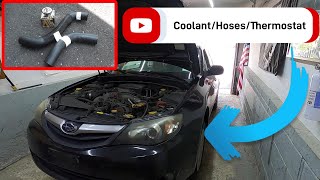
Typical fix: Replace the engine thermostat and its gasket. 🎬 Watch: This video shows a fast and easy thermostat replacement. It is highly recommended to use the updated OEM part (21210AA181) to prevent recurrence. Ensure the new thermostat's 'jiggle pin' or weep hole is oriented at the 12 o'clock position upon installation.
Est. part cost: $30-$50 for OEM part - Low Engine Coolant Level / Air in System 🟡 Medium Probability While not unique to this platform, Subarus can be sensitive to air pockets in the cooling system after service. An air pocket at the coolant temperature sensor can cause inaccurate readings and trigger P0128.
How to confirm: Visually inspect the coolant overflow reservoir and the radiator (when the engine is completely cool). If the level is below the 'MIN' line, it is low. Check for signs of leaks.
Typical fix: Top off the coolant with Subaru Super Coolant (blue) or a compatible equivalent. More importantly, properly 'burp' or bleed the system to remove air pockets. Using a spill-free funnel kit while the vehicle is on an incline is the recommended method. Investigate and fix the source of any coolant loss.
Est. part cost: $25-$35 for a gallon of coolant
Rare But Worth Checking
- Improper Coolant Flow (TSB 09-54-12): Subaru identified a rare issue where slight temperature variations between cylinder banks or small air pockets could cause P0128. To fix this, they released a revised heater hose pipe (Part No. 14070AA361) with a built-in orifice to better regulate coolant flow past the temperature sensor. This is an unlikely but documented cause if a new thermostat doesn't solve the problem.
- Faulty Engine Coolant Temperature (ECT) Sensor: This is less common for P0128, as a failing ECT sensor will usually trigger its own specific codes (like P0117 or P0118). However, if it provides inaccurate but plausible low readings, it can trigger P0128 without other codes. It's a part to consider only after the thermostat has been replaced with a quality OEM part and the system is confirmed to be free of air.
- Cooling Fan Stuck On: If an electric cooling fan relay fails in the 'on' position, the constant airflow can prevent the engine from reaching operating temperature, especially in cooler weather or on short trips. You would likely hear the fans running loudly immediately after a cold start.
Diagnosis Steps
- Check for other stored trouble codes with an OBD-II scanner.
- With the engine cold, check the coolant level in the overflow tank and radiator. Ensure it is full.
- Use a scan tool to monitor the Engine Coolant Temperature (ECT) sensor data live.
- Start the engine from cold and watch the temperature reading. It should climb steadily and not be erratic.
- If the temperature rises very slowly, fails to reach ~190°F, or drops while driving at speed, the thermostat is almost certainly stuck open and needs replacement.
- If the temperature reading is erratic or nonsensical from the start (e.g., reads -40°F on a warm day), suspect the ECT sensor or its wiring.
- Confirm the cooling fans are not running constantly when the engine is cold.
- If replacing the thermostat, ensure the new part's jiggle pin is installed in the 12 o'clock position and thoroughly bleed the system of air using a spill-free funnel.
Parts You'll Likely Need
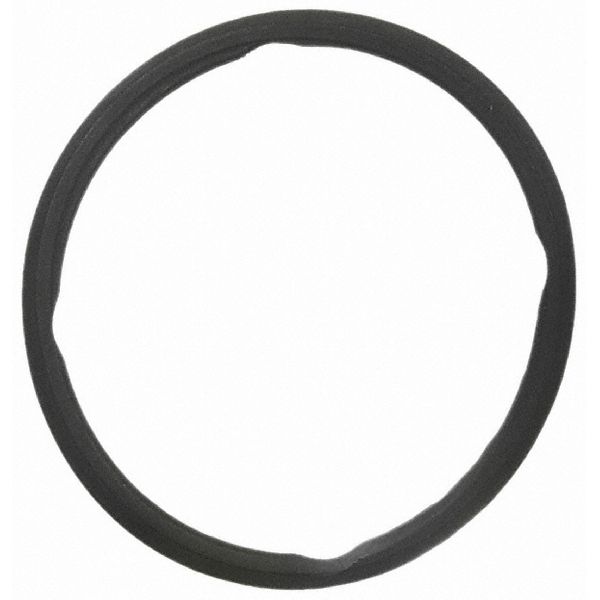
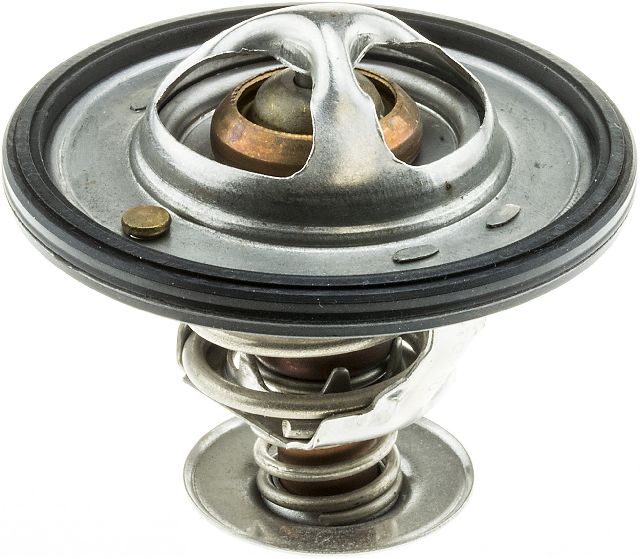
- Engine Coolant Thermostat & Gasket
(OEM #21210AA181)— This is the most common failure item for P0128 on the 2011-2014 Forester, as documented by Subaru TSB 09-56-13. It is the updated, 88°C countermeasure part that supersedes the failure-prone original (21210AA180).
Trusted brands: Subaru (OEM)
OEM price range: $30-$50
Aftermarket price range: $15-$30 - Subaru Super Coolant
(OEM #SOA868V9270)— You will lose coolant when replacing the thermostat and must refill the system with the correct OEM-specified fluid to prevent corrosion and ensure proper performance. The system must also be bled of air.
Trusted brands: Subaru (OEM)
OEM price range: $25-$35 per gallon
Technical Service Bulletins (TSBs) & Recalls
- 09-56-13R: 'Countermeasure Thermostat Availability for DTC P0128' - The most important TSB for this issue. It documents a known defect with the original thermostat on 2011-2014 models and provides the updated part number (21210AA181). TSB Bulletin #09-56-13 specifically notes that coolant may enter the thermostat’s internal piston, causing it to open at a temperature lower than specified.
- 09-54-12: 'DTC P0128 - Coolant Thermostat' - A secondary TSB that provides a fix for less common cases where P0128 is caused by air pockets or coolant flow variations, involving a revised heater hose pipe.
- TSB Bulletin #09-75-21: This bulletin announces the availability of NEW reprogramming files to correct DTC P0128.
Platform-Specific Known Issues
- Subaru TSB 09-56-13R was issued for 2011-2014 Foresters (among other models) due to thermostats failing and opening at a lower-than-specified temperature. The failure was caused by coolant entering the thermostat's internal piston during a cold soak. The fix is an updated countermeasure thermostat.
- Subaru TSB 09-54-12 addresses P0128 being caused by air pockets or slight temperature variations between cylinder banks. It introduced a revised heater hose pipe with an orifice to regulate coolant flow past the temp sensor as a potential fix.
- For later models (2019-2021), Subaru issued TSB 09-75-21 for P0128 being falsely triggered by ECM logic during downhill driving. While this doesn't apply to the 2011-2018 range, it shows Subaru's continued attention to this specific code.
Mechanic-Grade Diagnostic Values
- Engine Coolant Temperature (ECT) Sensor Resistance — expected: Approximately 2,200 - 3,000 Ω at 20°C (68°F) and 250 - 350 Ω at 80°C (176°F).. Failure: Readings that are significantly outside this range, or an open/short circuit. A lack of smooth resistance change as the sensor is heated also indicates failure.
- Engine Coolant Temperature (ECT) Sensor Voltage (Signal Wire to Ground) — expected: Approximately 3.0 - 3.5V on a cold start (~20°C) and dropping to around 1.0 - 1.3V at normal operating temperature (~80°C).. Failure: Voltage that is stuck high (e.g., 5V) or low (e.g., 0V), or does not decrease as the engine warms up.
- P0128 Set Condition (ECM Logic) — expected: The ECM expects the ECT to rise above a threshold, typically around 71-77°C (160-170°F), within a calculated time after startup, based on the initial Intake Air Temperature (IAT).. Failure: If the ECT fails to reach this minimum temperature within the time limit (e.g., 10-15 minutes of driving), the code is set. This is a 'two-trip' fault, meaning the condition must be detected on two consecutive drive cycles.
Scan Tool Commands That Help
- Subaru Select Monitor (SSM) or equivalent professional scanner: Radiator Fan Relay #1 ON/OFF — This bidirectional control is used to test the cooling fan circuit. If the fan is suspected of being stuck on (a rare cause of P0128), this command can verify if the ECM can control the fan relay properly. If the fan runs constantly and does not respond to the 'OFF' command, it points to a failed/stuck relay.
- Subaru Select Monitor (SSM) or equivalent professional scanner: Current Data Display - Coolant Temp — This is the primary function for diagnosing P0128. It allows for real-time monitoring of the ECT sensor data, which is essential to confirm if the engine is physically taking too long to warm up (indicating a thermostat issue) or if the sensor is providing erratic data.
Wiring & Ground Locations
- Main Engine Ground Strap — On the FB25, a primary ground strap connects from the top of the engine block (often near the alternator or intake manifold) to the chassis/firewall on the passenger side.. The ECU and its sensors rely on a clean ground path. A corroded or loose engine ground can introduce voltage offsets, potentially causing the ECT sensor to read inaccurately and contribute to false codes. The ECU itself is grounded via the intake manifold.
- ECT Sensor Connector (E16) — Located on the coolant crossover pipe on top of the engine, near the throttle body. It is a two-pin connector.. This connector is exposed to high heat, making it brittle and prone to failure over time. A poor connection here can cause erratic or incorrect temperature readings, leading to a P0128 or other ECT-related codes.
Real Owner Repair Stories
- subaruforester.org forum user (2011 Subaru Forester 2.5X (FB25)) — P0128 code returned one month after replacing the thermostat with an aftermarket part.
❌ Tried (didn't work) Replacing the thermostat with a new aftermarket part (Stant brand)., Clearing the code.
✅ What actually fixed it The user replaced the aftermarket thermostat with a genuine Subaru OEM thermostat (part number 21210AA181). The code did not return after installing the OEM part, confirming that some aftermarket thermostats do not regulate temperature to Subaru's specific parameters, causing the code to reappear. - Reddit user r/subaru (2012 Subaru Outback 2.5i (FB25, same engine/issue)) — Persistent P0128 code, especially when the heater was turned on.
❌ Tried (didn't work) Replacing the thermostat (with an OEM part)., Replacing the ECT sensor.
✅ What actually fixed it The issue was finally resolved by performing the fix from Subaru TSB 09-54-12, which involves replacing the original heater hose pipe with the updated part (14070AA361). This part has a built-in orifice that regulates coolant flow past the sensor, preventing false readings caused by temperature fluctuations when the heater is active. - NHTSA ODI #11557874 — An owner reported that emergency braking and other safety features were disabled due to code P0128, which was identified as a coolant thermostat issue.
OEM Part Supersession History
21210AA180→21210AA181— The original thermostat (21210AA180) was prone to failure where coolant could seep into its mechanism, causing it to open at a lower temperature than specified. The updated part, 21210AA181, is a countermeasure designed to prevent this internal leakage, as documented in TSB 09-56-13.
Model Year Variations Within This Range
- 2011-2013 (SH) vs 2014-2018 (SJ): While both generations use the FB25 engine and the same thermostat, the 2014+ SJ models feature a more complex exhaust manifold design that sits in front of the thermostat housing. This can make access for replacing the thermostat more difficult on SJ models compared to SH models, potentially requiring the exhaust manifold to be partially lowered for clearance.
- 2011-2018: Some later models with CVTs may have a secondary, smaller thermostat that regulates coolant flow to the CVT fluid warmer/cooler. While this is not directly related to the main engine thermostat that causes P0128, it's a notable complexity in the cooling system of later vehicles in this range.
Diagnostic Flowchart
Real Owner Stories
Aggregated from forums and TSBs cited above. Mileages and costs reflect what owners reported in those sources.
2011 Subaru Outback
Symptoms: Check engine, cruise light, brake light and traction control were flashing.
What fixed it: He replaced the thermostat, radiator, and flushed the CVT and replaced the CVT fluid.
Source hint: Reddit - r/MechanicAdvice - 'P0128 code keeps coming back- 2011 Subaru Outback'
2012 Subaru Outback — 96000 miles
Symptoms: check engine light came on along with the brake light and cruise control light flashing
What fixed it: Replacing the stuck open thermostat with an OEM Subaru thermostat.
Source hint: Reddit r/SubaruForester
Related OBD-II Codes
Frequently Asked Questions
Does TSB 09-56-13R apply to my 2011-2018 Subaru Forester?
Why are my BRAKE and CRUISE CONTROL lights flashing along with the Check Engine Light?
Should I use an aftermarket thermostat to fix P0128 on my FB25 engine?
How do I properly install the new thermostat on my Forester?
Can an air pocket in the cooling system cause P0128 on my Subaru?
Does TSB 09-75-21 apply to my 2011-2018 Forester?
Helpful Videos
We Have This Part in Stock



The information in this article is provided for general reference and educational purposes only. Vehicle specifications, procedures, and part compatibility can vary by production date, trim level, and region. Always consult your vehicle's factory service manual and verify part numbers before purchasing or performing repairs. Safety-critical components such as airbags, seat belts, and braking systems should be installed by a qualified professional.
- Subaru Forester:
- 🎬 Helpful Videos
- 🛍️ Shop This Part
- What's Unique About the 2011-2018 Subaru Forester
- Symptoms You May Notice
- Most Likely Causes
- Rare But Worth Checking
- Diagnosis Steps
- Parts You'll Likely Need
- Technical Service Bulletins (TSBs) & Recalls
- Platform-Specific Known Issues
- Mechanic-Grade Diagnostic Values
- Scan Tool Commands That Help
- Wiring & Ground Locations
- Real Owner Repair Stories
- OEM Part Supersession History
- Model Year Variations Within This Range
- Diagnostic Flowchart
- Real Owner Stories
- 2011 Subaru Outback
- 2012 Subaru Outback — 96000 miles
- Related OBD-II Codes
- Frequently Asked Questions
- 🎟️ Get 5% Off