

P0128 on 2018-2023 Chevrolet Traverse: Coolant Temp Below Normal Causes and Fixes
On a 2018-2023 Traverse with the 3.6L V6, code P0128 is almost always caused by a faulty thermostat that is stuck open. This can uniquely trigger a 'Service Steering Message.' Replacing the thermostat assembly is the most common fix, costing around $250-$500 at a shop. For 2021 models, a software update may be the required fix.
- P0128 on a 2018-2023 Traverse means the engine isn't warming up properly, most likely due to a stuck-open thermostat.
- Do not be alarmed by a 'Service Steering Message' appearing with this code; it is a known side effect and fixing the cooling issue should clear it.
- The most effective diagnostic step is to watch the live coolant temperature on a scan tool as the engine warms up.
- While a DIY fix is possible for those with mechanical experience, it involves draining coolant, which must be handled and disposed of properly.
- If you own a 2021 model, be aware that a simple dealer software update might be the required fix instead of replacing any parts.
What's Unique About the 2018-2023 Chevrolet TRAVERSE
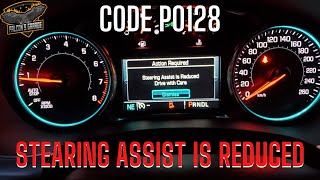
What's unusual about the P0128 code on the 2018-2023 Traverse and its platform mates (like the GMC Acadia and Buick Enclave) is its potential to trigger a 'Service Steering Message' or 'Steering Assist is Reduced' warning on the driver information center. This happens because the ECM, not trusting the coolant temperature reading, enables a protection mode for the electric power steering gear in case of an undetected engine overheat condition. The steering module uses the coolant temperature to adjust assist levels, compensating for thick grease in the steering gear when cold. When the temperature signal is deemed invalid, this function is disabled as a precaution. Technicians are specifically advised by GM TSBs to diagnose P0128 first when this seemingly unrelated steering message appears.
🎬 Watch: Why P0128 triggers a steering assist warningDiagnostic Flowchart
Tap your situation to follow the diagnostic path that matches what you're seeing on this vehicle.
Symptoms You May Notice
- Check Engine Light is on.
- Temperature gauge is inaccurate, inoperable, or reads lower than normal, often stuck on Cold.
- Cooling fans run constantly or continue to run long after the vehicle is turned off.
- 'Service Steering Message' or 'Steering Assist is Reduced' displayed on the Driver Information Center (DIC).
- Heater blows cool or lukewarm air instead of hot.
- Noticeably longer engine warm-up time.
- Reduced fuel economy.
- Replacing the ECT sensor when the thermostat is actually the problem. It's crucial to diagnose by watching the temperature warm-up curve on a scan tool 🎬 Watch: How to diagnose P0128 using live scan tool data rather than just replacing parts. However, due to the labor involved in accessing either part, many choose to replace both at the same time.
- Replacing the power steering gear in response to the 'Service Steering Message' without first checking for P0128. TSBs specifically warn against this.
Most Likely Causes
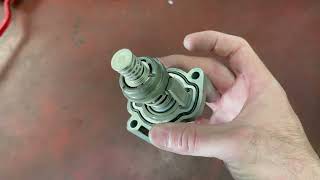
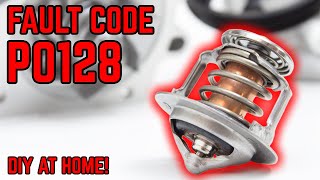
- Faulty Thermostat (Stuck Open) 🔴 High Probability This is the most common failure point for this code across all vehicles with the 3.6L LGX/LFY engine, including the Traverse. The thermostat assembly, often made with a plastic housing, can physically stick in the open position or a torn rubber seal can allow coolant to bypass it, preventing the engine from retaining heat and reaching operating temperature.
How to confirm: Use an OBD-II scanner to monitor the Engine Coolant Temperature (ECT) sensor reading. If the engine warms up very slowly, struggles to get over 170-180°F, or the temperature drops at highway speeds, the thermostat is almost certainly stuck open. Another key symptom is the heater not blowing hot air after 10-15 minutes of driving.
Typical fix: Replace the engine coolant thermostat and housing assembly. On the 3.6L V6, this is located between the cylinder heads and requires removing the intake manifold for access. It is recommended to replace the intake manifold gaskets at the same time. The system must be drained, refilled with Dex-Cool, and properly bled of air afterwards.
Est. part cost: $50-$150 - Faulty Engine Coolant Temperature (ECT) Sensor 🟡 Medium Probability The ECT sensor can fail and send inaccurate data to the ECM, making the computer believe the engine is cold when it is not. This can cause the temperature gauge to read zero and the cooling fans to run constantly as a default fail-safe.
How to confirm: Monitor the ECT sensor reading on a scan tool. If the reading is erratic, stuck at a single value (e.g., -40°F), or doesn't change as the engine warms up, the sensor is likely bad. You can also test the sensor's resistance with a multimeter against its specified values at different temperatures.
Typical fix: Replace the ECT sensor and top off the coolant. The sensor is located near the thermostat housing, under the intake manifold.
Est. part cost: $20-$60 - Low Engine Coolant Level 🟡 Medium Probability Coolant leaks can cause the level to drop. If the level is low enough, air pockets can form in the system, preventing the ECT sensor from getting an accurate reading of the coolant temperature, which can trigger P0128.
How to confirm: Visually inspect the coolant reservoir and radiator (when the engine is cold) to ensure the level is between the 'min' and 'max' marks. Check for visible signs of coolant leaks (puddles under the car, crusty pink/orange residue on hoses or the radiator).
Typical fix: Find and repair the source of any leaks, then refill and bleed the cooling system with the correct type of coolant (typically Dex-Cool for GM vehicles). - ECM Calibration Error ⚪ Low Probability Specifically for 2021 models, GM issued TSB #22-NA-054 stating that a timing error in the ECM software can cause a false P0128 code. The diagnostic for the code runs at the incorrect time, causing a false failure.
How to confirm: This must be confirmed by a GM dealership or a qualified shop with access to GM's Technical Service Bulletin database and programming tools. They will check if the vehicle's VIN is affected and if the updated calibration has been applied.
Typical fix: Reprogram the Engine Control Module (ECM) with the latest software calibration. This is not a DIY repair and requires specialized tools.
Est. part cost: $0-$200 (dealer labor)
Rare But Worth Checking
- Cooling Fan Stuck On: If a faulty relay or wiring causes the cooling fan to run constantly at full speed, it can over-cool the engine, especially in cold weather or at low speeds, preventing it from reaching operating temperature.
- Faulty Intake Air Temperature (IAT) Sensor: The ECM compares the ECT reading to the IAT reading to determine if the engine is warming up at a plausible rate. A faulty IAT sensor that reads colder than reality could contribute to setting a P0128, though this is very rare.
Diagnosis Steps
- Check the engine coolant level in the reservoir and radiator (only when the engine is completely cool). Top off if low and check for visible leaks.
- Connect an OBD-II scanner and verify that P0128 is present. Check for other codes, particularly U0401 in the power steering module.
- Use the scanner's live data function to monitor the 'Engine Coolant Temperature' (ECT) PID.
- Start the cold engine and watch the temperature reading. It should start near ambient temperature and climb steadily.
- A healthy system should reach operating temperature (approx. 195-220°F or 90-104°C) within 5-15 minutes of driving.
- If the temperature rises very slowly, struggles to get over 170°F, or drops significantly when driving at highway speeds, the thermostat is likely stuck open and needs replacement.
- If the temperature reading is erratic, stuck at a single value (e.g., -40°F), or jumps around illogically, the ECT sensor or its wiring is the primary suspect.
- If you have a 2021 model, check with a dealer for TSB #22-NA-054 regarding a potential ECM reprogram before replacing any parts.
Parts You'll Likely Need
- Engine Coolant Thermostat and Housing Assembly
(OEM #ACDelco 12712393 (previously 12678779))— This is the most frequent cause of P0128, as the thermostat physically sticks open, preventing the engine from warming up correctly.
Trusted brands: ACDelco (GM Genuine), Motorad, Duralast
OEM price range: $80-$150
Aftermarket price range: $50-$100 - Engine Coolant Temperature (ECT) Sensor
(OEM #ACDelco 12673534 (previously 12650595))— This sensor provides the temperature data to the ECM. If it fails, it can send incorrect readings, triggering the code. Often replaced with the thermostat due to shared labor.
Trusted brands: ACDelco (GM Genuine), Bosch, NTK
OEM price range: $30-$60
Aftermarket price range: $20-$40 - Engine Coolant / Antifreeze (Dex-Cool)
(OEM #ACDelco 10-101 (Concentrate) or 10-5027 (50/50 Pre-mix))— Required to refill the system after replacing the thermostat or if the level was found to be low.
Trusted brands: ACDelco Dex-Cool, Prestone Dex-Cool
OEM price range: $25-$35 per gallon
Aftermarket price range: $20-$28 per gallon - Intake Manifold Gasket Set — Required for re-installing the intake manifold, which must be removed to access the thermostat and ECT sensor on the 3.6L V6 engine.
Trusted brands: ACDelco, Fel-Pro, Mahle
OEM price range: $30-$50
Aftermarket price range: $20-$40
Related Codes That Often Appear With This One
- U0401: Invalid Data Received From ECM (often stored in the Power Steering Control Module as a result of P0128).
Technical Service Bulletins (TSBs) & Recalls
- 22-NA-054: Addresses a false P0128 on 2021 Traverse, Enclave, XT5, XT6, and Blazer models caused by an ECM calibration error. Symptoms include an inaccurate temp gauge and fans running after shutdown. The fix is an ECM reprogram.
- PIT5967: Links P0128 to a 'Service Steering Message' across the GM C1 platform (Traverse, Enclave, Acadia, XT5, XT6, Blazer) and advises diagnosing the P0128 code first to resolve the steering warning.
- 17-NA-158: An earlier TSB for 2017 Acadia and XT5 models explaining in detail why a P0128 code triggers a 'Steering Assist Reduced' message due to the steering module needing a valid temperature signal to compensate for cold grease.
Platform-Specific Known Issues
- Service Steering Message: A 'Service Steering Message' may appear on the dash as a direct result of the P0128 code, as documented in TSB #PIT5967 and #17-NA-158. This is a protective measure by the power steering control module due to an invalid coolant temperature signal from the ECM. Fixing the P0128 fault (usually by replacing the thermostat) will resolve the steering warning.
- ECM Software Update for 2021 Models: For some 2021 models, TSB #22-NA-054 indicates that an ECM software update is the correct fix, not parts replacement. Symptoms also include an inaccurate temperature gauge and fans running after shutdown. A dealer must perform this reprogram.
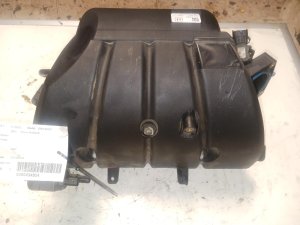
- Repair Complexity: On the 3.6L V6 engine, the thermostat is located deep between the cylinder heads, underneath the intake manifold. This makes replacement a more involved job than on many other engines, requiring removal of the air intake, throttle body, and the entire upper intake manifold to gain access.
Mechanic-Grade Diagnostic Values
- Engine Coolant Temperature (ECT) Sensor Resistance — expected: Approximately 3500 Ohms at 68°F (20°C) and ~180 Ohms at 212°F (100°C).. Failure: Readings that are infinite (open circuit), near zero (short circuit), or do not correspond with the actual coolant temperature indicate a faulty sensor.
- Engine Coolant Temperature (ECT) Sensor Voltage (at sensor connector, key on, engine off) — expected: Signal wire (Tan) should show ~3.0-3.5V on a cold-soaked engine, dropping to under 1.0V at full operating temperature. Reference wire (Yellow) should have a steady 5V.. Failure: Voltage that is stuck at 5V or 0V on the signal wire points to a sensor or wiring fault.
- Scan Tool Live Data: ECT vs IAT on Cold Soak — expected: On an engine that has been off for several hours (cold-soaked), the Engine Coolant Temperature (ECT) and Intake Air Temperature (IAT) readings should be within 5-10°F of each other and ambient temperature.. Failure: A significant difference between the two readings before starting the engine points to a faulty sensor (usually the ECT).
Hidden / Shadow Codes Worth Checking
- P0128 00: The '00' is a standard GM symptom byte indicating the generic 'Coolant Temperature Below Thermostat Regulating Temperature' condition has been met. It doesn't point to a more specific failure but confirms the primary fault logic was triggered. (see via GM GDS2 or other professional-grade scan tools that can read manufacturer-specific data.)
Scan Tool Commands That Help
- GM GDS2: Cooling Fan Control — This bidirectional command allows the technician to manually turn the cooling fans on and off and set their speed. It is used to rule out a 'cooling fan stuck on' scenario, which could cause the engine to run too cool and trigger a P0128.
- GM GDS2: Data Display / Freeze Frame — Reviewing the freeze frame data for when P0128 was set is critical. It shows the exact ECT, IAT, engine run time, and vehicle speed at the moment of failure, providing strong evidence for or against a stuck thermostat. For example, seeing a low ECT after 20 minutes of highway driving is a classic sign of a stuck-open thermostat.
Wiring & Ground Locations
- G104 — Mounted on the left (firewall side) cylinder head for the 3.6L LGX engine.. This is a primary engine ground. While not a direct cause, a loose or corroded ground at this location can introduce electrical noise or an unstable reference voltage for various engine sensors, including the ECT sensor, potentially causing erratic readings.
- B34 Engine Coolant Temperature Sensor Connector — Located on the thermostat housing, under the intake manifold.. This is the direct connection point for the sensor. Technicians will test for 5V reference and the signal voltage at this connector's pins to differentiate between a failed sensor and a wiring problem leading to the ECM.
Real Owner Repair Stories
- TraverseForum.com user (2018 Chevrolet Traverse) — Check Engine Light with P0128 and a 'Service Steering Message' on the dash.
❌ Tried (didn't work) Clearing the code, which would return promptly.
✅ What actually fixed it The dealership replaced the engine coolant thermostat and the ECT sensor under warranty, which resolved both the P0128 code and the steering message. This confirms the connection between the two issues. - Reddit user (2021 Chevrolet Traverse, ~30,000 miles) — Check Engine Light with P0128.
❌ Tried (didn't work) The owner was initially quoted for a thermostat replacement.
✅ What actually fixed it After the owner mentioned the possibility of a TSB, the dealer investigated and found GM TSB #22-NA-054. They performed the recommended ECM reprogram, which corrected the false P0128 code without replacing any parts. - YouTube video by 'DadsGarage Diagnostic Specialist' (GMC Acadia with 3.6L engine (platform mate)) — 'Steering Assist is Reduced' message, P0128, and cooling fans running on high.
❌ Tried (didn't work) Just checking the coolant level, which was full.
✅ What actually fixed it Diagnosis via scan tool live data showed the engine temperature dropping at speed, confirming a stuck-open thermostat. The thermostat and housing assembly were replaced, which resolved all symptoms.
OEM Part Supersession History
12678779→12712393— This is the OEM part number for the engine coolant thermostat and housing assembly. Part numbers are often superseded due to design improvements for reliability or manufacturing process changes.12650595→12673534— This is the OEM part number for the Engine Coolant Temperature (ECT) sensor. Supersession typically indicates a revised design for better accuracy or durability.
Model Year Variations Within This Range
- 2021 only: A specific ECM calibration error can cause a false P0128 code. GM TSB #22-NA-054 instructs dealers to reprogram the ECM as the primary fix before replacing any hardware.
- 2018-2023: The underlying cause related to the thermostat and the secondary symptom of the 'Service Steering Message' are consistent across the entire 2018-2023 model year range, as confirmed by TSB #PIT5967 which covers through 2023.
Helpful Videos
We Have This Part in Stock



The information in this article is provided for general reference and educational purposes only. Vehicle specifications, procedures, and part compatibility can vary by production date, trim level, and region. Always consult your vehicle's factory service manual and verify part numbers before purchasing or performing repairs. Safety-critical components such as airbags, seat belts, and braking systems should be installed by a qualified professional.
- Chevrolet TRAVERSE:
- 🎬 Helpful Videos
- 🛍️ Shop This Part
- What's Unique About the 2018-2023 Chevrolet TRAVERSE
- Diagnostic Flowchart
- Symptoms You May Notice
- Most Likely Causes
- Rare But Worth Checking
- Diagnosis Steps
- Parts You'll Likely Need
- Related Codes That Often Appear With This One
- Technical Service Bulletins (TSBs) & Recalls
- Platform-Specific Known Issues
- Mechanic-Grade Diagnostic Values
- Hidden / Shadow Codes Worth Checking
- Scan Tool Commands That Help
- Wiring & Ground Locations
- Real Owner Repair Stories
- OEM Part Supersession History
- Model Year Variations Within This Range
- 🎟️ Get 5% Off