

P0128 on 2017-2023 Cadillac XT5: Steering Messages, Causes, and Fixes
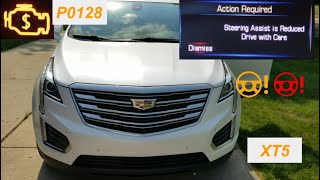
On a 2017-2023 Cadillac XT5 with the 3.6L V6 engine, code P0128 is almost always caused by a faulty, stuck-open thermostat (GM Part No. 12678779). This triggers a check engine light and, confusingly, a "Steering Assist is Reduced" message. The engine computer defaults to this protective mode because it receives an invalid temperature signal. Replacing the thermostat assembly is the definitive fix.
- P0128 on a Cadillac XT5 means the engine isn't warming up correctly, almost always due to a failed thermostat.
- Do not be alarmed by the "Steering Assist Reduced" message; it is a known side effect of this specific cooling system code and does not indicate a problem with the steering rack itself.
- The most effective repair is to replace the thermostat housing assembly, the ECT sensor, and any related seals at the same time.
- This job is moderately difficult for a DIYer due to the location of the thermostat under the intake manifold, but it is a straightforward repair for a professional mechanic.
What's Unique About the 2017-2023 Cadillac XT5

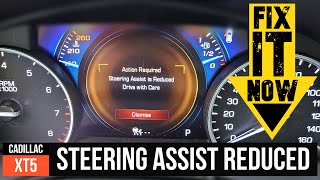
The most confusing aspect of P0128 on the Cadillac XT5 and its platform-mates is the direct link to the power steering system. Many owners are alarmed by a "Service Steering Message" or "Steering Assist is Reduced, Drive with Care" warning on the dashboard, which seems unrelated to the engine cooling system. This occurs because the electric power steering control module uses the engine coolant temperature reading to adjust steering effort. As TSB 17-NA-158 explains, the module provides more assist when the steering gear grease is cold and thick. When the P0128 code sets, the coolant temperature signal becomes invalid, so the steering module enters a protective mode, reduces power steering assistance, and displays the warning as a precaution. Manufacturer bulletins like PIT5967 and 17-NA-158 specifically instruct technicians to diagnose and fix P0128 *before* addressing any steering system components, as replacing the steering gear will not solve the problem.
🎬 Watch: How P0128 triggers the steering assist warning and the fix.Diagnostic Flowchart

Tap your situation to follow the diagnostic path that matches what you're seeing on this vehicle.
Symptoms You May Notice

- "Steering Assist is Reduced, Drive with Care" message in the Driver Information Center.
- "Service Steering Message" on the dash.
- Check Engine Light (Malfunction Indicator Lamp) is on.
- Engine cooling fans running at high speed constantly, even after the car is turned off.
- Temperature gauge reads cold or stays at the lowest position for an unusually long time.
- Heater may not blow hot air.
- Air Conditioning (A/C) may be inoperative.
- Reduced performance of the Auto Start/Stop system.
- Replacing the power steering rack, power steering control module, or other steering components in response to the "Steering Assist Reduced" message without first checking for P0128. TSB #17-NA-158 and #PIT5967 specifically warn against this, stating it will not correct the issue.
Most Likely Causes

- Stuck-Open Engine Coolant Thermostat 🔴 High Probability This is a widely documented failure point on the 3.6L V6 (LGX) engine used in the XT5 and many other GM vehicles. The thermostat is integrated into a larger housing assembly located in the valley between the cylinder heads, making replacement labor-intensive. GM has issued a special coverage program (N242484760) for this issue on some vehicles.
How to confirm: Use a scan tool to monitor the Engine Coolant Temperature (ECT) PID. On a cold start, the temperature should rise steadily to around 195-220°F and stabilize. If it warms up very slowly, never reaches full temperature (e.g., peaks at 170-180°F), or drops significantly at highway speeds, the thermostat is stuck open. Feeling the upper radiator hose after 5-10 minutes of idling from cold can also be a clue; if it's getting warm, coolant is flowing prematurely.
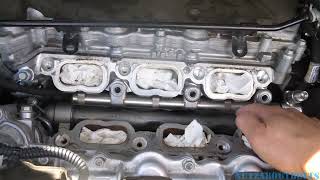
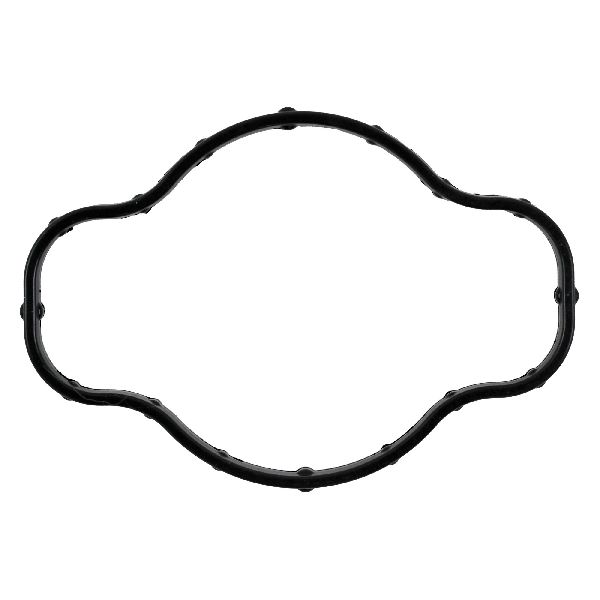
Typical fix: Replace the entire thermostat and housing assembly. It is also highly recommended to replace the coolant temperature sensor, the six upper intake manifold gaskets, and the two coolant air bleed pipe O-rings at the same time, as they are all located in the same area and require removing the intake manifold to access.
Est. part cost: $80-$200 - Low Engine Coolant Level 🟡 Medium Probability While not a specific prone issue, a low coolant level can prevent the ECT sensor from getting an accurate reading, which can trigger a P0128. These vehicles can be prone to radiator leaks.
How to confirm: Visually inspect the coolant reservoir (surge tank) when the engine is cold. The level should be at or above the 'FULL COLD' line. If low, there may be a leak in the system that needs to be identified and repaired. A user on a Camaro forum with the same LGX engine reported that simply topping off the coolant and clearing the codes resolved the issue.
Typical fix: Top off the coolant with the correct type (ACDelco Dex-Cool, orange or red color) and pressure test the system to inspect for leaks from the radiator, hoses, or water pump.
Est. part cost: $20-$40 - Faulty Engine Coolant Temperature (ECT) Sensor ⚪ Low Probability
How to confirm: With a scan tool, observe the ECT sensor reading with the engine cold after sitting overnight. It should be very close to the Intake Air Temperature (IAT) and ambient air temperature sensor readings. If the reading is erratic, nonsensical (e.g., -40°F), or doesn't change as the engine warms up, the sensor or its wiring is likely bad.
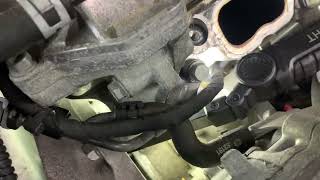
Typical fix: Replace the ECT sensor. 🎬 See this guide on replacing the coolant temperature sensor and thermostat. On the XT5's 3.6L engine, this is almost always done during the thermostat replacement due to its location under the intake manifold, right next to the thermostat housing.
Est. part cost: $20-$50
Rare But Worth Checking
- ECM Software Calibration Issue:
Diagnosis Steps
- Check for a "Steering Assist is Reduced" or "Service Steering Message" on the dash, which is a key indicator for this issue on the XT5.
- Scan the vehicle for diagnostic trouble codes. Confirm that P0128 is present. Note if U0401 is also stored in the Power Steering Control Module.
- With the engine cold, check the engine coolant level in the coolant reservoir. Ensure it is at the proper level.
- Using a scan tool, monitor the live data for the Engine Coolant Temperature (ECT) sensor. Compare it to the Intake Air Temp (IAT) sensor on a cold engine; they should be within a few degrees of each other.
- Start the engine from cold and watch the temperature reading. It should climb steadily and stabilize around 195-220°F within 15-20 minutes of driving.
- If the temperature rises very slowly, fails to reach operating temperature (e.g., stalls at 176°F as noted in one diagnostic video), or drops while driving at highway speeds, the thermostat is almost certainly stuck open and requires replacement.
- If the temperature reading is erratic or clearly incorrect from the start (e.g., reads -40°F on a warm day), suspect a faulty ECT sensor or wiring.
- Listen for the radiator fans. If they are running at maximum speed constantly, even with a cold engine, this is a default failure mode triggered by the P0128 code.
Parts You'll Likely Need
- Engine Coolant Thermostat Housing Assembly
(OEM #12678779)— This is the primary cause of code P0128. The original thermostat fails and remains in the open position. The part is an entire assembly, not just the thermostat itself.
Trusted brands: ACDelco (GM Genuine)
OEM price range: $100-$150
Aftermarket price range: $60-$100 - Engine Coolant Temperature (ECT) Sensor
(OEM #12650595)— While not always the cause, it is highly recommended to replace this sensor during a thermostat job due to its location. It's an inexpensive part that requires significant labor to access otherwise.
Trusted brands: ACDelco, Delphi
OEM price range: $25-$40
Aftermarket price range: $15-$30 - Upper Intake Manifold Gaskets (Set of 6)
(OEM #12648665)— The upper intake manifold must be removed to access the thermostat. These gaskets are single-use and must be replaced to prevent vacuum leaks.
Trusted brands: ACDelco (GM Genuine)
OEM price range: $30-$50
Aftermarket price range: $20-$40 - Engine Coolant Air Bleed Pipe O-rings (Set of 2)
(OEM #12648547)— The coolant crossover/air bleed pipe sits atop the thermostat housing and must be unbolted and moved. Replacing these two small O-rings is critical to prevent coolant leaks after the repair.
Trusted brands: ACDelco (GM Genuine)
OEM price range: $10-$20
Aftermarket price range: $5-$15 - Engine Coolant / Antifreeze
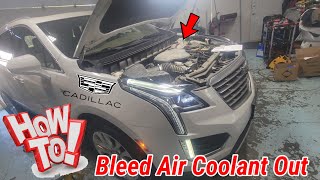
(OEM #12346290 (ACDelco Dex-Cool))— The cooling system must be partially drained to replace the thermostat, requiring a refill with the correct type 🎬 Watch: How to properly bleed the cooling system after your repair. of coolant (Orange/Red Dex-Cool).
Trusted brands: ACDelco Dex-Cool
Related Codes That Often Appear With This One
- U0401 — Stands for 'Invalid Data Received From ECM/PCM'. This code is set by the Power Steering Control Module when it receives an illogical or invalid coolant temperature reading from the engine computer (which has set P0128), triggering the steering warning message.
Technical Service Bulletins (TSBs) & Recalls
- 22-NA-054: Addresses a Check Engine Light, inaccurate temperature gauge, and cooling fans running after shutoff due to DTC P0128. It applies to 2021 models of the XT5, XT6, Blazer, Traverse, and Acadia.
- PIT5967: Instructs technicians to look for and diagnose P0128 when a "Service Steering Message" is present without any steering system codes. It covers 2017-2023 XT5, Acadia and 2018-2023 Enclave, Traverse, among others. Explains the message is a protective measure for the steering gear in case of an undetected overheat condition.
- 17-NA-158: Explains that the steering module reduces assist when the coolant temp signal is invalid because it can no longer compensate for cold, thick grease in the steering gear. Warns technicians not to replace the power steering gear for this condition.
- N242484760 (Special Coverage): A GM special coverage program to address failures of the engine coolant thermostat that can cause P0128, coolant leaks, or fans running after shutoff. Reimbursement for prior repairs may be available.
Platform-Specific Known Issues
- A "Service Steering Message" with no apparent steering-related fault codes is a strong indicator that P0128 is the root cause.
- The power steering control module reduces steering assist as a fail-safe when it detects an invalid coolant temperature signal from the ECM, which is triggered by P0128.
- TSB #PIT5967 explicitly states to diagnose and repair P0128 first when a customer reports a "Service Steering Message" before investigating the steering system itself.
- GM has a special coverage program, N242484760, that may cover the cost of thermostat replacement for this issue on certain vehicles. Owners should check with a GM dealer.
Mechanic-Grade Diagnostic Values
- ECT Sensor Resistance (Cold Engine) — expected: ~2000-3000 Ω at 20°C (68°F). Failure: Significantly higher or lower resistance, or an open/short circuit.
- ECT Sensor Resistance (Warm Engine) — expected: ~200-300 Ω at 90°C (194°F). Failure: Resistance does not drop as the engine warms, or drops to an incorrect value.
- ECT vs. IAT vs. Ambient Temp (Cold Soak) — expected: All three temperature readings should be within a few degrees of each other.. Failure: The ECT reading is significantly different from the other two, indicating a skewed sensor.
- ECT Sensor Signal Voltage (Warm Engine) — expected: Approximately 0.5V. Failure: Voltage remains high (e.g., above 1.0V) when the engine is at full operating temperature.
- Intake Manifold Bolt Torque — expected: 18 ft-lbs. Failure: N/A - This is a repair specification.
- Thermostat Housing Bolt Torque — expected: 7.4 ft-lbs (89 in-lbs). Failure: N/A - This is a repair specification.
Scan Tool Commands That Help
- GDS2 (GM Global Diagnostic System 2): Cooling Fan Control — To verify if the cooling fans are functional and not stuck on due to a mechanical or relay issue. This is useful since a default symptom of P0128 is the ECM commanding the fans to run at high speed continuously.
- GDS2 (GM Global Diagnostic System 2): Active Grille Shutter Control — To command the active grille shutters open and closed to check for proper mechanical operation. A shutter stuck in the open position could be a contributing factor to the engine running too cool, which is an edge-case cause for P0128.
Wiring & Ground Locations
- ECT Sensor Location — Mounted in the thermostat housing, located in the valley between the cylinder heads at the flywheel (transmission) end of the engine.. This is the sensor that provides the primary data for the ECM to set code P0128. Its inaccessible location under the intake manifold is why it is almost always replaced during a thermostat job.
- Engine Block Ground — A large ground strap connects the engine block to the vehicle's frame. The exact location can vary but it is a critical connection.. While not a direct cause of P0128, a poor or broken engine block ground can cause erratic behavior from multiple sensors, including the ECT sensor, due to an unstable ground reference for the ECM. This can lead to a variety of incorrect codes and misdiagnoses.
Real Owner Repair Stories
- YouTube channel 'EZ Auto' (2017 Cadillac XT5) — P0128 code, 'steering assist reduced' message, temperature gauge reading cold, cooling fans running at high speed.
✅ What actually fixed it Replaced the thermostat (GM# 12678779), ECT sensor (GM# 12650595), coolant air bleeder O-rings (GM# 12648547), and intake manifold gaskets (GM# 12648665). This resolved all symptoms. - YouTube channel 'NutzAboutBolts' (2017 Cadillac XT5) — P0128 code, 'steering assist is reduced' message.
❌ Tried (didn't work) Owner was quoted $1300 by a dealership for the repair.
✅ What actually fixed it Owner performed a DIY replacement of the thermostat and ECT sensor, which cleared the code and the warning message. - YouTube channel 'Ruva A.A' (2018 Cadillac XT5) — Temperature gauge reading high, A/C not working, cooling fans running constantly.
❌ Tried (didn't work) Replaced the Engine Coolant Temperature (ECT) sensor with a new part from the dealer.
✅ What actually fixed it After the new sensor did not fix the issue, the thermostat was replaced. This resolved the problem.
When the Usual Fixes Don't Work
- While the thermostat is the most common failure, it is not the only possibility. One owner's repair story documented replacing the ECT sensor first, based on the symptoms, but this did not solve the problem. The issue was only resolved after replacing the thermostat, confirming that even though the sensor provides the reading, the mechanical thermostat was the root cause of the illogical temperature.
OEM Part Supersession History
12670557, 12673659→12678779— Standard part evolution and updates by the manufacturer.12678779 (Full Assembly with Pipe)→12678780 (Housing Only)— GM issued a bulletin (PIP5940) in Sept 2023 to change the service procedure. For a P0128 thermostat failure, technicians are now instructed to replace only the housing (12678780) and reuse the original pipe.
Heads up: Part #12678779 is now only to be used if the coolant pipe itself is leaking, not for a standard thermostat replacement. Using the full assembly unnecessarily replaces non-failed parts and increases repair time/cost.
Model Year Variations Within This Range
- 2020-2023: A 2.0L Turbocharged 4-cylinder engine became the standard base engine after the 2020 model year refresh. The 3.6L V6 (LGX) remained available. This P0128 guide is specific to the 3.6L V6. The cooling system, including components like the active grille shutters, may differ between the 2.0L and 3.6L models.
Helpful Videos
Used OEM Parts in Stock




New Aftermarket Parts Available


The information in this article is provided for general reference and educational purposes only. Vehicle specifications, procedures, and part compatibility can vary by production date, trim level, and region. Always consult your vehicle's factory service manual and verify part numbers before purchasing or performing repairs. Safety-critical components such as airbags, seat belts, and braking systems should be installed by a qualified professional.
- Cadillac XT5:
- 🎬 Helpful Videos
- 🛍️ Shop This Part
- What's Unique About the 2017-2023 Cadillac XT5
- Diagnostic Flowchart
- Symptoms You May Notice
- Most Likely Causes
- Rare But Worth Checking
- Diagnosis Steps
- Parts You'll Likely Need
- Related Codes That Often Appear With This One
- Technical Service Bulletins (TSBs) & Recalls
- Platform-Specific Known Issues
- Mechanic-Grade Diagnostic Values
- Scan Tool Commands That Help
- Wiring & Ground Locations
- Real Owner Repair Stories
- When the Usual Fixes Don't Work
- OEM Part Supersession History
- Model Year Variations Within This Range
- 🎟️ Get 5% Off