

P0126 on 2007-2018 Ford Focus: Causes and Fixes for Insufficient Coolant Temperature
For a 2007-2018 Ford Focus, code P0126 almost always means the thermostat is stuck open. Replacing the thermostat assembly is the most common fix. Expect to pay around $20-$50 for an aftermarket part or $50-$85 for an OEM Motorcraft part. It's a moderately difficult DIY job due to tight access, especially on 2012-2018 models where it's under the intake manifold.
- P0126 on a Ford Focus means the engine isn't warming up quickly enough.
- The most probable cause, by a large margin, is a thermostat that is stuck in the open position.
- The fix is to replace the entire thermostat and housing assembly, not just the thermostat itself.
- While you're performing the repair, it's a good idea to also replace the Engine Coolant Temperature (ECT) sensor as it's a common secondary cause and often located nearby.
- Ensure you refill the system with the correct Ford-specified coolant (now typically yellow) and properly bleed any air out of the system.
What's Unique About the 2007-2018 Ford Focus
The Ford Focus, particularly the 2012-2018 (Mk3) generation with the 2.0L engine, integrates the thermostat directly into a plastic housing, which must be replaced as a single unit. Unlike some vehicles where just the thermostat itself can be swapped, on the Focus you must replace the entire assembly. The location of this housing is notoriously tight, located under the intake manifold on the 2.0L GDI engine, making the repair more challenging and labor-intensive than on many other vehicles.
Generation note: This guide covers the Ford Focus Mk2 (2007-2011) and Mk3 (2012-2018). While the principle of the P0126 code is the same for both, the exact location and procedure for replacing the thermostat and coolant temperature sensor can differ based on the engine (e.g., 2.0L Duratec vs. 2.0L GDI). The issue of a combined thermostat and housing is most noted on the Mk3 models. On the Mk3 2.0L, the thermostat is under the intake manifold, while the ECT sensor is on the right side of the cylinder head.
Symptoms You May Notice
- Check Engine Light is on.
- Temperature gauge on the dashboard stays on 'C' or takes a very long time to move.
- Heater blows lukewarm or cold air, especially when idling or at highway speeds.
- Noticeable decrease in fuel economy.
- Rough or unstable idle, particularly on cold starts.
- Replacing the coolant temperature sensor when the thermostat is actually the problem. The thermostat is the most likely culprit, and a faulty sensor is a secondary cause. Always diagnose by watching live data first. 🎬 Watch: How to diagnose and fix codes P0126 and P0128.
Most Likely Causes
- Thermostat Stuck Open 🔴 High Probability The thermostat is a mechanical wear item. Its internal wax element or spring can fail, causing it to remain in the open position. This allows coolant to circulate constantly through the radiator, over-cooling the engine.
How to confirm: Monitor the temperature gauge; if it stays low during extended driving or drops at highway speeds, the thermostat is likely open. An OBD-II scanner can also show live coolant temperature data that fails to reach the ~195°F target, which is the most definitive test.
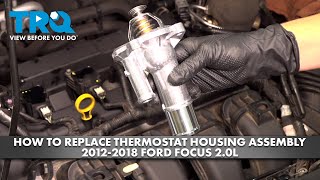
Typical fix: Replace the entire thermostat and housing assembly. It is also recommended to drain and refill the engine coolant at the same time. 🎬 See this walkthrough for replacing the thermostat housing assembly.
Est. part cost: $20-$85 - Faulty Engine Coolant Temperature (ECT) Sensor 🟡 Medium Probability The sensor can degrade over time, sending inaccurate (often colder than actual) readings to the PCM. This can trick the computer into thinking the engine isn't warming up, even if it is.
How to confirm: Use an OBD-II scanner to compare the ECT sensor reading to the ambient air temperature sensor reading on a cold engine (they should be very close). If the reading is erratic, illogical (e.g., -40°F), or never changes, the sensor is likely bad. A more advanced test involves measuring the sensor's resistance with a multimeter and comparing it to specifications at different temperatures.
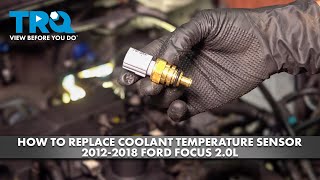
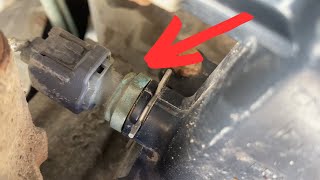
Typical fix: Replace the Engine Coolant Temperature sensor. On the Mk3 2.0L, it is located on the right side of the cylinder head. 🎬 Watch: How to locate and replace the ECT sensor. This is often done at the same time as the thermostat for convenience.
Est. part cost: $15-$40 - Low Engine Coolant Level ⚪ Low Probability Coolant can be lost through leaks in hoses, the radiator, water pump, or the thermostat housing itself. While not a specific Focus issue, it's a universal possibility that can cause the ECT sensor to read air instead of coolant.
How to confirm: Visually inspect the coolant reservoir. If it is below the 'MIN' line, the system is low. Check for visible leaks, puddles under the car, or the sweet smell of coolant after driving.
Typical fix: Find and repair the source of the leak, then refill and bleed the cooling system.
Est. part cost: $10-$300+ depending on the source of the leak
Rare But Worth Checking
- Air in the Cooling System: If the cooling system was recently serviced (like a thermostat replacement) and not properly bled, air pockets can form. These pockets can prevent proper coolant circulation and cause inaccurate temperature readings at the sensor.
- Wiring or Connector Issues: The wiring to the ECT sensor can become damaged, frayed, or corroded, leading to a loss of signal or incorrect voltage readings by the PCM.
- Faulty Powertrain Control Module (PCM): This is extremely rare. The PCM itself could have an internal fault preventing it from correctly interpreting the ECT sensor data, but all other possibilities should be exhausted first.
Diagnosis Steps
- Check the coolant level in the reservoir and top off if necessary. Look for any obvious signs of coolant leaks.
- Connect an OBD-II scanner to the vehicle. Confirm that P0126 is the active code, and check if P0128 is also present.
- Use the scanner's live data function to monitor the Engine Coolant Temperature (ECT) while driving. Start the engine from cold.
- Observe the ECT reading. It should steadily climb to around 195-210°F and then stabilize as the thermostat opens and closes.
- If the temperature takes an excessively long time to warm up, never reaches ~195°F, or drops significantly at highway speeds, the thermostat is very likely stuck open and needs to be replaced.
- If the temperature gauge on the scanner behaves erratically, shows an illogical value (e.g., -40°F), or doesn't move from the cold reading, the ECT sensor or its wiring is the likely problem.
- If the thermostat is replaced and the code returns, the next step is to test and likely replace the ECT sensor.
- After repairs, clear the codes and perform a drive cycle (typically 15-20 minutes of mixed driving) to ensure the problem is resolved.
Parts You'll Likely Need
- Thermostat and Housing Assembly
(OEM #CP9Z-8592-G (for 2012-2018 2.0L Non-Turbo))— This is the most common cause of P0126. On the Focus, the thermostat is integrated into the housing and must be replaced as a complete unit.
Trusted brands: Motorcraft (RT-1219), Gates, Dorman (e.g., 902-820 for Mk2)
OEM price range: $50-$85
Aftermarket price range: $20-$50 - Engine Coolant Temperature (ECT) Sensor — This is the second most likely cause. It provides the temperature reading to the PCM, and if it fails, it can trigger the code even with a good thermostat.
Trusted brands: Motorcraft, Bosch, Standard Motor Products
OEM price range: $25-$40
Aftermarket price range: $15-$30 - Engine Coolant/Antifreeze
(OEM #Motorcraft VC-13-G (Yellow))— The cooling system must be drained to replace the thermostat, so you will need to refill it. Ford has updated its recommendation from Orange to Yellow coolant (Motorcraft Yellow Antifreeze/Coolant), which is backward-compatible and recommended for these vehicles.
Trusted brands: Motorcraft, PEAK, Prestone
OEM price range: $20-$30 per gallon
Aftermarket price range: $15-$25 per gallon
Related Codes That Often Appear With This One
- P0128 — P0128 (Coolant Temperature Below Thermostat Regulating Temperature) is a very similar code that is often triggered by the same root cause: a stuck-open thermostat. It's common to see both P0126 and P0128 appear at the same time.
Technical Service Bulletins (TSBs) & Recalls
- Mazda TSB RF-24-09: While for a Mazda, this TSB addresses DTC P0126 and points to a faulty coolant control valve, highlighting the shared engineering DNA with Ford's Duratec engines.
Platform-Specific Known Issues
- On the 2012-2018 Mk3 Focus with the 2.0L GDI engine, the thermostat housing is located in a very tight space underneath the intake manifold. This makes replacement significantly more difficult than on other vehicles, requiring more time and potentially the removal of other components for access, which increases labor costs.
Mechanic-Grade Diagnostic Values
- Engine Coolant Temperature (ECT) Sensor Resistance — expected: Approx. 2,200 - 3,000 Ω at 20°C (68°F); Approx. 250 - 350 Ω at 80°C (176°F).. Failure: Readings are significantly outside the expected range for a given temperature, or resistance does not change as the engine warms up.
- Engine Coolant Temperature (ECT) Sensor Signal Voltage — expected: Approx. 3.0V - 3.5V on a cold engine (~20°C/68°F), dropping to approx. 1.0V - 1.3V at normal operating temperature (~80°C/176°F).. Failure: Voltage is stuck high (e.g., near 5V) or low, or does not decrease smoothly as the engine warms up. A reading of less than 0.20V may indicate a short to ground.
Scan Tool Commands That Help
- FORScan / Ford IDS: Monitor ECT (VOLT) PID — This is used during diagnosis to watch the raw voltage from the ECT sensor. Wiggling the harness from the sensor to the PCM while monitoring this PID can help identify intermittent wiring faults that may not be obvious from just watching the temperature reading.
- Ford IDS: Reset the keep alive memory (KAM) — After replacing a component like the ECT sensor, resetting the KAM is recommended to clear any learned adaptive values that the PCM may have stored based on the faulty sensor's readings.
Wiring & Ground Locations
- G104 / G102 — Located on the left front of the motor compartment on the frame rail, often near or under the airbox.. This is a primary chassis ground point for the engine bay. A corroded or loose connection here can cause erratic behavior in various sensors, including the ECT, leading to incorrect readings and false trouble codes.
- ECT Sensor Connector — On the Mk3 2.0L, the sensor is on the right side of the cylinder head. The connector has two pins: Pin 1 is the signal return (SIGRTN) and Pin 2 is the ECT signal.. This is the direct connection point for testing the sensor's resistance and the voltage being sent to the PCM. Damage or corrosion here is a common point of failure.
Real Owner Repair Stories
- Reddit user in r/askcarguys (2004 Ford Focus 2.3L Duratec (Mk1.5, similar engine architecture to Mk2)) — Engine running cold, difficulty passing smog checks.
❌ Tried (didn't work) Replaced the thermostat with an OEM Motorcraft part three separate times over a decade.
✅ What actually fixed it The owner insisted on trying a different brand and installed a Motorad thermostat, which finally resolved the running-cold issue and allowed the car to pass emissions tests.
Documented NHTSA Reports
- NHTSA ODI #10899284: An owner of a Ford vehicle with a similar powertrain architecture reported the P0126 code appearing twice, specifically noting the "Coolant Thermostat Temperature Below Thermostat Regulating" condition alongside other powertrain control module concerns.
OEM Part Supersession History
Unknown→CP9Z-8592-G (also listed as Motorcraft RT-1219)— Standard part evolution and design updates by Ford.
Heads up: This part is specific to the 2.0L non-turbo GDI engine. The part number for the Mk2 Focus (2007-2011) with the 2.0L Duratec engine is different (e.g., Dorman 902-820 is a common aftermarket replacement for the earlier design).
Model Year Variations Within This Range
- 2007-2011 (Mk2): The thermostat housing is a different design and located more accessibly on the 2.0L Duratec engine compared to the later GDI. An aftermarket replacement like the Dorman 902-820 is listed for these years and opens at 208°F.
- 2012-2018 (Mk3): The thermostat housing (OEM P/N CP9Z-8592-G / Motorcraft RT-1219) is for the 2.0L GDI engine and is located under the intake manifold. The OEM thermostat has a listed opening temperature of 190°F. This location makes replacement significantly more labor-intensive.
Diagnostic Flowchart
Other Known Issues on This Vehicle
Issues unrelated to this code that are worth knowing about as an owner of this generation:
- DPS6 PowerShift Automatic Transmission Failure 🔴 High — Extremely common on 2012-2016 models. Causes shuddering, hesitation, jerking, and complete failure. Subject of class-action lawsuits and multiple TSBs. (Ref: TSB 15-0121, TSB 13-9-4)
- Electronic Power Steering (EPAS) Failure 🔴 High — Commonly reported, especially in the 2012 model year, but affects others. Results in a sudden loss of power steering assist, making the vehicle very difficult to steer. Often requires full steering rack replacement.
- Faulty Canister Purge Valve 🟠 Medium — A very common failure on 2012-2018 models, causing engine stalling at low speeds, rough idle, hard starting, and inaccurate fuel gauge readings. (Ref: Recall 18S32 / NHTSA 18V735)
Used vs. New Parts: Buying Guide for This Vehicle
When a used part is the smart pick: For this specific repair, using used parts is generally not recommended. The primary failure components—the thermostat and ECT sensor—are wear items with a finite lifespan. The cost savings of a used part are minimal compared to the labor involved in the replacement, especially for the thermostat on Mk3 models.
Donor-vehicle mileage cap: roughly under 50000 miles for the part to have meaningful remaining life.
What to inspect on the donor part:
- If considering a used ECT sensor, ensure the connector pins are clean, straight, and free of corrosion.
- For a thermostat housing, inspect the plastic for any hairline cracks, chalkiness, or signs of brittleness, particularly around the hose connections and bolt holes.
- Avoid any parts from a vehicle that shows signs of cooling system neglect, such as sludgy or rusty coolant in the reservoir.
OEM-only on this vehicle (don't cheap out):
- No parts are strictly OEM-only for this repair, but using an OEM Motorcraft thermostat is often recommended for fit and correct temperature rating.
Aftermarket brands forum-validated for this vehicle:
- Motorcraft (OEM)
- Gates
- Stant
- Motorad (One owner reported success with this brand after OEM parts repeatedly failed to solve the issue)
Brands owners have reported issues with on this vehicle:
- Some owners have reported issues with lower-tier or 'white-box' store-brand thermostats failing prematurely or having incorrect temperature ratings.
Real Owner Stories
Aggregated from forums and TSBs cited above. Mileages and costs reflect what owners reported in those sources.
2015 Ford Focus ST
Symptoms: Check Engine Light came on with codes P0128 & P0126. The temperature gauge typically stays between the 1/4 and 1/2 mark and never goes past half.
What fixed it: Owner researched the issue and concluded a faulty thermostat was the most likely culprit, purchasing a new one for replacement.
Source hint: Reddit r/FocusST
Related OBD-II Codes
Frequently Asked Questions
I have a 2015 Focus and got both P0126 and P0128 codes. What's the most likely problem?
Why is it so expensive to replace the thermostat on my 2013 Ford Focus 2.0L?
How can I tell if the P0126 code is caused by the thermostat or the ECT sensor?
My heater is only blowing lukewarm air. Could this be related to my Check Engine Light and code P0126?
I have a Mazda3 with a similar engine. Does the Mazda TSB for P0126 apply to my car?
Can a low coolant level cause a P0126 code on my Focus?
Helpful Videos

We Have This Part in Stock

The information in this article is provided for general reference and educational purposes only. Vehicle specifications, procedures, and part compatibility can vary by production date, trim level, and region. Always consult your vehicle's factory service manual and verify part numbers before purchasing or performing repairs. Safety-critical components such as airbags, seat belts, and braking systems should be installed by a qualified professional.
- Ford Focus:
- 🎬 Helpful Videos
- 🛍️ Shop This Part
- What's Unique About the 2007-2018 Ford Focus
- Symptoms You May Notice
- Most Likely Causes
- Rare But Worth Checking
- Diagnosis Steps
- Parts You'll Likely Need
- Related Codes That Often Appear With This One
- Technical Service Bulletins (TSBs) & Recalls
- Platform-Specific Known Issues
- Mechanic-Grade Diagnostic Values
- Scan Tool Commands That Help
- Wiring & Ground Locations
- Real Owner Repair Stories
- Documented NHTSA Reports
- OEM Part Supersession History
- Model Year Variations Within This Range
- Diagnostic Flowchart
- Other Known Issues on This Vehicle
- Used vs. New Parts: Buying Guide for This Vehicle
- Real Owner Stories
- 2015 Ford Focus ST
- Related OBD-II Codes
- Frequently Asked Questions
- 🎟️ Get 5% Off