

P0121 on 2006-2009 Chevrolet TrailBlazer V8: Reduced Power Causes and Fixes
On a V8 TrailBlazer, P0121 almost always means the throttle body is either dirty or failing, triggering 'Reduced Engine Power' mode. The most common fix is to first thoroughly clean the throttle body; if that fails, replace the entire assembly. Expect to spend $150-$350 for a new throttle body.
- P0121 on your V8 TrailBlazer will almost certainly put the truck into 'Reduced Engine Power' mode.
- Before buying any parts, your first step should always be to remove and thoroughly clean the throttle body.
- If you clean or replace the throttle body, an 'idle relearn' procedure is mandatory to restore normal idle speed.
- The throttle position sensor (TPS) is built into the throttle body; if the sensor is bad, the entire assembly must be replaced.
- Do not confuse this code with a bad gas pedal; P0121 points specifically to a problem at the engine's throttle body.
What's Unique About the 2006-2009 Chevrolet TrailBlazer
The GMT360 platform, which includes the TrailBlazer, is well-known for this issue. The electronic throttle body is a common failure point, often referred to as a 'notorious problem' by mechanics working on these trucks. As carbon builds up from the PCV system, the ECM learns to open the throttle plate slightly more at idle to compensate. Eventually, the learned value reaches its limit or a significant mismatch occurs between the expected and actual throttle angle, triggering P0121 and Reduced Engine Power mode. A dirty throttle body is the most frequent trigger, but the internal electronics of the sensor, which are integrated into the throttle body, are also prone to failure. Unlike many codes that have a wide array of possible causes, P0121 on this specific vehicle points very strongly to the throttle body assembly or its immediate wiring.
Symptoms You May Notice
- "Reduced Engine Power" message on the dashboard
- Check Engine Light is on
- Severely limited acceleration and speed (limp mode)
- Unstable, rough, or high idle
- Engine hesitation or stumbling
- Engine may stall at low speeds.
- Engine will not rev past a certain RPM (e.g., 2000 RPM).
- Replacing the accelerator pedal position (APP) sensor. The P0121 code is specific to the throttle body circuit's performance, not the pedal sensor. Codes for the pedal sensor are typically P2135 or P2138.
Most Likely Causes
- Dirty Throttle Body 🔴 High Probability The PCV (Positive Crankcase Ventilation) system routes oil vapors and combustion byproducts back into the intake, which can bake onto the throttle plate and bore over time, restricting movement.
How to confirm: Remove the air intake tube from the throttle body and visually inspect the throttle plate and bore for a thick, black layer of carbon buildup. With the engine running, a scan tool may show a high throttle angle percentage at idle (e.g., over 20%).
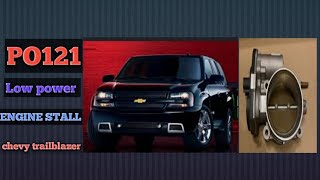
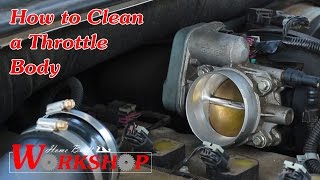
Typical fix: Remove the throttle body from the vehicle and clean it thoroughly with dedicated throttle body cleaner and a soft brush or rag. Do not use brake cleaner. 🎬 Watch: Step-by-step guide to cleaning your TrailBlazer's throttle body. After reinstallation, an idle relearn procedure is required.
Est. part cost: $5-$15 - Failing Throttle Body Assembly 🔴 High Probability The throttle position sensor (TPS) is integrated into the throttle body assembly and cannot be replaced separately. Wear and tear on the internal electronic contacts or motor can cause erratic signals. This is a very common failure on this platform.
How to confirm: If a thorough cleaning of the throttle body does not resolve the code, or only resolves it temporarily, the assembly itself is the next likely culprit. A scan tool may show erratic or jumping voltage from the TPS when the throttle is slowly opened and closed. Specifically, monitor TPS1 and TPS2 voltages; they should move smoothly in opposite directions.
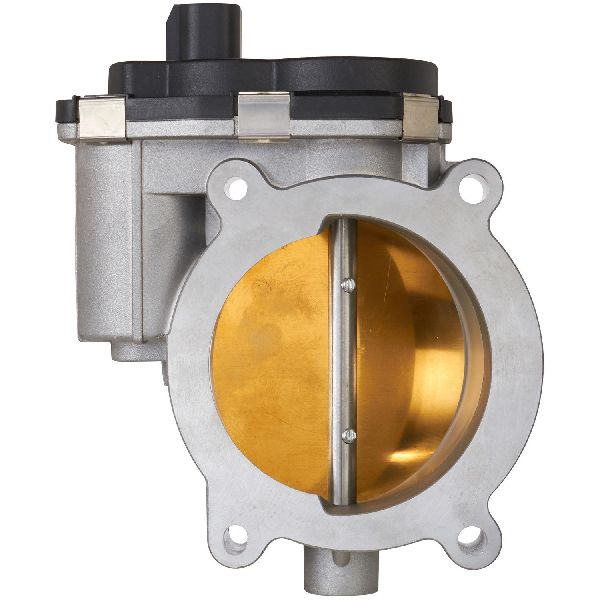
Typical fix: Replace the entire throttle body assembly. This is a bolt-on procedure that also requires an idle relearn procedure after installation. 🎬 See this walkthrough on how to replace the throttle body assembly. Some replacement parts may require programming by a dealer or qualified shop.
Est. part cost: $150-$350 - Wiring Harness Issue 🟡 Medium Probability The wiring harness near the throttle body is exposed to engine heat and vibration, which can cause wires to break internally or chafe against other components, even if the insulation looks intact.
How to confirm: With the engine running, carefully wiggle the wiring harness and connector at the throttle body. If this causes the engine to stumble or the code to appear/disappear, a wiring fault is likely. Perform a 'tug test' on each individual wire at the connector to check for breaks inside the insulation. Inspect and clean main engine grounds like G103 and G104.
Typical fix: Repair the broken or shorted wire(s). In some cases, a new connector pigtail (e.g., Dorman 645-595, ACDelco PT2160) may need to be spliced in.
Est. part cost: $15-$40
Rare But Worth Checking
- Failing Powertrain Control Module (PCM): This is very uncommon. All other possibilities, especially the throttle body and wiring, should be exhaustively ruled out before considering the PCM as the cause.
Diagnosis Steps
- Scan for trouble codes and confirm P0121 is present. Note any other codes, as they can provide clues.
- Visually inspect the air intake hose between the air filter box and the throttle body for cracks or loose clamps.
- Remove the intake hose from the throttle body. Inspect the throttle bore and plate for heavy carbon buildup.
- If dirty, remove the throttle body (typically four 10mm bolts) and clean it thoroughly off the vehicle using specialized throttle body cleaner and a soft cloth. Do not spray cleaner directly into the electronics.
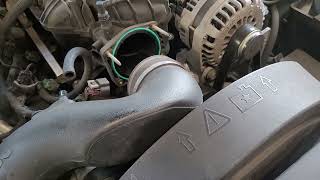
- Inspect the wiring harness and connector going to the throttle body. Look for chafed wires, corrosion on the pins, or a loose connection. Wiggle the harness with the engine running to see if it induces a stall or code. 🎬 Watch: How to fix the reduced engine power message yourself.
- Inspect and clean the primary engine ground points, specifically G103 (front of passenger side cylinder head) and G104 (rear of driver's side cylinder head).
- If cleaning does not resolve the issue, the most likely cause is a failed throttle body assembly.
- After cleaning or replacing the throttle body, you MUST perform an idle relearn procedure. A common method is to start the engine and let it idle in Park for 3 minutes, turn the engine OFF for 60 seconds, then restart and idle for another 3 minutes. The idle should stabilize. If not, a drive cycle may be required.
Parts You'll Likely Need
- Throttle Body Assembly
(OEM #12580760 (superseded by 12679524))— This is the most common fix when cleaning the original unit fails. The throttle position sensor is integrated into this assembly and is not sold separately.
Trusted brands: ACDelco (OEM), Bosch, Hitachi
OEM price range: $250-$400
Aftermarket price range: $150-$250 - Throttle Body Cleaner — Required for the first, most common diagnostic and repair step: cleaning the throttle plate and bore of carbon buildup.
Trusted brands: CRC, Berryman, Gumout
Aftermarket price range: $5-$15 - Throttle Body Connector Pigtail
(OEM #ACDelco PT2160 / Dorman 645-595)— Needed if the original connector or wiring at the throttle body is found to be damaged, corroded, or has loose pins.
Related Codes That Often Appear With This One
- P1516 — This code indicates the actual throttle position doesn't match the commanded position, a fault directly related to the P0121 performance issue.
- P2101 — This code points to a problem with the throttle actuator control motor, which is part of the same throttle body assembly.
- P0068 — Indicates a conflict between MAP/MAF sensor data and throttle position. A sticking throttle plate from carbon (causing P0121) can trigger this.
- P2176 — This code means the idle position has not been learned, which can be caused by carbon buildup (also causing P0121) or can occur after a throttle body replacement if the relearn procedure isn't done.
Technical Service Bulletins (TSBs) & Recalls
- PIP4578B: This TSB covers a wide range of GM V8 vehicles, including the 2006-2009 TrailBlazer. It explicitly states that on high-mileage vehicles, carbon buildup can cause P0121 and other related codes. It instructs technicians to clean the throttle body and perform an 'idle learn reset' with a scan tool. It warns that if the relearn is not performed, the issue may persist or return with new codes like P0506/P0507. Manufacturer TSB Bulletin #PIP4578B also notes that this condition may be associated with idle surge and reduced engine power mode.
Platform-Specific Known Issues
- Temporary Fix from Cleaning: Many owners report that cleaning the throttle body resolves the P0121 code and drivability issues, but the problem returns within a few weeks or months. This strongly indicates the internal electronic sensor is failing, and a complete throttle body replacement is the only permanent solution.
- Idle Relearn is Critical: Failure to perform an idle relearn procedure after cleaning or replacement is a common mistake. The PCM retains the old learned values for the previously dirty/faulty throttle body, which can cause a very high idle (1500-2500 RPM) or immediately set new codes (like P2176) with the new/clean part.
Mechanic-Grade Diagnostic Values
- TPS1 Voltage (Key On, Engine Off, 0% Throttle) — expected: 0.13V - 0.67V. Failure: Voltage is significantly higher, for example > 0.8V.
- TPS2 Voltage (Key On, Engine Off, 0% Throttle) — expected: 4.30V - 4.80V. Failure: Voltage is significantly lower, for example < 4.0V.
- TPS1 and TPS2 Voltage Sweep — expected: As throttle is opened, TPS1 should sweep smoothly up towards ~4.5V and TPS2 should sweep smoothly down towards ~0.5V. The sum of the two voltages should remain relatively constant.. Failure: Any jumps, glitches, or flat spots in the voltage sweep for either sensor indicates a failing throttle body.
- Scan Tool Throttle Angle % at Idle (before cleaning) — expected: Typically under 15-20%. Failure: A reading of 20% or higher at idle often indicates significant carbon buildup that the ECM is compensating for.
- Throttle Body Ground Circuit Voltage Drop — expected: Less than 100mV (0.1V). Failure: Higher voltage indicates excessive resistance in the ground circuit, which can cause sensor errors.
Scan Tool Commands That Help
- Tech2 / GDS2 or equivalent professional scan tool: Idle Learn Reset / Throttle Learn Reset — This function must be used after cleaning or replacing the throttle body. It clears the old learned idle airflow compensation values from the ECM. Failure to do so will result in a very high idle and other drivability problems. After running the command, the TPS angle percentage at idle should drop significantly (e.g., from >20% to <10%).
Wiring & Ground Locations
- G103 — On the front of the passenger side (right) cylinder head.. This is a primary engine sensor ground. A poor connection here can cause erratic voltage readings for multiple sensors, including the throttle position sensor.
- G104 — On the rear of the driver side (left) cylinder head.. This is another primary engine ground strap. A poor connection here can affect the entire engine management system and is a known cause of throttle-related faults.
- G107 / G108 — On the lower left side of the engine block.. These are additional engine block grounds that ensure proper grounding for the entire powertrain, including the ECM which controls the throttle.
- Throttle Body Connector — The 8-pin electrical connector on the throttle body itself.. This is the central connection point. Wires are known to break internally within a few inches of the connector due to heat and vibration. A 'tug test' on each wire can reveal these hidden breaks.
Real Owner Repair Stories
- YouTube user 'automotive tech-vet' (2008 Chevrolet Trailblazer) — Reduced Engine Power light, Check Engine Light on/off, code P0121.
❌ Tried (didn't work) Thoroughly cleaning the throttle body.
✅ What actually fixed it Replacing the entire throttle body assembly with a new, quality part (ACDelco or Bosch recommended). The narrator stated it's such a common problem that further testing was unnecessary after cleaning failed. - YouTube user 'Jabo THE MECHANIC' (2006 Chevrolet Trailblazer SS 6.0L V8) — Reduced Engine Power, codes P0121 and P060E.
❌ Tried (didn't work) Cleaning the throttle body multiple times (worked temporarily but problem returned).
✅ What actually fixed it Replacing the entire throttle body assembly with a new OEM part from the dealership. The old throttle body was physically sticking at the closed position. - Tahoe-Yukon Forum user (paraphrased from Go-Parts article) (2005 Chevrolet Trailblazer 5.3L V8) — Persistent 'Reduced Engine Power' message and code P1516 (related to throttle control).
❌ Tried (didn't work) Replacing unspecified parts.
✅ What actually fixed it Adding multiple redundant ground wires between the firewall, the engine block, and the TAC module mounting bracket to ensure a solid ground connection for the throttle control system.
OEM Part Supersession History
12572658→12580760— Standard part evolution and revision by the manufacturer.12580760→12679524— Standard part evolution and revision by the manufacturer.
Heads up: The latest part number, 12679524, may require programming or special setup procedures with a scan tool to function correctly in the vehicle.
Model Year Variations Within This Range
- 2006-2009 (V8 SS Model): The Trailblazer SS with the 6.0L LS2 V8 uses a larger 87mm or 90mm throttle body from the factory, compared to smaller units on other engines. While the P0121 diagnosis is the same, ensure the replacement part has the correct bore size for the SS model.
Diagnostic Flowchart
Other Known Issues on This Vehicle
Issues unrelated to this code that are worth knowing about as an owner of this generation:
- Fuel Level Sensor Failure 🟠 Medium — Extremely common; the fuel gauge becomes erratic or stuck on empty. Typically occurs around 90,000 miles. (Ref: GM offered to cover 50% of repair costs for some model years, though it was not a formal recall.)
- Failed Fan Clutch 🟠 Medium — Common failure, leading to a loud engine fan noise (like a jet engine) and potential overheating. Often occurs after 100,000 miles.
- HVAC Blower Motor Resistor Failure 🟡 Low — Very common issue where the fan only works on certain speeds (or not at all). Usually happens around 114,000 miles.
- 4WD System Faults 🟠 Medium — Issues with the 4WD selector switch or the front axle disconnect actuator are frequently reported, causing the 'Service 4WD' light to appear.
- Cracked Exhaust Manifold 🟠 Medium — The V8 models are known for developing cracks in the exhaust manifolds, resulting in a ticking noise, especially when the engine is cold.
Used vs. New Parts: Buying Guide for This Vehicle
When a used part is the smart pick: For this specific repair, buying a used throttle body is NOT recommended. The internal electronic sensors are a known high-failure item due to wear. A used part has unknown mileage and life remaining. Furthermore, newer replacement parts may require programming to the vehicle's ECM, which a junkyard part may not be compatible with, negating any initial cost savings.
Donor-vehicle mileage cap: roughly under 50000 miles for the part to have meaningful remaining life.
What to inspect on the donor part:
- Check for a clean throttle plate and bore with no deep scoring or gouges.
- Ensure the electrical connector pins are straight, clean, and free of corrosion.
- Manually (if possible, gently) move the throttle plate to feel for any binding, sticking, or gritty movement.
- Ask for the donor vehicle's mileage; lower is always better.
Aftermarket brands forum-validated for this vehicle:
- ACDelco (OEM)
- Bosch (Often the OE supplier)
- Hitachi
Brands owners have reported issues with on this vehicle:
- No-name, unbranded parts from online marketplaces are a gamble. Given the criticality of this part and the potential need for programming, sticking to known-good brands is highly advised to avoid repeat failures.
Real Owner Stories
Aggregated from forums and TSBs cited above. Mileages and costs reflect what owners reported in those sources.
2006-2009 Chevrolet TrailBlazer V8
Symptoms: Recurring P0121 code and drivability issues that would disappear after cleaning but return within a few weeks or months.
What fixed it: Complete throttle body replacement, as the internal electronic sensor was failing.
Source hint: vehicle_specific_issues section under 'Temporary Fix from Cleaning'
2006-2009 Chevrolet TrailBlazer V8
Symptoms: Reduced engine power message and P0121 code; user was advised that the issue might be wiring rather than the gas pedal.
What fixed it: Checking for wiring issues near the connector and fan harness.
Source hint: GMTNation Forum thread titled 'Reduced engine power P0121 Help me!!!!'
Related OBD-II Codes
Frequently Asked Questions
Does TSB PIP4578B apply to my 2006-2009 Chevrolet TrailBlazer V8?
Can I just replace the Throttle Position Sensor (TPS) on my TrailBlazer V8?
Why did my TrailBlazer start idling at 2000 RPM after I cleaned the throttle body?
Is there a specific cleaner I should use for the throttle body?
Are there specific wiring points I should check for P0121 on the TrailBlazer?
Will a dirty throttle body cause my TrailBlazer to go into 'Reduced Engine Power' mode?
Helpful Videos

Used OEM Parts in Stock


New Aftermarket Parts Available


The information in this article is provided for general reference and educational purposes only. Vehicle specifications, procedures, and part compatibility can vary by production date, trim level, and region. Always consult your vehicle's factory service manual and verify part numbers before purchasing or performing repairs. Safety-critical components such as airbags, seat belts, and braking systems should be installed by a qualified professional.
- Chevrolet TrailBlazer:
- 🎬 Helpful Videos
- 🛍️ Shop This Part
- What's Unique About the 2006-2009 Chevrolet TrailBlazer
- Symptoms You May Notice
- Most Likely Causes
- Rare But Worth Checking
- Diagnosis Steps
- Parts You'll Likely Need
- Related Codes That Often Appear With This One
- Technical Service Bulletins (TSBs) & Recalls
- Platform-Specific Known Issues
- Mechanic-Grade Diagnostic Values
- Scan Tool Commands That Help
- Wiring & Ground Locations
- Real Owner Repair Stories
- OEM Part Supersession History
- Model Year Variations Within This Range
- Diagnostic Flowchart
- Other Known Issues on This Vehicle
- Used vs. New Parts: Buying Guide for This Vehicle
- Real Owner Stories
- 2006-2009 Chevrolet TrailBlazer V8
- 2006-2009 Chevrolet TrailBlazer V8
- Related OBD-II Codes
- Frequently Asked Questions
- 🎟️ Get 5% Off