

P0118 on 2017-2025 Chrysler Pacifica 3.6L: Engine Coolant Temperature Sensor Causes and Fixes
Code P0118 on a Chrysler Pacifica most often means the Engine Coolant Temperature (ECT) sensor has failed. This causes the cooling fans to run constantly and the temperature gauge to read cold. Replacing the sensor, located in the thermostat housing at the front of the engine, is a common and relatively easy DIY fix with the part costing between $20 and $60.
- P0118 on your Pacifica almost always points to a problem with the Engine Coolant Temperature (ECT) sensor or its wiring.
- The most obvious symptom is the engine cooling fans running at full speed all the time.
- The ECT sensor is located in the thermostat housing at the front of the engine, making it easy to access for testing and replacement.
- A scan tool showing a -40°F temperature reading is the fastest way to confirm the fault.
- Replacing the sensor is a simple DIY job that can be done in under an hour with basic tools.
What's Unique About the 2017-2025 Chrysler Pacifica
On the 3.6L Pentastar V6 engine used in the 2017-2025 Pacifica, Chrysler moved the Engine Coolant Temperature (ECT) sensor to a very accessible location. Unlike some earlier versions of this engine where the sensor was difficult to reach, it is now located directly in the thermostat housing at the front of the engine. This makes diagnosis and replacement much simpler for owners and technicians. A common fail-safe strategy on these vehicles is for the cooling fans to run at full speed continuously when this code is active to prevent any chance of overheating.
Symptoms You May Notice
- Check Engine Light is on
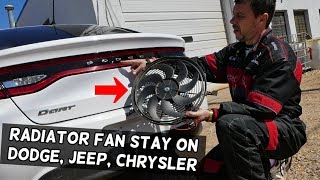
- Cooling fans run constantly at high speed, even when the engine is cold. 🎬 See why your radiator fan stays on all the time
- Inaccurate temperature gauge on the dashboard (may show no reading, stay at the lowest point, or not move at all).
- Rough idling or engine hesitation, especially when cold.
- Reduced fuel economy.
- Difficulty starting the engine, particularly when cold, due to incorrect fuel mixture.
- Black smoke from the exhaust in some cases due to a rich fuel condition.
- Replacing the thermostat. While a faulty thermostat can cause cooling issues, it will not cause the specific 'Circuit High Input' electrical fault of P0118.
- Replacing the cooling fans or relays. The fans running constantly is a symptom and a programmed fail-safe response to the P0118 code, not the cause of it.
Most Likely Causes
- Faulty Engine Coolant Temperature (ECT) Sensor 🔴 High Probability The sensor is a thermistor that can fail over time. The most common failure mode for a P0118 is the sensor's internal circuit breaking, creating an 'open'. The PCM reads this open circuit as maximum resistance, which corresponds to the highest possible voltage and the lowest possible temperature reading (-40°).
How to confirm: With a scan tool, check the live data for the ECT. If it reads an illogical, extremely low temperature (like -40°F) when the engine is at ambient temperature, the sensor is almost certainly bad. You can also test the sensor's internal resistance with a multimeter; an open circuit (infinite resistance or 'OL') confirms failure.
Typical fix: Replace the ECT sensor. It is a twist-and-lock sensor located in the thermostat housing. Some coolant will be lost during replacement, so have the new sensor ready to install quickly.
Est. part cost: $20-$60 - Damaged Wiring or Connector 🟡 Medium Probability Wires in the engine bay are exposed to heat and vibration, which can lead to breaks or corrosion, often right at the connector. Rodent damage is also a known cause.
How to confirm: Visually inspect the wiring harness and the two-wire connector going to the ECT sensor for any signs of corrosion, bent pins, or breaks. Wiggle the connector and wiring while watching the live data on a scan tool; if the temperature reading flickers or changes from -40° to a real number, a bad connection is likely.
Typical fix: Repair the broken wire or replace the connector pigtail if it is damaged. Pigtail connectors are readily available.
Est. part cost: $10-$30 for a pigtail connector - Open in the Ground or Signal Circuit ⚪ Low Probability
How to confirm: This requires more advanced electrical diagnosis. Unplug the sensor and jump the two terminals in the connector with a fused jumper wire or paperclip. The scan tool reading should immediately go to a very high temperature (e.g., 250°F+). If it does, the wiring to the PCM is good. If the reading stays at -40°F, it confirms an open in the wiring between the connector and the PCM.
Typical fix: Trace the signal and ground wires back to the PCM to find and repair the break in the circuit.
Est. part cost: $0-$20 for wiring supplies
Rare But Worth Checking
- Faulty Powertrain Control Module (PCM): This is extremely rare. All other possibilities, especially the sensor and wiring, should be exhaustively ruled out before considering the PCM as the cause. A faulty PCM is only a possibility if you've confirmed the wiring from the connector to the PCM is intact.
Diagnosis Steps
- Connect an OBD-II scanner and confirm the P0118 code is present and active.
- View live data on the scanner. With the engine cold and off (key on), compare the Engine Coolant Temperature (ECT) reading to the Intake Air Temperature (IAT) reading. They should be within a few degrees of each other and ambient temperature. If the ECT shows an extremely low value (e.g., -40°F or -40°C), it strongly suggests a fault in the ECT circuit.
- Turn the vehicle off. Locate the ECT sensor on the thermostat housing at the front of the 3.6L engine.
- Inspect the sensor's electrical connector and nearby wiring for any visible damage, corrosion, broken wires, or loose pins. Pay close attention to where the wires enter the back of the connector.
- If the wiring looks good, unplug the connector. Test the old sensor with a multimeter set to Ohms (resistance). A functioning sensor will show resistance (typically a few thousand ohms at room temp). An infinite resistance reading ('OL' on the meter) confirms the sensor has an internal open circuit and has failed.
- To test the wiring, turn the key to the 'On' position with the sensor still unplugged. Use a multimeter to check for a 5-volt reference on one of the connector's terminals and a good ground on the other.
- If the 5V reference and ground are present, perform a jumper test. Use a small wire or paperclip to connect the two terminals inside the electrical connector. The temperature on the scan tool should now read a very high value (e.g., 250°F+). If it does, the wiring and PCM are good, confirming the original sensor was faulty. If the reading does not change from -40°, there is an open circuit in the wiring harness between the connector and the PCM.
- Replace the ECT sensor if it tested bad or if the jumper test proved the wiring is good. The sensor is a twist-lock type. Turn it to release and pull it out. Be prepared for a small amount of coolant to spill; have the new sensor ready to insert immediately to minimize loss.
- After replacing the sensor or repairing the wiring, clear the code with the scanner. Start the engine and verify that the check engine light is off, the temperature gauge is reading correctly, and the cooling fans are not running constantly.
Parts You'll Likely Need
- Engine Coolant Temperature (ECT) Sensor
(OEM #68217702AC, superseded by 68217702AD)— This sensor is the most frequent point of failure for the P0118 code due to internal failure causing an open circuit. The part number has been revised multiple times (previous versions include 68217702AB), suggesting design updates.
Trusted brands: Mopar, Standard Motor Products, NGK, Holstein, Wells
OEM price range: $30-$60
Aftermarket price range: $20-$45
Technical Service Bulletins (TSBs) & Recalls
- No specific Technical Service Bulletin for P0118 on this platform was found during research. The issue is typically handled as a standard diagnostic and component replacement procedure.
Mechanic-Grade Diagnostic Values
- ECT Sensor Resistance (Sensor Unplugged) — expected: Approx. 2000-3000 Ohms at 68°F (20°C); Approx. 200-300 Ohms at 212°F (100°C).. Failure: Infinite resistance (OL) indicates an open circuit, which is the direct cause of a P0118 code. Near-zero resistance indicates a short, which would typically set a P0117 code instead.
- ECT Sensor Signal Voltage (Key On, Engine Off, Sensor Unplugged) — expected: Approx. 5.0 Volts on the signal wire terminal of the harness connector.. Failure: Voltage significantly below 5.0V suggests a problem with the PCM's reference voltage supply or a short in the harness.
- PCM Fault-Setting Threshold — expected: The PCM will set code P0118 if it sees a voltage greater than approximately 4.9 volts for more than a few seconds.. Failure: A sustained voltage at this level confirms the condition for the code is met.
Scan Tool Commands That Help
- wiTECH 2.0 or equivalent professional bidirectional scanner: Cooling Fan Actuator Test / Radiator Fan Relay Test — Use this command to manually turn the cooling fans on (low and high speed) and off. This is useful to confirm that the constant fan operation is a fail-safe symptom of P0118 and not a separate failure of the fan control module or relays. If the fans respond correctly to the scan tool commands, the fan control system is working properly.
Wiring & Ground Locations
- ECT Sensor Connector — On the thermostat housing at the front of the engine.. This is a 2-pin connector. Pin 1 is typically the Sensor Ground (often Dark Blue/Dark Green wire) which provides a return path to the PCM. Pin 2 is the ECT Signal wire (often Brown/Light Blue) which carries the 5V reference from the PCM and returns the variable voltage signal. An open in either of these wires will cause P0118.
- PCM Connector C2 — The Powertrain Control Module (PCM) is located in the engine bay. C2 is one of its main connectors.. The ECT sensor wires terminate here. For example, on some 3.6L applications, the ECT Signal wire goes to Pin 29 (K21) and the Sensor Ground goes to Pin 39 (K900). Verifying continuity from the sensor connector to these pins is the final step in diagnosing a wiring harness open circuit.
- G103 — Located at the left rear of the engine compartment on the cowl, above the brake booster.. This is a major ground point for multiple engine bay components and modules. While the ECT sensor uses a dedicated sensor ground return to the PCM, a poor main ground at G103 can cause floating voltages and erratic behavior in various systems, potentially leading to incorrect sensor readings or PCM faults. Checking that this ground is clean and tight is good practice when diagnosing any electrical issue.
Real Owner Repair Stories
- Jeep Wrangler Forum user (2012 Jeep JKU with 3.6L Pentastar engine) — A cluster of high voltage sensor codes including P0118 (ECT), P0198 (Oil Temp), P0113 (IAT), and P0108 (MAP), with the cooling fan running constantly.
❌ Tried (didn't work) Initial diagnosis pointed towards a faulty PCM due to the number of simultaneous sensor faults.
✅ What actually fixed it The root cause was a faulty common ground wire (K900 circuit) shared by the IAT, ECT, MAP, and oil temperature/pressure sensors. Repairing the shared ground connection resolved all the high-input codes at once.
OEM Part Supersession History
68217702AC→68217702AD— Part revisions are common to improve sensor accuracy, durability, or sealing against coolant intrusion. The change from AC to AD is the latest revision for this part.
Heads up: The AC and AD revisions are fully interchangeable for the 2017-2025 Pacifica. Always use the latest available part number (68217702AD) when replacing.
Diagnostic Flowchart
Other Known Issues on This Vehicle
Issues unrelated to this code that are worth knowing about as an owner of this generation:
- ZF 9-Speed Automatic Transmission Harsh/Jerky Shifting 🔴 High — Very common, especially on 2017-2021 models. Can occur at low mileage (e.g., 20,000 miles). Symptoms include violent clunks when shifting in low gears or when stopping. (Ref: Software updates (e.g., TSB 21-006-21) are often the first-line fix, addressing flawed torque calculation logic in the TCM.)
- Engine Start-Stop (ESS) System Unavailable / Battery Failure 🟠 Medium — Extremely common across all model years. The 'Stop/Start Unavailable' message is typically the first sign. Onset can be as early as 1-2 years of use. (Ref: No TSB, but the cause is almost always a failed auxiliary battery (size AUX14 AGM). The main battery (H6 AGM) may also be damaged as the two are linked.)
- 3.6L Pentastar Engine Ticking / Misfire 🔴 High — Less common than transmission or ESS issues, but severe when it occurs. A ticking noise can be an early sign of rocker arm/lifter failure. Misfires (e.g., P0303, P0305) can be caused by head gasket failure or, in rare cases, a cracked block allowing coolant into a cylinder.
- Uconnect Infotainment System Glitches 🟡 Low — Common complaint involving the screen freezing, going black, or becoming unresponsive (delamination). (Ref: Software updates can sometimes resolve issues, but hardware replacement is often necessary. Recalls have also been issued for rearview camera display failures.)
Used vs. New Parts: Buying Guide for This Vehicle
When a used part is the smart pick: A used part is a reasonable choice for the wiring connector pigtail if the original is damaged. A used sensor is generally not recommended as it is an inexpensive wear item with an unknown remaining lifespan.
Donor-vehicle mileage cap: roughly under 80000 miles for the part to have meaningful remaining life.
What to inspect on the donor part:
- For a pigtail, inspect for non-brittle plastic, an intact locking tab, and clean, uncorroded pins.
- Ensure the wires have sufficient length for splicing and show no signs of cracking or heat damage.
OEM-only on this vehicle (don't cheap out):
- Powertrain Control Module (PCM) - Aftermarket or remanufactured PCMs for Chrysler vehicles have a reputation for being unreliable. OEM is strongly advised if the PCM is condemned.
Aftermarket brands forum-validated for this vehicle:
- Standard Motor Products (SMP)
- NTK / NGK
- Denso
- Duralast (from AutoZone)
Brands owners have reported issues with on this vehicle:
- Unbranded 'white-box' sensors from online marketplaces should be avoided due to a high likelihood of incorrect resistance curves, leading to inaccurate readings or premature failure.
Real Owner Stories
Aggregated from forums and TSBs cited above. Mileages and costs reflect what owners reported in those sources.
2021 Chrysler Pacifica Hybrid
Symptoms: Check Engine Light illuminated with code P0118, along with U0401 and U1850 errors.
What fixed it: The dealership diagnosed and replaced a bad coolant temperature sensor.
Source hint: pacificaforums.com - Thread: 'P0118, U0401, and U1850 errors on 2021 PacHy'
Chrysler Pacifica 3.6L V6
Symptoms: The cooling fan was running constantly even when the weather was cold.
What fixed it: Replacement of the coolant temperature sensor.
Source hint: reddit.com/r/ChryslerPacifica - Thread: 'Coolant temp sensor replacement'
Related OBD-II Codes
Frequently Asked Questions
My 2017-2021 Pacifica is shifting very harshly in low gears; is this related to the P0118 code?
Why are my cooling fans running at high speed on my Pacifica even though I just started the engine in cold weather?
Where is the ECT sensor located on the 3.6L Pentastar engine in my Pacifica?
My dashboard says 'Stop/Start Unavailable' on my Pacifica. Is that caused by the coolant sensor?
Is there a specific TSB for the P0118 code on the 2017-2025 Chrysler Pacifica?
Can I test the Pacifica's ECT sensor myself before buying a new one?
Helpful Videos

We Have This Part in Stock


The information in this article is provided for general reference and educational purposes only. Vehicle specifications, procedures, and part compatibility can vary by production date, trim level, and region. Always consult your vehicle's factory service manual and verify part numbers before purchasing or performing repairs. Safety-critical components such as airbags, seat belts, and braking systems should be installed by a qualified professional.
- Chrysler Pacifica:
- 🎬 Helpful Videos
- 🛍️ Shop This Part
- What's Unique About the 2017-2025 Chrysler Pacifica
- Symptoms You May Notice
- Most Likely Causes
- Rare But Worth Checking
- Diagnosis Steps
- Parts You'll Likely Need
- Technical Service Bulletins (TSBs) & Recalls
- Mechanic-Grade Diagnostic Values
- Scan Tool Commands That Help
- Wiring & Ground Locations
- Real Owner Repair Stories
- OEM Part Supersession History
- Diagnostic Flowchart
- Other Known Issues on This Vehicle
- Used vs. New Parts: Buying Guide for This Vehicle
- Real Owner Stories
- 2021 Chrysler Pacifica Hybrid
- Chrysler Pacifica 3.6L V6
- Related OBD-II Codes
- Frequently Asked Questions
- 🎟️ Get 5% Off